
China Conversational AI Market (2025-2030)

The China Conversational AI Market was valued at $1130.8 Million in 2025 and projected to reach to $3499.5 Million by 2030, representing a compound annual growth rate of 20.7%. China's conversational AI market is poised for exceptional growth through 2030, fueled by strategic government investments in AI infrastructure and the country's commitment to becoming a global AI leader.


| Market Size in | USD 26.32 MN |
| Market Forecast in | |
| CAGR | |
| Forecast Period | |
| Units Considered | Value (USD MN) |
China Conversational AI Market Trends and Insights
- This accelerated growth trajectory reflects China's strategic investments in artificial intelligence infrastructure, robust digital ecosystem, and widespread adoption of conversational technologies across enterprise and consumer segments.
- China's dominance in cloud computing, mobile-first consumer base, and government support for AI innovation position the country as a critical growth engine within the Asia Pacific region. The conversational AI landscape in China is characterized by intense competition among domestic technology giants and emerging startups leveraging natural language processing and machine learning capabilities.
- China's market expansion is driven by increasing demand for customer service automation, intelligent virtual assistants, and multilingual chatbot solutions tailored to Mandarin and regional dialects.
- By 2030, China is expected to consolidate its position as a leading conversational AI hub, with applications spanning e-commerce, financial services, healthcare, and government sectors, fundamentally transforming how organizations interact with customers and employees..
Key Market Statistics
- CAGR (2025-2030) 20.7% CAGR
- Market Size, 2025 ~USD 1130.8 Million
- Forecast, 2030 ~USD 3499.5 Million
- Country China
China Conversational AI Market Overview
Rapid Market Expansion :
China's conversational AI market is projected to grow from USD 1,130.8 million in 2025 to USD 3,499.5 million by 2030, driven by government AI initiatives and massive tech investments.
Strong CAGR Performance :
At 20.7% CAGR, China's conversational AI growth outpaces the global average of 19.6%, reflecting the country's technological advancement and digital transformation priorities.
Digital Ecosystem Leadership :
China's mature digital infrastructure, dominated by tech giants like Alibaba, Tencent, and Baidu, accelerates conversational AI adoption across e-commerce, customer service, and enterprise applications.
Government-Backed AI Strategy :
National AI development plans and regulatory frameworks position China as a global conversational AI hub, attracting both domestic innovation and international partnerships.
China Conversational AI Market Dynamics
- The integration of conversational AI across e-commerce platforms, financial services, and customer support systems demonstrates widespread commercial adoption.
- Major technology companies are rapidly deploying advanced chatbots and voice assistants, creating competitive advantages in user engagement and operational efficiency. The market's trajectory is supported by China's large digital population, increasing smartphone penetration, and growing demand for personalized customer experiences.
- Regulatory developments and data privacy frameworks will shape market dynamics, while emerging applications in healthcare, education, and smart cities present significant growth opportunities.
- By 2030, conversational AI is expected to become integral to China's digital economy, driving innovation and creating substantial value across multiple sectors..
Market Ecosystem
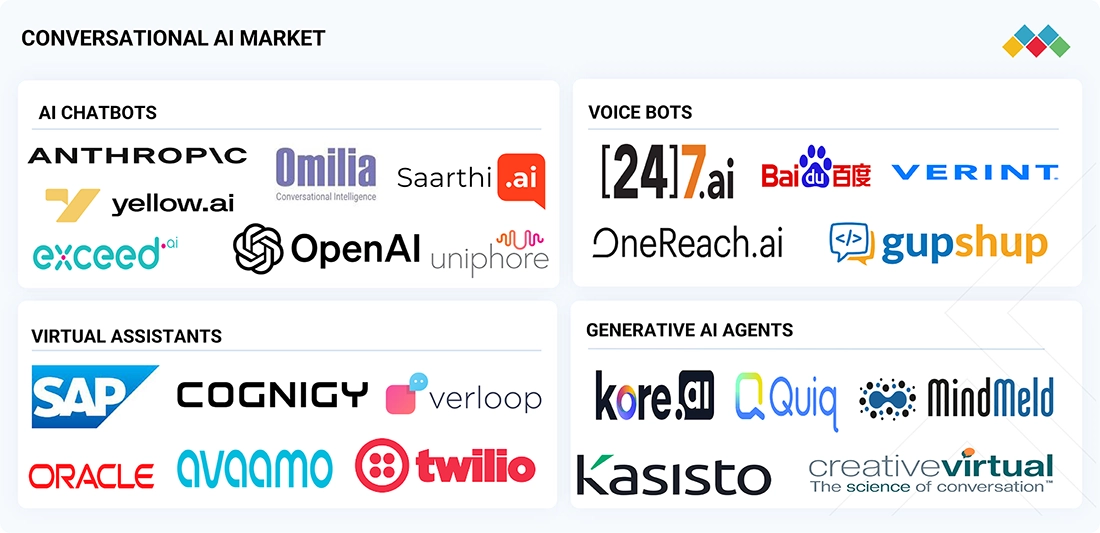
Conversational AI Market: COMMERCIAL USE CASES ACROSS INDUSTRIES
| COMPANY | USE CASE DESCRIPTION | BENEFITS |
|---|---|---|
 |
Humana is a Medicare Advantage and prescription drug plan provider ranked second on the Fortune 500 list. Humana's IVR system transferred too many calls to human agents at tremendous cost. Humana chose to work with IBM Watson, collaborating with IBM Data and AI Expert Labs to develop Provider Services Conversational Voice Agent using Watson Assistant. | Humana's Voice Agent with Watson provides faster, friendlier, and more consistent healthcare service administration. Access to services like medical eligibility verification is done without speaking to a live agent. The solution achieved 90%-95% sentence error rate accuracy with speech customization training. |
 |
City of Johns Creek in Fulton County is a suburb of Atlanta named Georgia's safest city in 2017 and 2018. Johns Creek's reception staff received between 50 and 100 calls daily with duplicate questions. O'Day built a chatbot with Amazon Lex based on technology used by Amazon Alexa, leveraging open data accessible to Johns Creek citizens. | Amazon Lex reduced after-hours voicemails by 90%, reduced receptionist call volume by 60% and delivered information to citizens up to 2x faster. The chatbot connects calls to the department through voicemail when devices are unable to answer, providing solutions accordingly. |
 |
Jio is an Indian telecommunications company and subsidiary of Jio Platforms, headquartered in Navi Mumbai, operating a national LTE network covering all 22 telecom circles. Needing an effective solution for agile responses to customer queries, Jioconnectivity and Haptik partnered to develop a WhatsApp chatbot for swift responses and enhanced customer experience. | Haptik's Proactive Messaging helped Jio Digital start seamless conversations with users. The chatbot integrates over 900 unique intents and 7,000 variations. Twenty-five million proactive messages were sent daily for nudges, recharge reminders, and engagement. Jio Fiber and 5G acquired 8,000 new customers daily. |
 |
Chime Financial is a San Francisco-based financial technology company partnering with regional banks to provide fee-free mobile banking services. Chime wanted to provide personalized member support across phone and digital channels using analytics and insight. With Twilio Programmable Messaging and Twilio Studio, Chime built a highly personalized IVR solution for all support levels. | Using Twilio Studio took only four weeks to implement. Twilio's easy-to-use and flexible integration enabled quick iteration and improvement. The integration was linked to customer data pipeline for in-depth trend analysis. The team observed a 12% increase in customer satisfaction with personalized support. |
Logos and trademarks shown above are the property of their respective owners. Their use here is for informational and illustrative purposes only.
Related Ecosystem
Analytics
- Natural Language Processing (NLP)
- Machine Learning
- Supply Chain Management
- Predictive Analytics
- Image Sensors
- International Business Machines Corporation
- MICROSOFT CORPORATION
- Oracle Corporation
- SAP SE
Cloud Computing
- Software as A Service (SaaS)
- Natural Language Processing (NLP)
- Platform as A Service (PaaS)
- Machine Learning
- Supply Chain Management
- International Business Machines Corporation
- MICROSOFT CORPORATION
- Oracle Corporation
- Amazon.com, Inc.
Mobility And Telecom
- Smart Utilities
- Smart Healthcare
- Sensors
- Parking Management System
- Passenger Information System (PIS)
- AT&T Inc.
- Cisco Systems, Inc.
- HUAWEI TECHNOLOGIES CO LTD
- Telefonaktiebolaget LM Ericsson (publ)
- International Business Machines Corporation
Key Takeaways
- China's conversational AI market will grow from USD 1,130.8M (2025) to USD 3,499.5M (2030) at a 20.7% CAGR, outpacing global growth.
- China's tech giants and startups are driving innovation in multilingual NLP and Mandarin-optimized conversational solutions.
- Enterprise adoption in China spans e-commerce, fintech, healthcare, and government sectors, accelerating digital transformation.
- China's government support for AI development and massive digital consumer base create sustained competitive advantages through 2030.
Conversational AI Market Report Scope
| Report Metric | Details |
|---|---|
| Base Year | 2025 |
| Fastest Growing Segment | GENERATIVE AI AGENTS (Product Type) |
| Forecast Period | 2025–2030 |
| Growth Rate | CAGR of 19.6% from 2025 to 2030 |
| Largest Segment | INTERNAL ENTERPRISE SYSTEMS (Integration Type) |
| Market Size Base Year (Billions) | ~USD 17.02 (2025) |
| Revenue Forecast (Billions) | ~USD 41.64 (2030) |
| Segments Covered | Offering, Deployment Mode, Service, Professional Service, Product Type, Business Function, Integration Type, End User, Enterprise |
China Conversational AI Market Report Segmentation
9 segment dimensions are covered across the global market.
By Offering
- Services
- Software
By Deployment Mode
- Cloud
- On-Premises
By Service
- Managed Services
- Professional Services
By Professional Service
- Consulting & Advisory
- Integration & Deployment
- Support & Maintenance
- Training & Education
By Product Type
- AI Chatbots
- Generative AI Agents
- Virtual Assistants
- Voice Bots
By Business Function
- Finance & Accounting
- Hr
- Itsm
- Operations & Supply Chain
- Sales & Marketing
By Integration Type
- External Communication Channels
- Internal Enterprise Systems
By End User
- Enterprises
- Individual Users
By Enterprise
- Automotive
- Bfsi
- Energy & Utilities
- Government & Defense
- Healthcare & Life Sciences
- Media & Entertainment
- Other Enterprise
- Other Enterprises
- Retail & E-Commerce
- Technology & Software
- Telecommunications
- Transportation & Logistics
- Travel & Hospitality
Target Audience
- Technology Companies & Startups : Evaluate market entry opportunities, competitive positioning, and growth potential in China's high-velocity conversational AI sector to guide product development and expansion strategies.
- Enterprise Software Vendors : Understand China-specific demand for conversational AI solutions in customer service, sales automation, and internal operations to tailor offerings and capture market share.
- Investment & Private Equity Firms : Assess investment opportunities in Chinese conversational AI companies and market segments with validated growth metrics and long-term value creation potential.
- Management Consultants & Strategists : Provide clients with authoritative China market data, competitive analysis, and strategic recommendations for AI-driven digital transformation initiatives.
- Government & Policy Makers : Leverage market intelligence to inform AI policy development, industry support programs, and strategic initiatives aligned with China's digital economy objectives.
Key Companies in the China Conversational AI Market
| Company | HQ | Ownership | Strongest segments |
|---|---|---|---|
| ENGHOUSE INTERACTIVE | United States | Private Company | Omnichannel contact center platforms,Telecommunications technology and infrastructure applications,EnghouseAI and customer experience automation, |
| SONATA SOFTWARE LIMITED | India | Public Company | Cloud & Infrastructure Modernization (Azure, AWS, GCP, managed cloud),Microsoft Business Applications & Dynamic Modernization (D365, Power Platform, CX),Data & AI (Fabric, Snowflake, data privacy, generative and agentic AI), |
| LARSEN & TOUBRO INFOTECH LIMITED | India | Public Company | Application Management & Enterprise Applications (SAP, Oracle, ServiceNow, Microsoft),Cloud, Infrastructure & Cybersecurity (CIS, enterprise cloud, integration),Data, Analytics & AI-led Engineering (BlueVerse, Voicing.AI, AI engineering), |
| SOPRA STERIA | France | Public Company | Consulting and Digital Transformation Services,Technology Services (AI, Cloud, Data, IoT, Blockchain, 5G, Industrial Metaverse, Intelligent Automation),Systems Integration and Application Modernization, |
| TERADATA CORPORATION | United States | Public Company | AI & Knowledge Platform (software, subscriptions, cloud),Consulting & Support Services, |
| PRESIDIO, INC. | United States | Private Company | Cloud & Modern Platform (incl. AWS-centric solutions),Cybersecurity & Physical Security,Modern Networking & Connectivity, |
| MICROSOFT | United States | Public Company | Productivity and Business Processes,Intelligent Cloud,Personal Computing, |
| IBM | United States | Public Company | Software (Hybrid Cloud & AI Platforms),Consulting (Strategy, Technology, Intelligent Operations),Infrastructure (Servers, Storage, Lifecycle Services), |
| United States | Public Company | Search & Other Google Services Ads,YouTube Ads,Google Cloud (including Workspace), | |
| ORACLE | United States | Public Company | Cloud Applications (Fusion ERP/EPM/SCM/HCM, NetSuite, Oracle Health, CX),Database and Middleware (Oracle Database, MySQL, Java, middleware tools),Cloud Infrastructure (compute, storage, networking, autonomous database on IaaS/PaaS), |
| BAIDU | China | Public Company | Online marketing & search (Baidu App, feed, maps),iQIYI online entertainment and services,AI cloud and enterprise AI solutions, |
| SAP | Germany | Public Company | S/4HANA and core ERP finance,Human Experience Management (SAP SuccessFactors),Spend Management and Business Network, |
| LIVEPERSON | United States | Public Company | Core LivePerson Platform (messaging, chat, hosted services),Conversational AI and automation (LLM automation, agent tools, orchestration),Syntrix AI validation and conversation intelligence, |
| EGAIN | United States | Public Company | Cloud-based CX and knowledge platform (subscription),Professional services (consulting, implementation, training),Legacy licenses and maintenance, |
| SOUNDHOUND AI | United States | Public Company | Houndify / Voice AI Platform & Custom Voice AI Solutions,Chat AI for Automotive & Dynamic Drive-Thru / Smart Ordering,Smart Answering & Employee Assist / Customer Service AI, |
| VERINT | United States | Public Company | Call recording and quality monitoring,Workforce management and optimization,Speech and text analytics, |
ENGHOUSE INTERACTIVE
Enghouse Interactive is a private software company founded in 1984 and based in the United States, with 243 employees.
SONATA SOFTWARE LIMITED
Sonata Software Limited is a public Indian software company founded in 1986 with 5,948 employees.
LARSEN & TOUBRO INFOTECH LIMITED
Larsen & Toubro Infotech Limited is a large public Indian IT services company founded in 1996, employing 87,950 people.
SOPRA STERIA
Sopra Steria is a French public technology and consulting company founded in 1968 with 51,275 employees.
TERADATA CORPORATION
Teradata Corporation is a public U.S. software company founded in 1979 with 5,100 employees.
PRESIDIO, INC.
Presidio, Inc. is a private U.S. technology services company founded in 2003 with 2,900 employees.
MICROSOFT
Microsoft is a public U.S. technology company founded in 1975 with 228,000 employees.
IBM
IBM is a public U.S. technology and services company founded in 1911 with 264,300 employees.
Google is a public U.S. technology company founded in 1998 with 194,668 employees.
ORACLE
Oracle is a public U.S. software company founded in 1977 with 141,000 employees.
BAIDU
Baidu is a public Chinese technology company founded in 2000 with 33,500 employees.
SAP
SAP is a public German software company founded in 1972 with 111,038 employees.
LIVEPERSON
LivePerson is a public U.S. software company founded in 1995 with 606 employees.
EGAIN
eGain is a public U.S. software company founded in 1997 with 445 employees.
SOUNDHOUND AI
SoundHound AI is a public U.S. artificial intelligence company founded in 2005 with 954 employees.
VERINT
Verint is a public U.S. technology company founded in 1994.
Reasons to Buy this Report
- Market Size & Growth Validation : Access precise market valuations for China (USD 1,130.8M in 2025) with verified 20.7% CAGR projections through 2030, enabling confident investment and expansion decisions.
- Competitive Intelligence : Understand China's conversational AI landscape, including dominant players, technology trends, and market positioning strategies specific to the Chinese market dynamics.
- Sector-Specific Insights : Identify high-growth application areas within China including e-commerce, fintech, healthcare, and customer service where conversational AI deployment is accelerating.
- Regulatory & Policy Context : Navigate China's AI governance framework, data privacy regulations, and government initiatives that directly impact market opportunities and business strategy.
- Strategic Market Entry : Develop localized go-to-market strategies with data-driven insights on China's digital ecosystem, consumer preferences, and partnership opportunities with local tech leaders.
Frequently asked questions
What is the projected size of China's conversational AI market by 2030?
China's conversational AI market is projected to reach USD 3,499.5 million by 2030, growing from USD 1,130.8 million in 2025.
What is the CAGR for China's conversational AI market?
China's conversational AI market is expected to grow at a compound annual growth rate of 20.7% between 2025 and 2030.
Which industries are driving conversational AI adoption in China?
Key industries driving adoption in China include e-commerce, financial services, healthcare, customer service, and government sectors seeking automation and enhanced customer engagement.
What factors are accelerating conversational AI growth in China?
Growth factors include government AI initiatives, a massive mobile-first consumer base, cloud infrastructure investments, competition among tech giants, and demand for multilingual NLP solutions.
How does China's conversational AI market compare to global growth?
China's 20.7% CAGR exceeds the global conversational AI market CAGR of 19.6%, reflecting China's strategic positioning and accelerated digital transformation.
RESEARCH METHODOLOGY
The research study for the conversational AI market involved extensive secondary sources, directories, journals, and paid databases. Primary sources were mainly industry experts from the core and related industries, preferred conversational AI providers, third-party service providers, consulting service providers, end users, and other commercial enterprises. In-depth interviews with primary respondents, including key industry participants and subject matter experts, were conducted to obtain and verify critical qualitative and quantitative information and assess the market’s prospects.
Secondary Research
In the secondary research process, various sources were referred to identify and collect information for the study. The secondary sources included annual reports, press releases, investor presentations of companies, white papers, journals, certified publications, and articles from recognized authors, directories, and databases. The data was also collected from other secondary sources, such as AI conferences and related magazines. Additionally, the conversational AI spending of various countries was extracted from respective sources. Secondary research was used to obtain key information about the industry’s value chain and supply chain to identify key players by solution, service, market classification, and segmentation according to the offerings of major players and industry trends related to solutions, applications, verticals, and regions, and key developments from both market and technology-oriented perspectives.
Primary Research
In the primary research process, various primary sources from both the supply and demand sides were interviewed to obtain qualitative and quantitative information on the market. The primary sources from the supply side included various industry experts, including Chief Experience Officers (CXOs); Vice Presidents (VPs); directors from business development, marketing, and conversational AI expertise; related key executives from conversational AI solution vendors, SIs, managed service providers, and industry associations; and key opinion leaders.
Primary interviews were conducted to gather insights, such as market statistics, revenue data collected from solutions and services, market breakups, market size estimations, market forecasts, and data triangulation. Primary research also helped understand various trends related to technologies, applications, data types, service types, software types, verticals, and regions. Stakeholders from the demand side, such as Chief Information Officers (CIOs), Chief Technology Officers (CTOs), Chief Strategy Officers (CSOs), and end users using conversational AI solutions, were interviewed to understand the buyer’s perspective on suppliers, products, service providers, and their current usage of conversational AI, which would impact the overall conversational AI market.
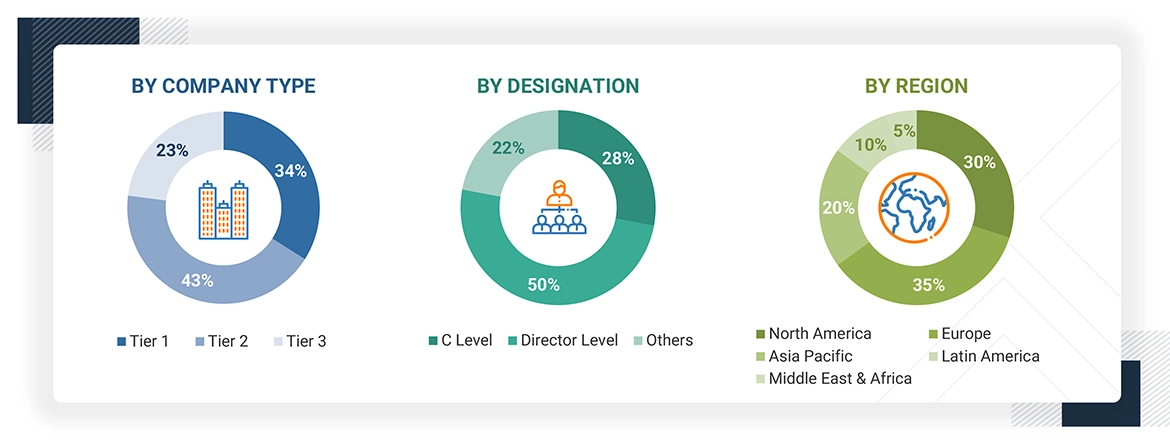
Note: Tier 1 companies account for annual revenue of >USD 10 billion; tier 2 companies’ revenue ranges
between USD 1 and 10 billion; and tier 3 companies’ revenue ranges between USD 500 million–USD 1 billion
Source: MarketsandMarkets Analysis
To know about the assumptions considered for the study, download the pdf brochure
Market Size Estimation
Multiple approaches were adopted to estimate and forecast the conversational AI market. The first approach involves estimating the market size by summing up the companies’ revenue generated by selling solutions and services.
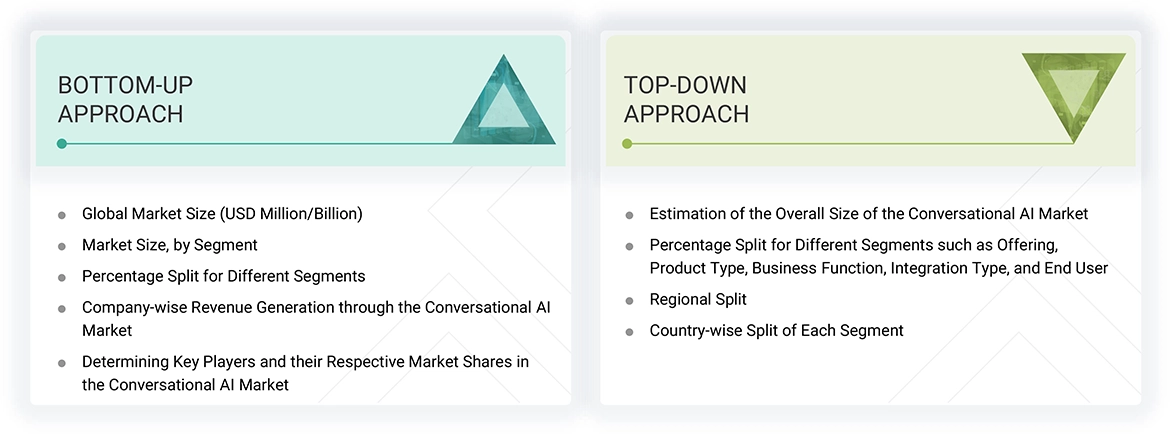
Market Size Estimation Methodology - Top-down approach
In the top-down approach, an exhaustive list of all the vendors offering solutions and services in the conversational AI market was prepared. The revenue contribution of the market vendors was estimated through annual reports, press releases, funding, investor presentations, paid databases, and primary interviews. Each vendor's offerings were evaluated based on the breadth of solutions according to software type, service type, product type, business function, integration type, and end user. The aggregate of all the companies’ revenue was extrapolated to reach the overall market size. Each subsegment was studied and analyzed for its global market size and regional penetration. The markets were triangulated through both primary and secondary research. The primary procedure included extensive interviews for key insights from industry leaders, such as CIOs, CEOs, VPs, directors, and marketing executives. The market numbers were further triangulated with the existing MarketsandMarkets repository for validation.
Market Size Estimation Methodology - Bottom-up approach
In the bottom-up approach, the adoption rate of conversational AI solutions and services among different end users in key countries with respect to their regions contributing the most to the market share was identified. For cross-validation, the adoption of conversational AI solutions among industries, along with different use cases with respect to their regions, was identified and extrapolated. Use cases identified in different regions were given weightage for the market size calculation.
Based on the market numbers, the regional split was determined by primary and secondary sources. The procedure included the analysis of the conversational AI market’s regional penetration. Based on secondary research, the regional spending on Information and Communications Technology (ICT), socio-economic analysis of each country, strategic vendor analysis of major conversational AI providers, and organic and inorganic business development activities of regional and global players were estimated. With the data triangulation procedure and data validation through primary interviews, the exact values of the overall conversational AI market size and segments’ size were determined and confirmed using the study.
Conversational AI Market : Top-Down and Bottom-Up Approach
Data Triangulation
After arriving at the overall market size using the market size estimation processes explained above, the market was split into several segments and subsegments. To complete the overall market engineering process and arrive at the exact statistics of each market segment and subsegment, data triangulation and market breakup procedures were employed, wherever applicable. The overall market size was then used in the top-down procedure to estimate the size of other individual markets via percentage splits of the market segmentation.
Market Definition
Conversational AI enables machines to engage in human-like interactions by understanding, processing, and generating natural language through text or speech. It powers applications such as chatbots, virtual assistants, and voice-enabled devices, allowing them to interpret user intent, provide relevant responses, and carry out tasks in real-time. This technology leverages natural language processing (NLP), machine learning, and speech recognition to create seamless and dynamic communication between humans and machines.
Stakeholders
- Conversational AI software providers
- Conversational AI service providers
- Third-party administrators
- Business analysts
- Cloud service providers
- Consulting service providers
- Enterprise end users
- Distributors and value-added resellers (VARs)
- Government agencies
- Independent Software Vendors (ISVs)
- Managed service providers
- Market research and consulting firms
- Support & maintenance service providers
- System Integrators (SIs)/Migration service providers
- Technology providers
Report Objectives
- To define, describe, and forecast the conversational AI market by offering, product type, business function, integration type, and end user
- To provide detailed information related to major factors (drivers, restraints, opportunities, and industry-specific challenges) influencing the market growth
- To analyze the micro markets with respect to individual growth trends, prospects, and their contribution to the total market
- To analyze the opportunities in the market for stakeholders by identifying the high-growth segments of the conversational AI market
- To analyze opportunities in the market and provide details of the competitive landscape for stakeholders and market leaders
- To forecast the market size of segments for the five main regions: North America, Europe, Asia Pacific, the Middle East & Africa, and Latin America
- To profile the key players and comprehensively analyze their market ranking and core competencies
- To analyze competitive developments, such as partnerships, product launches, and mergers & acquisitions, in the conversational AI market
Available Customizations
With the given market data, MarketsandMarkets offers customizations as per your company’s specific needs. The following customization options are available for the report:
Product Analysis
- Product quadrant, which gives a detailed comparison of the product portfolio of each company.
Geographic Analysis as per Feasibility
- Further breakup of the North American conversational AI market
- Further breakup of the European market
- Further breakup of the Asia Pacific market
- Further breakup of the Middle Eastern & African market
- Further breakup of the Latin American conversational AI market
Company Information
- Detailed analysis and profiling of additional market players (up to five)
Get the Full Conversational AI Market Report
Full forecast, segment splits, and company analysis for all Conversational AI Market.
- US Conversational AI Market
- Canada Conversational AI Market
- UK Conversational AI Market
- Germany Conversational AI Market
- France Conversational AI Market
- Italy Conversational AI Market
- Spain Conversational AI Market
- India Conversational AI Market
- Japan Conversational AI Market
- South Korea Conversational AI Market
- UAE Conversational AI Market
- Qatar Conversational AI Market
- Egypt Conversational AI Market
- South Africa Conversational AI Market
- Brazil Conversational AI Market
- Mexico Conversational AI Market
- Argentina Conversational AI Market
Need a Tailored Report?
Customize this report to your needs
Get 10% FREE Customization
Customize This Report
