
Rest Of Europe Dairy Alternatives Market (2023-2028)

The Rest Of Europe Dairy Alternatives Market was valued at $332.8 Million in 2023 and projected to reach to $440.4 Million by 2028, representing a compound annual growth rate of 5.8%. Rest of Europe's dairy alternatives market is positioned for steady expansion as consumer awareness of plant-based options continues to rise across Eastern and Southern European nations.


| Market Size in | USD 26.32 MN |
| Market Forecast in | |
| CAGR | |
| Forecast Period | |
| Units Considered | Value (USD MN) |
Rest Of Europe Dairy Alternatives Market Trends and Insights
- South America's dairy alternatives sector is experiencing steady growth driven by increasing consumer awareness of plant-based options, lactose intolerance prevalence, and sustainability concerns.
- In 2023, South America represented a developing but significant market segment within the global dairy alternatives landscape, with regional preferences favoring soy and coconut-based products. By 2028, South America is expected to capture greater market share as distribution networks expand and product innovation accelerates across the region.
- South America's growth trajectory, while more moderate than the global average of 10.1% CAGR, reflects the region's unique demographic and economic conditions.
- Key markets within South America, including Brazil and Argentina, are driving adoption through retail expansion and e-commerce channels, positioning the region as an increasingly important hub for dairy alternative manufacturers seeking Latin American penetration..
Key Market Statistics
- CAGR (2023-2028) 5.8% CAGR
- Market Size, 2023 ~USD 332.8 Million
- Forecast, 2028 ~USD 440.4 Million
- Country Rest Of Europe
Rest Of Europe Dairy Alternatives Market Overview
Steady Regional Growth :
Rest of Europe's dairy alternatives market is valued at USD 332.8 million in 2023, with a projected CAGR of 5.8% through 2028, reaching USD 440.4 million. This moderate but consistent growth reflects increasing adoption across smaller European markets.
Plant-Based Consumer Shift :
Eastern and Southern European consumers are increasingly embracing plant-based alternatives due to rising lactose intolerance awareness, dietary preferences, and growing availability of affordable local and imported options in retail channels.
Sustainability & Health Drivers :
Environmental concerns and health consciousness are primary growth catalysts in Rest of Europe, with consumers seeking sustainable alternatives to conventional dairy. Local producers are capitalizing on eco-friendly positioning and clean-label products.
Market Fragmentation Opportunity :
Unlike Western Europe, Rest of Europe remains fragmented with emerging local brands and limited major player dominance, creating opportunities for regional expansion and niche product development in underserved segments.
Rest Of Europe Dairy Alternatives Market Dynamics
- The region's growth trajectory, while more moderate than global averages, reflects increasing penetration in urban centers and gradual adoption in rural markets.
- Key drivers include rising lactose intolerance prevalence, growing environmental consciousness, and improving product availability through modern retail channels. The forecast period through 2028 will likely see intensified competition from both international brands entering emerging markets and local producers developing region-specific products.
- Price sensitivity remains a critical factor in Rest of Europe, necessitating competitive positioning and value-oriented product lines.
- Innovation in taste, texture, and nutritional profiles will be essential for capturing market share from traditional dairy consumers..
Market Ecosystem
Related Ecosystem
Fandb Ingredients
- Dairy Products
- Bakery Products
- Microorganism
- Polydextrose
- Carbohydrates
- AZELIS HOLDINGS SA
- Archer-Daniels-Midland Company
- Kerry Group plc
- Amway
- DSM FIRMMENICH
Key Takeaways
- South America's dairy alternatives market is valued at USD 332.8 million in 2023 and will reach USD 440.4 million by 2028, representing a 5.8% CAGR.
- South America's growth rate of 5.8% is below the global average of 10.1%, indicating a more conservative adoption pace in the region.
- South America shows strong potential for market expansion through improved distribution infrastructure and rising consumer health consciousness.
- South America's market is dominated by soy and coconut-based alternatives, reflecting regional taste preferences and agricultural capabilities.
Dairy Alternatives Market Report Scope
| Report Metric | Details |
|---|---|
| Base Year | 2023 |
| Fastest Growing Segment | YOGURT (Application) |
| Forecast Period | 2023–2028 |
| Growth Rate | CAGR of 10.1% from 2023 to 2028 |
| Largest Segment | RETAIL (Distribution Channel) |
| Market Size Base Year (Billions) | ~USD 26.95 (2023) |
| Revenue Forecast (Billions) | ~USD 43.6 (2028) |
| Segments Covered | Source, Formulation, Application, Distribution Channel, Subtype, Type |
Rest Of Europe Dairy Alternatives Market Report Segmentation
6 segment dimensions are covered across the global market.
By Source
- Almond
- Coconut
- Hemp
- Oat
- Oats
- Other Sources
- Pea
- Rice
- Soy
- Wheat
By Formulation
- Flavored
- Plain
By Application
- Butter
- Cheese
- Creamers
- ICE Cream
- Milk
- Other Applications
- Yogurt
By Distribution Channel
- Food Services
- Online Stores
- Retail
By Subtype
- Convenience Stores
- Health Food Stores
- Other Retail Channels
- Pharmacies
- Supermarkets/Hypermarkets
By Type
- Flour
- Milk
- Paste
- Pieces
- Whole
Target Audience
- Food & Beverage Manufacturers : Producers seeking to expand dairy alternatives portfolios into Rest of Europe need region-specific market data, consumer preferences, and competitive positioning insights to develop localized products and distribution strategies.
- Retail & Distribution Companies : Retailers and distributors operating in Rest of Europe require market sizing, growth forecasts, and consumer demand analysis to optimize shelf space allocation, supplier partnerships, and inventory management for dairy alternatives categories.
- Investment & Private Equity Firms : Investors evaluating opportunities in Rest of Europe's dairy alternatives sector need comprehensive market analysis, growth projections, and competitive landscape data to assess investment viability and identify acquisition targets.
- Market Research & Strategy Consultants : Consultants advising clients on Rest of Europe expansion require detailed regional market intelligence, consumer insights, and forecasts to develop credible business cases and strategic recommendations for market entry or growth.
- Government & Trade Organizations : Policy makers and trade bodies in Rest of Europe need market data and trend analysis to inform agricultural policies, trade agreements, and industry development initiatives supporting the growing dairy alternatives sector.
Key Companies in the Rest Of Europe Dairy Alternatives Market
| Company | HQ | Ownership | Strongest segments |
|---|---|---|---|
| VINAMILK | Vietnam | Public Company | Liquid dairy (fresh milk, flavored milk, juicy milk drinks),Yogurt and cultured products,Infant, maternal, and adult nutrition powders, |
| UNILEVER PLC | United Kingdom | Public Company | Beauty & Wellbeing,Personal Care,Home Care, |
| THE HAIN CELESTIAL GROUP, INC. | United States | Public Company | Baby, infant, and toddler foods,Plant-based beverages and dairy alternatives,Snacks and meat-free meals, |
| SUNOPTA | United States | Private Company | Plant-based beverages (oat, almond, soy, coconut, rice, hemp, other),Plant-based ingredients (oatbase, soybase, liquid ingredients),Fruit-based snacks (bars, bits, twists, strips, pressed bars), |
| FREEDOM FOODS GROUP LIMITED | Australia | Public Company | Plant-based milks (retail and foodservice),Dairy beverages (fresh and long-life),Nutritionals and protein (powders, drinks, dietary enhancements), |
| VALSOIA S.P.A. | Italy | Public Company | Plant-based beverages (soy, oat, almond, rice drinks),Plant-based ice cream and desserts,Spreads, creams, mayonnaise, cooking creams, |
| OATLY GROUP AB | Sweden | Public Company | Core ambient and chilled oatmilk (original/low-fat/full-fat/unsweetened/Super Basic),Barista edition and foodservice-focused formats,Oatgurts and frozen desserts, |
VINAMILK
VINAMILK is a public company founded in 1976 in Vietnam with 9,794 employees.
UNILEVER PLC
UNILEVER PLC is a public company founded in 1860 in the United Kingdom with 93,732 employees.
THE HAIN CELESTIAL GROUP, INC.
THE HAIN CELESTIAL GROUP, INC. is a public company founded in 1993 in the United States with 2,600 employees.
SUNOPTA
SUNOPTA is a private company founded in 1973 in the United States with 1,331 employees.
FREEDOM FOODS GROUP LIMITED
FREEDOM FOODS GROUP LIMITED is a public company founded in 1984 in Australia with 500 employees.
VALSOIA S.P.A.
VALSOIA S.P.A. is a public company founded in 1990 in Italy with 194 employees.
OATLY GROUP AB
OATLY GROUP AB is a public company founded in 1994 in Sweden with 1,379 employees.
Reasons to Buy this Report
- Regional Market Sizing & Forecasts : Obtain precise market valuation for Rest of Europe (USD 332.8M in 2023) with detailed 5-year projections through 2028. Make informed investment and expansion decisions based on region-specific growth trajectories and CAGR analysis.
- Competitive Landscape Intelligence : Understand the fragmented competitive environment unique to Rest of Europe, identifying gaps where local and international brands can establish market presence and capture share from emerging consumer segments.
- Consumer Behavior & Drivers : Access insights into Rest of Europe-specific consumer motivations including lactose intolerance prevalence, sustainability concerns, and health consciousness. Tailor product development and marketing strategies to regional preferences and values.
- Market Entry & Expansion Strategy : Leverage region-specific data to develop targeted go-to-market strategies for Rest of Europe. Identify high-potential sub-markets, distribution channels, and pricing strategies suited to local economic conditions and consumer purchasing power.
- Trend Analysis & Future Outlook : Stay ahead of emerging trends in Rest of Europe's dairy alternatives sector, from product innovation to retail channel evolution. Anticipate market shifts and position your business for sustainable growth through 2028 and beyond.
Frequently asked questions
What is the current size of the dairy alternatives market in South America?
In 2023, South America's dairy alternatives market was valued at USD 332.8 million, with projections to reach USD 440.4 million by 2028.
What is the expected growth rate for South America's dairy alternatives market?
South America's dairy alternatives market is expected to grow at a CAGR of 5.8% from 2023 to 2028, which is lower than the global average of 10.1%.
Which product types dominate South America's dairy alternatives market?
Soy-based and coconut-based alternatives are the leading product categories in South America, driven by regional agricultural production and consumer preferences.
What factors are driving growth in South America's dairy alternatives market?
Key growth drivers in South America include rising lactose intolerance awareness, sustainability concerns, expanding retail distribution, and increasing health consciousness among consumers.
How does South America's market growth compare to global trends?
South America's 5.8% CAGR is notably lower than the global 10.1% CAGR, reflecting slower adoption rates and different market maturity levels compared to developed regions.
RESEARCH METHODOLOGY
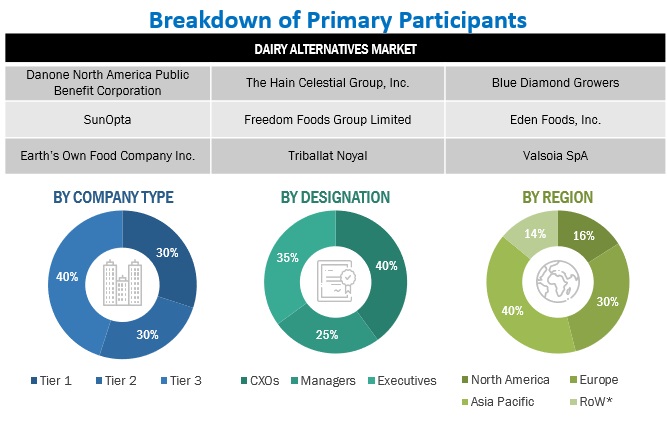
This research study involved the extensive use of secondary sources—directories and databases such as Bloomberg Businessweek and Factiva—to identify and collect information useful for a technical, market-oriented, and commercial study of the dairy alternatives market. In-depth interviews were conducted with various primary respondents—such as key industry participants, subject matter experts (SMEs), C-level executives of key market players, and industry consultants—to obtain and verify critical qualitative and quantitative information as well as to assess prospects.
Secondary Research
The secondary sources referred for this research study include government sources, the EU Commission, the European Food Safety Authority, the German Federal Institute of Risk Assessment, the Food Safety and Standards Authority of India (FSSAI), and the Japanese Ministry of Health, Labor and Welfare have referred to, to identify and collect information for this study. The secondary sources also included dairy alternatives annual reports, press releases & investor presentations of companies, white papers, food journals, certified publications, articles from recognized authors, gold & silver standard websites, regulatory bodies, trade directories, and paid databases.
Secondary research was used to obtain key information about the industry’s supply chain, the total pool of key players, and market classification and segmentation according to industry trends to the bottom-most level, regional markets, and key developments from both market and technology-oriented perspectives. The secondary data was collected and analyzed to arrive at the overall market size, which was further validated by primary research. It was also used to obtain information on the key developments from a market-oriented perspective.
Primary Research
The dairy alternatives market comprises multiple stakeholders, including raw material suppliers, processed food suppliers, and regulatory organizations in the supply chain. Various primary sources from the supply and demand sides of the market were interviewed to obtain qualitative and quantitative information. Primary interviewees from the supply side include research institutions involved in R&D to introduce to the manufacturers and importers & exporters of dairy alternatives products, from the demand side include distributors, wholesalers, and key opinion leaders through questionnaires, emails, and telephonic interviews.
To know about the assumptions considered for the study, download the pdf brochure
Market Size Estimation
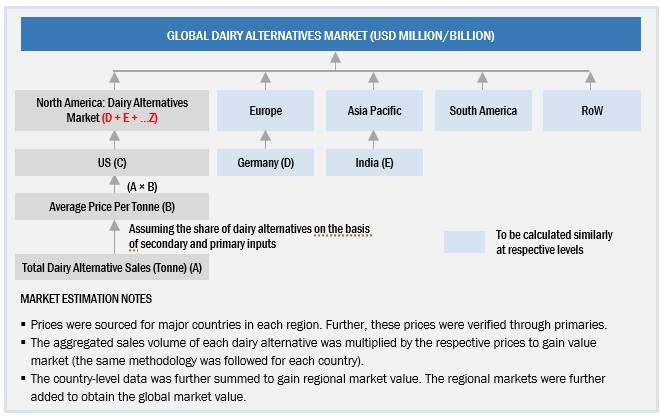
- Both top-down and bottom-up approaches were used to estimate and validate the total size of the dairy alternatives market. These approaches were also used extensively to estimate the size of various dependent submarkets. The research methodology used to estimate the market size includes the following:
- Key players were identified through extensive secondary research.
- The industry’s supply chain and market size were determined through primary and secondary research.
- All percentage share splits and breakdowns were determined using secondary sources and verified through primary sources.
- All the possible parameters that affect the markets covered in this research study were accounted for, viewed in extensive detail, verified through primary research, and analyzed to obtain the final quantitative and qualitative data.
- The research includes the study of reports, reviews, and newsletters of top market players, along with extensive interviews for key opinions from industry experts (such as CEOs, vice presidents, directors, and marketing executives).
The following sections (bottom-up & top-down) (supply-demand) depict the overall market size estimation process employed for this study.
Dairy Alternatives Market Size Estimation (Bottom-up Approach)
Through the bottom-up approach, the data extracted from secondary research was utilized to validate the market segment sizes obtained. The approach was employed to arrive at the overall size of the dairy alternatives market in particular regions, and its share in the market was validated through primary interviews conducted with product manufacturers, suppliers, dealers, and distributors.
With the data triangulation procedure and validation of data through primaries, the overall size of the parent market and each segmental market were determined.
To know about the assumptions considered for the study, Request for Free Sample Report
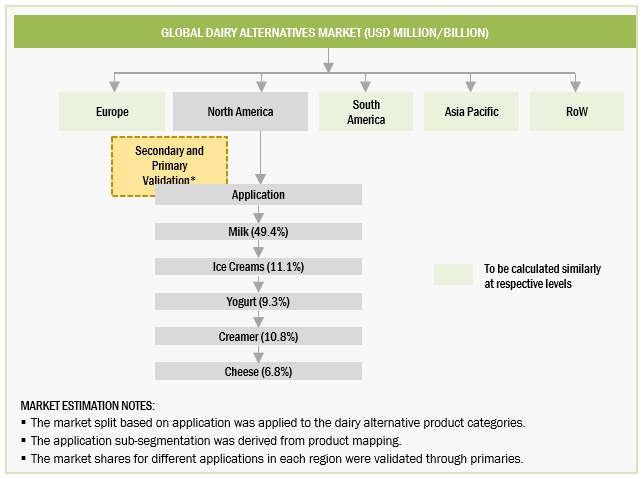
dairy alternatives market size estimation (Top-down approach
For the estimation of the dairy alternatives market, the size of the most appropriate immediate parent market was considered to implement the top-down approach. For the dairy alternatives market, the plant-based food market was considered as the parent market to arrive at the market size, which was again used to estimate the size of individual markets (mentioned in the market segmentation) through percentage shares arrived from secondary and primary research.
Data Triangulation
After arriving at the overall market size from the estimation process explained above, the total market was split into several segments and subsegments. To estimate the overall dairy alternatives market and arrive at the exact statistics for all segments and subsegments, data triangulation and market breakdown procedures were employed, wherever applicable. The data was triangulated by studying various factors and trends from the demand and supply sides. Along with this, the market size was validated using both the top-down and bottom-up approaches.
Market Definition
Dairy alternatives are food & beverage products that are like certain types of dairy-based products in terms of texture and flavor, as well as the nutritional benefits they offer. They are lactose-free and are used to replace dairy-based products. They are manufactured using cereals, such as oats, rice, wheat, barley, and nuts. The health benefits of dairy alternatives have resulted in their wide-scale adoption in numerous applications.
Key Stakeholders
- Food & beverage manufacturers, suppliers, and processors
- Research & development institutions
- Traders & Retailers
- Distributors, importers, and exporters
-
Regulatory bodies
- Organizations such as the Food and Drug Administration (FDA), United States Department of Agriculture (USDA), European Food Safety Agency (EFSA), EUROPA, and Food Safety Australia and New Zealand (FSANZ)
- Government agencies
- Intermediary suppliers
- Universities and industry bodies
- End users
Report Objectives
Market Intelligence
- Determining and projecting the size of the dairy alternatives market with respect to source, application, formulation, distribution channel, and region over a five-year period ranging from 2023 to 2028.
-
Identifying the attractive opportunities in the market by determining the largest and fastest-growing segments across the key regions and analyzing the demand-side factors based on the following:
- Impact of macro- and microeconomic factors on the market
- Shifts in demand patterns across different subsegments and regions
Competitive Intelligence
- Identifying and profiling the key market players in the dairy alternatives market
- Determining the market share of key players operating in the dairy alternatives market
-
Providing a comparative analysis of the market leaders on the basis of the following:
- Product offerings
- Business strategies
- Strengths and weaknesses
- Key financials
- Understanding the competitive landscape and identifying the major growth strategies adopted by key players across the key regions
- Providing insights on the trade scenario
Available Customizations:
MarketsandMarkets offers customizations according to client-specific scientific needs with the given market data.
The following customization options are available for the report:
Product Analysis
- Product matrix, which gives a detailed comparison of the product portfolio of each company.
Geographic Analysis
- Further breakdown of the rest of the Asia Pacific’s dairy alternatives market into South Korea, Taiwan, Singapore, Malaysia, and Indonesia.
- Further breakdown of the rest of Europe's dairy alternatives market into Greece and Eastern European countries.
- Further breakdown of the Rest of South America includes Chile, Peru, and Bolivia.
Company Information
- Detailed analyses and profiling of additional market players (up to five)
Get the Full Dairy Alternatives Market Report
Full forecast, segment splits, and company analysis for all Dairy Alternatives Market.
- Canada Dairy Alternatives Market
- US Dairy Alternatives Market
- Mexico Dairy Alternatives Market
- UK Dairy Alternatives Market
- Germany Dairy Alternatives Market
- France Dairy Alternatives Market
- Italy Dairy Alternatives Market
- Spain Dairy Alternatives Market
- China Dairy Alternatives Market
- Japan Dairy Alternatives Market
- India Dairy Alternatives Market
- Brazil Dairy Alternatives Market
- Argentina Dairy Alternatives Market
Need a Tailored Report?
Customize this report to your needs
Get 10% FREE Customization
Customize This Report
