
South Africa Digital Asset Management Market (2026-2031)

The South Africa Digital Asset Management Market was valued at $130.5 Million in 2026 and projected to reach to $210.7 Million by 2031, representing a compound annual growth rate of 10.0%. South Africa's Digital Asset Management market is positioned for steady growth as organizations recognize the critical need for centralized asset repositories and streamlined content workflows.


| Market Size in | USD 26.32 MN |
| Market Forecast in | |
| CAGR | |
| Forecast Period | |
| Units Considered | Value (USD MN) |
South Africa Digital Asset Management Market Trends and Insights
- This 10.0% compound annual growth rate reflects South Africa's increasing adoption of digital transformation initiatives across enterprises and creative industries.
- South Africa's market is driven by rising demand for centralized asset management solutions, cloud-based platforms, and the need for organizations to streamline content workflows and enhance collaboration. The South Africa Digital Asset Management sector is benefiting from growing investments in technology infrastructure and the expansion of media, marketing, and e-commerce sectors.
- South Africa's enterprises are increasingly recognizing the value of DAM systems in reducing operational costs, improving asset discoverability, and enabling faster time-to-market for digital content.
- Between 2026 and 2031, South Africa's market will be shaped by the adoption of AI-powered asset tagging, integration with marketing automation platforms, and the shift toward hybrid work environments requiring robust digital asset governance..
Key Market Statistics
- CAGR (2026-2031) 10.0% CAGR
- Market Size, 2026 ~USD 130.5 Million
- Forecast, 2031 ~USD 210.7 Million
- Country South Africa
South Africa Digital Asset Management Market Overview
Market Valuation Growth :
South Africa's Digital Asset Management Market is valued at USD 130.5 million in 2026, with projections reaching USD 210.7 million by 2031, representing a robust 10% CAGR over the forecast period.
Digital Transformation Adoption :
South African enterprises and creative industries are increasingly investing in centralized digital asset management solutions to streamline workflows, enhance collaboration, and improve operational efficiency across organizations.
Regional Growth Dynamics :
While South Africa's 10% CAGR trails the global average of 15.4%, the market demonstrates steady expansion driven by local demand for content management, brand asset organization, and media workflow optimization.
Enterprise & Creative Sector Focus :
South Africa's DAM market is primarily driven by adoption among large enterprises, media companies, advertising agencies, and creative studios seeking to manage digital content at scale and improve asset discoverability.
South Africa Digital Asset Management Market Dynamics
- The 10% CAGR reflects increasing digital maturity among South African enterprises, particularly in media, advertising, and professional services sectors.
- Growing cloud adoption and remote work trends are accelerating DAM implementation across the country. Looking ahead to 2031, South Africa's DAM market will benefit from enhanced AI-powered asset tagging, improved integration capabilities with existing enterprise systems, and rising awareness of digital asset governance.
- Investment in digital infrastructure and skills development will further support market expansion, though growth rates may remain moderate compared to global benchmarks due to economic constraints and competitive pressures in the region..
Market Ecosystem
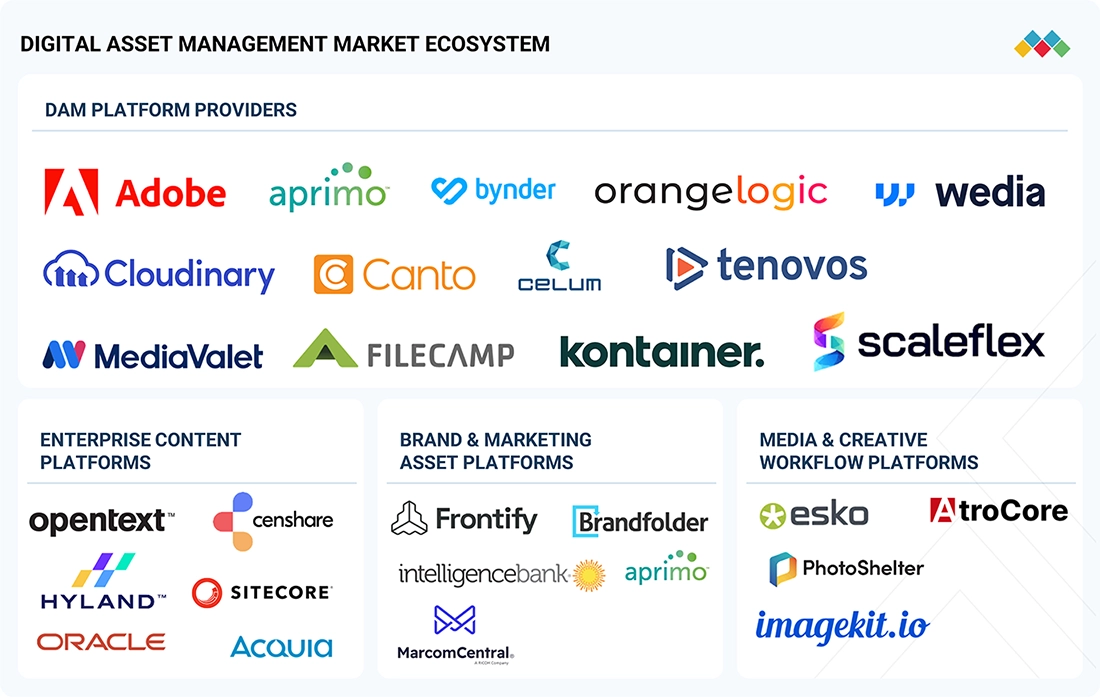
DIGITAL ASSET MANAGEMENT MARKET: COMMERCIAL USE CASES ACROSS INDUSTRIES
| COMPANY | USE CASE DESCRIPTION | BENEFITS |
|---|---|---|
 |
Hachette Book Group modernized its digital asset operations by deploying Aprimo’s DAM platform to centralize asset management, automate metadata workflows, and improve content distribution across its publishing ecosystem | The deployment automated the distribution of book cover assets for retailers, improved asset search, metadata management, and accessibility across teams, reduced asset retrieval time from hours to nearly 20 minutes, eliminated duplicate assets and inconsistent file naming, and enabled scalable collaboration across creative, publishing, and distribution |
 |
Amnesty International strengthens secure digital media management with the Asset Bank digital asset management platform | Secure management of sensitive images and videos used in human rights campaigns. Improved control over asset usage, protecting individuals featured in visual media |
 |
Hootsuite improves global content management and brand consistency with the Acquia DAM platform | The central repository improved asset discovery and eliminated scattered storage systems. Strengthened brand consistency by ensuring teams have access to approved and up-to-date assets. Reduced manual effort and redundant tasks for creative and marketing teams |
 |
Lionsgate centralizes global marketing assets with the Orange Logic digital asset management platform | Centralized access to approved marketing assets for global teams and partners. Improved speed and efficiency in locating and distributing creative assets. Reduced operational complexity by consolidating multiple content management tools. Enhanced collaboration across internal marketing teams and external agencies |
Logos and trademarks shown above are the property of their respective owners. Their use here is for informational and illustrative purposes only.
Related Ecosystem
Cloud Computing
- Software as A Service (SaaS)
- Natural Language Processing (NLP)
- Platform as A Service (PaaS)
- Machine Learning
- Supply Chain Management
- International Business Machines Corporation
- MICROSOFT CORPORATION
- Oracle Corporation
- Amazon.com, Inc.
Software And Services
- Natural Language Processing (NLP)
- Machine Learning
- Supply Chain Management
- Predictive Analytics
- Image Sensors
- International Business Machines Corporation
- MICROSOFT CORPORATION
- Oracle Corporation
- SAP SE
- Amazon.com, Inc.
Information System And Analytics
- Machine Learning
- Natural Language Processing (NLP)
- Sensors
- Software as A Service (SaaS)
- Data Loss Prevention (DLP)
- International Business Machines Corporation
- MICROSOFT CORPORATION
- Amazon.com, Inc.
- Oracle Corporation
Key Takeaways
- South Africa's Digital Asset Management Market is valued at USD 130.5 million in 2026 and is forecast to reach USD 210.7 million by 2031, representing a 10.0% CAGR.
- South Africa's market growth is driven by digital transformation initiatives, cloud adoption, and the need for centralized content management across enterprises.
- South Africa's DAM adoption is accelerating in media, marketing, and e-commerce sectors seeking improved asset governance and operational efficiency.
- South Africa's market will be shaped by AI-powered features, marketing automation integration, and hybrid work enablement through 2031.
Digital Asset Management Market Report Scope
| Report Metric | Details |
|---|---|
| Base Year | 2026 |
| Fastest Growing Segment | SERVICES (Offering) |
| Forecast Period | 2026–2031 |
| Growth Rate | CAGR of 15.4% from 2026 to 2031 |
| Largest Segment | CLOUD (Deployment Type) |
| Market Size Base Year (Billions) | ~USD 7.09 (2026) |
| Revenue Forecast (Billions) | ~USD 14.51 (2031) |
| Segments Covered | Offering, Type, Deployment Type, Asset, Business Function, Application, Organization Size, Vertical, Solution, Service, Professional Service |
South Africa Digital Asset Management Market Report Segmentation
11 segment dimensions are covered across the global market.
By Offering
- Services
- Solutions
By Type
- AI-Powered Digital Asset Management
- Implementation & Integration
- Managed Services
- Professional Services
- Support & Maintenance
- Traditional Digital Asset Management
- Training & Consulting
By Deployment Type
- Cloud
- On-Premises
By Asset
- Creative & Design Assets
- Document Assets
- Video & Audio Assets
- Web & Interactive Assets
By Business Function
- Finance & Accounting
- Human Resources
- It & Operations
- Marketing & Sales
By Application
- Brand & Marketing Asset Management
- Digital Rights, Governance, & Compliance
- Enterprise Content & Knowledge Management
- Media Production & Broadcast Asset Management
- Other Applications
- Product Content Management
By Organization Size
- Large Enterprises
- Smes
By Vertical
- Bfsi
- Education
- Government & Public Sector
- Healthcare & Life Sciences
- It & Ites
- Manufacturing
- Media & Entertainment
- Other Verticals
- Retail & Consumer Goods
- Telecommunications
- Travel & Hospitality
By Solution
- AI-Powered Digital Asset Management
- Traditional Digital Asset Management
By Service
- Managed Services
- Professional Services
By Professional Service
- Implementation & Integration
- Support & Maintenance
- Training & Consulting
Target Audience
- DAM Software Vendors : Vendors need South Africa-specific market data to develop localized go-to-market strategies, understand competitive positioning, identify high-growth customer segments, and forecast revenue potential in the region.
- Enterprise IT Decision Makers : South African CIOs and IT leaders require market insights to justify DAM investments, benchmark against regional peers, understand implementation trends, and make informed technology procurement decisions.
- Investment & Private Equity Firms : Investors evaluating South African tech opportunities need detailed market sizing, growth trajectories, and sector dynamics to assess investment viability and identify acquisition targets in the DAM space.
- Consulting & Systems Integration Partners : South African consultants and integrators need market intelligence to identify client opportunities, develop service offerings, understand customer pain points, and position DAM solutions effectively.
- Media & Creative Industry Leaders : South African media companies, advertising agencies, and creative studios need market data to evaluate DAM adoption trends, understand competitive practices, and plan digital asset infrastructure investments.
Key Companies in the South Africa Digital Asset Management Market
| Company | HQ | Ownership | Strongest segments |
|---|---|---|---|
| INFOR INC | United States | Private Company | Data Integration & Engineering,API & Application Integration,Data Quality & Observability, |
| CONCENTRIX | United States | Public Company | Managed CX Operations (voice, chat, back office),Digital CX & Transformation (design, engineering, self-service),Analytics, AI & Enterprise Intelligence, |
| ADOBE | United States | Public Company | Digital Media (Creative Cloud and Document Cloud),Digital Experience,Publishing and Advertising / Other, |
| OPENTEXT | Canada | Public Company | Content Services & Information Management Cloud,Business Network & B2B Integration Managed Services,Cybersecurity, DevOps, Observability & Service Management, |
| COGNIZANT | United States | Public Company | Financial Services,Health Sciences,Products and Resources, |
| APRIMO | United States | Private Company | Digital Asset Management (DAM),Content Operations & Workflow Automation Platform,Marketing Project & Resource Management, |
| HYLAND | United States | Private Company | OnBase ECM and workflow platform,Healthcare enterprise imaging and healthcare content solutions,Perceptive Content, Saperion, and legacy ECM/BPM suites, |
| VEEVA SYSTEMS | United States | Public Company | Veeva Commercial Cloud (Vault CRM Suite, Medical, PromoMats, Crossix, CRM Pulse),Veeva Development Cloud (Clinical Platform, Clinical Data Management, Safety, RIM),Veeva Quality Cloud, |
| PATTERN | United States | Private Company | Utility-scale wind generation,Utility-scale solar and hybrid projects,Transmission and grid infrastructure, |
| ESKO | South Africa | Private Company | Coal-fired generation and related sales,Transmission and distribution services,Nuclear, renewables, and other generation (diesel, hydro, gas, pumped storage), |
INFOR INC
Infor Inc. is a private software company founded in 1993 and headquartered in the United States with 5,200 employees. The company develops enterprise resource planning and business management software solutions.
CONCENTRIX
Concentrix is a public customer experience and digital transformation company founded in 2004 with 455,000 employees across the United States. The company provides business services including customer engagement, technology, and analytics solutions.
ADOBE
Adobe is a public software company founded in 1982 in the United States with 31,360 employees. The company is a global leader in digital media and marketing software, including creative, document, and analytics solutions.
OPENTEXT
OpenText is a public Canadian software company founded in 1991 with 20,500 employees. The company provides enterprise information management and cloud solutions for businesses worldwide.
COGNIZANT
Cognizant is a public information technology services company founded in 1988 in the United States with 357,600 employees. The company offers digital, technology, and consulting services to clients globally.
APRIMO
Aprimo is a private marketing software company founded in 1998 in the United States with 190 employees. The company develops marketing resource management and digital asset management solutions.
HYLAND
Hyland is a private software company founded in 1991 in the United States with 336 employees. The company develops content management and business process automation solutions.
VEEVA SYSTEMS
Veeva Systems is a public cloud computing company founded in 2007 in the United States with 7,928 employees. The company provides industry-specific software solutions for the life sciences and pharmaceutical industries.
PATTERN
Pattern is a private software company founded in 2012 in the United States with 228 employees. The company operates in the technology and software services sector.
ESKO
Esko is a private packaging and printing software company founded in 1923 in South Africa with 42,030 employees. The company provides solutions for packaging design, production, and automation.
Reasons to Buy this Report
- Market-Specific Sizing & Forecasts : Access precise valuation data for South Africa's DAM market with detailed 2026-2031 projections, enabling accurate budget allocation and investment planning tailored to regional market conditions.
- Competitive Landscape Intelligence : Understand South Africa-specific vendor positioning, market share distribution, and competitive dynamics to identify partnership opportunities and strategic positioning within the local DAM ecosystem.
- Sector-Specific Growth Drivers : Gain insights into which South African industries—media, advertising, enterprises, creative studios—are driving DAM adoption, allowing targeted go-to-market strategies and customer segmentation.
- Regional Adoption Trends : Analyze South Africa-specific digital transformation initiatives, cloud migration patterns, and technology adoption rates to anticipate market demand and align product development roadmaps accordingly.
- Strategic Decision Support : Leverage comprehensive South Africa market analysis to support M&A decisions, market entry strategies, and resource allocation for vendors and investors targeting the region's growing DAM opportunity.
Frequently asked questions
What is the current size of South Africa's Digital Asset Management Market?
South Africa's Digital Asset Management Market is valued at USD 130.5 million in 2026 and is expected to grow to USD 210.7 million by 2031.
What is the projected growth rate for South Africa's DAM Market?
South Africa's Digital Asset Management Market is projected to grow at a compound annual growth rate (CAGR) of 10.0% from 2026 to 2031.
Which industries are driving South Africa's DAM Market growth?
South Africa's DAM Market is primarily driven by media, marketing, e-commerce, and enterprise sectors seeking centralized asset management and improved content workflows.
What are the key drivers of DAM adoption in South Africa?
South Africa's DAM adoption is driven by digital transformation initiatives, cloud migration, hybrid work environments, and the need for efficient asset governance and collaboration.
What emerging technologies are impacting South Africa's DAM Market?
South Africa's DAM Market is being shaped by AI-powered asset tagging, machine learning-based metadata automation, and integration with marketing automation and e-commerce platforms.
RESEARCH METHODOLOGY
This research study on the digital asset management (DAM) market involved extensive secondary sources, including directories, IEEE Communications/Efficient Algorithms and Systems, and the International Journal of Innovation and Technology Management, as well as paid databases. Primary sources were mainly industry experts from core and related industries, preferred digital DAM providers, third-party service providers, consulting service providers, end users, and other commercial enterprises. In-depth interviews with primary respondents, including key industry participants and subject matter experts, were conducted to gather and verify critical qualitative and quantitative information and to assess the market’s prospects.
Secondary Research
In the secondary research process, various sources were referred to identify and collect information for this study. Secondary sources included annual reports, press releases, and investor presentations of companies; white papers; journals; certified publications; and articles from recognized authors, directories, and databases. The data was also collected from other secondary sources, such as journals, government websites, blogs, and vendors’ websites. Additionally, digital asset management (DAM) spending for various countries was extracted from their respective sources.
Primary Research
In the primary research process, various sources from the supply and demand sides were interviewed to obtain qualitative and quantitative information on the market. The primary sources from the supply side included various industry experts, such as chief experience officers (CXOs), vice presidents (VPs), and directors specializing in business development, marketing, and digital asset management services. It also included key executives from digital asset management vendors, system integrators (SIs), professional service providers, industry associations, and other key opinion leaders
Breakup of Primary Profiles
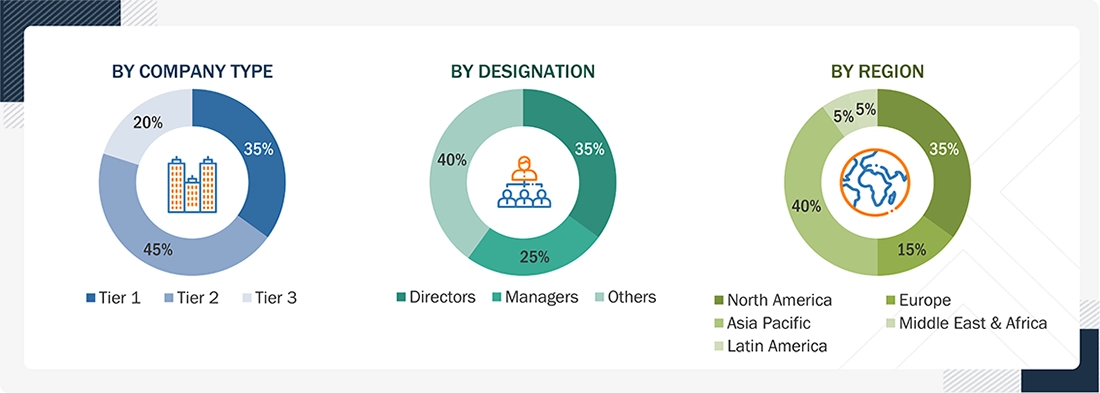
Note: Tier 1 companies’ revenues are more than USD 10 billion; tier 2 companies’ revenues range between USD 1 and 10 billion; and tier 3 companies’ revenues range between USD 500 million and USD 1 billion. Other designations include sales, marketing, and product managers.
Source: Industry Experts
To know about the assumptions considered for the study, download the pdf brochure
Market Size Estimation
Multiple approaches were adopted to estimate and forecast the DAM market. The first approach involved estimating the market size based on companies’ revenue from the sale of DAM products
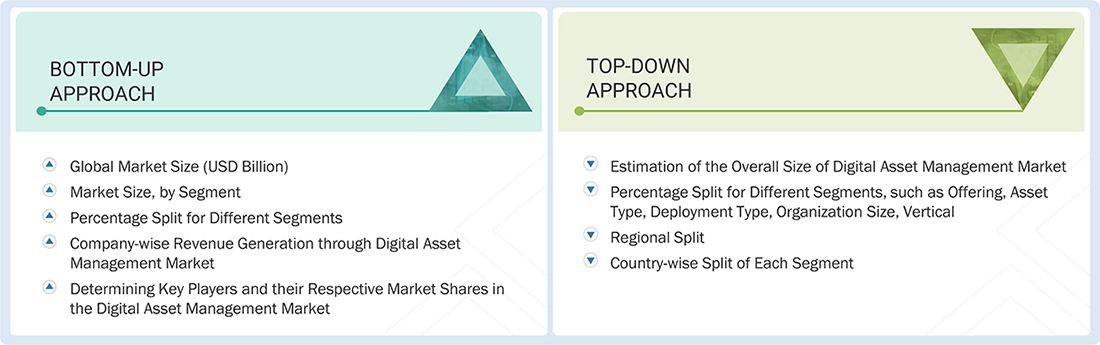
Market Size Estimation Methodology: Top-down Approach
The top-down approach prepared an exhaustive list of all the vendors offering products in the digital asset management (DAM) market. The revenue contribution of the market vendors was estimated through annual reports, press releases, funding, investor presentations, paid databases, and primary interviews. Each vendor’s offerings were evaluated based on offering, asset type, deployment mode, organization size, vertical, and region. The markets were triangulated through primary and secondary research. The primary procedure included extensive interviews with industry leaders, including CIOs, CEOs, VPs, directors, and marketing executives, to obtain key insights. The market numbers were further triangulated with the existing MarketsandMarkets’ repository for validation.
Market Size Estimation Methodology: Bottom-up Approach
The bottom-up approach identified the adoption rate of digital asset management solutions across different verticals in key countries, considering the regions that contribute the most to the market share. For cross-validation, the adoption of DAM products among enterprises and other use cases for their regions was identified and extrapolated. Use cases identified in different areas were weighed for the market size calculation.
Based on the market numbers, the regional split was determined by primary and secondary sources. The procedure included an analysis of the digital asset management market’s regional penetration. Based on secondary research, the regional spending on information technology (IT), content management, digital marketing, and enterprise content operations, strategic vendor analysis of major digital asset management providers, and organic and inorganic business development activities of regional and global players were estimated.
Digital Asset Management Market : Top-Down and Bottom-Up Approach
Data Triangulation
After determining the overall market size using the market size estimation processes as explained above, the market was split into several segments and subsegments. Data triangulation and market breakup procedures were employed, wherever applicable, to complete the overall market engineering process and arrive at the exact statistics of each market segment and subsegment. The overall market size was then used in the top-down approach to estimate the size of other individual markets by applying percentage splits to the market segmentation.
Market Definition
Digital asset management (DAM) is the practice of storing, organizing, managing, retrieving, and distributing digital assets through centralized software platforms. It enables users to manage images, videos, documents, audio files, creative assets, and other branded content with improved visibility, governance, and accessibility.
Digital asset management (DAM) refers to software and related services that help organizations centrally manage the lifecycle of digital assets, from creation and organization to storage, retrieval, sharing, and distribution. DAM platforms provide capabilities such as metadata tagging, workflow management, version control, access permissions, search and discovery, and integration with adjacent enterprise systems. These platforms help organizations improve asset reuse, maintain brand consistency, support collaboration across teams, and streamline digital content operations across multiple business functions and channels.
Key Stakeholders
- Digital asset management software providers
- AI-powered digital asset management platform vendors
- Enterprise content management and marketing technology vendors
- Cloud infrastructure and digital experience platform providers
- Creative workflow and collaboration software providers
- System integrators and digital transformation partners
- Professional service providers offering DAM implementation and consulting services
- Managed service providers supporting DAM operations
- Digital agencies and content production partners
- Industry associations and digital governance bodies
Report Objectives
- To define, describe, and forecast the digital asset management market based on offering (solutions [traditional digital asset management, AI-powered digital asset management], services [professional services (implementation & integration, training & consulting), managed services (support & maintenance)]), deployment type (on-premises, cloud), asset type (video & audio assets, document assets, web & interactive assets, creative & design assets), application (brand & marketing asset management, product content management, digital rights governance & compliance, media production & broadcast asset management, enterprise content & knowledge management, others), business function (human resources, marketing & sales, IT & operations, finance & accounting), organization size (large enterprises, SMEs), and vertical (BFSI, retail & consumer goods, healthcare & life sciences, IT & ITeS, telecommunications, media & entertainment, manufacturing, government & public sector, travel & hospitality, education, and other verticals).
- To forecast the market size of five major regional segments: North America, Europe, Asia Pacific, the Middle East & Africa, and Latin America
- To strategically analyze the market subsegments with respect to individual growth trends, prospects, and contributions to the total market
- To provide detailed information related to the major factors influencing the growth of the market (drivers, restraints, opportunities, and challenges)
- To strategically analyze macro and micro markets with respect to growth trends, prospects, and their contributions to the overall market
- To analyze industry trends, patents and innovations, and pricing data related to the market
- To analyze the opportunities in the market for stakeholders and provide details of the competitive landscape for major players
- To analyze the impact of AI/generative AI on the market
- To profile key players in the market and comprehensively analyze their market share/ranking and core competencies
- To track and analyze competitive developments, such as mergers & acquisitions, product launches, and partnerships & collaborations, in the market
Available customizations:
With the given market data, MarketsandMarkets offers customizations as per the company’s specific needs. The following customization options are available for the report:
Product Analysis
- The product matrix provides a detailed comparison of the product portfolio of each company.
Geographic Analysis
- Further breakup of the North American digital asset management market
- Further breakup of the European digital asset management market
- Further breakup of the Asia Pacific digital asset management market
- Further breakup of the Middle East & African digital asset management market
- Further breakup of the Latin American digital asset management market
Company Information
- Detailed analysis and profiling of additional market players (up to five)
Get the Full Digital Asset Management Market Report
Full forecast, segment splits, and company analysis for all Digital Asset Management Market.
- US Digital Asset Management Market
- Canada Digital Asset Management Market
- UK Digital Asset Management Market
- Germany Digital Asset Management Market
- France Digital Asset Management Market
- Italy Digital Asset Management Market
- China Digital Asset Management Market
- India Digital Asset Management Market
- Japan Digital Asset Management Market
- Australia Digital Asset Management Market
- Saudi Arabia Digital Asset Management Market
- UAE Digital Asset Management Market
- Brazil Digital Asset Management Market
- Mexico Digital Asset Management Market
Need a Tailored Report?
Customize this report to your needs
Get 10% FREE Customization
Customize This Report
