
US Digital Identity Solutions Market (2025-2030)

The US Digital Identity Solutions Market was valued at $12362.8 Million in 2025 and projected to reach to $28497.2 Million by 2030, representing a compound annual growth rate of 18.3%. The US Digital Identity Solutions Market is positioned for sustained expansion through 2030, fueled by increasing regulatory requirements and heightened cybersecurity concerns.


| Market Size in | USD 26.32 MN |
| Market Forecast in | |
| CAGR | |
| Forecast Period | |
| Units Considered | Value (USD MN) |
US Digital Identity Solutions Market Trends and Insights
- This 18.3% compound annual growth rate reflects the US's accelerating adoption of digital identity technologies across government, financial services, and enterprise sectors.
- The US market is driven by regulatory mandates, cybersecurity concerns, and the shift toward contactless and remote authentication solutions. In 2025, the US represents a mature yet rapidly evolving market where enterprises and government agencies are prioritizing identity verification and fraud prevention.
- By 2030, the US is expected to lead North America in digital identity innovation, with significant investments in biometric systems, blockchain-based identity solutions, and zero-trust security frameworks.
- The US market's growth outpaces global trends, reflecting strong demand for compliance-driven identity management and consumer privacy protection..
Key Market Statistics
- CAGR (2025-2030) 18.3% CAGR
- Market Size, 2025 ~USD 12362.8 Million
- Forecast, 2030 ~USD 28497.2 Million
- Country US
US Digital Identity Solutions Market Overview
Market Valuation Growth :
The US Digital Identity Solutions Market is valued at $12,362.8 million in 2025 and is projected to reach $28,497.2 million by 2030, representing a 130% increase over the five-year forecast period.
Strong CAGR Performance :
The US market is growing at an 18.3% CAGR from 2025-2030, slightly below the global rate of 20%, indicating steady domestic adoption while global markets accelerate faster.
Regulatory & Compliance Drivers :
US government mandates, including federal identity verification requirements and state-level digital identity initiatives, are primary catalysts for market expansion across public and private sectors.
Multi-Sector Adoption :
Growth is driven by implementation across government agencies, financial services institutions, healthcare providers, and enterprise organizations prioritizing cybersecurity and fraud prevention.
US Digital Identity Solutions Market Dynamics
- Federal and state governments are investing heavily in digital identity infrastructure, while financial institutions and enterprises accelerate adoption to combat identity fraud and enhance customer verification processes.
- The market's 18.3% CAGR reflects strong demand for biometric authentication, blockchain-based identity verification, and zero-trust security frameworks. Looking ahead, the US market will benefit from technological advancements in AI-driven identity verification, mobile-first solutions, and interoperable identity ecosystems.
- Enterprise digital transformation initiatives and compliance with emerging privacy regulations will continue to drive investment.
- As cybersecurity threats evolve, organizations across sectors will prioritize robust digital identity solutions, ensuring sustained market growth and innovation through the forecast period..
Market Ecosystem
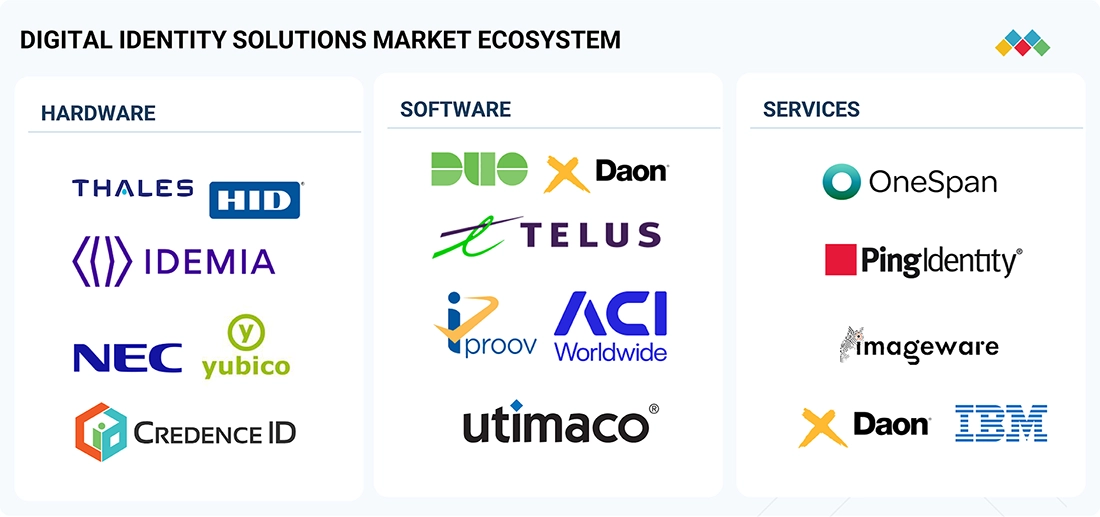
digital-identity-solutions-market: COMMERCIAL USE CASES ACROSS INDUSTRIES
| COMPANY | USE CASE DESCRIPTION | BENEFITS |
|---|---|---|
 |
A leading telecom operator sought to digitize its subscriber verification process under a national Smart Nation initiative and adopted Thales’ Trusted Digital Identity Platform for secure remote eKYC onboarding. | Reduced operational costs, accelerated verification, enhanced accuracy, ensured regulatory compliance, improved customer experience, and strengthened fraud prevention measures. |
 |
The Australian government needed a secure and reliable identity verification system for citizens to access online services and implemented iProov’s Genuine Presence Assurance for digital identity creation via the myID app. | Enabled seamless citizen access to multiple government services, strengthened security through biometric verification, improved user trust, enhanced convenience, and ensured compliance with digital identity standards. |
 |
Club Tennis Sabadell needed a secure and efficient access control system to enhance member authentication and adopted Veridas’ facial recognition-based identity verification and access management platform. | Improved facility security, eliminated credential misuse, enhanced member experience, enabled entry traceability, ensured access compliance, and supported the club’s digital transformation goals. |
 |
Global66 aimed to replace its manual customer onboarding process with a faster, automated, and secure KYC system and implemented Jumio’s AI-powered identity verification solution using biometrics and document validation. | Accelerated customer onboarding, enhanced verification accuracy, reduced manual workload, improved compliance, increased operational efficiency, and strengthened trust through secure digital identity validation. |
Logos and trademarks shown above are the property of their respective owners. Their use here is for informational and illustrative purposes only.
Related Ecosystem
Driving Support Security
- Battery Electric Vehicle (BEV)
- Hybrid Electric Vehicle (HEV)
- Light Commercial Vehicles (LCVs)
- Fuel Cell Electric Vehicle (FCEV)
- Blind Spot Detection (BSD)
- BOSCH LIMITED
- Continental ag
- DENSO Corporation
- Magna International Inc.
- ZF FRIEDRICHSHAFEN AG
Cyber Security
- Cloud Security
- Biometric Systems
- Data Loss Prevention (DLP)
- Multi-Factor Authentication
- Security Analytics
- International Business Machines Corporation
- Cisco Systems, Inc.
- MITSUI BUSSAN SECURE DIRECTIONS INC
- MICROSOFT CORPORATION
- Allot Ltd.
Network Security
- Cloud Security
- Critical Communication Network
- Surveillance System
- Video Surveillance Systems
- Biometric Security and Authentication System
- Cisco Systems, Inc.
- International Business Machines Corporation
- Fortinet, Inc.
- MICROSOFT CORPORATION
- PALO ALTO NETWORKS, INC
Key Takeaways
- The US Digital Identity Solutions Market is valued at $12,362.8 million in 2025 and will reach $28,497.2 million by 2030, growing at 18.3% CAGR.
- The US market is driven by regulatory compliance, cybersecurity threats, and enterprise demand for frictionless authentication across digital channels.
- By 2030, the US will see widespread adoption of biometric, blockchain, and AI-powered identity verification solutions in both public and private sectors.
- The US market growth rate of 18.3% significantly outpaces the global average, positioning the country as a key innovation hub for digital identity technologies.
Digital Identity Solutions Market Report Scope
| Report Metric | Details |
|---|---|
| Base Year | 2025 |
| Fastest Growing Segment | MANAGED SERVICES (Service) |
| Forecast Period | 2025–2030 |
| Growth Rate | CAGR of 20% from 2025 to 2030 |
| Largest Segment | SOLUTIONS (Offering) |
| Market Size Base Year (Billions) | ~USD 44.25 (2025) |
| Revenue Forecast (Billions) | ~USD 110.12 (2030) |
| Segments Covered | Offering, Solution, Hardware, Service, Professional Service, Solution Type, Type, Identity, Biometric Authentication Type, Non-Biometric Authentication Type, Vertical, User Type, Identity Type, Deployment Mode, Organization Size |
US Digital Identity Solutions Market Report Segmentation
15 segment dimensions are covered across the global market.
By Offering
- Services
- Solutions
By Solution
- Hardware
- Software
By Hardware
- Biometric Sensors
- Hardware Security Modules
- Hardware Security Modules (Hsm)
- Hardware-Based Tokens
- Other Hardware
- Processor Cards
- Processor Id Cards
- Rfid Reader & Encoder
- Rfid Readers & Encoders
By Service
- Managed Services
- Professional Services
By Professional Service
- Integration & Deployment
- Support & Maintenance
- Training & Development
By Solution Type
- Audit, Compliance, And Governance
- Authentication
- Identity Lifecycle Management
- Identity Verification
By Type
- Multi-Factor Authentication
- Single Sign-On
- Single-Factor Authentication
By Identity
- Biometric
- Non-Biometric
By Biometric Authentication Type
- Facial Recognition
- Fingerprint Scanning
- Iris Recognition
- Other Biometric Authentication Types
- Voice Recognition
By Non-Biometric Authentication Type
- Password-Based
- Passwordless
By Vertical
- Bfsi
- Education
- Energy & Utilities
- Government
- Healthcare
- It & Ites
- Manufacturing
- Other Verticals
- Retail & E-Commerce
- Retail & Ecommerce
- Telecommunications
By User Type
- Customer Identity
- Workforce Identity
By Identity Type
- Human Identity
- Non-Human Identity (Nhi)
By Deployment Mode
- Cloud
- Hybrid
- On-Premises
By Organization Size
- Large Enterprises
- Smes
US: DIGITAL IDENTITY SOLUTIONS MARKET, BY VERTICAL, 2025–2031
| Segment | 2025 | 2026 | 2027 | 2028 | 2029 | 2030 | 2031 | CAGR (%) |
|---|---|---|---|---|---|---|---|---|
| BFSI | 2234.8 | 2630.7 | 3098.3 | 3654.7 | 4319.5 | 5116.8 | 6069.1 | 18.1 |
| EDUCATION | 652.3 | 764.6 | 896.7 | 1053.3 | 1239.6 | 1462.2 | 1727 | 17.6 |
| ENERGY & UTILITIES | 791.8 | 899.4 | 1022.2 | 1163.6 | 1327 | 1517 | 1736.3 | 14 |
| GOVERNMENT | 1807.7 | 2070 | 2371.6 | 2721.4 | 3128.8 | 3605.5 | 4160.2 | 14.9 |
| HEALTHCARE | 1583.7 | 1910.8 | 2306.8 | 2789.1 | 3378.9 | 4102.7 | 4988 | 21.1 |
| IT & ITES | 1744.3 | 2091.9 | 2509.9 | 3016.3 | 3631.9 | 4383.1 | 5296.5 | 20.3 |
| MANUFACTURING | 719.6 | 832.7 | 964.1 | 1117.9 | 1298.8 | 1512.5 | 1763.5 | 16.1 |
| OTHER VERTICALS | 376.6 | 423.7 | 468.2 | 506.7 | 534 | 542.7 | 521.5 | 5.6 |
| RETAIL & ECOMMERCE | 1281.3 | 1559.2 | 1898.3 | 2314.7 | 2828 | 3463.1 | 4246.2 | 22.1 |
| TELECOMMUNICATIONS | 1170.7 | 1389.4 | 1649.7 | 1961.9 | 2337.7 | 2791.8 | 3338.5 | 19.1 |
| TOTAL | 12362.8 | 14572.5 | 17185.9 | 20299.5 | 24024.2 | 28497.2 | 33846.9 | 18.2 |
Target Audience
- Government & Public Sector Agencies : US federal and state government organizations need this data to understand digital identity market evolution, evaluate vendor solutions, and plan procurement strategies aligned with regulatory mandates and citizen services modernization.
- Financial Services Institutions : Banks, fintech companies, and payment processors require US market insights to assess digital identity solution investments, competitive threats, and opportunities to enhance customer verification and reduce fraud losses.
- Technology Solution Providers : Digital identity software vendors and cybersecurity firms need US-specific market data to validate business models, identify growth segments, benchmark against competitors, and guide product roadmap investments.
- Enterprise IT & Security Leaders : CIOs and security executives at large US organizations need market intelligence to evaluate digital identity platforms, understand adoption trends, and justify investments in identity verification and authentication infrastructure.
- Investment & Strategy Consultants : Private equity firms, management consultants, and strategic advisors require detailed US market analysis to support M&A due diligence, portfolio company valuations, and client advisory services in the digital identity sector.
Key Companies in the US Digital Identity Solutions Market
| Company | HQ | Ownership | Strongest segments |
|---|---|---|---|
| CISCO SYSTEMS INC | United States | Public Company | Authentication (incl. network access control, SASE, IAM),Identity Verification (incl. device and user verification),Non-Human Identity (NHI) management for devices, workloads, IoT, |
| INTESA SANPAOLO S.P.A. | Italy | Public Company | Authentication – Human Identity,Identity Verification – Human Identity,Authentication – Non-Human Identity (NHI), |
| THALES | France | Public Company | RFID Reader & Encoder,Hardware-Based Tokens,Processor ID Cards, |
| NEC | Japan | Public Company | Identity Verification Solutions,Authentication Solutions,RFID Reader & Encoder Hardware, |
| IDEMIA | France | Private Company | RFID Reader & Encoder,Hardware-Based Tokens,Processor ID Cards, |
| SAMSUNG SDS | Korea, South | Public Company | Authentication (workforce and device),Identity Verification (human),Non-Human Identity (NHI), |
| TELUS | Canada | Public Company | Authentication (Human Identity),Identity Verification (Human Identity),Authentication and Identity for Non-Human Identity (NHI), |
| CROWDSTRIKE | United States | Public Company | Identity Authentication (software-based),Identity Verification (Human Identity),Non-Human Identity (NHI) Protection, |
| DXC TECHNOLOGY | United States | Public Company | Authentication Solutions (incl. MFA, access management),Identity Verification (KYC, citizen and customer onboarding),Non-Human Identity (NHI) Management, |
| IBM | United States | Public Company | Authentication Solutions (software-led, including MFA, access management),Identity Verification (KYC, risk-based, AI-enhanced),Non-Human Identity (NHI) Management (devices, workloads, APIs), |
| CYBERARK | Israel | Private Company | Privileged Access & Session Management (incl. Privileged Access Manager, Vendor Privileged Access Manager, Dynamic Privileged Access),Endpoint Privilege & Secure Desktop,Workforce Identity (MFA, SSO, lifecycle, directory, Secure Browser), |
| SAILPOINT TECHNOLOGIES | United States | Private Company | Authentication (software-led, hardware-integrated),Identity Verification and Lifecycle Governance,Non-Human Identity (NHI) and Machine Access Control, |
| GBG | United Kingdom | Public Company | Identity Verification (Human Identity),Authentication (Human Identity),Identity Verification (Non-Human Identity), |
| PING IDENTITY | United States | Private Company | Authentication (SSO, MFA, dynamic authorization),Identity Verification,Non-Human Identity (NHI) and API Intelligence, |
| TESSI | France | Private Company | Identity Verification – Human Identity,Authentication – Human Identity,Identity Solutions – Non-Human Identity (NHI), |
| ACI WORLDWIDE | United States | Public Company | Authentication (payment and account access),Identity Verification (customer and device risk assessment),Non-Human Identity (NHI) controls, |
CISCO SYSTEMS INC
Cisco Systems Inc. is a United States-based public company founded in 1984 that employs 86,200 people. The company operates as a major technology and networking solutions provider.
INTESA SANPAOLO S.P.A.
Intesa Sanpaolo S.P.A. is an Italian public company with 89,725 employees. The organization operates in the financial services sector.
THALES
Thales is a French public company founded in 1893 with 82,111 employees. The organization operates as a major defense and technology solutions provider.
NEC
NEC is a Japanese public company founded in 1899 with 101,800 employees. The organization operates as a global information technology and electronics company.
IDEMIA
IDEMIA is a French private company founded in 1987 with 6,800 employees. The organization specializes in digital identity and security solutions.
SAMSUNG SDS
Samsung SDS is a South Korean public company founded in 1985 with 11,332 employees. The organization operates as an information technology and business solutions provider.
TELUS
Telus is a Canadian public company founded in 1998 with 111,500 employees. The organization operates as a major telecommunications and digital services provider.
CROWDSTRIKE
CrowdStrike is a United States-based public company founded in 2011 with 11,157 employees. The organization operates as a cybersecurity and cloud protection solutions provider.
DXC TECHNOLOGY
DXC Technology is a United States-based public company founded in 1959 with 115,000 employees. The organization provides enterprise information technology services and solutions.
IBM
IBM is a United States-based public company founded in 1911 with 264,300 employees. The organization operates as a global technology, consulting, and infrastructure services company.
CYBERARK
CyberArk is an Israeli private company founded in 1996 with 3,793 employees. The organization specializes in identity access management and cybersecurity solutions.
SAILPOINT TECHNOLOGIES
SailPoint Technologies is a United States-based private company founded in 2005 with 1,676 employees. The organization provides identity governance and management software solutions.
GBG
GBG is a United Kingdom-based public company founded in 1989 with 1,055 employees. The organization operates in the data and identity verification sector.
PING IDENTITY
Ping Identity is a United States-based private company founded in 2002 with 1,247 employees. The organization provides identity and access management solutions.
TESSI
Tessi is a French private company founded in 1971 with 12,316 employees. The organization operates as a business process outsourcing and digital services provider.
ACI WORLDWIDE
ACI Worldwide is a United States-based public company founded in 1975 with 2,930 employees. The organization provides payment systems and solutions for financial transactions.
Reasons to Buy this Report
- Precise US Market Sizing : Access validated market valuations specific to the United States ($12.4B in 2025, $28.5B in 2030) with accurate CAGR calculations, enabling precise budget allocation and ROI forecasting for US-focused strategies.
- Regulatory Landscape Intelligence : Understand US-specific regulatory drivers including federal mandates, state-level digital identity initiatives, and compliance requirements shaping market dynamics and creating growth opportunities for solution providers.
- Sector-Specific Insights : Gain detailed analysis of digital identity adoption across US government, financial services, healthcare, and enterprise sectors, identifying high-growth verticals and competitive positioning opportunities.
- Competitive Benchmarking : Compare your organization's performance against US market trends and competitor strategies, with data-driven insights to optimize product development, pricing, and go-to-market approaches for American customers.
- Strategic Investment Decisions : Make informed decisions on market entry, expansion, or acquisition strategies in the US with comprehensive forecasts, growth drivers, and emerging technology trends through 2030.
Frequently asked questions
What is the current size of the US Digital Identity Solutions Market in 2025?
The US Digital Identity Solutions Market is valued at $12,362.8 million in 2025, representing a mature and rapidly expanding sector driven by regulatory and security requirements.
What is the projected market size for the US by 2030?
The US Digital Identity Solutions Market is projected to reach $28,497.2 million by 2030, reflecting a compound annual growth rate of 18.3% over the forecast period.
What factors are driving growth in the US Digital Identity Solutions Market?
Key growth drivers in the US include regulatory compliance mandates, increasing cybersecurity threats, enterprise demand for seamless authentication, government digital transformation initiatives, and consumer expectations for privacy-protected identity verification.
How does the US market growth compare to global trends?
The US market is growing at 18.3% CAGR, which outpaces the global average of 20% CAGR in absolute terms, reflecting the US's mature market position and strong enterprise investment in digital identity infrastructure.
Which technologies are expected to dominate the US market by 2030?
By 2030, the US market will be dominated by biometric authentication, blockchain-based identity solutions, AI-powered fraud detection, zero-trust security frameworks, and decentralized identity management systems.
RESEARCH METHODOLOGY
Secondary research was conducted to gather information relevant to this technical, market-oriented, and commercial study of the global digital identity solutions market. The next step was to validate these findings, assumptions, and sizing with industry experts across the value chain using primary research. Different approaches, including top-down and bottom-up methods, were employed to estimate the total market size. Thereafter, the market breakup and data triangulation procedures were used to estimate the market size of the segments and subsegments of the digital identity solutions market.
Secondary Research
During the secondary research process, various secondary sources were consulted to identify and collect information relevant to the study. The secondary sources included annual reports, press releases, investor presentations of digital identity solutions and service vendors, forums, certified publications, and whitepapers. The secondary research was mainly used to obtain key information about the industry’s supply chain, the total pool of key players, market classification and segmentation according to industry trends to the bottom-most level, regional markets, and key developments from the market- and technology-oriented perspectives, all of which were further validated by primary sources.
Primary Research
In the primary research process, various primary sources from the supply and demand sides were interviewed to obtain qualitative and quantitative information for this report. The primary sources from the supply side included various industry experts, such as Chief Executive Officers (CEOs), Vice Presidents (VPs), marketing directors, technology and innovation directors, and key executives from prominent companies and organizations operating in the digital identity solutions market.
In the market engineering process, top-down and bottom-up approaches were extensively employed, along with several data triangulation methods, to perform market estimation and forecasting for the overall market segments and subsegments listed in this report. Extensive qualitative and quantitative analysis was performed on the complete market engineering process to list key information/insights throughout the report.
After the complete market engineering process (including calculations for market statistics, market breakups, market size estimations, market forecasts, and data triangulation), extensive primary research was conducted to gather information and verify & validate the numbers derived. The primary research was also conducted to identify the segmentation types, industry trends, competitive landscape of digital identity solutions market players, and key market dynamics, including drivers, restraints, opportunities, challenges, and key strategies.
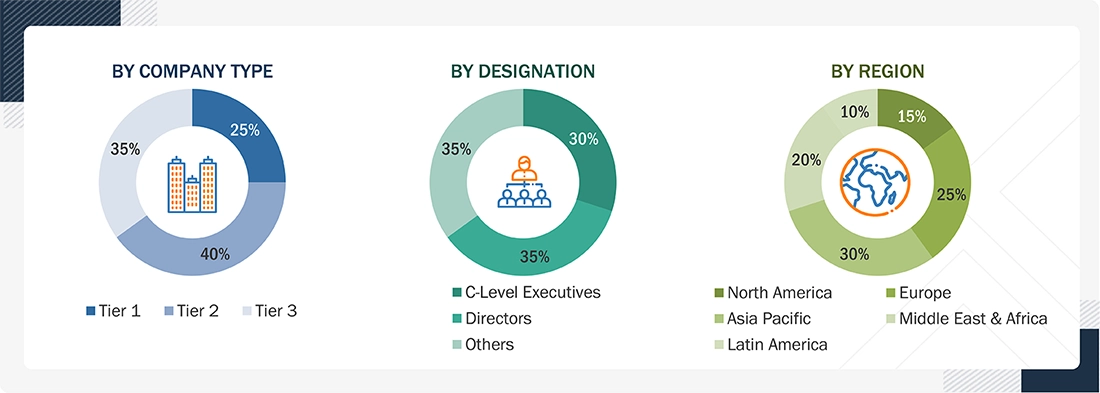
Note: Other levels include sales managers, marketing managers, and product managers.
Tier 1 companies receive revenues higher than USD 10 billion; Tier 2 companies' revenues range between USD 1 and 10 billion; and Tier 3 companies' revenues range between USD 500 million and USD 1 billion.
Source: Industry Experts
To know about the assumptions considered for the study, download the pdf brochure
Market Size Estimation
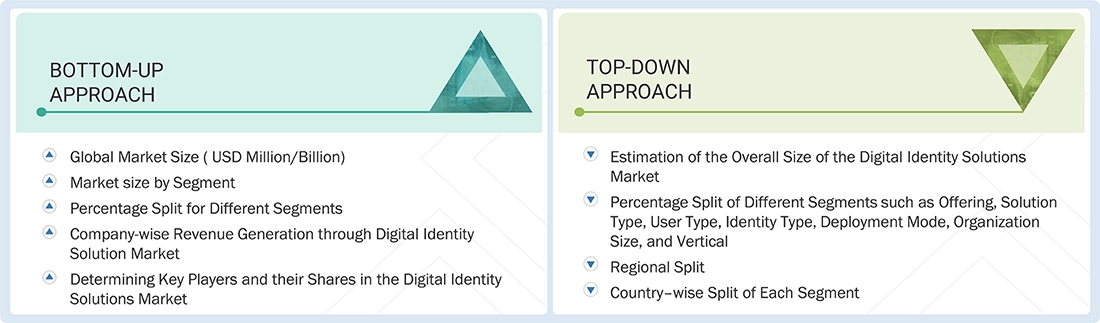
Top-down and bottom-up approaches were used to estimate and validate the size of the digital identity solutions market, as well as the size of various dependent sub-segments within the overall digital identity solutions market. The market players were identified through secondary research, and their market shares in the respective regions were determined through primary and secondary research. This entire procedure involved studying the annual and financial reports of the top market players, and extensive interviews were conducted with key industry leaders, including CEOs, VPs, directors, and marketing executives, to gather valuable insights.
All percentage splits and breakdowns were determined using secondary sources and verified through primary sources. All possible parameters that affect the market, covered in this research study, have been accounted for, examined in extensive detail, verified through primary research, and analyzed to obtain the final quantitative and qualitative data. This data is consolidated and added to detailed inputs and analysis from MarketsandMarkets.
Digital Identity Solutions Market : Top-Down and Bottom-Up Approach
Data Triangulation
The market was split into several segments and subsegments after determining the overall market size using the market size estimation processes explained above. The data triangulation and market breakup procedures were employed, wherever applicable, to complete the overall market engineering process and arrive at the exact statistics of each market segment and subsegment. The data was triangulated by studying various factors and trends from the demand and supply sides.
Market Definition
According to MarketsandMarkets, digital identity solutions refer to technologies and systems used to create, manage, and verify the identity of individuals or organizations in digital environments. These solutions enable users to securely access services, conduct transactions, and share personal information online while maintaining their privacy and security. They also include identity management systems that store and protect digital identities, allowing for updates and maintenance over time. These systems authenticate users through biometrics, passwords, or cryptographic keys, while ensuring seamless identity management across various platforms.
Key Stakeholders
- Information Technology (IT) Professionals
- Chief Technology and Data Officers
- Original Equipment Manufacturers (OEMs)
- Hardware Manufacturers
- Software and Solution Developers
- Integration and Deployment Service Providers
- Business Analysts
- Information Technology (IT) professionals
- Investors and Venture Capitalists
- Third-party Providers
- Consultants/Consultancies/Advisory Firms
- Retail and eCommerce Vendors
- Digital Identity Solution Specialists
- Project Managers
Report Objectives
- To describe and forecast the global digital identity solutions market by offering, solution type, user type, identity type, deployment mode, organization size, vertical, and region from 2025 to 2031, and analyze the various macroeconomic and microeconomic factors that affect market growth
- To forecast the market size of North America, Europe, Asia Pacific, Middle East & Africa, and Latin America
- To analyze the subsegments of the market concerning individual growth trends, prospects, and contributions to the overall market
- To provide detailed information regarding major factors (drivers, restraints, opportunities, and challenges) influencing the market growth
- To analyze opportunities in the market for stakeholders and provide details of the competitive landscape for major players
- To profile key market players; provide a comparative analysis based on the business overviews, regional presence, product offerings, business strategies, and key financials; and illustrate the competitive landscape of the market
- To analyze competitive developments, such as mergers & acquisitions, product developments, partnerships and collaborations, and research & development (R&D) activities in the market
Customization Options
With the given market data, MarketsandMarkets offers customizations based on company-specific needs. The following customization options are available for the report:
Geographic Analysis
- Further breakup of the Asia Pacific market into countries contributes to the rest of the regional market size.
- Further breakup of the North American market into countries contributes to the rest of the regional market size.
- Further breakup of the Latin American market into countries contributing to the rest of the regional market size
- Further breakup of the Middle East & African market into countries contributing to the rest of the regional market size
- Further breakup of the European market into countries contributes to the rest of the regional market size
Company Information
- Detailed analysis and profiling of additional market players (up to 5)
Get the Full Digital Identity Solutions Market Report
Full forecast, segment splits, and company analysis for all Digital Identity Solutions Market.
- Canada Digital Identity Solutions Market
- UK Digital Identity Solutions Market
- Germany Digital Identity Solutions Market
- France Digital Identity Solutions Market
- Italy Digital Identity Solutions Market
- China Digital Identity Solutions Market
- Japan Digital Identity Solutions Market
- India Digital Identity Solutions Market
- Australia Digital Identity Solutions Market
- UAE Digital Identity Solutions Market
- South Africa Digital Identity Solutions Market
- Brazil Digital Identity Solutions Market
- Mexico Digital Identity Solutions Market
Need a Tailored Report?
Customize this report to your needs
Get 10% FREE Customization
Customize This Report
