
India Distribution Automation Market (2025-2030)

The India Distribution Automation Market was valued at $300.5 Million in 2025 and projected to reach to $507.6 Million by 2030, representing a compound annual growth rate of 11.1%. India's distribution automation market is poised for sustained expansion as utilities prioritize grid modernization to meet rising electricity demand and reduce technical losses.


| Market Size in | USD 26.32 MN |
| Market Forecast in | |
| CAGR | |
| Forecast Period | |
| Units Considered | Value (USD MN) |
India Distribution Automation Market Trends and Insights
- This 11.1% compound annual growth rate reflects India's accelerating investment in smart grid infrastructure and digital transformation of power distribution networks.
- India's aging grid infrastructure and rising electricity demand are driving utilities to adopt automated solutions for improved efficiency, reduced losses, and enhanced reliability. The Indian market benefits from government initiatives promoting renewable energy integration and grid modernization across the country.
- India's focus on reducing technical and commercial losses in distribution networks has positioned distribution automation as a critical priority for state and central utilities.
- By 2030, India is expected to emerge as a key market for advanced metering infrastructure, SCADA systems, and real-time monitoring solutions that enable utilities to optimize operations and customer service delivery..
Key Market Statistics
- CAGR (2025-2030) 11.1% CAGR
- Market Size, 2025 ~USD 300.5 Million
- Forecast, 2030 ~USD 507.6 Million
- Country India
India Distribution Automation Market Overview
Market Valuation & Growth :
India's distribution automation market is valued at USD 300.5 million in 2025, with a projected CAGR of 11.1% through 2030, reaching USD 507.6 million. This growth outpaces many emerging markets due to India's aggressive smart grid modernization initiatives.
Infrastructure Modernization Driver :
India's aging power distribution infrastructure and rapidly increasing electricity demand are catalyzing investments in automation technologies. State-owned utilities and private operators are prioritizing grid digitalization to reduce losses and improve reliability across urban and rural networks.
Government Policy Support :
India's National Smart Grid Mission and renewable energy integration targets are accelerating distribution automation adoption. Government incentives and regulatory frameworks are encouraging utilities to deploy advanced metering infrastructure (AMI) and real-time monitoring systems.
Regional Deployment Opportunities :
Metropolitan areas like Delhi, Mumbai, and Bangalore are leading adoption, while tier-2 and tier-3 cities present significant growth opportunities. Rural electrification programs are also driving demand for cost-effective automation solutions across distributed networks.
India Distribution Automation Market Dynamics
- The integration of renewable energy sources, coupled with government initiatives like the National Smart Grid Mission, is accelerating the adoption of advanced automation technologies across distribution networks.
- Investment in digital infrastructure and IoT-enabled monitoring systems will drive market growth through 2030. Key growth drivers include India's commitment to achieving 500 GW of renewable energy capacity, increasing focus on reducing distribution losses, and the need to enhance grid reliability in rapidly urbanizing regions.
- Private sector participation and public-private partnerships are expected to accelerate technology deployment, particularly in smart metering and real-time grid management solutions.
- The market will benefit from declining technology costs and growing awareness of operational efficiency benefits among state and private utilities..
Market Ecosystem
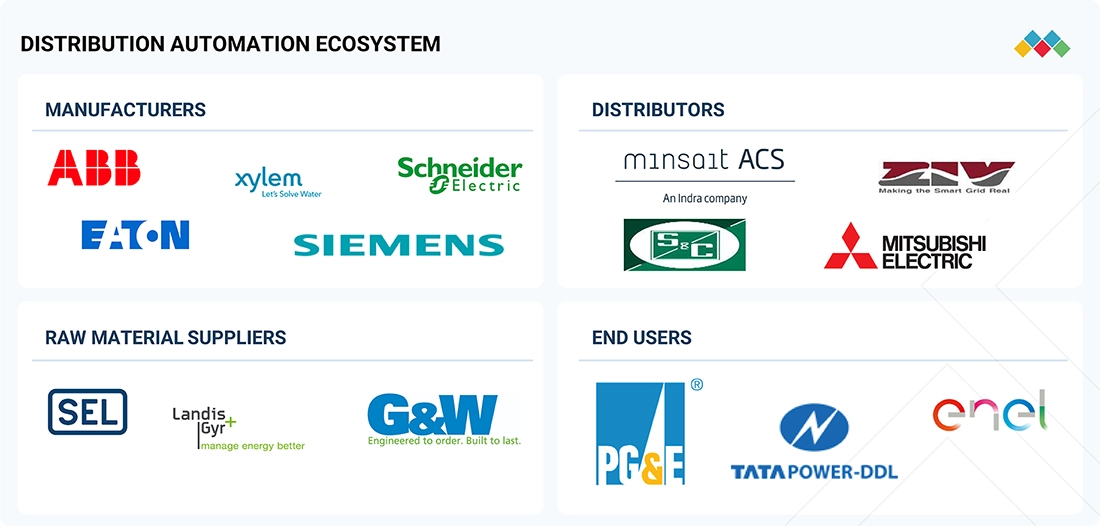
Distribution Automation Market: COMMERCIAL USE CASES ACROSS INDUSTRIES
| COMPANY | USE CASE DESCRIPTION | BENEFITS |
|---|---|---|
 |
TATA POWER Delhi Distribution Limited Adopts automated solutions to improve efficiency and reduce aggregate technical and commercial losses | TPDD implemented automation in its operations to improve efficiency and reduce losses. The company has established a separate training center, the Center for Power Efficiency in Distribution, which offers training to its employees and other power companies. TPDD has also established the Rithala captive power plant to serve as a backup in the event of breakdowns, particularly for essential services such as hospitals and streetlights. |
 |
US DOE grants Chattanooga Electric Power Board contract to deploy smart grid technologies for transformers | Itron’s distribution automation solutions leverage industrial IoT-enabled edge devices to communicate, coordinate, and control equipment across the distribution network in real-time, improving distribution system reliability by reducing outage duration and the number of customers affected. Intelligently connected devices, such as capacitor bank controllers, smart meters, line sensors, and reclosers that leverage peer-to-peer communication, can quickly pinpoint and isolate outages, protecting equipment and helping keep the lights on. |
Logos and trademarks shown above are the property of their respective owners. Their use here is for informational and illustrative purposes only.
Related Ecosystem
Power Infrastructure
- Geographical Information System (GIS)
- Cogeneration
- Battery Electric Vehicle (BEV)
- Cellular Network
- Fuel Cell
- Siemens ag
- ABB India Limited
- SCHNEIDER ELECTRIC SE
- General Electric Company
- Eaton Corporation plc
Smart Energy And Digital Solutions
- Cellular Network
- Analytics Software
- Geographical Information System (GIS)
- Meter Data Management (MDM)
- Smart Meters
- Siemens ag
- SCHNEIDER ELECTRIC SE
- ABB India Limited
- General Electric Company
- Eaton Corporation plc
Key Takeaways
- India's distribution automation market will grow from USD 300.5M (2025) to USD 507.6M (2030) at an 11.1% CAGR.
- India's aging grid infrastructure and high distribution losses are primary drivers for automation adoption among utilities.
- Government smart grid initiatives and renewable energy targets are accelerating distribution automation investments across India.
- India's market will increasingly focus on advanced metering, SCADA, and real-time monitoring technologies by 2030.
Distribution Automation Market Report Scope
| Report Metric | Details |
|---|---|
| Base Year | 2025 |
| Fastest Growing Segment | PRIVATE UTILITIES (Utility) |
| Forecast Period | 2025–2030 |
| Growth Rate | CAGR of 14.5% from 2025 to 2030 |
| Largest Segment | FIELD DEVICES (Offering) |
| Market Size Base Year (Billions) | ~USD 20.53 (2025) |
| Revenue Forecast (Billions) | ~USD 40.4 (2030) |
| Segments Covered | Communication Technology, Type, Offering, Utility, Field Devices, Wired Communication Technology, Wireless Communication Technology |
India Distribution Automation Market Report Segmentation
7 segment dimensions are covered across the global market.
By Communication Technology
- Wired Communication Technology
- Wireless Communication Technology
By Type
- Automated Capacitors
- Automated Feeder Switches/Reclosers
- Automated Voltage Regulators
- Cellular Network
- Ethernet
- Feeder Monitors
- Fiber Optic
- Ip
- Powerline Carrier
- Radio Frequency Mesh
- Remote Fault Indicators
- Remote Terminal Units
- Smart Relays
- Transformer Monitors
- Wimax
By Offering
- Field Devices
- Services
- Software
By Utility
- Private Utilities
- Public Utilities
By Field Devices
- Automated Capacitors
- Automated Feeder Switches/Reclosers
- Automated Voltage Regulators
- Feeder Monitors
- Remote Fault Indicators
- Remote Terminal Units
- Smart Relays
- Transformer Monitors
By Wired Communication Technology
- Ethernet
- Fiber Optic
- Fiber Optics
- Ip
- Powerline Carrier
By Wireless Communication Technology
- Cellular Network
- Radio Frequency Mesh
- Wimax
Target Audience
- Utility Companies & Grid Operators : State-owned and private distribution utilities in India need market data to justify smart grid investments, plan modernization budgets, and benchmark operational efficiency improvements against industry standards.
- Technology & Equipment Manufacturers : Automation equipment providers, software vendors, and IoT solution companies require India-specific market insights to develop localized products, identify customer segments, and plan manufacturing and distribution strategies.
- Investment & Financial Institutions : Private equity firms, venture capital investors, and infrastructure funds evaluating opportunities in India's energy sector need credible market data to assess growth potential, risk profiles, and investment returns.
- Government & Policy Bodies : Ministry of Power, regulatory commissions, and government agencies developing energy policies require market intelligence to align smart grid initiatives with infrastructure development goals and renewable energy targets.
- System Integrators & Consultants : Engineering firms and management consultants advising utilities on digital transformation need India-specific market trends, technology adoption patterns, and competitive landscapes to deliver strategic recommendations.
Key Companies in the India Distribution Automation Market
| Company | HQ | Ownership | Strongest segments |
|---|---|---|---|
| MAXWELL TECHNOLOGIES, INC. | United States | Private Company | Field Devices – High-Voltage Capacitors and Instrument Transformers,Field Devices – Ultracapacitor Modules for Grid and Industrial,Services and Engineering Support, |
| EMERSON ELECTRIC CO. | United States | Public Company | Field Devices,Software,Services, |
| EMERA INCORPORATED | Canada | Public Company | Field Devices,Software,Services, |
| BOREALIS AG | United States | Private Company | Field Devices – Cable, Conduit, and Enclosure Materials,Communication Technology – Wired Infrastructure Materials,Services and Technical Support to Utilities and OEMs, |
| ENGIE | France | Public Company | Field Devices,Software,Services, |
| ADANI GREEN ENERGY | India | Public Company | Field Devices,Software,Services, |
| ABB | India | Public Company | Field Devices,Software,Services, |
| SIEMENS | Germany | Public Company | Field Devices,Software,Services, |
| SCHNEIDER ELECTRIC | Canada | Public Company | Field Devices,Software,Services, |
| EATON | Ireland | Public Company | Field Devices,Software,Services, |
| GE VERNOVA | United States | Public Company | Field Devices,Software,Services, |
| XYLEM | United States | Public Company | Field Devices,Software,Services, |
| TOSHIBA CORPORATION | Japan | Private Company | Field Devices,Software,Services, |
| ITRON INC. | United States | Public Company | Field Devices,Software,Services, |
| HUBBELL | United States | Public Company | Field Devices,Software,Services, |
MAXWELL TECHNOLOGIES, INC.
Maxwell Technologies, Inc. is a private company founded in 1965 in the United States with 368 employees.
EMERSON ELECTRIC CO.
Emerson Electric Co. is a public company founded in 1890 in the United States with 71,000 employees.
EMERA INCORPORATED
Emera Incorporated is a public company founded in 1998 in Canada with 7,812 employees.
BOREALIS AG
Borealis AG is a private company founded in 1994 in the United States with 5,887 employees.
ENGIE
ENGIE is a public company founded in 1880 in France with 84,809 employees.
ADANI GREEN ENERGY
Adani Green Energy is a public company founded in 2015 in India with 976 employees.
ABB
ABB is a public company founded in 1883 in India with 111,900 employees.
SIEMENS
Siemens is a public company founded in 1847 in Germany with 310,312 employees.
SCHNEIDER ELECTRIC
Schneider Electric is a public company founded in 1836 in Canada with 158,122 employees.
EATON
Eaton is a public company founded in 1911 in Ireland with 97,303 employees.
GE VERNOVA
GE Vernova is a public company founded in 2023 in the United States with 78,000 employees.
XYLEM
Xylem is a public company founded in 2011 in the United States with 22,000 employees.
TOSHIBA CORPORATION
Toshiba Corporation is a private company founded in 1875 in Japan with 106,648 employees.
ITRON INC.
Itron Inc. is a public company founded in 1977 in the United States with 4,987 employees.
HUBBELL
Hubbell is a public company founded in 1888 in the United States with 18,200 employees.
Reasons to Buy this Report
- Market Size & Growth Validation : Obtain precise market valuation data for India's distribution automation sector with verified CAGR of 11.1% through 2030. Validate investment decisions and business expansion strategies with credible market sizing and forecasts specific to the Indian market.
- Regional Opportunity Identification : Identify high-growth regions and tier-2/tier-3 city opportunities within India where distribution automation adoption is accelerating. Understand geographic deployment patterns and prioritize market entry strategies based on infrastructure modernization initiatives.
- Competitive Positioning Intelligence : Benchmark your offerings against market trends and understand India-specific competitive dynamics. Gain insights into utility procurement patterns, technology preferences, and regulatory requirements that influence purchasing decisions in the Indian market.
- Policy & Regulatory Landscape : Stay informed on India's National Smart Grid Mission, renewable energy integration mandates, and government incentive programs driving automation adoption. Understand regulatory frameworks and compliance requirements essential for market success in India.
- Strategic Partnership Opportunities : Identify potential partnerships with state utilities, private operators, and technology providers in India's distribution automation ecosystem. Leverage market insights to establish collaborations that accelerate market penetration and revenue growth.
Frequently asked questions
What is the current size of India's distribution automation market?
India's distribution automation market is valued at USD 300.5 million in 2025 and is expected to grow to USD 507.6 million by 2030.
What is the projected growth rate for India's distribution automation market?
India's distribution automation market is projected to grow at a compound annual growth rate (CAGR) of 11.1% from 2025 to 2030.
What are the main drivers of growth in India's distribution automation market?
Key drivers include India's aging grid infrastructure, high distribution losses, government smart grid initiatives, renewable energy integration targets, and the need for improved operational efficiency among utilities.
Which technologies are most relevant to India's distribution automation market?
Advanced metering infrastructure (AMI), SCADA systems, real-time monitoring solutions, and IoT-enabled devices are among the most relevant technologies driving India's market growth.
Who are the primary adopters of distribution automation solutions in India?
State electricity distribution companies (DISCOMs) and central utilities are the primary adopters of distribution automation solutions across India.
RESEARCH METHODOLOGY
This study involved major activities in estimating the current size of the distribution automation market. Comprehensive secondary research was done to collect information on the market, peer market, and parent market. The next step involved the validation of these findings, assumptions, and market sizing with industry experts across the value chain through primary research. The total market size was estimated through country-wise analysis. Then, the market breakdown and data triangulation were performed to estimate the market size of the segments and sub-segments.
Secondary Research
The secondary research involved the extensive use of secondary sources, directories, and databases, such as Hoover’s, Bloomberg BusinessWeek, Factiva, IEA, and OneSource, to identify and collect information useful for a technical, market-oriented, and commercial study of the global distribution automation market. The other secondary sources comprised press releases & investor presentations of companies, white papers, certified publications, articles by recognized authors, manufacturers, associations, trade directories, and databases.
Primary Research
The distribution automation market comprises several stakeholders, such as project developers, exchanges, traders/brokers, auction platforms, and end users/carbon emitters in the supply chain. The demand side of this market is characterized by end users. Moreover, the market growth is also fueled by the growing demand for industrial and utility services. The supply side is characterized by an increase in the number of contracts in the industrial sector and acquisitions among big players. Various primary sources from both the supply and demand sides of the market were interviewed to obtain qualitative and quantitative information. The breakdown of primary respondents is given below:
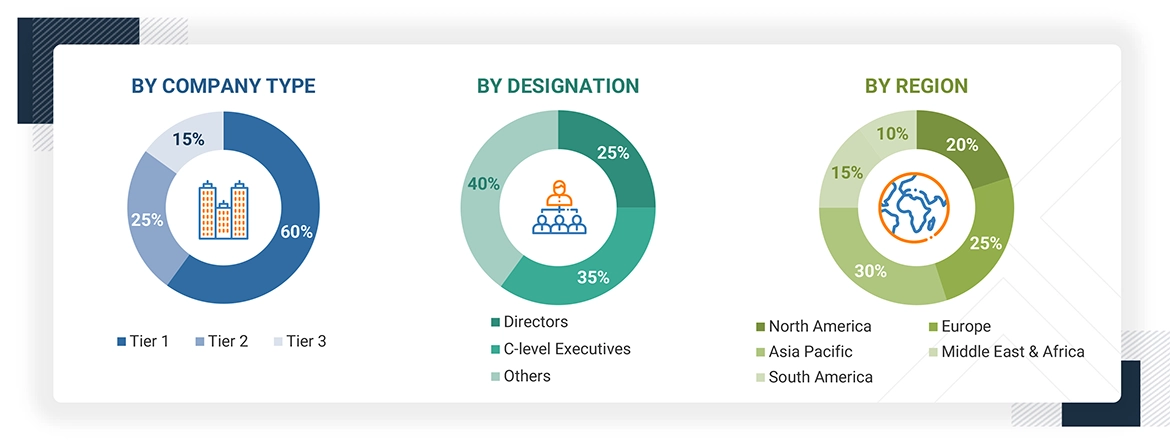
Note 1: Others include sales managers, marketing managers, and product managers.
Note 2: Tier 1 companies’ revenues are more than USD 10 billion; tier 2 companies’ revenues range between USD 1 and 10 billion; and tier 3 companies’ revenues range between USD 500 million and USD 1 billion.
Source: Industry Experts
To know about the assumptions considered for the study, download the pdf brochure
Market Size Estimation
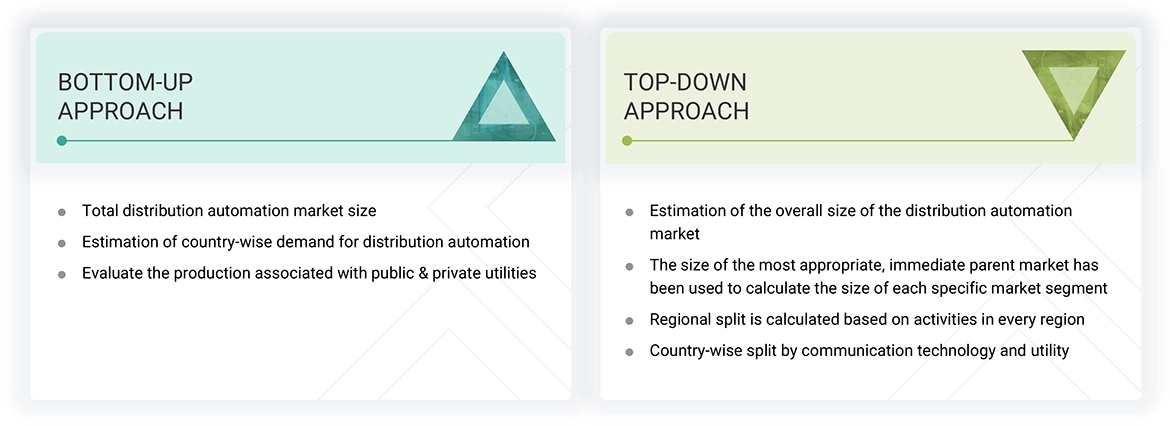
Both top-down and bottom-up approaches were used to estimate and validate the total size of the distribution automation market. These methods were also extensively used to estimate the size of various subsegments in the market. The research methodology used to estimate the market size includes the following:
- The key players in the industry and market have been identified through extensive secondary research, and their market share has been determined through primary and secondary research.
- The industry’s value chain and market size, in terms of value, have been determined through both primary and secondary research processes.
- All percentage shares, splits, and breakdowns have been determined using secondary sources and verified through primary sources.
Distribution Automation Market : Top-Down and Bottom-Up Approach
Data Triangulation
After arriving at the overall market size from the estimation process explained above, the total market has been split into several segments and subsegments. Data triangulation and market breakdown processes have been employed to complete the overall market engineering process and arrive at the exact statistics for all the segments and sub-segments, wherever applicable. The data has been triangulated by studying various factors and trends from both the demand and supply sides. Along with this, the market has been validated using both the top-down and bottom-up approaches.
Market Definition
Distribution automation is a key component of modern grid infrastructure as it enables the real-time monitoring and control of distribution assets to maximize grid efficiency and reliability. It uses digital sensors and switches with advanced control and communication technologies to automate feeder switching, voltage monitoring and control, outage management, reactive power management, preventative equipment maintenance for critical substation equipment, and grid integration of distributed energy resources. This helps utilities in collecting and analyzing data to improve the operational efficiency of power distribution systems.
The distribution automation market refers to the year-on-year investments in distribution automation across the five main regions, namely, North America, South America, Europe, Asia Pacific, and the Middle East & Africa.
Stakeholders
- Field device manufacturers
- Public and private electric utilities
- Distribution companies (DISCOMS)
- Energy & power sector consulting companies
- Government & research organizations
- Independent power producers
- Investment banks
- Electrical equipment associations
- Network and communication service providers
- Support and maintenance service providers
- Smart grid players
Report Objectives
- To describe and forecast the distribution automation market based on offering, communication technology, utility, and region in terms of value
- To describe and forecast the market for five key regions: Asia Pacific, North America, Europe, South America, and the Middle East & Africa, along with their country-level market sizes in terms of value
- To forecast the distribution automation market by offering and region, in terms of volume
- To provide detailed information regarding key drivers, restraints, opportunities, and challenges influencing the growth of the market
- To strategically analyze the micromarkets1 with respect to individual growth trends, prospects, and contributions to the overall market size
- To provide the supply chain analysis, trends/disruptions impacting customers’ businesses, market map, ecosystem analysis, tariffs and regulations, pricing analysis, patent analysis, case study analysis, impact of 2025 US tariff, impact of generative AI & AI on distribution automation market, global macroeconomic outlook, technology analysis, key conferences and events, trade analysis, Porter’s Five Forces analysis, key stakeholders and buying criteria, and regulatory analysis of the distribution automation market
- To analyze opportunities for stakeholders and draw a competitive landscape of the distribution automation market
- To benchmark market players using the company evaluation matrix, which analyzes market players on broad categories of business and product strategies adopted by them
- To compare key market players with respect to product specifications and applications
- To strategically profile key players and comprehensively analyze their market rankings and core competencies
- To analyze competitive developments, such as contracts & agreements, investments & expansions, mergers & acquisitions, product launches, partnerships, and joint ventures & collaborations, in the distribution automation market
Available Customizations
With the given market data, MarketsandMarkets offers customizations based on the company’s specific needs. The following customization options are available for the report:
Product Analysis
- Product Matrix, which provides a detailed comparison of the product portfolio of each company
Geographic Analysis as per Feasibility
- Further breakdown of the distribution automation market, by country
Company Information
- Detailed analyses and profiling of additional market players
Get the Full Distribution Automation Market Report
Full forecast, segment splits, and company analysis for all Distribution Automation Market.
- US Distribution Automation Market
- Canada Distribution Automation Market
- Mexico Distribution Automation Market
- Germany Distribution Automation Market
- France Distribution Automation Market
- Italy Distribution Automation Market
- UK Distribution Automation Market
- China Distribution Automation Market
- Japan Distribution Automation Market
- Australia Distribution Automation Market
- South Korea Distribution Automation Market
- Brazil Distribution Automation Market
- Argentina Distribution Automation Market
- UAE Distribution Automation Market
- Iran Distribution Automation Market
- South Africa Distribution Automation Market
- GCC Countries Distribution Automation Market
- Rest Of South America Distribution Automation Market
- Rest Of GCC Distribution Automation Market
- Saudia Arabia Distribution Automation Market
Need a Tailored Report?
Customize this report to your needs
Get 10% FREE Customization
Customize This Report
