
Canada Drone Sensor Market (2024-2029)

The Canada Drone Sensor Market was valued at $133.1 Million in 2024 and projected to reach to $218.8 Million by 2029, representing a compound annual growth rate of 10.4%. Canada's drone sensor market is poised for significant expansion, growing from USD 133.1 million in 2024 to USD 218.8 million by 2029, representing a 10.4% CAGR.


| Market Size in | USD 26.32 MN |
| Market Forecast in | |
| CAGR | |
| Forecast Period | |
| Units Considered | Value (USD MN) |
Canada Drone Sensor Market Trends and Insights
- This expansion reflects Canada's increasing adoption of drone technology across agriculture, infrastructure inspection, and public safety sectors.
- Canada's strong regulatory framework and technological infrastructure position the country as a key player in North America's drone ecosystem. The 10.4% compound annual growth rate demonstrates Canada's commitment to advancing autonomous systems and sensor innovation.
- Canada benefits from proximity to major North American markets and a skilled workforce in semiconductor and electronics manufacturing.
- By 2029, Canada's drone sensor market is expected to capture significant value as enterprises and government agencies expand their unmanned systems capabilities. Canada's growth trajectory is supported by increasing investment in precision agriculture, environmental monitoring, and smart city initiatives.
- The country's focus on regulatory clarity and industry standards strengthens confidence among manufacturers and end-users operating in Canada's drone sensor space..
Key Market Statistics
- CAGR (2024-2029) 10.4% CAGR
- Market Size, 2024 ~USD 133.1 Million
- Forecast, 2029 ~USD 218.8 Million
- Country Canada
Canada Drone Sensor Market Overview
Market Valuation :
Canada's drone sensor market reached USD 133.1 million in 2024, with strong momentum driven by adoption across multiple sectors including agriculture, infrastructure, and public safety applications.
Regulatory Leadership :
Canada's robust regulatory framework and advanced technological infrastructure position the country as a key player in North America, enabling faster innovation and market penetration compared to neighboring regions.
Agricultural Dominance :
The agriculture sector leads drone sensor adoption in Canada, leveraging precision farming technologies for crop monitoring, yield optimization, and resource management across vast farmland areas.
Infrastructure & Safety Growth :
Increasing deployment of drone sensors for infrastructure inspection, pipeline monitoring, and public safety operations reflects Canada's investment in modernizing critical infrastructure management.
Canada Drone Sensor Market Dynamics
- This growth trajectory outpaces global averages in select applications, driven by Canada's emphasis on technological innovation and regulatory clarity.
- The country's vast geography and resource-intensive industries create substantial demand for aerial monitoring solutions. Key growth drivers include increased investment in precision agriculture, heightened infrastructure maintenance requirements, and expanding public safety applications.
- Canadian enterprises are increasingly integrating advanced sensor technologies with AI and data analytics, creating competitive advantages.
- Government support for drone technology development and favorable policies for commercial operations will continue to accelerate market adoption through 2029..
Market Ecosystem
Related Ecosystem
Sensors And Control
- Sensors
- Temperature Sensors
- Image Sensors
- Pressure Sensors
- Flow Sensors
- BAUMER ELECTRIC AG
- HONEYWELL INTERNATIONAL INC.
- Stmicroelectronics
- Lenovo
- Texas Instruments Incorporated
Aviation
- Narrow Body Aircraft
- Wide Body Aircraft
- Military Helicopters
- Special Mission Aircraft
- Fighter Aircraft
- HONEYWELL INTERNATIONAL INC.
- COLLINS AEROSPACE
- Thales group
- Safran group
- HEICO Corporation
Communication And Connectivity Technology
- Sensors
- Smart Card & Readers
- Cellular Network
- Femtocell
- Image Sensors
- Cisco Systems, Inc.
- HUAWEI TECHNOLOGIES CO LTD
- Lenovo
- CommScope Holding Company, Inc.
- Texas Instruments Incorporated
Key Takeaways
- Canada's drone sensor market is valued at USD 133.1 million in 2024 and will reach USD 218.8 million by 2029, representing a 10.4% CAGR.
- Canada's regulatory environment and technological infrastructure make it a competitive hub for drone sensor development and deployment in North America.
- Agriculture, infrastructure inspection, and public safety are primary growth drivers for drone sensor adoption across Canada.
- Canada's proximity to major North American markets and skilled workforce support sustained expansion in the drone sensor sector through 2029.
Drone Sensor Market Report Scope
| Report Metric | Details |
|---|---|
| Base Year | 2024 |
| Fastest Growing Segment | SPEED & DISTANCE SENSORS (Sensor Type) |
| Forecast Period | 2024-2029 |
| Growth Rate | CAGR of 12.1% from 2024 to 2029 |
| Largest Segment | VTOL (Platform Type) |
| Market Size Base Year (Billions) | ~USD 1.41 (2024) |
| Revenue Forecast (Billions) | ~USD 2.5 (2029) |
| Segments Covered | Sensor Type, Application, Platform Type, End-User Industry |
Canada Drone Sensor Market Report Segmentation
4 segment dimensions are covered across the global market.
By Sensor Type
- Altimeter Sensors
- Current Sensors
- Flow Sensors
- Image Sensors
- Inertial Sensors
- Light Sensors
- Other Sensor Types
- Position Sensors
- Pressure Sensors
- Speed & Distance Sensors
- Ultrasonic Sensors
By Application
- Air Pressure Measurement
- Collision Detection & Avoidance
- Crop Scouting
- Data Acquisition
- Field Mapping
- Monitoring And Spraying
- Motion Detection
- Navigation
- Other Applications
- Other Precision Agriculture Applications
- Power Monitoring
By Platform Type
- Fixed Wing
- Hybrid
- Vtol
By End-User Industry
- Consumer
- Defense
- Energy & Utilities
- Law Enforcement
- Media & Entertainment
- Other End-User Industries
- Precision Agriculture
- Security & Surveillance
Target Audience
- Drone Sensor Manufacturers : Manufacturers need Canada-specific market data to identify growth opportunities, understand local demand patterns, and develop targeted product strategies for the Canadian agricultural and infrastructure sectors.
- Agricultural Technology Companies : AgTech firms require detailed insights into Canada's precision farming adoption rates and sensor requirements to position precision agriculture solutions effectively across Canadian farmland.
- Infrastructure & Inspection Service Providers : Service providers need market intelligence on infrastructure inspection demand, regulatory requirements, and competitive dynamics to expand drone-based inspection services across Canada.
- Investment & Private Equity Firms : Investors require comprehensive Canadian market analysis to evaluate acquisition targets, assess growth potential, and make informed funding decisions in the drone sensor technology space.
- Government & Policy Makers : Government agencies and policy makers need market data to understand drone technology adoption trends, inform regulatory decisions, and support strategic initiatives in public safety and infrastructure management.
Reasons to Buy this Report
- Market-Specific Sizing & Forecasts : Access precise valuation data for Canada's drone sensor market with detailed projections through 2029, enabling accurate budgeting and investment planning specific to the Canadian market landscape.
- Sector-Level Insights : Understand growth dynamics across Canada's key drone sensor applications including agriculture, infrastructure inspection, and public safety, with segment-specific trends and opportunity identification.
- Regulatory & Competitive Landscape : Gain intelligence on Canada's unique regulatory environment, competitive positioning, and technological infrastructure advantages that differentiate the market from global trends.
- Strategic Market Entry : Develop informed go-to-market strategies for Canada with localized insights on customer adoption patterns, regional preferences, and sector-specific requirements for drone sensor solutions.
- Investment Decision Support : Make confident investment and expansion decisions backed by comprehensive Canadian market data, growth forecasts, and competitive analysis specific to this high-potential North American market.
Frequently asked questions
What is the current size of Canada's drone sensor market?
Canada's drone sensor market was valued at USD 133.1 million in 2024 and is projected to grow to USD 218.8 million by 2029.
What is the expected growth rate for Canada's drone sensor market?
Canada's drone sensor market is expected to grow at a compound annual growth rate (CAGR) of 10.4% from 2024 to 2029.
Which industries are driving drone sensor adoption in Canada?
Key industries driving adoption in Canada include precision agriculture, infrastructure inspection, environmental monitoring, and public safety applications.
Why is Canada positioned as a key market for drone sensors?
Canada benefits from a strong regulatory framework, advanced technological infrastructure, skilled workforce, and proximity to major North American markets, making it attractive for drone sensor innovation and deployment.
What factors will influence Canada's drone sensor market growth through 2029?
Growth factors include increased investment in smart city initiatives, precision agriculture expansion, regulatory clarity, government support for autonomous systems, and rising demand for infrastructure monitoring solutions.
RESEARCH METHODOLOGY
Four main activities were undertaken to determine the size of the drone sensor market. Initial extensive secondary research gathered data on the market, peer market, and parent market. Following this, validation of these findings, assumptions, and sizing occurred through primary research involving industry experts across the value chain. Utilizing both top-down and bottom-up approaches, the global market size was estimated. Subsequently, market breakdown and data triangulation were employed to determine the sizes of segments and subsegments within the market.
Secondary Research
Secondary sources for this research study encompass corporate filings (including annual reports, investor presentations, and financial statements), trade publications, professional associations, white papers, accredited publications, articles authored by reputable sources, directories, and databases. Secondary data was gathered and analyzed to ascertain the overall market size, subsequently corroborated through primary research.
Primary Research
Following a comprehensive secondary research phase to comprehend and analyze the drone sensor market landscape, extensive primary research was conducted. This involved numerous interviews with key opinion leaders representing both demand- and supply-side vendors across four primary regions: North America, Asia Pacific, Europe, and RoW (comprising the GCC, Rest of Middle East & Africa, and South America). Subsequent to engaging with industry experts, concise sessions were held with seasoned independent consultants to validate the primary findings. These efforts, combined with insights from in-house subject matter experts, culminated in the findings detailed in the remainder of this report.
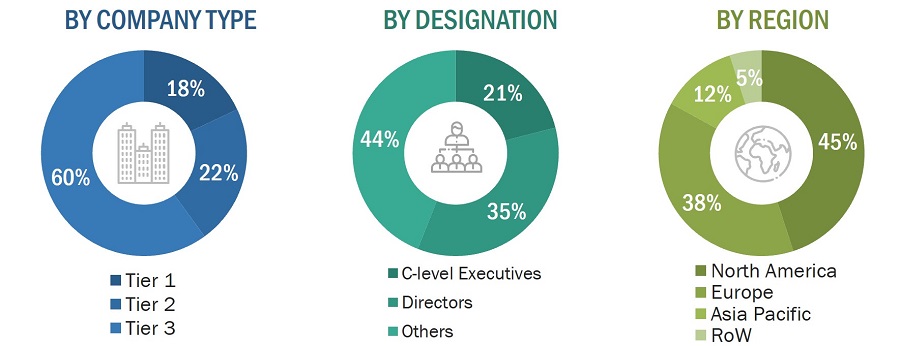
To know about the assumptions considered for the study, download the pdf brochure
Market Size Estimation
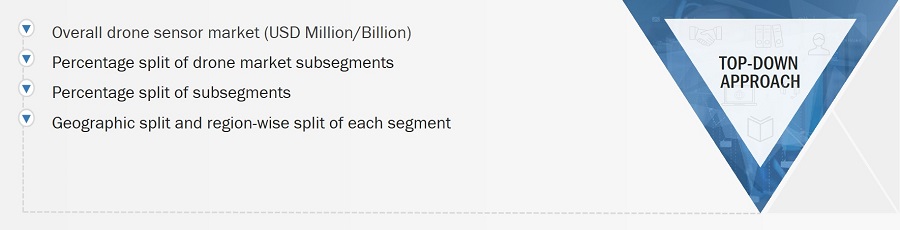
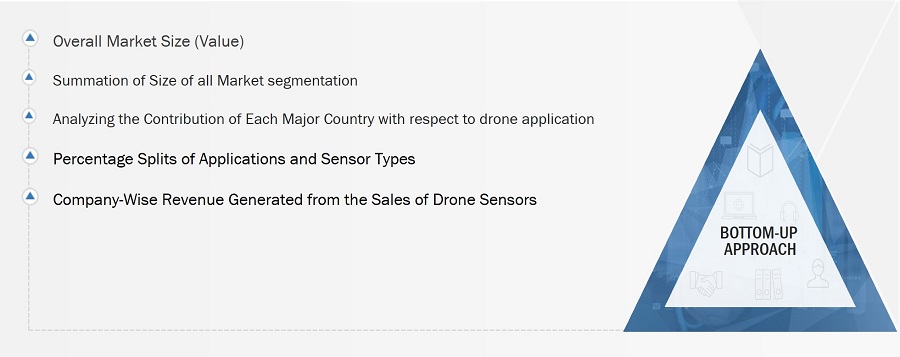
Both top-down and bottom-up methodologies have been employed to estimate and validate the overall size of the drone sensor market. These approaches were also extensively utilized to determine the sizes of various market subsegments. The research methodology utilized to estimate the market sizes encompasses the following:
Market Size Estimation Methodology-Top-Down Approach
Market Size Estimation Methodology-Bottom-up Approach
Data Triangulation
After determining the overall market size through the previously outlined market size estimation processes, the market has been subdivided into multiple segments and subsegments. Data triangulation and market breakdown procedures were used to finalize the overall market engineering process and ascertain precise statistics for each market segment and subsegment. This triangulation involved examining various factors and trends from both the demand and supply perspectives.
The market has been divided into multiple segments and subsegments following the determination of the overall market size, utilizing the market size estimation methodologies outlined previously. Data triangulation and market breakdown techniques were used to finalize the overall market engineering process and attain precise statistics for each market segment and subsegment. Triangulation of data has been achieved through an examination of diverse factors and trends from both demand and supply perspectives.
Market Definition
A sensor functions as a mechanism to identify alterations in electrical, physical, or various parameters, generating an output in response to such alterations. Typically, this output manifests as an electrical or optical signal. Drone sensors perceive modifications in their environment, enhancing their navigation capabilities and enabling them to gather vital information regarding the objects they observe.
Key Stakeholders
- Raw material and manufacturing equipment suppliers
- Integrated device manufacturers (IDMs)
- Drone sensor manufacturers
- Original device manufacturers (ODMs)
- Original equipment manufacturers (OEMs)
- Drone sensor-related technology providers
- Distributors and traders
- Research & education organizations
- End users
Report Objectives
- To describe and forecast the drone sensor market based on sensor type, platform type, application, and end-user industry in terms of value
- To forecast the drone sensor market based on sensor type, platform type, and end-user industry in terms of volume
- To forecast the size of the market for North America, Europe, Asia Pacific, and the Rest of the World (RoW) in terms of value
- To provide detailed information regarding drivers, restraints, opportunities, and challenges influencing the growth of the drone sensor market
- To strategically analyze micromarkets1 with respect to individual growth trends, prospects, and contributions to the drone sensor market
- To describe the pricing analysis, value chain analysis, ecosystem analysis, investment and funding scenario, technology analysis, technology roadmap, patent analysis, trade analysis, the impact of megatrends, key conferences and events, case study analysis, regulatory landscape, Porter’s Five Forces analysis, and key stakeholder buying criteria
- To analyze opportunities in the market for the stakeholders and provide a detailed competitive landscape of the drone sensor market
- To strategically profile the key players and comprehensively analyze their market rankings and core competencies2.
- To analyze competitive developments such as product launches, partnerships, and collaborations in the drone sensor market
Available Customizations:
With the given market data, MarketsandMarkets offers customizations according to the specific requirements of companies. The following customization options are available for the report:
Company Information
- Detailed analysis and profiling of 25 market players
Get the Full Drone Sensor Market Report
Full forecast, segment splits, and company analysis for all Drone Sensor Market.
- US Drone Sensor Market
- Mexico Drone Sensor Market
- France Drone Sensor Market
- UK Drone Sensor Market
- Germany Drone Sensor Market
- Italy Drone Sensor Market
- Russia Drone Sensor Market
- China Drone Sensor Market
- India Drone Sensor Market
- South Korea Drone Sensor Market
- Australia Drone Sensor Market
- Rest Of Europe Drone Sensor Market
- Japan Drone Sensor Market
- Rest Of Asia Pacific Drone Sensor Market
Need a Tailored Report?
Customize this report to your needs
Get 10% FREE Customization
Customize This Report
