
South Korea Electronic Shelf Labels Market (2024-2029)

The South Korea Electronic Shelf Labels Market was valued at $81.2 Million in 2024 and projected to reach to $168.3 Million by 2029, representing a compound annual growth rate of 15.7%. South Korea's Electronic Shelf Labels market is poised for exceptional growth through 2029, driven by the nation's commitment to retail digitalization and competitive advantage in semiconductor technology.


| Market Size in | USD 26.32 MN |
| Market Forecast in | |
| CAGR | |
| Forecast Period | |
| Units Considered | Value (USD MN) |
South Korea Electronic Shelf Labels Market Trends and Insights
- This represents a compound annual growth rate of 15.7%, significantly outpacing global trends, driven by South Korea's advanced retail infrastructure and rapid digital transformation across the retail sector.
- South Korea's early adoption of IoT and automation technologies positions the country as a key growth hub in the Asia Pacific region. The expansion of South Korea's e-commerce and omnichannel retail environments is accelerating demand for dynamic pricing and inventory management solutions.
- South Korea's major retailers and convenience store chains are increasingly deploying electronic shelf labels to enhance operational efficiency and customer experience.
- Between 2024 and 2029, South Korea is expected to see substantial investments in smart retail technologies, with electronic shelf labels becoming integral to modernized store operations across hypermarkets, supermarkets, and specialty retail formats..
Key Market Statistics
- CAGR (2024-2029) 15.7% CAGR
- Market Size, 2024 ~USD 81.2 Million
- Forecast, 2029 ~USD 168.3 Million
- Country South Korea
South Korea Electronic Shelf Labels Market Overview
Fastest Growing Market Globally :
South Korea's Electronic Shelf Labels market grows at 15.7% CAGR, significantly exceeding the global rate of 12.3%, reflecting the nation's leadership in retail technology adoption and digital transformation initiatives.
Rapid Market Expansion :
Market valuation is projected to more than double from USD 81.2 million in 2024 to USD 168.3 million by 2029, demonstrating strong investor confidence and accelerating retail modernization across South Korea's competitive retail landscape.
Advanced Retail Infrastructure :
South Korea's sophisticated retail ecosystem, characterized by high e-commerce penetration and tech-savvy consumers, creates ideal conditions for Electronic Shelf Labels deployment across hypermarkets, convenience stores, and specialty retailers.
Digital Transformation Leadership :
Early adoption of IoT and smart retail technologies positions South Korea as a regional innovation hub, with retailers leveraging ESLs for real-time pricing, inventory management, and enhanced customer engagement strategies.
South Korea Electronic Shelf Labels Market Dynamics
- Major retailers are increasingly investing in ESL systems to optimize operations, reduce labor costs, and improve pricing accuracy in an intensely competitive market.
- The convergence of advanced manufacturing capabilities, strong consumer technology adoption, and government support for digital retail transformation creates a favorable environment for sustained expansion. The market will be further catalyzed by integration with AI-powered inventory management systems and omnichannel retail strategies.
- South Korean retailers' focus on customer experience and operational efficiency will continue to drive ESL adoption across diverse retail formats.
- As regional supply chains strengthen and manufacturing costs stabilize, South Korea is expected to emerge as both a significant market and a technology export hub for Electronic Shelf Labels solutions throughout Asia-Pacific..
Market Ecosystem
Related Ecosystem
Electronics System And Components
- Sensors
- Temperature Sensors
- Pressure Sensors
- Actuators
- Image Sensors
- Lenovo
- Samsung
- Texas Instruments Incorporated
- HONEYWELL INTERNATIONAL INC.
- Teledyne Technologies Incorporated
Information System And Analytics
- Machine Learning
- Natural Language Processing (NLP)
- Sensors
- Software as A Service (SaaS)
- Data Loss Prevention (DLP)
- International Business Machines Corporation
- MICROSOFT CORPORATION
- Amazon.com, Inc.
- Oracle Corporation
Key Takeaways
- South Korea's Electronic Shelf Labels market is projected to double from USD 81.2M (2024) to USD 168.3M (2029), growing at 15.7% CAGR.
- South Korea's advanced retail infrastructure and high technology adoption rates drive faster market expansion compared to global averages.
- South Korea's omnichannel retail strategies and convenience store density create significant deployment opportunities for electronic shelf label solutions.
- South Korea's focus on automation and operational efficiency positions the country as a leading market for smart retail technologies in Asia Pacific.
Electronic Shelf Labels Market Report Scope
| Report Metric | Details |
|---|---|
| Base Year | 2024 |
| Fastest Growing Segment | OTHER COMMUNICATION TECHNOLOGIES (Communication Technology) |
| Forecast Period | 2024-2029 |
| Growth Rate | CAGR of 12.3% from 2024 to 2029 |
| Largest Segment | RETAIL (End User) |
| Market Size Base Year (Billions) | ~USD 2.34 (2024) |
| Revenue Forecast (Billions) | ~USD 4.18 (2029) |
| Segments Covered | Component, Display Type, Product Type, End User, Retail Store Type, Communication Technology, Display Size, Offering |
South Korea Electronic Shelf Labels Market Report Segmentation
8 segment dimensions are covered across the global market.
By Component
- Batteries
- Displays
- Microprocessors
- Other Components
- Transceivers
By Display Type
- E-Paper Display
- Lcd
- Other Display Types
By Product Type
- Fully Graphic E-Paper Display
- Lcd
- Segmented E-Paper Display
By End User
- Industrial
- Retail
By Retail Store Type
- Hypermarkets
- Non-Food Retail Stores
- Other Retail Stores
- Specialty Stores
- Supermarkets
By Communication Technology
- Infrared
- Near-Field Communication
- Other Communication Technologies
- Radio Frequency
By Display Size
- 3 To 7 Inches
- 7 To 10 Inches
- Less Than 3 Inches
- More Than 10 Inches
By Offering
- Hardware
- Software & Services
Target Audience
- Retail Technology Vendors : ESL manufacturers and software providers need South Korea-specific market data to develop localized solutions, establish distribution partnerships, and capture share in Asia's fastest-growing ESL market.
- Retail Chains & Operators : Major South Korean retailers require competitive benchmarking data and adoption trends to justify ESL investments, optimize implementation timelines, and enhance operational efficiency across store networks.
- Investment & Private Equity Firms : Investors targeting South Korean retail technology need detailed market forecasts and growth drivers to evaluate acquisition targets, fund allocation decisions, and portfolio company performance benchmarking.
- System Integrators & Consultants : Technology consultants and system integrators need South Korea market insights to advise clients on ESL adoption strategies, vendor selection, and implementation best practices aligned with local market conditions.
- Government & Policy Makers : South Korean government agencies and trade organizations require market intelligence to support digital retail initiatives, technology export strategies, and policy frameworks promoting retail sector modernization.
Reasons to Buy this Report
- Market-Specific Growth Intelligence : Gain detailed insights into South Korea's 15.7% CAGR trajectory, understanding the unique drivers and dynamics that differentiate this market from global trends and competing regional markets.
- Competitive Positioning Strategy : Identify market entry opportunities and competitive advantages specific to South Korea's advanced retail infrastructure, enabling data-driven decisions for product launches and market expansion strategies.
- Investment Decision Support : Access comprehensive market sizing and forecasting data (2024-2029) to support capital allocation decisions, partnership evaluations, and ROI projections for South Korean retail technology investments.
- Regional Supply Chain Insights : Understand South Korea's role as both a major market and technology hub, identifying opportunities for manufacturing partnerships, distribution networks, and technology collaboration within the region.
- Customer Segment Analysis : Discover detailed breakdowns of South Korean retail segments adopting ESLs—hypermarkets, convenience stores, and specialty retailers—enabling targeted marketing and solution customization strategies.
Frequently asked questions
What is the current size of South Korea's Electronic Shelf Labels market?
South Korea's Electronic Shelf Labels market was valued at USD 81.2 million in 2024 and is expected to reach USD 168.3 million by 2029.
What is the growth rate of South Korea's Electronic Shelf Labels market?
South Korea's Electronic Shelf Labels market is growing at a compound annual growth rate (CAGR) of 15.7% from 2024 to 2029.
Why is South Korea's Electronic Shelf Labels market growing faster than the global average?
South Korea's advanced retail infrastructure, high technology adoption, strong e-commerce presence, and dense convenience store networks drive faster adoption of electronic shelf label solutions compared to global markets.
Which retail segments are driving growth in South Korea's Electronic Shelf Labels market?
South Korea's hypermarkets, supermarkets, convenience stores, and specialty retailers are primary drivers, with omnichannel retailers leading adoption of dynamic pricing and inventory management technologies.
What factors will influence South Korea's Electronic Shelf Labels market through 2029?
South Korea's continued digital transformation, increasing labor costs, demand for real-time pricing capabilities, and integration with IoT ecosystems will drive sustained market growth through 2029.
RESEARCH METHODOLOGY
The research study involved 4 major activities in estimating the size of the electronic shelf lables market. Exhaustive secondary research has been done to collect important information about the market and peer markets. The validation of these findings, assumptions, and sizing with the help of primary research with industry experts across the supply chain has been the next step. Both top-down and bottom-up approaches have been used to estimate the market size. Post which the market breakdown and data triangulation have been adopted to estimate the market sizes of segments and sub-segments.
Secondary Research
In the secondary research process, various secondary sources have been referred to for identifying and collecting information required for this study. The secondary sources include annual reports, press releases, investor presentations of companies, white papers, and articles from recognized authors. Secondary research has been mainly done to obtain key information about the market’s supply chain, the pool of key market players, market segmentation according to industry trends, regional outlook, and developments from both market and technology perspectives.
In the electronic shelf lables market report, the global market size has been estimated using both the top-down and bottom-up approaches, along with several other dependent submarkets. The major players in the market were identified using extensive secondary research, and their presence in the market was determined using secondary and primary research. All the percentage shares splits, and breakdowns have been determined using secondary sources and verified through primary sources.
Primary Research
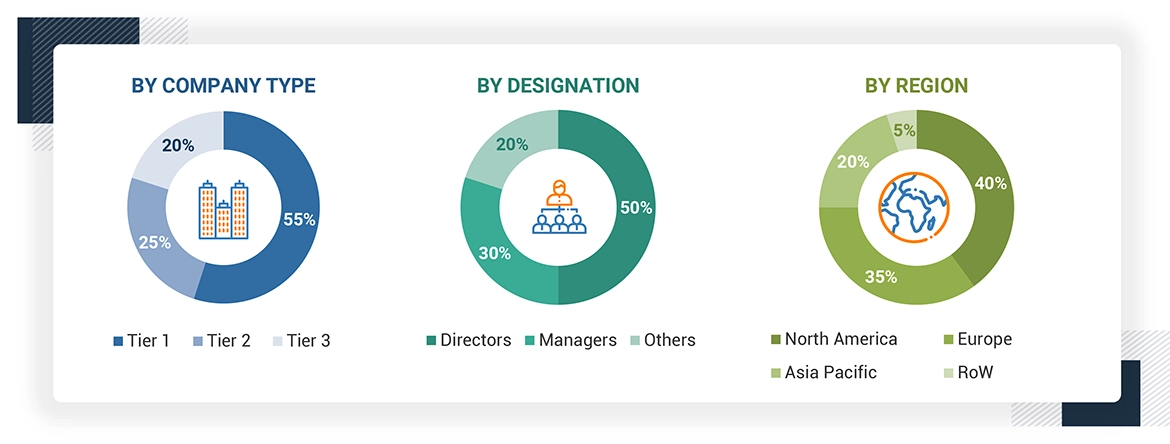
Extensive primary research has been conducted after understanding the electronic shelf lables market scenario through secondary research. Several primary interviews have been conducted with key opinion leaders from both demand- and supply-side vendors across 4 major regions— North America, Europe, Asia Pacific, and the Rest of the World. Approximately 25% of the primary interviews have been conducted with the demand-side vendors and 75% with the supply-side vendors. Primary data has been collected mainly through telephonic interviews, which consist of 80% of the total primary interviews; questionnaires and emails have also been used to collect the data.
After successful interaction with industry experts, brief sessions were conducted with highly experienced independent consultants to reinforce the findings of our primary research. This, along with the in-house subject matter experts’ opinions, has led us to the findings as described in the report. The breakdown of primary respondents is as follows:
To know about the assumptions considered for the study, download the pdf brochure
Market Size Estimation
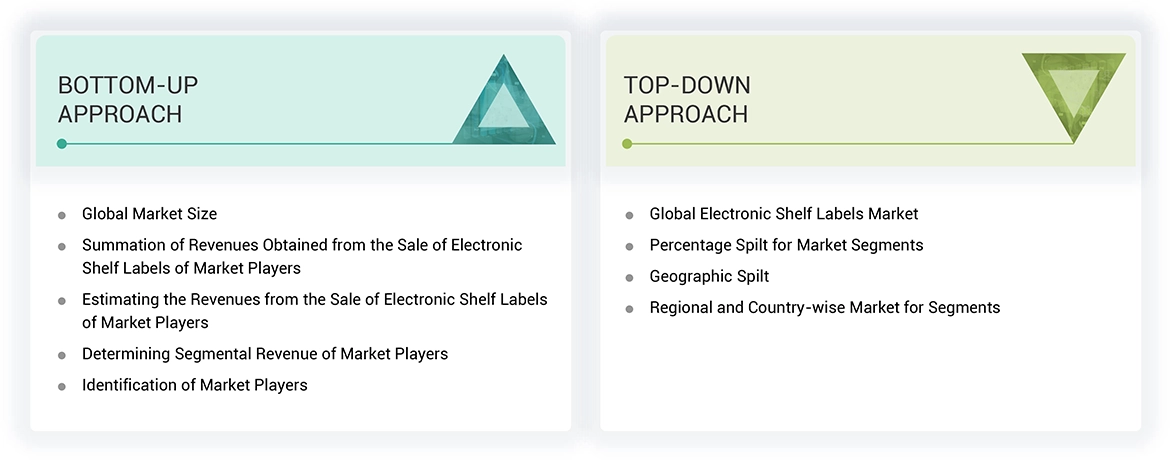
In the market engineering process, both top-down and bottom-up approaches, along with data triangulation methods, have been used to estimate and validate the size of the electronic shelf labels and other dependent submarkets. The research methodology used to estimate the market sizes includes the following:
- Identifying different stakeholders in the electronic shelf labels market that influence the entire market, along participants across the value chain.
- Analyzing major manufacturers of electronic shelf labels (OEMs) as well as studying their product portfolios
- Analyzing trends related to the adoption of electronic shelf labels based on application
- Tracking the recent and upcoming developments in the market that include investments, R&D activities, product launches, collaborations, mergers & acquisitions, and partnerships as well as forecasting the market size based on these developments and other critical parameters
- Carrying out multiple discussions with key opinion leaders to identify the adoption trends of electronic shelf labels
- Segmenting the overall market into various other market segments
- Validating the estimates at every level through discussions with key opinion leaders, such as chief executives (CXOs), directors, and operation managers, and finally with the domain experts at MarketsandMarkets
Electronic Shelf Labels Market : Top-Down and Bottom-Up Approach
Data Triangulation
After arriving at the overall market size-using the market size estimation processes as explained above-the market has been split into several segments and subsegments. To complete the entire market engineering process and arrive at the exact statistics of each market segment and subsegment, data triangulation and market breakdown procedures have been employed, wherever applicable. The data has been triangulated by studying various factors and trends from the demand and supply sides in the electronic shelf lables market.
Market Definition
Electronic Shelf Labels (ESLs) are digital price tags that replace traditional paper labels in retail environments. They are fixed on the shelves and it is possible to post different information on them as price for products, motives for a sale, quantity in stock, and barcode numbers. The core of ESLs is based on e-paper technology, which facilitates proper information illumination and does not require additional external light sources. They provide instant information using wireless technologies whereby retailers can change prices, promotional campaigns and stock details of the whole store from one location. That minimizes the amount of handling required, increases the accuracy of the prices charged, and optimizes the processing functionality. Also, ESLs play a role in helping the sustainability causes through elimination of papers helps to cut paper usage and hence be more environmentally friendly as compared to paper based tag.
Key Stakeholders
- Original equipment manufacturers (OEMs)
- Raw material suppliers
- System integrators
- Product assembly and packaging vendors
- Electronic shelf label software solution providers
- Distributors
- Research organizations
- Market research and consulting firms
- End Users
Report Objectives
- To define, describe, segment, and forecast the electronic shelf lables market, by component, product type, communication technology, display size, end-user in terms of value
- To forecast the market for display sizes, in terms of volume
- To describe and forecast the market for various segments, with respect to four main regions: North America, Europe, Asia Pacific, RoW along with their respective countries, in terms of value
- To provide detailed information regarding the drivers, restraints, opportunities, and challenges influencing the growth of the electronic shelf lables market
- To provide a detailed overview of the electronic shelf labels market’s supply chain, along with the ecosystem, technology trends, use cases, regulatory environment, and Porter’s five forces analysis
- To analyze industry trends, pricing data, patents and innovations, and trade data (export and import data) related to the electronic shelf labels
- To strategically analyze the micromarkets with respect to individual growth trends, prospects, and contributions to the total market
- To strategically profile the key players and comprehensively analyze their market shares and core competencies
- To analyze opportunities for stakeholders and provide a detailed competitive landscape of the market
- To analyze competitive developments, such as product launches/developments, collaborations, partnerships, acquisitions, and research & development (R&D) activities carried out by players in the electronic shelf lables market
Available Customizations
With the given market data, MarketsandMarkets offers customizations according to the specific requirements of companies. The following customization options are available for the report:
- Detailed analysis and profiling of additional market players (up to 5)
Get the Full Electronic Shelf Labels Market Report
Full forecast, segment splits, and company analysis for all Electronic Shelf Labels Market.
- US Electronic Shelf Labels Market
- Canada Electronic Shelf Labels Market
- Mexico Electronic Shelf Labels Market
- Germany Electronic Shelf Labels Market
- UK Electronic Shelf Labels Market
- France Electronic Shelf Labels Market
- Italy Electronic Shelf Labels Market
- Rest Of Europe Electronic Shelf Labels Market
- China Electronic Shelf Labels Market
- Japan Electronic Shelf Labels Market
- Taiwan Electronic Shelf Labels Market
- Rest Of Asia Pacific Electronic Shelf Labels Market
- GCC Countries Electronic Shelf Labels Market
Need a Tailored Report?
Customize this report to your needs
Get 10% FREE Customization
Customize This Report
