
France Electronic Toll Collection Market (2026-2031)

The France Electronic Toll Collection Market was valued at $413.1 Million in 2026 and projected to reach to $620.1 Million by 2031, representing a compound annual growth rate of 7.0%. France's electronic toll collection market is positioned for sustained growth through 2031, supported by ongoing government initiatives to modernize toll infrastructure and enhance traffic management efficiency.


| Market Size in | USD 26.32 MN |
| Market Forecast in | |
| CAGR | |
| Forecast Period | |
| Units Considered | Value (USD MN) |
France Electronic Toll Collection Market Trends and Insights
- France has established itself as a leader in toll infrastructure modernization across Europe, with extensive highway networks requiring advanced collection systems.
- The market in France is driven by government investments in smart transportation infrastructure and the need to optimize traffic flow on major routes connecting to neighboring European nations. The growth trajectory for France reflects increasing adoption of open-road tolling technologies and interoperable payment systems across the country's toll networks.
- France's commitment to reducing congestion and improving revenue collection efficiency has accelerated the deployment of electronic toll collection solutions.
- By 2031, France is expected to see continued expansion as the country integrates advanced semiconductor-based technologies and real-time monitoring capabilities into its toll infrastructure..
Key Market Statistics
- CAGR (2026-2031) 7.0% CAGR
- Market Size, 2026 ~USD 413.1 Million
- Forecast, 2031 ~USD 620.1 Million
- Country France
France Electronic Toll Collection Market Overview
Market Valuation :
France's electronic toll collection market is valued at $413.1 million in 2026 and is projected to reach $620.1 million by 2031, demonstrating strong growth potential in Western Europe's toll infrastructure sector.
Steady Growth Trajectory :
With a CAGR of 7.0% through 2031, France's market growth outpaces many European counterparts, driven by modernization of existing highway networks and adoption of advanced collection technologies across the country.
Infrastructure Leadership :
France operates one of Europe's most extensive highway networks requiring sophisticated toll collection systems. Government investment in digital infrastructure modernization continues to drive market expansion and technology upgrades.
Technology Adoption :
Increasing deployment of interoperable electronic toll systems, RFID technology, and integrated payment solutions across French toll operators reflects the market's shift toward seamless, cashless collection mechanisms.
France Electronic Toll Collection Market Dynamics
- The country's extensive highway network and commitment to digital transformation create consistent demand for advanced collection technologies.
- Investment in interoperable systems and integration with broader smart transportation initiatives will further accelerate market expansion.
- Additionally, regulatory frameworks promoting cashless transactions and environmental monitoring through toll systems present new growth opportunities for market participants in France..
Market Ecosystem
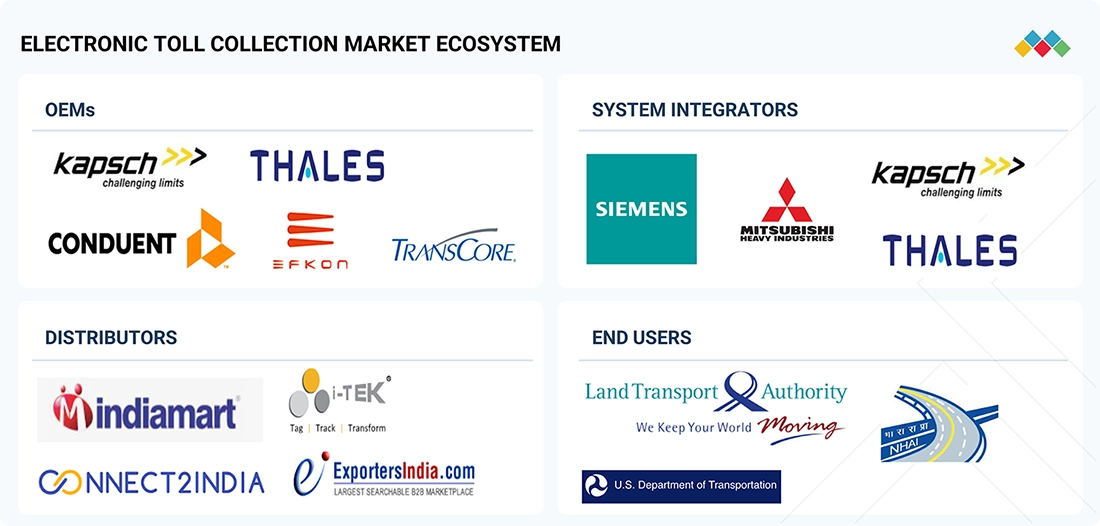
ELECTRONIC TOLL COLLECTION MARKET SIZE, SHARE & TRENDS, 2025 TO 2030: COMMERCIAL USE CASES ACROSS INDUSTRIES
| COMPANY | USE CASE DESCRIPTION | BENEFITS |
|---|---|---|
 |
Nationwide deployment of an RFID-based Electronic Toll Collection system across highways to enable automatic, cashless toll payments | Reduced congestion and wait times by over 90%, enhanced toll revenue accuracy, lower fuel consumption, and improved commuter convenience |
 |
Implementation of a hybrid ETC system combining conventional toll booths with Open Road Tolling (ORT) lanes for seamless traffic flow | 40% reduction in transaction time, 20% increase in traffic capacity, minimized congestion and emissions, and improved user experience |
 |
Integration of E-ZPass electronic toll payment and account management system for streamlined customer service | Shorter wait times, easier account handling, reduced payment discrepancies, and higher customer satisfaction |
 |
Migration to a cloud-based toll management platform with AI-enabled OCR and real-time analytics to improve operational efficiency | 40% reduction in operational costs, increased billing accuracy, 100% system uptime, and better data visibility for operators |
 |
Deployment of AI-powered ANPR toll tracking using NVIDIA GPUs for vehicle detection and fraud prevention in RFID-based tolling | 97% accuracy in vehicle recognition, improved toll enforcement, reduced revenue leakage, and optimized traffic throughput |
Logos and trademarks shown above are the property of their respective owners. Their use here is for informational and illustrative purposes only.
Related Ecosystem
Mobility And Telecom
- Smart Utilities
- Smart Healthcare
- Sensors
- Parking Management System
- Passenger Information System (PIS)
- AT&T Inc.
- Cisco Systems, Inc.
- HUAWEI TECHNOLOGIES CO LTD
- Telefonaktiebolaget LM Ericsson (publ)
- International Business Machines Corporation
Electronics System And Components
- Sensors
- Temperature Sensors
- Pressure Sensors
- Actuators
- Image Sensors
- Lenovo
- Samsung
- Texas Instruments Incorporated
- HONEYWELL INTERNATIONAL INC.
- Teledyne Technologies Incorporated
Key Takeaways
- France's electronic toll collection market is valued at $413.1 million in 2026 and will reach $620.1 million by 2031 at a 7.0% CAGR.
- France leads European toll modernization with extensive highway networks requiring advanced semiconductor-based collection systems.
- Government investments in smart transportation and interoperable payment systems are primary growth drivers for France's market.
- France is integrating real-time monitoring and open-road tolling technologies to improve efficiency and reduce congestion by 2031.
Electronic Toll Collection Market Report Scope
| Report Metric | Details |
|---|---|
| Base Year | 2026 |
| Fastest Growing Segment | CROSS-BORDER TOLLING (Application) |
| Forecast Period | 2026–2031 |
| Growth Rate | CAGR of 8.9% from 2026 to 2031 |
| Largest Segment | HIGHWAYS/EXPRESSWAYS (Application) |
| Market Size Base Year (Billions) | ~USD 9.98 (2026) |
| Revenue Forecast (Billions) | ~USD 15.29 (2031) |
| Segments Covered | Tolling Architecture, Technology, Offering, Type, Application |
France Electronic Toll Collection Market Report Segmentation
5 segment dimensions are covered across the global market.
By Tolling Architecture
- Barrier-Based Etc
- Hybrid Systems
- Open Road Tolling (Ort)
By Technology
- Dsrc
- Gnss/Gps
- Other Technologies
- Rfid
By Offering
- Hardware
- Services
- Software
By Type
- Analytics & Monitoring
- Anpr Cameras
- Consulting
- Integration & Deployment
- Interoperability Platforms
- Maintenance & Support
- Managed Services
- Revenue Management
- Rfid/Dsrc Readers
- Roadside Infrastructure
- Sensors & Controllers
- Toll Management
- Transaction Processing
- Transponders/Obus
- Violation Enforcement
By Application
- Bridges & Tunnels
- Cross-Border Tolling
- Highways/Expressways
- Urban Congestion Charging
FRANCE: ELECTRONIC TOLL COLLECTION MARKET, BY APPLICATION, 2026–2032
| Segment | 2026 | 2027 | 2028 | 2029 | 2030 | 2031 | 2032 | CAGR (%) |
|---|---|---|---|---|---|---|---|---|
| BRIDGES & TUNNELS | 114 | 120 | 127 | 135 | 144.3 | 153.3 | 167.4 | 6.6 |
| CROSS-BORDER TOLLING | 24.8 | 27.5 | 30.1 | 33.1 | 36.6 | 40.7 | 46.5 | 11.1 |
| HIGHWAYS/EXPRESSWAYS | 229.7 | 240.9 | 253.9 | 269 | 286.5 | 302.6 | 328.7 | 6.2 |
| URBAN CONGESTION CHARGING | 44.6 | 48 | 52.4 | 57.4 | 63.1 | 69 | 77.5 | 9.6 |
| TOTAL | 413.1 | 436.4 | 463.4 | 494.6 | 530.6 | 565.6 | 620.1 | 7 |
Target Audience
- Toll Operators & Infrastructure Companies : French and European toll operators need detailed market data to plan technology upgrades, evaluate modernization investments, and understand growth opportunities within France's highway toll network.
- Technology & Software Providers : Electronic toll collection system vendors require France-specific market insights to identify customer segments, assess demand for interoperable solutions, and develop localized product strategies.
- Investment & Private Equity Firms : Investors evaluating opportunities in French transportation infrastructure need comprehensive market sizing and growth forecasts to assess returns and identify acquisition or partnership targets.
- Government & Policy Makers : French transportation authorities and government agencies use market data to inform infrastructure investment decisions, regulatory frameworks, and digital transformation initiatives for toll systems.
- Consulting & Strategy Firms : Management consultants advising clients on French toll market entry, expansion, or optimization require detailed market intelligence and competitive analysis specific to the country's landscape.
Key Companies in the France Electronic Toll Collection Market
| Company | HQ | Ownership | Strongest segments |
|---|---|---|---|
| YOKOWO | Japan | Public Company | Automotive antennas and vehicle communication,Connectors and test tools (electronic, microwave, FPC/FCC),Advanced devices (LTCC RF substrates, interposers, LED packages), |
| SENER | Spain | Private Company | Space equipment and subsystems,Defence systems and engineering,Aeronautics structures and systems, |
| LENOVO | China | Public Company | Small form factor PCs and embedded signage controllers,Thin clients and dedicated media players,Tablets and smart devices used as kiosks/PoS displays, |
| KAPSCH TRAFFICCOM AG | Austria | Public Company | Tolling systems and services,Traffic management systems and platforms,Components and related services, |
| CONDUENT INCORPORATED | United States | Public Company | Commercial (CX, BPaaS, healthcare and human capital solutions),Government (public assistance, healthcare, payments, eligibility),Transportation (tolling, road-usage, transit, digital payments), |
| ST ENGINEERING (TRANSCORE) | Singapore | ||
| THALES | France | Public Company | Defence & Security Systems (air, land, naval, C4ISR, EW),Aerospace & Space (avionics, ATM, satcom, payloads),Digital Identity & Security (banking, IAM, biometrics, secure IoT), |
| SIEMENS | Germany | Public Company | Digital Industries (automation, PLM, simulation, drives),Smart Infrastructure (grid, building, electrification),Mobility (rail systems, automation, services), |
| Q-FREE | Norway | Private Company | Tolling and congestion charging platforms,Traffic signal control hardware and controllers,Traffic management and corridor software (MaxTimer, Kinetic Mobility, Kinetic Corridors), |
| CUBIC CORPORATION | United States | Private Company | Transit fare collection and revenue management,Transit real-time information and operations platforms,Defense C4ISR solutions, |
| TOSHIBA CORPORATION, | Japan | Private Company | Energy Systems & Solutions,Infrastructure Systems & Solutions,Building Solutions, |
| MITSUBISHI HEAVY INDUSTRIES, LTD. | Japan | Public Company | Thermal power generation (gas turbine combined cycle, steam),Nuclear power systems and post-operational services,Air-conditioning, refrigeration, industrial AC and heat pumps, |
| QUARTERHILL INC. | Canada | Public Company | Tolling systems and back office (congestion charging, interoperability, mobility marketplace),Safety, enforcement, and compliance (WIM, e-screening, violation enforcement, roadside),Mobility data, analytics, and BI (performance measurement, insights, multi-modal data), |
YOKOWO
YOKOWO is a Japanese public company founded in 1922 with 7,624 employees, specializing in electronic components and connectors.
SENER
SENER is a Spanish private company established in 1956 with 5,558 employees, operating in engineering and technology sectors.
LENOVO
Lenovo is a Chinese public company founded in 1984, a global leader in personal computers and information technology solutions.
KAPSCH TRAFFICCOM AG
Kapsch TrafficCom AG is an Austrian public company founded in 1892 with 3,041 employees, providing intelligent transportation systems and traffic management solutions.
CONDUENT INCORPORATED
Conduent Incorporated is a United States public company founded in 2016 with 48,000 employees, offering business process services and digital transformation solutions.
ST ENGINEERING (TRANSCORE)
ST Engineering (TransCore) is a Singapore-based company providing intelligent transportation systems and tolling solutions.
THALES
Thales is a French public company founded in 1893 with 82,111 employees, specializing in aerospace, defense, and security technologies.
SIEMENS
Siemens is a German public company founded in 1847 with 310,312 employees, a global leader in electrification, automation, and digitalization.
Q-FREE
Q-Free is a Norwegian private company founded in 1984 with 369 employees, specializing in intelligent transportation systems and tolling solutions.
CUBIC CORPORATION
Cubic Corporation is a United States private company founded in 1951 with 6,100 employees, providing defense, transportation, and technology solutions.
TOSHIBA CORPORATION,
Toshiba Corporation is a Japanese private company founded in 1875 with 106,648 employees, operating in electronics, energy, and infrastructure sectors.
MITSUBISHI HEAVY INDUSTRIES, LTD.
Mitsubishi Heavy Industries, Ltd. is a Japanese public company founded in 1884 with 78,793 employees, specializing in machinery, aerospace, and energy systems.
QUARTERHILL INC.
Quarterhill Inc. is a Canadian public company founded in 1992 with 417 employees, providing intelligent transportation systems and tolling solutions.
Reasons to Buy this Report
- Market-Specific Sizing : Access precise valuation data for France's electronic toll collection market with detailed 2026-2031 forecasts, enabling accurate investment planning and resource allocation for French market entry or expansion.
- Growth Opportunity Identification : Understand France's 7% CAGR trajectory and identify high-potential segments within the country's toll infrastructure modernization initiatives, government spending patterns, and technology adoption trends.
- Competitive Landscape Intelligence : Gain insights into France-specific market dynamics, key infrastructure projects, regulatory environment, and competitive positioning of toll operators to inform strategic business decisions.
- Investment Decision Support : Leverage comprehensive France market data to evaluate investment viability, assess market maturity, and benchmark performance against European peers in the electronic toll collection sector.
- Strategic Planning Resources : Utilize France-focused market intelligence for product development, partnership strategies, and go-to-market planning tailored to the country's unique toll infrastructure requirements and regulatory framework.
Frequently asked questions
What is the current size of France's electronic toll collection market?
France's electronic toll collection market is valued at $413.1 million in 2026 and is expected to grow to $620.1 million by 2031.
What is the growth rate for electronic toll collection in France?
France's electronic toll collection market is growing at a compound annual growth rate (CAGR) of 7.0% from 2026 to 2031.
What technologies are driving France's toll collection market?
France's market is driven by open-road tolling technologies, interoperable payment systems, real-time monitoring capabilities, and advanced semiconductor-based solutions.
Why is France investing in electronic toll collection systems?
France is investing in electronic toll collection to optimize traffic flow, reduce congestion, improve revenue collection efficiency, and modernize its extensive highway infrastructure.
How much will France's toll collection market grow by 2031?
France's electronic toll collection market is projected to grow by $207.0 million, from $413.1 million in 2026 to $620.1 million in 2031.
RESEARCH METHODOLOGY
The study involved major activities to estimate the current market size of the electronic toll collection market. Extensive secondary research was conducted to collect information on the electronic toll collection ecosystem, including tolling technologies, deployment trends, regulatory frameworks, and competitive developments. The next step involved validating these findings, assumptions, and market estimates through primary research with industry participants across the value chain, including solution providers, transportation authorities, infrastructure operators, and technology experts. Different approaches, including top-down and bottom-up methodologies, were employed to estimate the overall market size. Following this, market breakdown and data triangulation procedures were applied to determine the market size of individual segments and subsegments within the electronic toll collection market.
Secondary Research
Secondary research for this study involved gathering information from various credible sources, including company annual reports, investor presentations, government transportation agencies, toll authority publications, industry associations, technical papers, and transportation journals. This process supported the understanding of the market ecosystem, supply and value chains, identification of key stakeholders, analysis of market segmentation and regional adoption patterns, and tracking of major market, infrastructure, and technology developments. The collected data was then synthesized and validated through primary research to estimate and finalize the overall market size.
Primary Research
Extensive primary research was conducted after gaining knowledge about the current scenario of the electronic toll collection market through secondary research. Several primary interviews were conducted with experts from the demand and supply sides across three major regions—North America, Asia Pacific, Europe, and the Rest of the World. This primary data was collected through questionnaires, emails, and telephonic interviews.
Breakdown of Primary Interviews
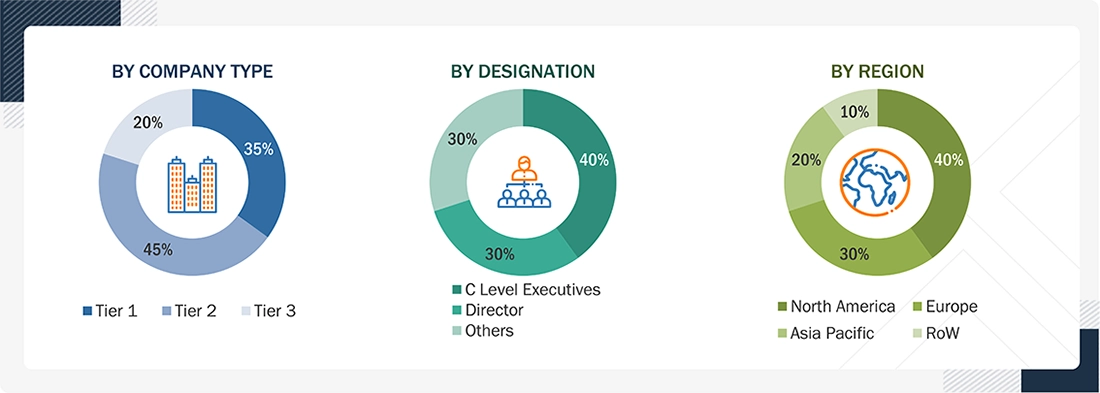
Notes: Other designations include product managers, sales managers, and marketing managers.
Tier 1 companies include market players with revenues above USD 500 million; tier 2 companies earn revenues between USD 100 million and USD 500 million; and tier 3 companies up to USD 100 million.
To know about the assumptions considered for the study, download the pdf brochure
Market Size Estimation
A bottom-up approach has been used to determine the overall size of the electronic toll collection market.
- Identifying applications wherein electronic toll collection systems are deployed or are expected to be used
- Analyzing major providers of electronic toll collections and original equipment manufacturers (OEMs), as well as studying their portfolios and understanding the different technologies used
- Analyzing the average selling price of electronic toll collection systems powered by different technologies
- Arriving at the market estimates by analyzing the revenue of companies and then combining these figures to arrive at the market size
- Studying various paid and unpaid sources, such as annual reports, press releases, white papers, and databases, to gather the required information
- Tracking the ongoing developments and identifying the upcoming developments in the market that include investments, research and development activities, product launches, contracts, collaborations, and partnerships undertaken, and forecasting the market size based on these developments
- Carrying out multiple discussions with the key opinion leaders to understand the installation of electronic toll collection systems and the sales of related raw materials and products, to analyze the break-up of the scope of work carried out by the key companies manufacturing panels.
- Verifying and cross-checking the estimate at every level through discussions with key opinion leaders, such as chief executives (CXOs), directors, and operations managers, and finally with the domain experts in MarketsandMarkets
The top-down approach has been used to estimate and validate the total size of the electronic toll collection market.
- Focusing on top-line investments and expenditures made in the ecosystems of various applications
- Calculating the market size, considering revenues from major players through the cost of electronic toll collection systems
- Estimating the percentage split of each offering & device type by application and deriving the global application market size
- Segmenting each application of the electronic toll collection system by region and deriving the global regional market size
- Estimating country-level market size by analyzing the percentage split for each region by country
- Analyzing information related to revenues generated by players through their crucial product offerings
- Conducting multiple on-field discussions with key opinion leaders involved in developing various electronic toll collection solutions
Electronic Toll Collection Market : Top-Down and Bottom-Up Approach

Data Triangulation
After arriving at the overall market size using the market size estimation processes as explained above, the market has been split into several segments and subsegments. Data triangulation and market breakdown procedures have been employed to complete the entire market engineering process and arrive at the exact statistics of each market segment and subsegment. The data has been triangulated by studying various factors and trends from the demand and supply sides in the electronic toll collection market.
Market Definition
After arriving at the overall market size using the market size estimation processes as explained above, the market has been split into several segments and subsegments. Data triangulation and market breakdown procedures have been employed to complete the entire market engineering process and arrive at the exact statistics of each market segment and subsegment. The data has been triangulated by studying various factors and trends from the demand and supply sides in the electronic toll collection market.
Key Stakeholders
- Original device manufacturers (ODMs)
- System integrators
- Software providers
- Raw material and manufacturing equipment suppliers
- Electronic toll collection system manufacturers
- Government departments such as municipal corporations, transport agencies, highway authorities, and road construction corporations
- Research organizations
- Technology standards organizations, forums, alliances, and associations
- End users
- Technical universities
- Government/private research institutes
- Market research and consulting firms
Report Objectives
- To define, analyze, and forecast the electronic toll collection market, by technology, offering, tolling architecture, and application, in terms of value
- To define, analyze, and forecast the electronic toll collection market, by RFID tags, in terms of volume
- To forecast the market size for various segments with respect to four main regions, namely, North America, Europe, Asia Pacific, and Rest of the World
- To provide detailed information regarding the major drivers, restraints, opportunities, and challenges influencing the growth of the electronic toll collection market
- To study the complete value chain and related industry segments for the electronic toll collection market
- To strategically analyze the micromarkets1 with respect to individual growth trends, prospects, and contributions to the total market
- To analyze the value chain; market ecosystem; trends/disruptions impacting customer’s business; technology analysis; pricing analysis; Porter’s Five Forces analysis; key stakeholders & buying criteria; impact of Gen AI/AI; case study analysis; Impact of US Tariff, trade analysis; patent analysis; key conferences & events, 2026–2027; regulations; macroeconomic outlook analysis, and investment and funding scenario
- To analyze opportunities in the market for various stakeholders by identifying the high-growth segments of the market
- To strategically profile key players and comprehensively analyze their market position in terms of ranking, core competencies, company valuation and financial metrics, and product/brand comparison, along with detailing the competitive landscape for the market leaders
- To analyze competitive developments, such as product launches, product developments, partnerships, collaborations, acquisitions, joint investments, agreements, contracts, acquisitions, expansions, and research & development (R&D) activities, carried out by players in the electronic toll collection market
Available customizations:
With the given market data, MarketsandMarkets offers customizations according to the company‘s specific needs. The following customization options are available for the report.
Company Information
- Detailed analysis and profiling of additional market players (up to five)
Get the Full Electronic Toll Collection Market Report
Full forecast, segment splits, and company analysis for all Electronic Toll Collection Market.
- Nordics Electronic Toll Collection Market
- Rest Of Europe Electronic Toll Collection Market
- Rest Of Asia Pacific Electronic Toll Collection Market
- GCC Countries Electronic Toll Collection Market
- Argentina Electronic Toll Collection Market
- Brazil Electronic Toll Collection Market
- Rest Of South America Electronic Toll Collection Market
- US Electronic Toll Collection Market
- Canada Electronic Toll Collection Market
- Mexico Electronic Toll Collection Market
- UK Electronic Toll Collection Market
- Germany Electronic Toll Collection Market
- Italy Electronic Toll Collection Market
- Spain Electronic Toll Collection Market
- Norway Electronic Toll Collection Market
- China Electronic Toll Collection Market
- Japan Electronic Toll Collection Market
- South Korea Electronic Toll Collection Market
- Australia Electronic Toll Collection Market
- Singapore Electronic Toll Collection Market
- India Electronic Toll Collection Market
Need a Tailored Report?
Customize this report to your needs
Get 10% FREE Customization
Customize This Report
