
Asia Pacific Environmental Remediation Market (2025-2030)

The Asia Pacific Environmental Remediation Market was valued at $39070.8 Million in 2025 and projected to reach to $64478.1 Million by 2030, representing a compound annual growth rate of 10.5%. Asia Pacific's environmental remediation market is poised for exceptional growth, driven by the region's dominance in global semiconductor manufacturing and intensifying environmental compliance requirements.


| Market Size in | USD 26.32 MN |
| Market Forecast in | |
| CAGR | |
| Forecast Period | |
| Units Considered | Value (USD MN) |
Asia Pacific Environmental Remediation Market Trends and Insights
- Asia Pacific's 10.5% compound annual growth rate significantly outpaces the global average, driven by accelerating semiconductor manufacturing expansion and stringent environmental regulations across the region.
- The region's dominance in electronics production has intensified demand for advanced remediation technologies to manage industrial contamination and comply with evolving environmental standards. Asia Pacific's environmental remediation sector is characterized by rapid industrialization and heightened regulatory scrutiny in key markets including China, South Korea, Taiwan, and Japan.
- Asia Pacific manufacturers are increasingly investing in soil and groundwater remediation solutions to address legacy contamination and prevent future environmental liabilities.
- The forecast period through 2030 reflects Asia Pacific's commitment to sustainable manufacturing practices and circular economy principles within the semiconductor and electronics supply chain..
Key Market Statistics
- CAGR (2025-2030) 10.5% CAGR
- Market Size, 2025 ~USD 39070.8 Million
- Forecast, 2030 ~USD 64478.1 Million
- Geography Asia Pacific
Asia Pacific Environmental Remediation Market Overview
Fastest Growing Regional Market :
Asia Pacific's 10.5% CAGR significantly outpaces the global average of 8.2%, positioning the region as the fastest-growing environmental remediation market for semiconductor and electronics manufacturing.
Semiconductor Manufacturing Expansion :
Accelerating semiconductor production capacity across China, Japan, South Korea, and Taiwan is driving unprecedented demand for environmental remediation services to manage manufacturing waste and emissions.
Stringent Regulatory Environment :
Increasingly strict environmental regulations across Asia Pacific nations are compelling semiconductor manufacturers to invest heavily in remediation technologies and compliance solutions.
Market Scale & Growth Trajectory :
The region's market is valued at USD 39,070.8 million in 2025 and is projected to reach USD 64,478.1 million by 2030, representing a 65% increase over the five-year forecast period.
Asia Pacific Environmental Remediation Market Dynamics
- China, Japan, and India are leading this expansion as major semiconductor hubs investing in advanced remediation infrastructure.
- The region's 10.5% CAGR reflects both the scale of manufacturing operations and regulatory pressures that mandate sophisticated environmental management solutions. Looking ahead to 2030, Asia Pacific will continue to capture significant market share as semiconductor fabs expand production capacity and adopt cleaner technologies.
- Government initiatives promoting sustainable manufacturing, combined with corporate environmental commitments, will accelerate adoption of remediation solutions.
- The market's trajectory suggests Asia Pacific will remain the primary growth engine for global environmental remediation services in the semiconductor sector..
Market Ecosystem
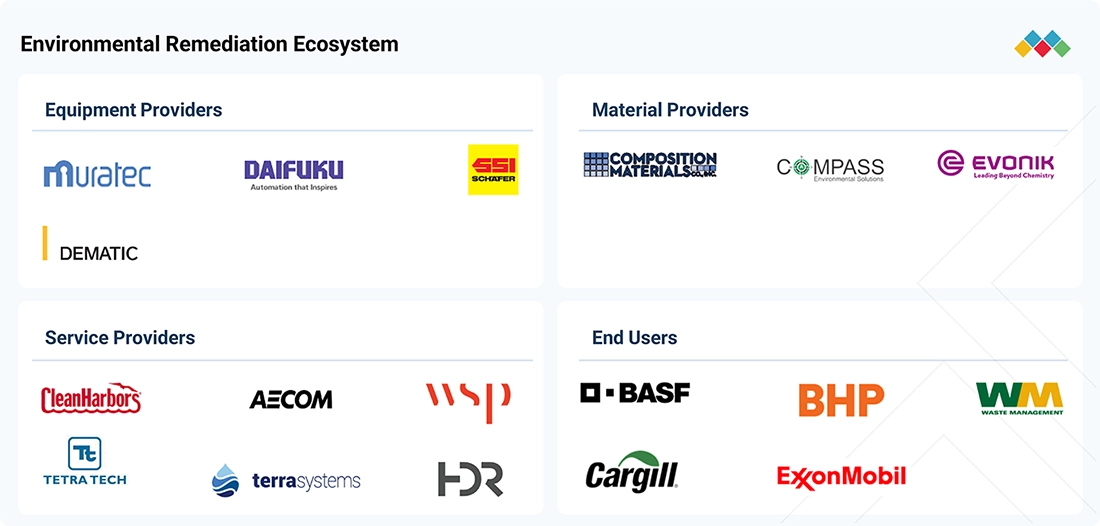
ENVIRONMENTAL REMEDIATION MARKET SIZE, SHARE, TRENDS AND GROWTH: COMMERCIAL USE CASES ACROSS INDUSTRIES
| COMPANY | USE CASE DESCRIPTION | BENEFITS |
|---|---|---|
 |
Cognition Land and Water was appointed by Homes England in May 2023 to undertake enabling works at the former Pirbright Institute site in Compton, Berkshire. The project involved demolition, environmental remediation, ground clearance, and platform construction to prepare the contaminated brownfield site for residential redevelopment. | The remediation removed environmental hazards and safely prepared the land for housing development while protecting local biodiversity. The project also supported sustainable brownfield redevelopment, reduced environmental impact, and enabled the transformation of a former research facility into a community-focused residential site. |
|
|
Cognition Land and Water conducted extensive remediation and enabling works at Lombard Square in Plumstead, transforming a heavily contaminated former motor works and munitions site. The project included soil remediation, asbestos and unexploded ordnance (UXO) removal, bioremediation, soil stabilization, basement excavation, and site infrastructure works. | The project remediated and reused more than 38,000 cubic meters of soil on site, reducing off-site disposal requirements and supporting sustainable redevelopment. The works enabled planning condition discharge and prepared the site for construction of more than 1,750 residential units. |
 |
Onterris, Inc. addressed PFAS (per- and polyfluoroalkyl substances) contamination in Katherine, Australia, linked to historical firefighting foam use at RAAF Base Tindal. The company deployed a mobile treatment system using ion exchange technology, followed by development of a permanent 10-million-liter-per-day treatment facility. | The mobile treatment system became operational within four months, providing safer drinking water to local residents. It treated more than 2.3 billion liters of contaminated water over its operating life, reducing exposure to PFAS chemicals while supporting long-term water supply resilience. |
Logos and trademarks shown above are the property of their respective owners. Their use here is for informational and illustrative purposes only.
Related Ecosystem
Testing Inspection And Certification
- Eddy Current Testing (ECT)
- Safety Testing
- Signal Generators
- Acoustic Emission Testing (AET)
- Automated Test Equipment
- Sgs s.a.
- Intertek Group plc
- TUV RHEINLAND AG
- Bureau veritas s.a.
- TUV SUD AG
Key Takeaways
- Asia Pacific environmental remediation market grows at 10.5% CAGR from 2025 to 2030, outpacing global growth rates.
- Asia Pacific market size expands from USD 39.1 billion in 2025 to USD 64.5 billion by 2030, representing 65% growth.
- Asia Pacific's semiconductor manufacturing dominance drives elevated demand for soil, groundwater, and air remediation solutions.
- Asia Pacific regulatory frameworks and ESG commitments accelerate adoption of advanced environmental remediation technologies.
Environmental Remediation Market Report Scope
| Report Metric | Details |
|---|---|
| Base Year | 2025 |
| Fastest Growing Segment | BIOREMEDIATION (Technology) |
| Forecast Period | 2025-2030 |
| Growth Rate | CAGR of 8.2% from 2025 to 2030 |
| Largest Segment | PRIVATE (Site Type) |
| Market Size Base Year (Billions) | ~USD 141.98 (2025) |
| Revenue Forecast (Billions) | ~USD 210.56 (2030) |
| Segments Covered | Environmental Medium, Technology, Site Type, Application |
Asia Pacific Environmental Remediation Market Report Segmentation
4 segment dimensions are covered across the global market.
By Environmental Medium
- Groundwater
- Soil
By Technology
- Air Sparging
- Bioremediation
- Chemical Treatment
- Electrokinetic Remediation
- Excavation
- In Situ Grouting
- In Situ Vitrification
- In-Situ Grouting
- In-Situ Vitrification
- Permeable Reactive Barriers
- Phytoremediation
- Pump And Treat
- Soil Vapor Extraction
- Soil Washing
- Thermal Treatment
By Site Type
- Private
- Public
By Application
- Agriculture
- Automotive
- Construction & Land Development
- Landfills & Waste Disposal Sites
- Manufacturing, Industrial, And Chemical Production/Processing
- Mining & Forestry
- Oil & Gas
Target Audience
- Semiconductor Manufacturers : Semiconductor fabs across Asia Pacific need this data to benchmark environmental remediation investments, understand regulatory requirements, and plan compliance strategies.
- Environmental Remediation Service Providers : Remediation companies require regional market insights to identify growth opportunities, assess competitive positioning, and develop targeted expansion strategies in Asia Pacific.
- Investment & Private Equity Firms : Investors evaluating opportunities in environmental services need Asia Pacific market data to assess growth potential, market size, and ROI in the high-growth remediation sector.
- Government & Regulatory Bodies : Policymakers and environmental agencies use market data to understand remediation industry capacity, identify compliance gaps, and develop effective environmental regulations.
- Technology & Equipment Suppliers : Suppliers of remediation technologies and equipment need regional market forecasts to prioritize product development, sales strategies, and distribution channels in Asia Pacific.
Countries within Asia Pacific - compare and drill down
| Country | 2025 size (native) |
|---|---|
| China | USD 22900.2 Million |
| Japan | USD 17452.1 Million |
| India | USD 7446.3 Million |
| Australia & New Zealand | USD 9438.3 Million |
| Rest Of Asia Pacific | USD 7241.1 Million |
Country market size visualization
Reasons to Buy this Report
- Regional Market Intelligence : Gain comprehensive insights into Asia Pacific's 10.5% CAGR growth trajectory and understand how the region outpaces global averages, enabling strategic market positioning.
- Country-Level Breakdown : Access detailed market sizing for China (USD 22.9B), Japan (USD 17.5B), India (USD 7.4B), and Australia & New Zealand, identifying high-opportunity markets within Asia Pacific.
- Regulatory & Compliance Insights : Understand stringent environmental regulations driving remediation demand across Asia Pacific semiconductor manufacturing hubs and their impact on market growth.
- Competitive Landscape Analysis : Identify key players and market dynamics specific to Asia Pacific's semiconductor remediation sector, including emerging opportunities in India and Southeast Asia.
- Investment & Expansion Strategy : Leverage 2025-2030 forecast data to make informed decisions about market entry, capacity expansion, and partnership opportunities in the fastest-growing regional market.
Frequently asked questions
What is the current size of the Asia Pacific environmental remediation market?
The Asia Pacific environmental remediation market is valued at USD 39,070.8 million in 2025 and is projected to grow to USD 64,478.1 million by 2030.
What is the growth rate for Asia Pacific environmental remediation?
Asia Pacific environmental remediation market is growing at a compound annual growth rate (CAGR) of 10.5% from 2025 to 2030.
Which countries drive Asia Pacific environmental remediation demand?
Key markets in Asia Pacific include China, South Korea, Taiwan, and Japan, where semiconductor manufacturing and regulatory compliance drive remediation investments.
What remediation types are most prevalent in Asia Pacific?
Asia Pacific demand focuses on soil remediation, groundwater treatment, and air quality management solutions for semiconductor and electronics manufacturing facilities.
How does Asia Pacific growth compare to global environmental remediation trends?
Asia Pacific's 10.5% CAGR significantly exceeds the global average of 8.2%, reflecting the region's accelerated industrialization and regulatory enforcement.
RESEARCH METHODOLOGY
The research process for this technical, market-oriented, and commercial study of the environmental remediation market involved systematically gathering, recording, and analyzing data on companies operating in the market. It relied heavily on secondary sources, directories, and databases (Factiva, OANDA) to identify and collect relevant information. In-depth interviews were conducted with various primary respondents, including experts from core and related industries and preferred manufacturers, to obtain and verify critical qualitative and quantitative information as well as to assess the growth prospects of the market. The study identified key players in the environmental remediation market through secondary research and determined their market rankings through primary and secondary research. This included studying annual reports of top players and interviewing key industry experts, such as CEOs, directors, and marketing executives.
Secondary Research
In the secondary research process, various secondary sources were used to identify and collect information relevant to this study. Secondary sources include annual reports, press releases, and investor presentations of companies; white papers, certified publications, and articles from recognized authors; directories; and databases. Secondary research mainly focused on key information on industry supply, the total pool of key players, and market segmentation by industry trends, geographic markets, and key developments from market- and technology-oriented perspectives.
Primary Research
In the primary research process, primary sources from the supply and demand sides have been interviewed to obtain qualitative and quantitative information for this report. Primary sources from the supply side include experts, such as CEOs, vice presidents, marketing directors, technology and innovation directors, subject-matter experts, consultants, and related key executives from major companies and organizations operating in the environmental remediation market.
After the complete market engineering process (market statistics calculations, market breakdown, market size estimations, market forecasting, and data triangulation), extensive primary research has been conducted to gather information and verify and validate the critical market numbers.
Several primary interviews have been conducted with experts from the demand and supply sides across four major regions—North America, Europe, Asia Pacific, and RoW. Approximately 25% of the primary interviews were conducted with the demand side and 75% with the supply side. This primary data has been collected through questionnaires, emails, and telephonic interviews.
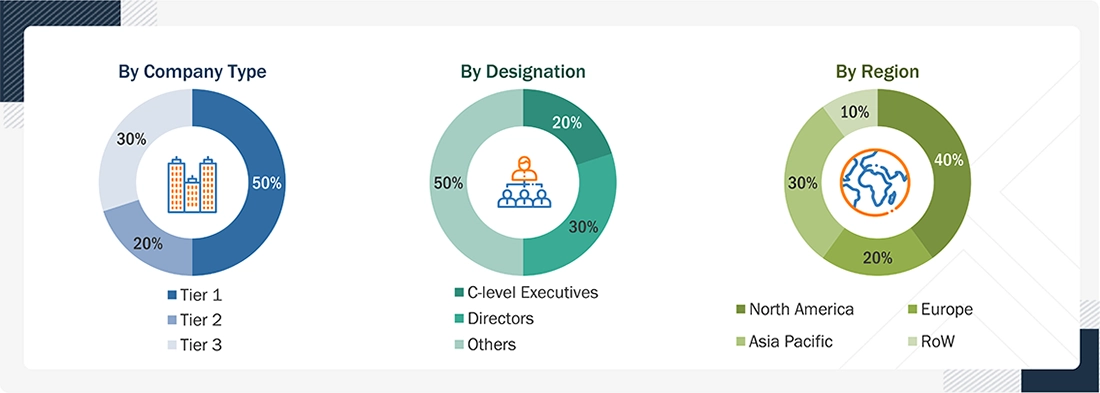
Note: Other designations include technology heads, media analysts, sales managers, marketing managers, and product managers.
The three tiers of companies are based on total revenues as of 2024: Tier 1: >USD 1 billion, Tier 2: USD 500 million–1 billion, and Tier 3: <USD 500 million.
To know about the assumptions considered for the study, download the pdf brochure
Market Size Estimation
In the complete market estimation process, the top-down and bottom-up approaches have been used, along with several data triangulation methods, to estimate and forecast the size of the market and its segments and subsegments listed in the report. Extensive qualitative and quantitative analyses were carried out across the entire market engineering process to identify key information/insights on the environmental remediation market.
Key players in the environmental remediation market were identified through secondary research, and their rankings in the respective regions were determined through primary and secondary research. This process involved reviewing the annual and financial reports of top players and interviewing industry experts, such as chief executive officers, vice presidents, directors, and marketing executives, to gather quantitative and qualitative insights. All percentage shares, splits, and breakdowns have been determined using secondary sources and verified through primary sources. All parameters that affect the markets covered in this research study have been accounted for, viewed in extensive detail, verified through primary research, and analyzed to obtain the final quantitative and qualitative data. This data has been consolidated and enhanced with detailed inputs and analysis from MarketsandMarkets and presented in this report.
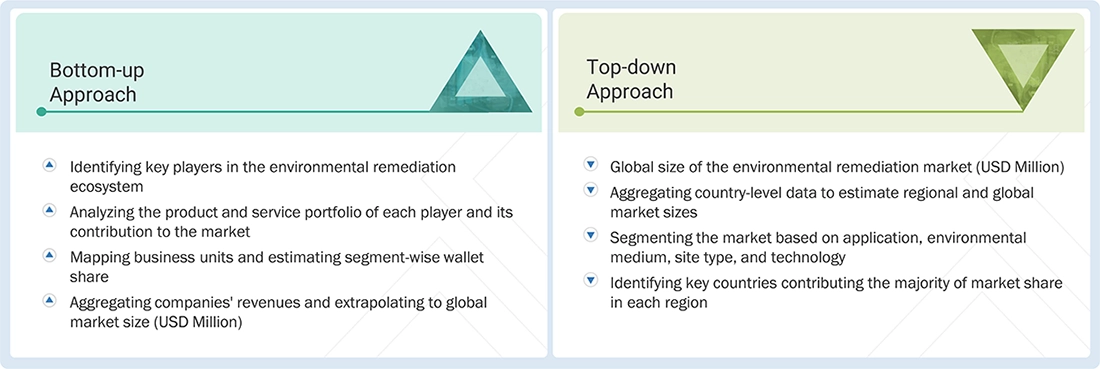
BOTTOM-UP APPROACH
- Identify key countries contributing the majority share in each region based on environmental contamination levels, active remediation projects, and government-led cleanup initiatives
- Segment the market in each country by application, environmental medium, site type, and technology
- Collect country-level data from primary and secondary sources, including government databases, project registries, company disclosures, and expert interviews
- Aggregate the country-wise estimates to derive regional market sizes
- Sum up regional values to estimate the global market size for environmental remediation (value)
- Verifying and cross-checking the estimate at every level, from discussions with key opinion leaders such as CXOs, directors, and operations managers, and finally with the domain experts at MarketsandMarkets
- Studying various paid and unpaid sources of information, such as annual reports, press releases, white papers, and databases
TOP-DOWN APPROACH
- Identifying major players actively offering environmental remediation services across technologies such as excavation, bioremediation, chemical treatment, and advanced in-situ methods
- Analyzing company revenues from environmental services and infrastructure business units through annual reports, investor briefings, and third-party databases
- Estimating the percentage contribution of environmental remediation within broader service portfolios based on disclosed segmental data, business descriptions, and market positioning
- Aggregating remediation-specific revenues of leading companies to estimate the collective market contribution at a global level
- Splitting global revenues by various segments such as region, application, technology, site type, and environmental medium, using geographic presence, project distribution, and regional revenue disclosures of each player
- Validating regional splits using indicators such as national remediation budgets, environmental cleanup contracts, and regulatory compliance levels
- Conducting interviews with industry stakeholders, including project heads, business development leads, and ESG officers, to verify company revenue contribution toward remediation
- Triangulating data using company disclosures, third-party financials, and expert insights to extrapolate global market size and growth forecasts
- Cross-verifying estimates at every level with key opinion leaders, environmental consultants, remediation engineers, and government agency experts
Data Triangulation
After arriving at the overall market size, the market was split into several segments and subsegments using the market size estimation processes explained above. Data triangulation and market breakdown procedures completed the market engineering process and determined the exact statistics for each market segment and subsegment. The data were triangulated by studying various factors and trends from the demand and supply sides in the environmental remediation market.
Market Definition
Environmental remediation refers to the process of removing, reducing, or neutralizing pollutants and contaminants from soil, groundwater, surface water, or sediments to restore the environment to a safe and usable state. It involves a variety of technologies and methods, such as excavation, bioremediation, chemical treatment, and pump-and-treat systems, to address contamination caused by industrial activities, waste disposal, oil spills, and other sources. The goal is to protect human health, support ecological recovery, and enable safe land and water use for future development.
Key Stakeholders
- Heavy equipment manufacturers and providers
- Chemical solution providers
- Original equipment manufacturers (OEMs)
- Environmental technology and service providers
- Environmental service contractors
- Market research and consulting firms
- Associations, organizations, forums, standards, and alliances related to the environmental remediation industry
- Technology investors
- Governments and financial institutions
- Venture capitalists, private equity firms, and start-up companies
- End users
Report Objectives
- To define, describe, and forecast the environmental remediation market, in terms of value, based on environmental medium, site type, technology, application, and region
- To forecast the market size for various segments across the main regions: North America, Europe, Asia Pacific, and the Rest of the World (RoW), along with their respective country-level market size, in terms of value
- To provide industry-specific information regarding the major drivers, restraints, opportunities, and challenges influencing the growth of the environmental remediation market
- To study the complete supply chain and related industry segments for the environmental remediation market
- To identify key environmental remediation providers and analyze their product offerings in the market
- To analyze trends/disruptions impacting customer business; pricing analysis; patent analysis; trade analysis (export and import scenario); Porter's five forces analysis; macroeconomic indicators; case studies; investment and funding scenario; decision-making process; buyer stakeholders and buying evaluation criteria; adoption barriers & internal challenges; unmet needs from various industries; technology analysis; ecosystem analysis; regional regulations and compliance; impact of artificial intelligence; impact of the 2025 US tariff; and key conferences and events related to the environmental remediation market
- To analyze opportunities in the market for various stakeholders by identifying the high-growth segments of the market
- To strategically profile the key players and comprehensively analyze their market position regarding ranking, along with detailing the competitive landscape for the market leaders
- To analyze competitive developments, such as product launches, collaborations, agreements, expansion, partnerships, and research and development (R&D) activities carried out by players in the environmental remediation market
Available customizations:
With the given market data, MarketsandMarkets offers customizations according to the company’s specific needs. The following customization options are available for the report:
COMPANY INFORMATION
- Detailed analysis and profiling of additional market players (up to 7)
Get the Full Environmental Remediation Market Report
Full forecast, segment splits, and company analysis for all Environmental Remediation Market.
- US Environmental Remediation Market
- Canada Environmental Remediation Market
- Mexico Environmental Remediation Market
- Germany Environmental Remediation Market
- UK Environmental Remediation Market
- France Environmental Remediation Market
- China Environmental Remediation Market
- Japan Environmental Remediation Market
- India Environmental Remediation Market
- Rest Of Europe Environmental Remediation Market
- Rest Of Asia Pacific Environmental Remediation Market
Need a Tailored Report?
Customize this report to your needs
Get 10% FREE Customization
Customize This Report
