
Poland Environmental Testing Market (2025-2030)

The Poland Environmental Testing Market was valued at $116.4 Million in 2025 and projected to reach to $142 Million by 2030, representing a compound annual growth rate of 4.1%. Poland's environmental testing market is positioned for sustained growth as EU regulatory frameworks become increasingly stringent and domestic food producers prioritize compliance.


| Market Size in | USD 26.32 MN |
| Market Forecast in | |
| CAGR | |
| Forecast Period | |
| Units Considered | Value (USD MN) |
Poland Environmental Testing Market Trends and Insights
- This steady expansion reflects Poland's increasing regulatory compliance requirements and heightened consumer awareness regarding food safety and environmental contamination risks.
- Poland's position as a significant food producer and exporter within Europe drives demand for rigorous environmental testing protocols across production facilities and supply chains. The growth trajectory in Poland is supported by stricter EU environmental directives and Poland's commitment to food safety standards that align with European Union regulations.
- Between 2025 and 2030, Poland's market will benefit from investments in testing infrastructure, laboratory modernization, and adoption of advanced analytical technologies.
- Poland's food and beverage industry continues to prioritize environmental testing to mitigate contamination risks, ensure product quality, and maintain competitive advantage in international markets..
Key Market Statistics
- CAGR (2025-2030) 4.1% CAGR
- Market Size, 2025 ~USD 116.4 Million
- Forecast, 2030 ~USD 142 Million
- Country Poland
Poland Environmental Testing Market Overview
Market Valuation :
Poland's environmental testing market in food & beverage reached USD 116.4 million in 2025, with projected growth to USD 142.0 million by 2030, driven by stringent EU regulations and domestic food safety standards.
Regulatory Compliance Drivers :
Poland's alignment with EU food safety directives and increasing national food contamination monitoring requirements are accelerating demand for environmental testing services across the F&B sector.
Consumer Awareness Growth :
Rising Polish consumer consciousness about food safety, pesticide residues, and environmental contaminants is pushing food manufacturers to invest in comprehensive environmental testing protocols.
Steady Growth Trajectory :
With a CAGR of 4.1% through 2030, Poland's market demonstrates consistent expansion, outpacing some European peers and reflecting the country's maturing food safety infrastructure.
Poland Environmental Testing Market Dynamics
- The country's growing food export sector necessitates rigorous testing standards to maintain competitive advantage in European markets.
- Investment in laboratory infrastructure and testing capabilities is accelerating across major Polish food manufacturing hubs. The forecast period through 2030 will see expanded adoption of advanced testing methodologies, including microbial analysis and chemical residue detection.
- Polish food companies are increasingly recognizing environmental testing as a competitive differentiator rather than a compliance burden, supporting market expansion and attracting both domestic and international testing service providers to establish operations in Poland..
Market Ecosystem
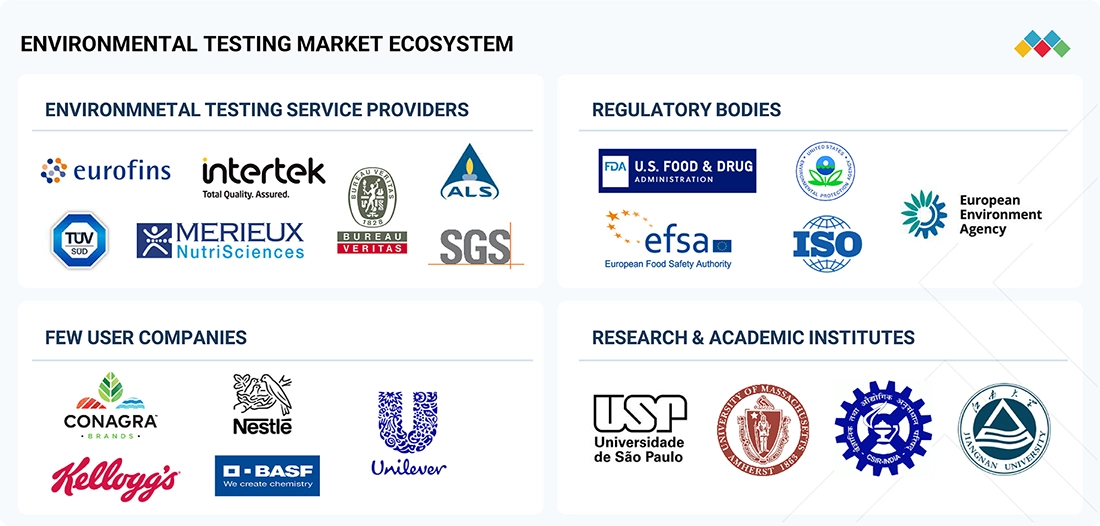
Environmental Testing Market: COMMERCIAL USE CASES ACROSS INDUSTRIES
| COMPANY | USE CASE DESCRIPTION | BENEFITS |
|---|---|---|
 |
The company performs asbestos testing for services and other contaminants testing for soil using highly sensitive Scanning Electron Microscopy (SEM), Transmission Electron Microscopy (TEM), and Polarized Light Microscopy (PLM) instruments. | Provides precise, scientifically rigorous data about soil contamination, |
 |
Provides comprehensive air quality testing services, including ambient and industrial air monitoring, using both active and passive sampling methods | This testing helps detect an ultrarace level of hazardous compounds in various air. The samples can be tested for ambient air, metals, dust fall measurement, or soil vapor. |
 |
Physical, chemical, and microbiological testing are performed for samples like drinking water, groundwater, process water, cooling tower water, wastewater, etc. | Their services help in early pollution detection, assessing treatment efficiency, and evaluating water quality for various purposes, from industrial discharge to environmental protection. |
 |
The company supports testing for various types of water, such as marine potable water quality testing, cooling water conditioning and control, microbiology services, water content testing for the petroleum industry, sea water analysis, water activity testing, and drinking water quality testing. | Precise and accurate results, regulatory expertise, and comprehensive risk management. |
Logos and trademarks shown above are the property of their respective owners. Their use here is for informational and illustrative purposes only.
Related Ecosystem
Food Safety And Tic
- Dairy Products
- Polymerase Chain Reaction (PCR)
- Campylobacter
- Enzyme-Linked Immunosorbent Assay (ELISA)
- Safety Testing
- EUROFINS SCIENTIFIC SE
- Intertek Group plc
- Sgs s.a.
- Als limited
- PROMEGA CORPORATION
Testing Inspection And Certification
- Eddy Current Testing (ECT)
- Safety Testing
- Signal Generators
- Acoustic Emission Testing (AET)
- Automated Test Equipment
- Sgs s.a.
- Intertek Group plc
- Bureau veritas s.a.
- TUV RHEINLAND AG
- TUV SUD AG
Key Takeaways
- Poland's environmental testing market is valued at USD 116.4 million in 2025 and will reach USD 142.0 million by 2030.
- Poland experiences a 4.1% CAGR, driven by EU regulatory compliance and food safety standards.
- Poland's role as a major European food producer necessitates comprehensive environmental testing across supply chains.
- Poland's market growth is supported by laboratory modernization and adoption of advanced analytical technologies through 2030.
Environmental Testing Market Report Scope
| Report Metric | Details |
|---|---|
| Base Year | 2025 |
| Fastest Growing Segment | GMOS (Targets Tested) |
| Forecast Period | 2025–2030 |
| Growth Rate | CAGR of 4.6% from 2025 to 2030 |
| Largest Segment | PATHOGENS (Targets Tested) |
| Market Size Base Year (Billions) | ~USD 7.44 (2025) |
| Revenue Forecast (Billions) | ~USD 9.32 (2030) |
| Segments Covered | Tested Material, Microbial Contamination, Organic Compound, Inorganic Compound, Sample, Targets Tested, Technology, Conventional/Traditional Method, Rapid Testing Method, End User, Industry, Rapid Testing |
Poland Environmental Testing Market Report Segmentation
12 segment dimensions are covered across the global market.
By Tested Material
- Inorganic Compounds
- Microbial Contamination
- Organic Compounds
- Residues
- Solids
By Microbial Contamination
- Bacteria
- Fungi & Molds
- Viruses
By Organic Compound
- Herbicides
- Pesticides
- Polychlorinated Biphenyls (Pcb'S)
- Polycyclic Aromatic Hydrocarbons (Pahs)
By Inorganic Compound
- Asbestos
- Heavy Metals
- Nitrates & Phosphates
By Sample
- Air
- Soil & Sediment
- Soil & Sediments
- Wastewater/Effluent
- Water
By Targets Tested
- Inorganic Compounds
- Microbial Contamination
- Organic Compounds
- Residues
- Solids
By Technology
- Conventional/Traditional Methods
- Rapid Testing
- Rapid Testing Methods
By Conventional/Traditional Method
- Biological & Chemical Oxygen Demand
- Culture Plate Method
- Dissolved Oxygen Demand
By Rapid Testing Method
- Acidity/Alkalinity Testing
- Chromatography Testing
- Immunoassay Testing
- Mass Spectrometer Testing
- Molecular Spectroscopy Testing
- Other Rapid Testing Methods
- Pcr Testing
- Turbidity Testing
By End User
- Agriculture & Irrigation Sector
- Forestry & Geology
- Government Institutes
- Healthcare Sector
- Industries
- Research And Academic Institutions
By Industry
- Automotive
- Chemicals & Petrochemicals
- Energy (Renewable And Non-Renewable)
By Rapid Testing
- Acidity/Alkalinity Testing
- Chromatography Testing
- Immunoassay Testing
- Mass Spectrometer Testing
- Molecular Spectroscopy Testing
- Pcr Testing
- Turbidity Testing
Target Audience
- Food & Beverage Manufacturers : Polish F&B producers need this data to understand compliance testing requirements, budget for environmental testing services, and benchmark their testing investments against market standards and competitor practices.
- Environmental Testing Service Providers : Testing laboratories and service companies require Poland-specific market insights to evaluate expansion opportunities, forecast revenue potential, and develop service offerings aligned with local regulatory demands.
- Regulatory & Compliance Officers : Food safety and compliance professionals in Poland need market data to justify testing investments, understand regulatory trends, and communicate the business case for enhanced environmental testing programs to leadership.
- Investment & Private Equity Firms : Investors evaluating opportunities in Poland's food safety sector require market sizing and growth forecasts to assess portfolio company potential, identify acquisition targets, and evaluate sector attractiveness.
- Government & Trade Organizations : Polish government agencies and food industry associations need this market intelligence to develop food safety policies, support industry competitiveness, and track sector growth aligned with EU standards.
Key Companies in the Poland Environmental Testing Market
| Company | HQ | Ownership | Strongest segments |
|---|---|---|---|
| AGILENT TECHNOLOGIES | United States | Public Company | Life Sciences and Diagnostics Markets,Agilent CrossLab,Applied Markets, |
| DANAHER CORPORATION | United States | Public Company | Biotechnology (bioprocessing and related solutions),Life Sciences (instruments, genomics, and analytical tools),Diagnostics (clinical instruments, consumables, software, services), |
| SGS SA | Switzerland | Public Company | Testing & Inspection – Industrial, Oil & Gas, Power,Testing & Inspection – Agriculture, Food, Mining, Commodities,Certification, Auditing, and Assessment, |
| BUREAU VERITAS | France | Public Company | Buildings & Infrastructure,Industry,Marine & Offshore, |
| EUROFINS SCIENTIFIC | Luxembourg | Public Company | Food and Feed Testing,Environment Testing,Biopharma and Clinical Diagnostics, |
| INTERTEK GROUP PLC. | United Kingdom | Public Company | Consumer Products,Corporate Assurance,Health and Safety, |
| ALS LIMITED | France | Public Company | Rolling stock (metros, regional, high-speed, locomotives, people movers/monorails),Signaling and train control (urban, mainline, freight and mining),Services (maintenance, modernization, overhaul, parts, support), |
| ASUREQUALITY | New Zealand | Private Company | Food testing and analysis,On-farm and livestock services,Meat inspection (ante- and post-mortem), |
AGILENT TECHNOLOGIES
Agilent Technologies is a publicly traded United States company founded in 1999 that employs 18,000 people. The company operates as a major provider of analytical instruments and laboratory solutions.
DANAHER CORPORATION
Danaher Corporation is a publicly traded United States company founded in 1969 that employs 59,000 people. The company operates as a diversified conglomerate with significant life sciences and diagnostics operations.
SGS SA
SGS SA is a publicly traded Swiss company founded in 1878 that employs 83,000 people. The company is a leading provider of inspection, verification, testing, and certification services globally.
BUREAU VERITAS
Bureau Veritas is a publicly traded French company founded in 1828 that employs 80,449 people. The company provides testing, inspection, and certification services across multiple sectors worldwide.
EUROFINS SCIENTIFIC
Eurofins Scientific is a publicly traded Luxembourg company founded in 1987 that employs 65,694 people. The company operates as a leading international provider of laboratory testing and analytical services.
INTERTEK GROUP PLC.
Intertek Group PLC is a publicly traded United Kingdom company founded in 1885 that employs 45,425 people. The company provides quality and safety solutions, testing, inspection, and certification services globally.
ALS LIMITED
ALS Limited is a publicly traded company founded in 1928 that employs 87,832 people. The company operates as a global provider of testing, inspection, and certification services.
ASUREQUALITY
AsureQuality is a privately held New Zealand company founded in 1998 with 1,375 employees. The company provides assurance, testing, and certification services primarily in the food and agricultural sectors.
Reasons to Buy this Report
- Poland-Specific Market Sizing : Access precise valuation data for Poland's environmental testing market with verified 2025 baseline (USD 116.4M) and 2030 forecasts, enabling accurate budget allocation and investment planning for Polish operations.
- Regulatory Landscape Intelligence : Understand Poland-specific compliance drivers including EU directive implementation timelines and domestic food safety standards that directly impact testing demand and service provider opportunities.
- Growth Opportunity Identification : Leverage Poland's 4.1% CAGR forecast to identify high-potential segments within the country's food & beverage sector and plan market entry or expansion strategies with confidence.
- Competitive Positioning : Benchmark your Poland operations against market growth trends and identify gaps in testing service coverage across Polish food manufacturing regions and export-focused producers.
- Strategic Decision Support : Make informed decisions on laboratory investments, service expansion, and partnership development in Poland based on comprehensive market data and consumer awareness trends specific to the country.
Frequently asked questions
What is the current size of Poland's environmental testing market?
Poland's environmental testing market in the food and beverage sector is valued at USD 116.4 million in 2025.
What is the projected market size for Poland by 2030?
Poland's environmental testing market is projected to reach USD 142.0 million by 2030.
What is the CAGR for Poland's environmental testing market?
Poland's environmental testing market is expected to grow at a compound annual growth rate of 4.1% between 2025 and 2030.
What factors are driving growth in Poland's environmental testing market?
Growth in Poland is driven by stricter EU environmental directives, food safety compliance requirements, laboratory modernization, and Poland's position as a major European food producer and exporter.
How does Poland's market compare to global trends?
Poland's 4.1% CAGR is slightly below the global average of 4.6%, reflecting regional market maturity and established regulatory frameworks within the European Union.
RESEARCH METHODOLOGY
The study involved two major approaches in estimating the current size of the environment testing market. Exhaustive secondary research was done to collect information on the market, peer, and parent markets. The next step was to validate these findings, assumptions, and sizing with industry experts across the value chain through primary research. Both top-down and bottom-up approaches were employed to estimate the complete market size. After that, market breakdown and data triangulation were used to estimate the market size of segments and subsegments.
Secondary Research
This research study involved the extensive use of secondary sources—directories and databases such as Bloomberg Businessweek and Factiva—to identify and collect information useful for a technical, market-oriented, and commercial study of the market.
In the secondary research process, various sources such as annual reports, press releases & investor presentations of companies, white papers, food journals, certified publications, articles from recognized authors, directories, and databases were referred to identify and collect information.
Secondary research was mainly used to obtain key information about the industry’s supply chain, the total pool of key players, and market classification and segmentation as per the industry trends to the bottom-most level, regional markets, and key developments from both market- and technology-oriented perspectives.
Primary Research
Extensive primary research was conducted after obtaining information regarding the environmental testing market scenario through secondary research. Several primary interviews were conducted with market experts from both the demand and supply sides across major countries of North America, Europe, Asia Pacific, South America, and the Rest of the World. Primary data was collected through questionnaires, emails, and telephonic interviews. The primary sources from the supply side included various industry experts, such as Chief X Officers (CXOs), Vice Presidents (VPs), Directors from business development, marketing, research, and development teams, and related key executives from distributors and key opinion leaders. Primary interviews were conducted to gather insights such as market statistics, data on revenue collected from the products and services, market breakdowns, market size estimations, market forecasting, and data triangulation. Primary research also helped in understanding the various trends related to environmental testing samples, tested material, technology, end-users and region. Stakeholders from the demand side, such as food associations, dealers, distributors, and government agencies, were interviewed to understand the demand side perspective on the suppliers, products, and their current usage of environmental testing and the outlook of their business, which will affect the overall market.
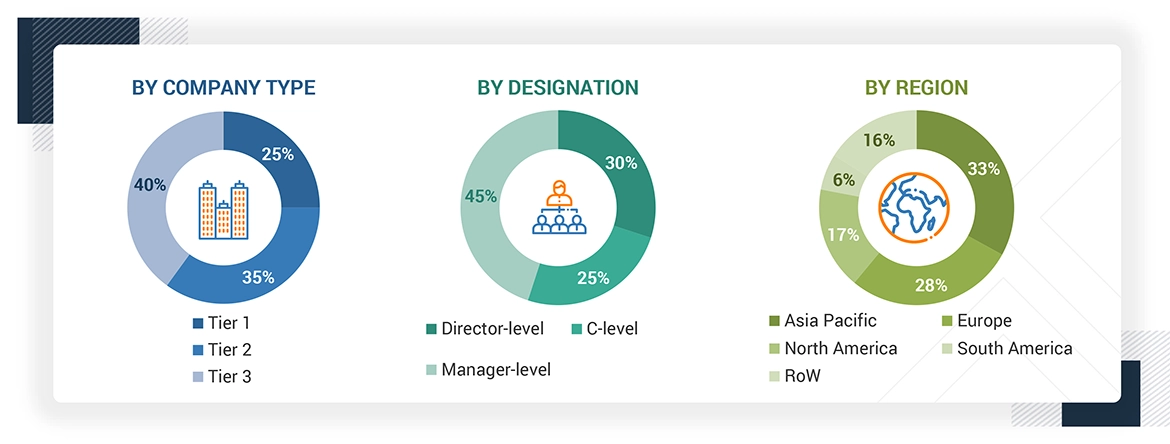
Note: The three tiers of the companies are defined based on their total revenues in 2022 or 2023, as per
the availability of financial data: Tier 1: Revenue > USD 1 billion; Tier 2: USD 100 million = Revenue = USD
1 billion; Tier 3: Revenue USD 100 million.
To know about the assumptions considered for the study, download the pdf brochure
|
COMPANY NAME |
DESIGNATION |
|
SGS SA (Switzerland) |
Regional Sales Manager |
|
Eurofins Scientific (Luxembourg) |
Senior Vice President |
|
TUV SUD (Germany) |
General Manager |
|
Intertek Group Plc (UK) |
Director of Business Development |
|
Bureau Veritas (France) |
Product Specialist |
Market Size Estimation
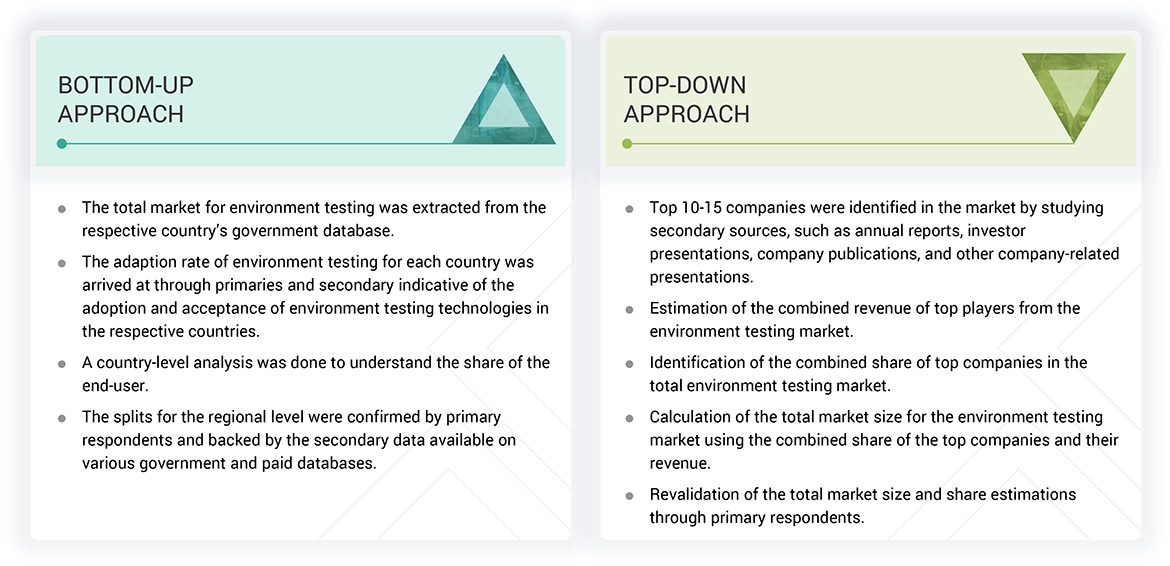
Both the top-down and bottom-up approaches were used to estimate and validate the total size of the environmental testing market. These approaches were also used extensively to determine the size of various subsegments in the market. The research methodology used to estimate the market size includes the following details:
- The key players in the industry and the overall markets were identified through extensive secondary research.
- All shares, splits, and breakdowns were determined using secondary sources and verified through primary sources.
- All possible parameters that affect the market covered in this research study were accounted for, viewed in extensive detail, verified through primary research, and analyzed to obtain final quantitative and qualitative data.
- The research included the study of reports, reviews, and newsletters of top market players, along with extensive interviews for opinions from leaders, such as CXOs, directors, and marketing executives.
Environmental Testing Market : Top-Down and Bottom-Up Approach
Data Triangulation
After arriving at the overall market size from the estimation process explained above, the total market was split into several segments and subsegments. Data triangulation and market breakdown procedures were employed, wherever applicable, to estimate the overall environmental testing market and arrive at the exact statistics for all segments and subsegments. The data was triangulated by studying various factors and trends from the demand and supply sides. Along with this, the market size was validated using both the top-down and bottom-up approaches.
Market Definition
The environmental testing market is focused on analyzing and monitoring environmental factors such as air, water, soil, and waste to detect pollutants, hazardous substances, and contaminants. It plays a critical role in ensuring environmental safety, public health, and compliance with environmental regulations. The market involves testing materials like water (drinking, wastewater, and groundwater), soil, air, and industrial waste for harmful substances such as heavy metals, chemicals, pathogens, and volatile organic compounds (VOCs). The demand for environmental testing is driven by the need for strict regulatory compliance, especially from agencies like the EPA, WHO, and EEA, and growing concerns about pollution, climate change, and environmental sustainability.
Stakeholders
- Supply side: Reagent manufacturers & suppliers, diagnostic instruments and kits manufacturers/suppliers, R&D institutes and laboratories, environmental testing service providers, third-party testing & certification laboratories, associations, regulatory bodies, and other industry-related bodies, importers, exporters, & traders, end users.
- Demand side: Industries, agriculture & irrigation sector, government institutes, research and academic institutions, forestry & geology, and healthcare sector that are actively involved in the R&D phase to innovate environmental testing methods.
- Regulatory side: Concerned government authorities, commercial research & development (R&D) institutions, and other regulatory bodies.
- Associations and industry bodies such as the United States Department of Agriculture (USDA), the International Organization for Standardization (ISO), the European Food Safety Authority (EFSA), the Food Safety and Standards Authority of India (FSSAI)
Report Objectives
MARKET INTELLIGENCE
- Determining and projecting the size of the environmental testing market based on sample, tested material, technology, end users, and region from 2025 to 2030
- Identifying the attractive opportunities in the market by determining the largest and fastest-growing segments across the key regions
- Analyzing the demand-side factors based on the following:
- Impact of macro and microeconomic factors on the market
- Shifts in demand patterns across different subsegments and regions
This research report categorizes the environmental testing market based on sample, tested material, technology, end users, and region.
Available Customizations
With the given market data, MarketsandMarkets offers customizations according to company-specific scientific needs.
The following customization options are available for the report:
Product Analysis
- Product Matrix, which gives a detailed comparison of the product portfolio of each company.
Geographic Analysis as per Feasibility
With the given market data, MarketsandMarkets offers customizations according to company-specific scientific needs.
- Further breakdown of the Rest of Europe environmental testing market into key countries.
- Further breakdown of the Rest of Asia Pacific environmental testing market into key countries.
- Further breakdown of the Rest of South America environmental testing market into key countries.
Company Information
- Detailed analyses and profiling of additional market players (up to five)
Get the Full Environmental Testing Market Report
Full forecast, segment splits, and company analysis for all Environmental Testing Market.
- Canada Environmental Testing Market
- Mexico Environmental Testing Market
- US Environmental Testing Market
- UK Environmental Testing Market
- Germany Environmental Testing Market
- France Environmental Testing Market
- Italy Environmental Testing Market
- Spain Environmental Testing Market
- China Environmental Testing Market
- India Environmental Testing Market
- Japan Environmental Testing Market
- South Korea Environmental Testing Market
- Brazil Environmental Testing Market
- Argentina Environmental Testing Market
- South Africa Environmental Testing Market
- Rest Of Europe Environmental Testing Market
- South America Environmental Testing Market
Need a Tailored Report?
Customize this report to your needs
Get 10% FREE Customization
Customize This Report
