
Japan Fingerprint Sensor Market (2026-2031)

The Japan Fingerprint Sensor Market was valued at $289.3 Million in 2026 and projected to reach to $345.9 Million by 2031, representing a compound annual growth rate of 3.0%. Japan's fingerprint sensor market is positioned for steady, predictable growth through 2031, expanding from USD 289.3 million in 2026 to USD 345.9 million by 2031.


| Market Size in | USD 26.32 MN |
| Market Forecast in | |
| CAGR | |
| Forecast Period | |
| Units Considered | Value (USD MN) |
Japan Fingerprint Sensor Market Trends and Insights
- Japan maintains a mature and stable market for biometric authentication technologies, driven by strong demand from consumer electronics, banking, and government sectors.
- The slower growth rate in Japan compared to global averages reflects the market's maturity and high existing penetration of fingerprint sensor technology across smartphones, payment systems, and security applications. Japan's fingerprint sensor adoption is supported by the country's advanced semiconductor manufacturing capabilities and stringent security standards across financial and public institutions.
- Between 2026 and 2031, Japan will continue to see incremental growth as manufacturers focus on enhancing sensor accuracy, reducing power consumption, and integrating multi-modal biometric solutions.
- Japan's emphasis on contactless and hygienic authentication methods, accelerated by pandemic-related trends, further supports steady market expansion through the forecast period..
Key Market Statistics
- CAGR (2026-2031) 3.0% CAGR
- Market Size, 2026 ~USD 289.3 Million
- Forecast, 2031 ~USD 345.9 Million
- Country Japan
Japan Fingerprint Sensor Market Overview
Mature Market Stability :
Japan's fingerprint sensor market demonstrates steady growth at 3.0% CAGR, reflecting a mature and well-established biometric authentication ecosystem with consistent demand across multiple sectors.
Strong Consumer Electronics Adoption :
Japanese smartphone and device manufacturers continue to integrate fingerprint sensors as standard security features, driving sustained demand from the consumer electronics sector.
Banking & Financial Security Focus :
Japan's robust banking sector prioritizes biometric authentication for secure transactions and customer verification, creating reliable demand from financial institutions and fintech companies.
Government & Public Sector Integration :
Government initiatives for digital identity verification and secure access control systems support steady adoption of fingerprint sensor technology across public sector applications in Japan.
Japan Fingerprint Sensor Market Dynamics
- The 3.0% CAGR reflects Japan's mature market characteristics, where fingerprint biometrics have achieved mainstream adoption across consumer, financial, and governmental applications.
- While growth rates lag behind global averages, Japan's market benefits from high consumer trust in biometric technology and stringent security standards. Future growth will be driven by continued integration in next-generation consumer devices, enhanced banking security protocols, and government digital transformation initiatives.
- The market's stability and predictability make it attractive for established players seeking consistent revenue streams in a technologically advanced economy with strong regulatory frameworks..
Market Ecosystem
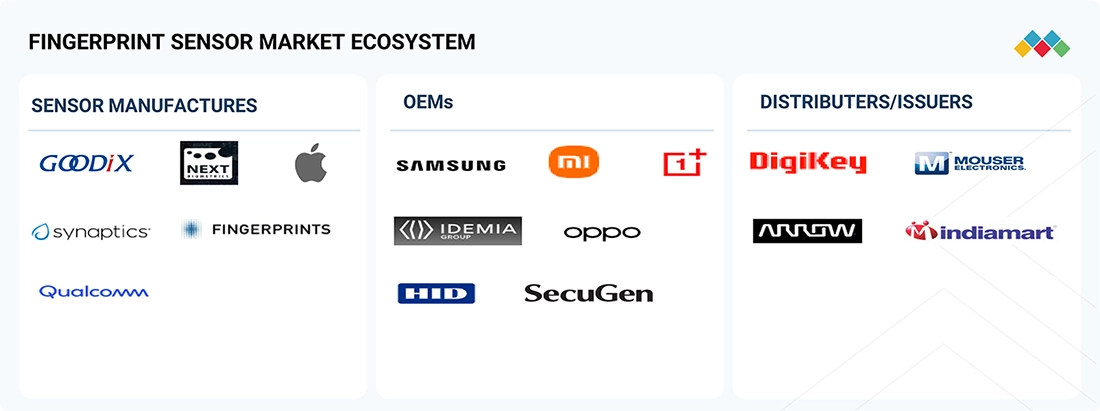
FINGERPRINT SENSOR MARKET SIZE, SHARE & GROWTH: COMMERCIAL USE CASES ACROSS INDUSTRIES
| COMPANY | USE CASE DESCRIPTION | BENEFITS |
|---|---|---|
 |
In-display optical and capacitive fingerprint sensors for smartphones, tablets, laptops, and IoT devices | Enables fast and secure biometric authentication, enhances user convenience, and supports seamless device access |
 |
Fingerprint sensing solutions for smartphones, payment cards, access control systems, and enterprise security applications | Improves identity verification, reduces fraud risks, and delivers reliable and convenient user authentication |
 |
Fingerprint sensors integrated into PCs, laptops, mobile devices, and enterprise authentication platforms | Enhances device security, supports password-free access, and improves user experience through accurate biometric recognition |
 |
Capacitive and optical fingerprint sensors for consumer electronics, payment authentication, and access control systems | Provides high-accuracy fingerprint recognition, strengthens data protection, and enables secure digital transactions |
 |
Ultrasonic fingerprint sensing solutions for premium smartphones and advanced mobile devices | Delivers superior authentication accuracy, improved spoof resistance, and secure in-display biometric verification under various operating conditions |
Logos and trademarks shown above are the property of their respective owners. Their use here is for informational and illustrative purposes only.
Related Ecosystem
Bfsi Security
- Multi-Factor Authentication
- Single-Factor Authentication
- Biometric Systems
- Fraud Analytics
- Application Integration
- International Business Machines Corporation
- Fiserv, Inc.
- ROLAND BERGER
- Oracle Corporation
- FINASTRA
Banking
- Image Sensors
- Machine Learning
- Natural Language Processing (NLP)
- Platform as A Service (PaaS)
- Predictive Analytics
- ROLAND BERGER
- Oracle Corporation
- FINASTRA
- SAP SE
- International Business Machines Corporation
Data Centre And Networking
- Software-Defined Networking (SDN)
- Mid-Sized Data Centers
- Small Data Centers
- Remote Monitoring
- Smart Healthcare
- Cisco Systems, Inc.
- HUAWEI TECHNOLOGIES CO LTD
- Hewlett Packard Enterprise Company
- MITSUBISHI ELECTRIC INFORMATION SYSTEMS CORPORATION
- MITSUBISHI ELECTRIC INFORMATION NETWORK CORPORATION
Key Takeaways
- Japan's fingerprint sensor market is valued at USD 289.3 million in 2026 and will reach USD 345.9 million by 2031 at a 3.0% CAGR.
- Japan exhibits a mature market with high existing penetration, resulting in slower growth compared to global averages of 5.7% CAGR.
- Strong demand from consumer electronics, banking, and government sectors drives steady adoption of fingerprint authentication in Japan.
- Japan's advanced semiconductor infrastructure and focus on security standards position it as a stable, innovation-driven market through 2031.
Fingerprint Sensor Market Report Scope
| Report Metric | Details |
|---|---|
| Base Year | 2026 |
| Fastest Growing Segment | COMMERCIAL (End-Use Application) |
| Forecast Period | 2026–2031 |
| Growth Rate | CAGR of 5.7% from 2026 to 2031 |
| Largest Segment | AREA & TOUCH SENSORS (Type) |
| Market Size Base Year (Billions) | ~USD 5.01 (2026) |
| Revenue Forecast (Billions) | ~USD 6.6 (2031) |
| Segments Covered | Sensor Technology, Type, Technology, End-Use Application |
Japan Fingerprint Sensor Market Report Segmentation
4 segment dimensions are covered across the global market.
By Sensor Technology
- 2D
- 3D
By Type
- Area & Touch Sensors
- Swipe Sensors
By Technology
- Capacitive
- Optical
- Thermal
- Ultrasonic
By End-Use Application
- Banking & Finance
- Commercial
- Consumer Electronics
- Government & Law Enforcement
- Healthcare
- Military, Defense & Aerospace
- Other End-Use Applications
- Smart Homes
- Travel & Immigration
Target Audience
- Semiconductor & Electronics Manufacturers : Manufacturers need Japan-specific market data to optimize product portfolios, forecast demand from Japanese OEMs, and plan production capacity for fingerprint sensor components and integrated solutions.
- Financial Services & Banking Institutions : Banks and fintech companies require market insights to evaluate biometric authentication adoption rates, competitive offerings, and technology investment opportunities for secure customer verification systems.
- Government & Public Sector Agencies : Government bodies need market intelligence to inform digital identity initiatives, procurement strategies, and technology standards for fingerprint sensor deployment in public security and administrative systems.
- Technology Investors & Private Equity : Investors seeking exposure to Japan's stable biometric market need detailed forecasts, growth drivers, and competitive dynamics to evaluate investment opportunities and portfolio positioning.
- Market Entry & Expansion Strategists : Companies planning market entry or expansion in Japan require localized market data, demand forecasts, and sector-specific insights to develop effective go-to-market strategies and competitive positioning.
Key Companies in the Japan Fingerprint Sensor Market
| Company | HQ | Ownership | Strongest segments |
|---|---|---|---|
| MORPHO SAS | Germany | Private Company | Oncology therapeutics (hematology and solid tumors),Autoimmune and inflammatory disease,Cardiometabolic and thrombosis, |
| SHENZHEN GOODIX TECHNOLOGY CO., LTD. | China | Public Company | Fingerprint sensors (ultrasonic, optical in-display, capacitive),Touch controllers, touchpad, stylus, haptic and MCU for touch keys,IoT and connectivity (BLE, NB-IoT), AIoT sensors and smart amplifiers, |
| FINGERPRINT CARDS AB | Sweden | Private Company | Mobile and consumer electronics fingerprint sensors,Biometric payment cards,Security keys and enterprise authentication, |
| SYNAPTICS INCORPORATED | United States | Public Company | PC and peripheral human interface (touch, display, fingerprint, DisplayLink docks),Mobile and consumer SoCs (touch, display, multimedia, biometrics),Connectivity (Wi-Fi, Bluetooth, BLE, Zigbee, Thread, Matter, UWB, GNSS), |
| EGIS TECHNOLOGY INC. | Taiwan | Public Company | Fingerprint sensors and mobile authentication hardware,Security software, U2F, and mobile authentication solutions,Foundation IP (standard cells, memory compilers, I/O libraries), |
| APPLE INC. | United States | Public Company | iPhone,Mac,iPad, |
| NEXT BIOMETRICS | Norway | Public Company | Fingerprint sensors and sensor modules,Fingerprint readers and touchpads,Software (face recognition, biometrics SDKs) and development kits, |
| NOVATEK MICROELECTRONICS CORP. | Taiwan | Public Company | LCD TV and desktop monitor display driver ICs,Notebook, tablet, and PC display driver ICs,Smartphone and wearable display driver ICs, |
MORPHO SAS
MORPHO SAS is a private company founded in 1992 and based in Germany with 446 employees.
SHENZHEN GOODIX TECHNOLOGY CO., LTD.
SHENZHEN GOODIX TECHNOLOGY CO., LTD. is a public company founded in 2002 and based in China with 1344 employees.
FINGERPRINT CARDS AB
FINGERPRINT CARDS AB is a private company founded in 1971 and based in Sweden with 39 employees.
SYNAPTICS INCORPORATED
SYNAPTICS INCORPORATED is a public company founded in 1986 and based in the United States with 1700 employees.
EGIS TECHNOLOGY INC.
EGIS TECHNOLOGY INC. is a public company founded in 2007 and based in Taiwan.
APPLE INC.
APPLE INC. is a public company founded in 1976 and based in the United States with 166000 employees.
NEXT BIOMETRICS
NEXT BIOMETRICS is a public company founded in 2000 and based in Norway with 24 employees.
NOVATEK MICROELECTRONICS CORP.
NOVATEK MICROELECTRONICS CORP. is a public company founded in 1997 and based in Taiwan with 2653 employees.
Reasons to Buy this Report
- Accurate Market Sizing & Forecasts : Obtain precise valuation data for Japan's fingerprint sensor market with detailed projections through 2031, enabling confident investment and resource allocation decisions in this mature segment.
- Sector-Specific Demand Insights : Understand demand drivers across Japan's consumer electronics, banking, and government sectors to identify high-potential customer segments and tailor market entry or expansion strategies.
- Competitive Landscape Analysis : Gain intelligence on market dynamics, competitive positioning, and growth opportunities specific to Japan's stable biometric authentication ecosystem to benchmark against regional and global players.
- Strategic Planning & Risk Assessment : Leverage Japan-specific market data to develop informed business strategies, assess market maturity levels, and identify emerging opportunities within a predictable 3% CAGR growth environment.
- Regulatory & Technology Compliance : Access insights into Japan's stringent security standards and regulatory requirements for fingerprint sensor deployment, ensuring compliant product development and market-ready solutions.
Frequently asked questions
What is the current size of Japan's fingerprint sensor market?
Japan's fingerprint sensor market is valued at USD 289.3 million in 2026 and is expected to grow to USD 345.9 million by 2031.
What is the growth rate of Japan's fingerprint sensor market?
Japan's fingerprint sensor market is growing at a compound annual growth rate (CAGR) of 3.0% from 2026 to 2031.
Why is Japan's fingerprint sensor market growing slower than the global average?
Japan's market is mature with high existing penetration of fingerprint sensor technology across consumer electronics, banking, and security applications, resulting in a 3.0% CAGR compared to the global 5.7% CAGR.
Which sectors drive fingerprint sensor demand in Japan?
Key sectors driving demand in Japan include consumer electronics (smartphones), banking and financial services, government security applications, and payment systems.
What factors support Japan's fingerprint sensor market growth through 2031?
Japan's advanced semiconductor manufacturing capabilities, stringent security standards, focus on contactless authentication, and integration of multi-modal biometric solutions support steady market growth through 2031.
RESEARCH METHODOLOGY
The research study involved four major activities in estimating the fingerprint sensor market size. Exhaustive secondary research has been done to collect important information about the market and peer markets. The next step has been to validate these findings and assumptions and size them with the help of primary research with industry experts across the value chain. Both top-down and bottom-up approaches have been used to estimate the market size. Post which, the market breakdown and data triangulation have been adopted to estimate the market sizes of segments and subsegments.
Secondary Research
The market size of the companies offering fingerprint sensors to various end users was arrived at based on the secondary data available through paid and unpaid sources and by analyzing the product portfolios of major companies in the ecosystem and rating the companies based on their performance and quality. In the secondary research process, various sources were referred to identify and collect information for the study. The secondary sources include annual reports, press releases, investor presentations of companies, white papers, certified publications, and articles from recognized associations and government publishing sources. Several journals and industry organizations, such as the International Biometrics + Identity Association (IBIA), FIDO Alliance, Biometrics Institute, IEEE Biometrics Council, Semiconductor Industry Association (SIA), and the International Association for Pattern Recognition (IAPR), were also referred to.
Secondary research was mainly used to obtain critical information about industry insights, the market’s monetary chain, the overall pool of key players, market classification and segmentation according to industry trends to the bottom-most level, regional markets, and key developments from both market-oriented and technology-oriented perspectives.
Primary Research
In the primary research process, various sources from the supply and demand sides were interviewed to obtain qualitative and quantitative information for the report, such as chief experience officers (CXOs), vice presidents (VPs), directors from business development, marketing, and product development/innovation teams, and related key executives from fingerprint sensor vendors, system integrators, professional and managed service providers, industry associations, independent consultants, and key opinion leaders.
Primary interviews were conducted to gather insights, such as market statistics, data on revenue collected from platforms and services, market breakups, market size estimations, market forecasts, and data triangulation. Stakeholders from the demand side, such as chief information officers (CIOs), chief finance officers (CFOs), chief strategy officers (CSOs), and the installation team of end users who use fingerprint sensors, were interviewed to understand buyers’ perspectives on suppliers, products, service providers, and their current usage of fingerprint sensors which is expected to affect the overall fingerprint sensor market growth.
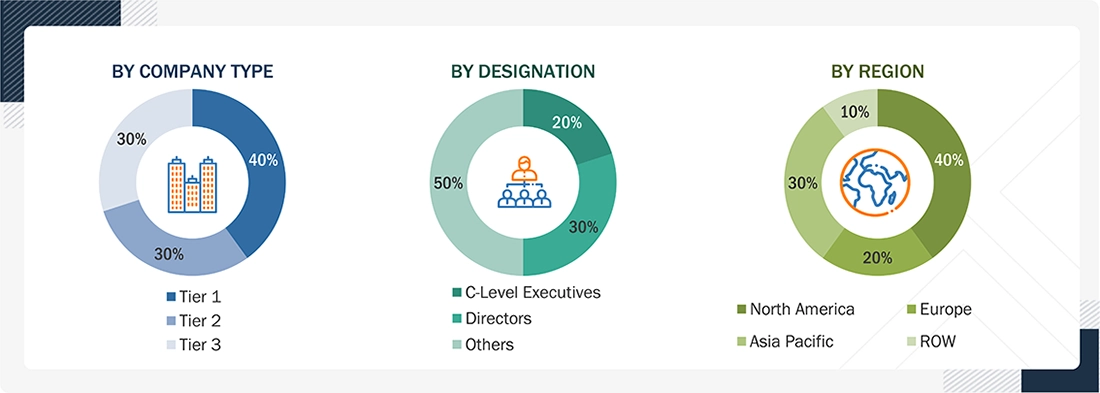
Note 1: Tier 1 companies have revenues over USD 1 billion; Tier 2 companies’ revenues range between USD 500 million and 1 billion; and Tier 3 companies have revenues of less than USD 500 million.
To know about the assumptions considered for the study, download the pdf brochure
Market Size Estimation
Multiple approaches were adopted to estimate and forecast the size of the fingerprint sensor market. The first approach involves estimating market size by summing up the revenue generated by companies through the sale of solutions.
Top-down and bottom-up approaches were used to estimate and validate the total size of the fingerprint sensor market. These methods were extensively used to estimate the size of various segments in the market. The research methodology used to evaluate the market size is listed below.
- Key players in the market have been identified through extensive secondary research.
- In terms of value, the industry’s supply chain and market size have been determined through primary and secondary research processes.
- All percentage shares, splits, and breakups have been determined using secondary sources and verified through primary sources.
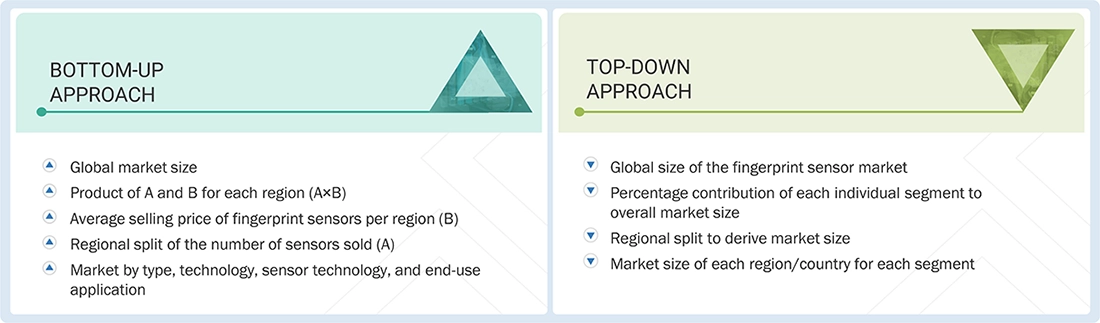
Data Triangulation
After arriving at the overall market size from the above estimation process, the fingerprint sensor market has been split into several segments and subsegments. To complete the overall market engineering process and arrive at the exact statistics for all segments and subsegments, data triangulation and market breakdown procedures have been used, wherever applicable. The data has been triangulated by studying various factors and trends from both the demand and supply sides. The fingerprint sensor market size has been validated using top-down and bottom-up approaches.
Market Definition
A fingerprint sensor is an electronic component used to capture a digital image of the fingerprint pattern of a person, i.e., the ridges and valleys (minutiae) found on the surface tips of a human finger, to identify an individual. The captured image is called a live scan, and live scans are digitally processed to create a biometric template stored and used for matching the patterns. Since every person’s fingerprint is unique and different from any other in the world, it has become an ideal and popular identification method.
Key Stakeholders
- Smartphone original equipment manufacturers (OEMs), access control system providers, fingerprint scanner providers, and Internet of Things (IoT) device manufacturers
- Sensor manufacturers
- Smartcard providers
- Integrated device manufacturers
- Research organizations and consulting companies
- Subcomponent manufacturers
- Technology providers
- Sensor chip traders and distributors
- Electronic hardware equipment manufacturers
- Research institutes and organizations
Report Objectives
- To define, describe, and forecast the fingerprint sensor market, in terms of value, by technology, sensor technology, type, end-use application, and region
- To describe and forecast the fingerprint sensor market, by end-use application, in terms of volume
- To forecast the size of the market segments for four major regions—North America, Europe, Asia Pacific, and the Rest of the World (RoW)
- To explain the different materials used in fingerprint sensors, key standards for fingerprint sensors, and various products that use fingerprint sensors
- To provide detailed information regarding the major factors influencing the growth of the market (drivers, restraints, opportunities, and challenges)
- To offer an ecosystem analysis, case study analysis, patent analysis, technology analysis, pricing analysis, Porter’s Five Forces analysis, and regulations pertaining to the market
- To give a detailed overview of the value chain of the fingerprint sensor market ecosystem
- To strategically analyze micromarkets with respect to individual growth trends, prospects, and contributions to the total market
- To strategically profile the key players and comprehensively analyze their market shares and core competencies
- To analyze the opportunities in the market for stakeholders and describe the competitive landscape of the market
- To study competitive developments such as collaborations, partnerships, product developments, and acquisitions in the market
Available customizations:
With the given market data, MarketsandMarkets offers customizations per the company’s specific needs. The following customization options are available for the report:
Company Information
- Detailed analysis and profiling of additional market players (up to 5)
Get the Full Fingerprint Sensor Market Report
Full forecast, segment splits, and company analysis for all Fingerprint Sensor Market.
- China Fingerprint Sensor Market
- India Fingerprint Sensor Market
- South Korea Fingerprint Sensor Market
- Rest Of Europe Fingerprint Sensor Market
- Rest Of Asia Pacific Fingerprint Sensor Market
- Canada Fingerprint Sensor Market
- Mexico Fingerprint Sensor Market
- US Fingerprint Sensor Market
- France Fingerprint Sensor Market
- Germany Fingerprint Sensor Market
- Italy Fingerprint Sensor Market
- UK Fingerprint Sensor Market
Need a Tailored Report?
Customize this report to your needs
Get 10% FREE Customization
Customize This Report
