
South Korea Fire-resistant Fabrics Market (2025-2030)

The South Korea Fire-resistant Fabrics Market was valued at $93.4 Million in 2025 and projected to reach to $135.7 Million by 2030, representing a compound annual growth rate of 7.76%. South Korea's fire-resistant fabrics market is poised for sustained growth through 2030, driven by stringent regulatory frameworks and industrial safety mandates.


| Market Size in | USD 26.32 MN |
| Market Forecast in | |
| CAGR | |
| Forecast Period | |
| Units Considered | Value (USD MN) |
South Korea Fire-resistant Fabrics Market Trends and Insights
- This expansion reflects South Korea's stringent safety regulations and increasing demand across industrial, automotive, and protective apparel sectors.
- South Korea's advanced manufacturing capabilities and emphasis on worker safety standards are driving adoption of high-performance fire-resistant textiles. The South Korea market is characterized by strong regulatory compliance requirements and technological innovation in fabric treatments.
- Between 2025 and 2030, South Korea is expected to see accelerated growth driven by rising industrial production, enhanced building codes, and growing consumer awareness of fire safety.
- South Korea's position as a global textile hub positions it favorably for continued market expansion in specialized fabric applications. South Korea's fire-resistant fabrics sector benefits from established chemical and material science expertise, supporting both domestic consumption and export opportunities.
- The market's 7.76% CAGR through 2030 underscores South Korea's commitment to safety standards and sustainable industrial practices..
Key Market Statistics
- CAGR (2025-2030) 7.76% CAGR
- Market Size, 2025 ~USD 93.4 Million
- Forecast, 2030 ~USD 135.7 Million
- Country South Korea
South Korea Fire-resistant Fabrics Market Overview
Regulatory Compliance Driving Growth :
South Korea's stringent occupational safety and health regulations mandate fire-resistant fabrics in industrial and manufacturing sectors, creating sustained demand and market expansion opportunities.
Advanced Manufacturing Ecosystem :
South Korea's sophisticated textile and chemical manufacturing infrastructure enables rapid innovation in fire-resistant fabric technologies, positioning the country as a regional production hub.
Automotive Sector Expansion :
Growing demand from South Korea's automotive industry for fire-resistant interior materials and protective components is a key market driver, supported by major OEM production facilities.
Worker Safety Emphasis :
Increasing corporate focus on occupational safety standards and protective apparel requirements across construction, petrochemical, and manufacturing sectors fuels consistent market growth.
South Korea Fire-resistant Fabrics Market Dynamics
- The market's 7.76% CAGR reflects strong demand from automotive manufacturers, chemical plants, and construction sectors requiring advanced protective materials.
- South Korea's competitive advantage in advanced textile manufacturing and chemical innovation positions domestic producers to capture growing regional demand. The forecast expansion from USD 93.4 million (2025) to USD 135.7 million (2030) underscores increasing investment in worker protection and industrial safety infrastructure.
- Government initiatives promoting occupational health standards and corporate sustainability commitments will continue supporting market growth.
- Strategic partnerships between textile manufacturers and chemical suppliers will accelerate product development and market penetration across key industrial verticals..
Market Ecosystem
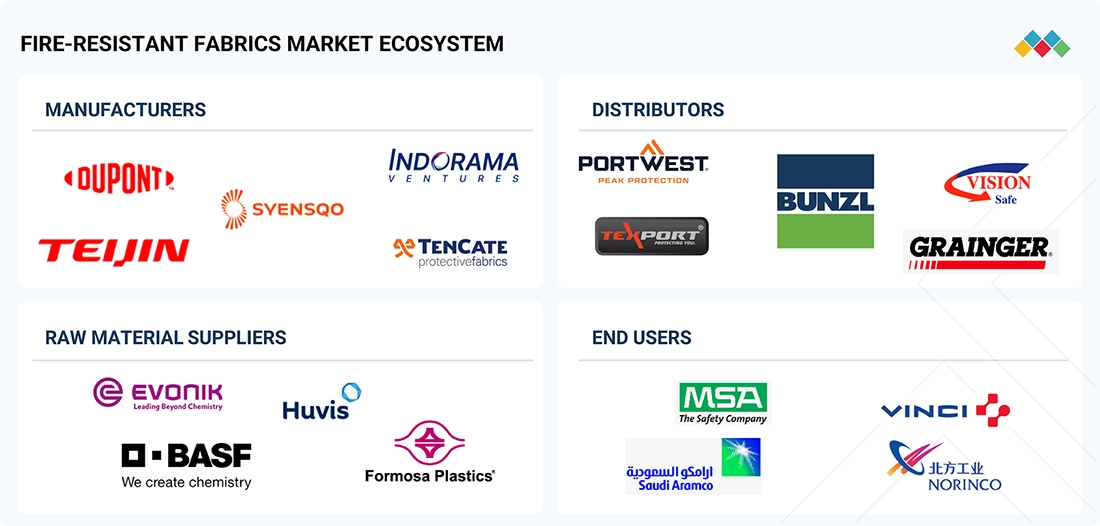
Fire-resistant Fabrics Market: COMMERCIAL USE CASES ACROSS INDUSTRIES
| COMPANY | USE CASE DESCRIPTION | BENEFITS |
|---|---|---|
 |
Inherently flame- and heat-resistant aramid fabrics for industrial FR workwear, oil and gas, transportation, and firefighter gear where protection must not wash out | Won’t melt or drip, maintains FR for life of the garment, and delivers long wear life versus FRT cotton due to superior durability and tear resistance |
 |
Westex DH and UltraSoft fabrics for arc-flash and flash-fire garments with breathability and moisture management for comfort-critical daily wear | Certified to NFPA 2112/NFPA 70E with guaranteed flame resistance for the life of the garment and proven arc-flash performance in Westex programs |
 |
Cellulosic-origin FR fibers used in multilayer firefighter, military, oil and gas, and metal industry PPE to add comfort and moisture management in blends | Layered systems with LENZING FR can reduce second/third-degree burns versus conventional garments while lowering heat stress through superior moisture transport |
 |
Meta-aramid fibers for protective clothing across high-heat environments requiring materials that resist melting and sticking with >400°C heat resistance | High flame and chemical resistance with low thermal conductivity, enabling lighter garments via high tenacity while maintaining thermal protection |
Logos and trademarks shown above are the property of their respective owners. Their use here is for informational and illustrative purposes only.
Related Ecosystem
Yarns Fabric And Textile
- Agrotech
- Clothtech
- Indutech
- Oekotech
- Packtech
- MILLIKEN & COMPANY
- Toray Industries, Inc.
- 3M COMPANY
- DuPont de Nemours, Inc.
- Kimberly-Clark Corporation
Key Takeaways
- South Korea's fire-resistant fabrics market will grow from USD 93.4M (2025) to USD 135.7M (2030) at a 7.76% CAGR.
- South Korea's stringent industrial safety regulations and building codes are primary drivers of market expansion.
- South Korea's advanced textile manufacturing infrastructure supports both domestic demand and export competitiveness.
- South Korea's market growth is fueled by increased adoption in automotive, industrial, and protective apparel applications.
Fire-resistant Fabrics Market Report Scope
| Report Metric | Details |
|---|---|
| Base Year | 2025 |
| Fastest Growing Segment | –RAILWAY (End-Use Industry) |
| Forecast Period | 2025–2030 |
| Growth Rate | CAGR of 7.24% from 2025 to 2030 |
| Largest Segment | APPAREL (Application) |
| Market Size Base Year (Billions) | ~USD 3.98 (2025) |
| Revenue Forecast (Billions) | ~USD 5.65 (2030) |
| Segments Covered | Type, Application, End-Use Industry |
South Korea Fire-resistant Fabrics Market Report Segmentation
3 segment dimensions are covered across the global market.
By Type
- Inherent
- Treated
By Application
- Apparel
- Non-Apparel
By End-Use Industry
- Defense & Public Safety Services
- Industrial
- Other End-Use Industries
- Transport
- –Aerospace
- –Automotive
- –Marine
- –Railway
- –Railways
Target Audience
- Chemical & Material Manufacturers : South Korean and international chemical companies need market-specific data to develop fire-resistant fabric formulations aligned with local regulatory standards and industrial demand.
- Textile & Apparel Producers : Domestic and foreign textile manufacturers require insights into South Korea's protective apparel market dynamics, safety standards, and growth opportunities in industrial clothing segments.
- Automotive OEMs & Suppliers : Major automotive manufacturers and component suppliers need detailed market intelligence on fire-resistant interior materials and protective component demand in South Korea's production ecosystem.
- Industrial Safety Equipment Distributors : Safety equipment distributors and occupational health providers require South Korea-specific market data to identify growth opportunities and optimize product portfolios for industrial clients.
- Investment & Strategy Consultants : Corporate strategists and investment firms need comprehensive South Korea market analysis to evaluate expansion opportunities, competitive positioning, and M&A potential in the fire-resistant fabrics sector.
Key Companies in the South Korea Fire-resistant Fabrics Market
| Company | HQ | Ownership | Strongest segments |
|---|---|---|---|
| DUPONT DE NEMOURS, INC. | United States | Public Company | Healthcare & Water Technologies,Construction Materials,Engineered Components & Specialty Materials, |
| TEIJIN LIMITED | Japan | Public Company | Aramid and High-Performance Fibers,Carbon/Glass Fiber Composites and Resins,Films and Sheets (PC, Microporous, HDPE), |
| INDORAMA VENTURES PUBLIC COMPANY LIMITED | Thailand | Public Company | Combined PET (PET, PTA, PX, recycling, specialty PET chemicals),Fibers (polyester, rayon, nylon, polypropylene, composites, wool),Indovida (packaging), |
| SYENSQO SA/NV | Belgium | Public Company | Specialty Polymers and Advanced Materials,Performance & Care Chemicals (surfactants, solvents, specialty amines),Flavors, Fragrances, and Vanillin Portfolio, |
| LENZING AG | Austria | Public Company | Lyocell fibers (TENCEL and related),Modal fibers,Viscose and LENZING ECOVERO fibers, |
| KANEKA CORPORATION | Japan | Public Company | PVC and vinyl-related polymers (PVC, crosslinked PVC, PVC-PVAc, paste PVC, chlorinated PVC),Specialty additives, engineering resins, films, and elastomers,Advanced materials for energy, electronics, and insulation, |
| GUN EI CHEMICAL INDUSTRY CO., LTD. | Japan | Public Company | Chemicals Business – Electronic materials (RESITOP photoresist, reactive polyimide, high-purity bisphenol F),Chemicals Business – Industrial materials (functional phenolic resins, kynol fibers, spherical phenolics, s-RP nano sand, Milex),Chemicals Business – Foundry systems (RESITOP shell molding, NFURAN, a-system, AR SAND), |
| BANSWARA SYNTEX LIMITED | India | Public Company | Yarn (polyester, viscose, blends, wool, acrylic),Woven and knitted fabrics (cotton, worsted, jacquard, blended),Technical and automotive fabrics, |
DUPONT DE NEMOURS, INC.
DuPont de Nemours, Inc. is a publicly traded United States-based company founded in 2015 with 15,000 employees. The company operates in the chemical and materials science industry.
TEIJIN LIMITED
Teijin Limited is a Japanese public company established in 1918 with 15,689 employees. The company is engaged in advanced fibers, composites, and specialty chemicals.
INDORAMA VENTURES PUBLIC COMPANY LIMITED
Indorama Ventures Public Company Limited is a Thailand-based public company founded in 1994 with 22,027 employees. The company operates in petrochemicals and specialty chemicals production.
SYENSQO SA/NV
Syensqo SA/NV is a Belgian public company with roots dating to 1863 and 13,000 employees. The company specializes in specialty chemicals and advanced materials.
LENZING AG
Lenzing AG is an Austrian public company founded in 1892 with 7,589 employees. The company is a leading producer of specialty fibers and cellulose-based materials.
KANEKA CORPORATION
Kaneka Corporation is a Japanese public company established in 1949 with 11,762 employees. The company operates in chemicals, plastics, and specialty materials.
GUN EI CHEMICAL INDUSTRY CO., LTD.
Gun Ei Chemical Industry Co., Ltd. is a Japanese public company founded in 1946 with 541 employees. The company produces specialty chemicals and chemical products.
BANSWARA SYNTEX LIMITED
Banswara Syntex Limited is an India-based public company founded in 1976 with 12,596 employees. The company manufactures synthetic fibers and textiles.
Reasons to Buy this Report
- Market-Specific Growth Projections : Access detailed South Korea market forecasts with 7.76% CAGR through 2030, enabling precise investment planning and resource allocation for regional expansion strategies.
- Regulatory Landscape Intelligence : Understand South Korea's unique occupational safety regulations and compliance requirements driving market demand across industrial, automotive, and protective apparel sectors.
- Competitive Positioning Analysis : Identify key South Korean manufacturers and suppliers, assess competitive dynamics, and benchmark against regional players to optimize market entry and growth strategies.
- Sector-Specific Demand Insights : Gain actionable intelligence on demand drivers across South Korea's automotive, petrochemical, construction, and manufacturing industries with quantified market opportunities.
- Strategic Partnership Opportunities : Discover collaboration potential with South Korean textile manufacturers, chemical suppliers, and industrial safety providers to accelerate product development and market penetration.
Frequently asked questions
What is the current size of South Korea's fire-resistant fabrics market?
South Korea's fire-resistant fabrics market is valued at USD 93.4 million in 2025.
What is the projected market size for South Korea by 2030?
South Korea's fire-resistant fabrics market is forecast to reach USD 135.7 million by 2030.
What is the CAGR for South Korea's fire-resistant fabrics market?
South Korea's fire-resistant fabrics market is expected to grow at a compound annual growth rate of 7.76% from 2025 to 2030.
What are the main drivers of growth in South Korea's market?
South Korea's market growth is driven by stringent safety regulations, increased industrial production, enhanced building codes, and rising demand in automotive and protective apparel sectors.
Why is South Korea a significant market for fire-resistant fabrics?
South Korea's advanced manufacturing capabilities, strong regulatory framework, and position as a global textile hub make it a significant market for fire-resistant fabrics with strong export potential.
RESEARCH METHODOLOGY
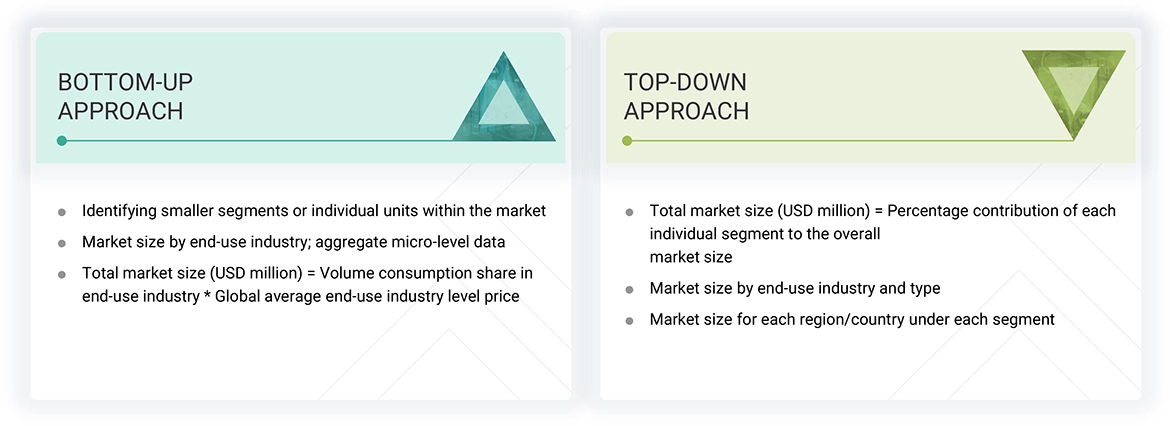
The study involved four major activities in estimating the market size for fire-resistant fabrics. Exhaustive secondary research was done to collect information on the market, the peer market, and the parent market. The next step was to validate these findings, assumptions, and sizing with industry experts across the value chain through primary research. Both top-down and bottom-up approaches were employed to estimate the complete market size. After that, the market breakdown and data triangulation procedures were used to estimate the market size of the segments and subsegments.
Secondary Research
Secondary sources used in this study included annual reports, press releases, and investor presentations of companies; white papers; certified publications; articles from recognized authors; and gold standard & silver standard websites such as Factiva, ICIS, Bloomberg, and others. The findings of this study were verified through primary research by conducting extensive interviews with key officials such as CEOs, VPs, directors, and other executives. The breakdown of the profiles of the primary interviewees is illustrated in the figure below.
Primary Research
The fire-resistant fabrics market comprises several stakeholders, such as raw material suppliers, end-product manufacturers, and regulatory organizations in the supply chain. The demand side of this market is characterized by key opinion leaders in various applications for the fire-resistant fabrics market. The supply side is characterized by advancements in technology and diverse application industries. Various primary sources from both the supply and demand sides of the market were interviewed to obtain qualitative and quantitative information.
Breakdown of Primary Participants
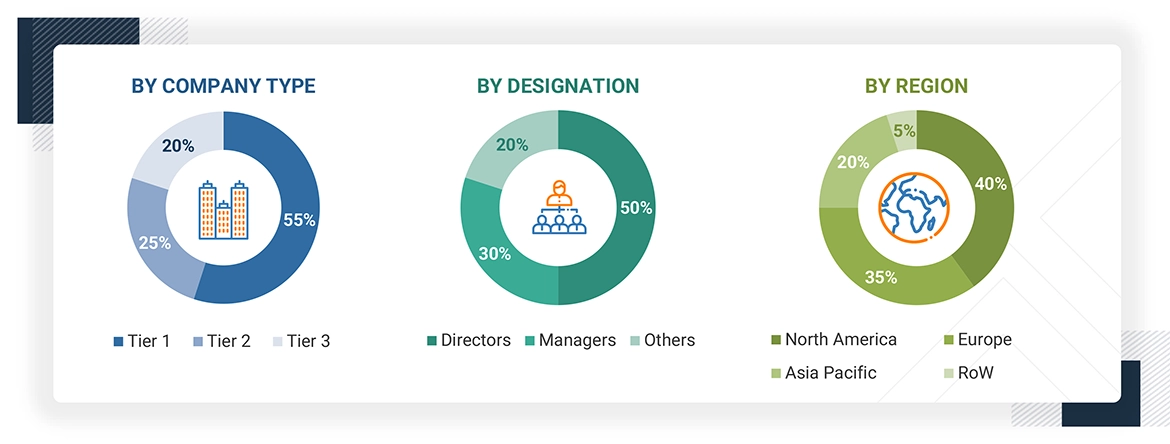
Note: Tier 1, Tier 2, and Tier 3 companies are classified based on their market revenue in 2023/2024, available in the public domain, product portfolios, and geographical presence.
Other designations include consultants and sales, marketing, and procurement managers.
To know about the assumptions considered for the study, download the pdf brochure
| COMPANY NAME | DESIGNATION | |
|---|---|---|
| DuPont de Nemours, Inc. | Senior Manager | |
| Teijin Limited | Innovation Manager | |
| Indorama Ventures Public Company Limited | Vice President | |
| Syensqo SA/NV | Production Supervisor | |
| TenCate Protective Fabrics | Sales Manager | |
Market Size Estimation
Both top-down and bottom-up approaches were used to estimate and validate the total size of the fire-resistant fabrics market. These methods were also used extensively to estimate the size of various subsegments in the market. The research methodology used to estimate the market size includes the following:
- The key players in the industry have been identified through extensive secondary research.
- The supply chain of the industry has been determined through primary and secondary research.
- All percentage shares, splits, and breakdowns have been determined using secondary sources and verified through primary sources.
- All possible parameters that affect the markets covered in this research study have been accounted for, viewed in extensive detail, verified through primary research, and analyzed to obtain the final quantitative and qualitative data.
Data Triangulation
After arriving at the overall market size—using the market size estimation processes as explained above—the market was split into several segments and subsegments. To complete the overall market engineering process and arrive at the exact statistics of each market segment and subsegment, data triangulation and market breakdown procedures were employed, wherever applicable. The data was triangulated by studying various factors and trends from both the demand and supply sides in the fire-resistant fabrics industry.
Market Definition
According to Comité International de la Rayonne et des Fibres Synthétiques (CIRFS), “Fire-resistant fabrics are materials that do not burn when exposed to fire due to their chemical structure.
Fire-resistant fabrics are used as the last-level protection barrier in case of direct exposure to fire. They do not catch fire or melt when exposed to fire. This type of fabric can have inherent fire resistance properties or be treated to make it fire resistant. Fire-resistant fabrics are also used to manufacture personal protective equipment (PPE) to safeguard personnel working in harsh, high-temperature environments.
Stakeholders
- Transfection products manufacturing companies
- Pharmaceutical & Biopharmaceutical Companies
- Chemical Companies
- Biopharmaceutical Companies
- Contract Research Organizations (CROs)
- Contract Development and Manufacturing Organizations (CDMOs)
- Research Institutes and Universities
- Venture Capitalists & Investors
- Government Associations
Report Objectives
- To define, describe, and forecast the fire-resistant fabrics market in terms of value and volume
- To provide detailed information regarding the major factors (drivers, opportunities, restraints, and challenges) influencing the market growth
- To estimate and forecast the market size by type, application, end-use industry, and region
- To forecast the size of the market with respect to five main regions (along with key countries of each region): Asia Pacific, North America, Europe, the Middle East & Africa, and South America
- To strategically analyze micromarkets with respect to individual growth trends, prospects, and their contribution to the overall market
- To analyze opportunities in the market for stakeholders and provide a competitive landscape of the market leaders
- To analyze competitive developments, such as product launches, acquisitions, partnerships, and expansions
- To strategically profile the key players and comprehensively analyze their core competencies
Get the Full Fire-resistant Fabrics Market Report
Full forecast, segment splits, and company analysis for all Fire-resistant Fabrics Market.
- China Fire-resistant Fabrics Market
- Japan Fire-resistant Fabrics Market
- India Fire-resistant Fabrics Market
- US Fire-resistant Fabrics Market
- Canada Fire-resistant Fabrics Market
- Mexico Fire-resistant Fabrics Market
- Germany Fire-resistant Fabrics Market
- France Fire-resistant Fabrics Market
- UK Fire-resistant Fabrics Market
- Italy Fire-resistant Fabrics Market
- Russia Fire-resistant Fabrics Market
- Brazil Fire-resistant Fabrics Market
- Argentina Fire-resistant Fabrics Market
- Saudi Arabia Fire-resistant Fabrics Market
- UAE Fire-resistant Fabrics Market
- Iran Fire-resistant Fabrics Market
- South America Fire-resistant Fabrics Market
- Rest Of Europe Fire-resistant Fabrics Market
Need a Tailored Report?
Customize this report to your needs
Get 10% FREE Customization
Customize This Report
