
South America Flow Meter Market (2024-2029)

The South America Flow Meter Market was valued at $651 Million in 2024 and projected to reach to $915 Million by 2029, representing a compound annual growth rate of 7.04%. South America's flow meter market is positioned for sustained expansion through 2029, with the region's growing chemical and materials industries driving demand for precision measurement solutions.


| Market Size in | USD 26.32 MN |
| Market Forecast in | |
| CAGR | |
| Forecast Period | |
| Units Considered | Value (USD MN) |
South America Flow Meter Market Trends and Insights
- South America's chemical and materials industries are driving demand for precision flow measurement solutions across oil & gas, water treatment, and industrial processing applications.
- The region's increasing investment in infrastructure modernization and regulatory compliance is accelerating adoption of advanced flow metering technologies throughout South America. South America's market expansion reflects growing industrialization and the need for operational efficiency in resource-intensive sectors.
- Between 2024 and 2029, South America is expected to maintain a compound annual growth rate of 7.04%, outpacing global trends.
- South America's emerging economies are prioritizing automation and digital transformation, creating sustained demand for flow meter innovations and integrated monitoring systems..
Key Market Statistics
- CAGR (2024-2029) 7.04% CAGR
- Market Size, 2024 ~USD 651 Million
- Forecast, 2029 ~USD 915 Million
- Geography South America
South America Flow Meter Market Overview
Strong Regional Growth Trajectory :
South America's flow meter market is expanding at 7.04% CAGR, outpacing the global average of 6.7%, driven by increased industrialization and infrastructure modernization across the region.
Brazil Leads Market Expansion :
Brazil dominates South America's flow meter market with $419.1 million in 2024, representing the largest demand base for precision measurement solutions in oil & gas, petrochemicals, and water treatment sectors.
Oil & Gas Sector Momentum :
South America's abundant hydrocarbon reserves and ongoing exploration activities fuel sustained demand for advanced flow measurement technologies in upstream, midstream, and downstream operations.
Infrastructure Investment Wave :
Regional governments' commitment to modernizing water treatment facilities, chemical processing plants, and industrial infrastructure creates significant opportunities for flow meter adoption and upgrades.
South America Flow Meter Market Dynamics
- Brazil and Argentina lead market activity, supported by investments in oil & gas infrastructure, water management systems, and industrial modernization initiatives.
- The region benefits from increasing regulatory focus on process efficiency and environmental compliance, compelling manufacturers to adopt advanced flow measurement technologies. Key growth drivers include rising energy demand, expansion of chemical processing facilities, and infrastructure development projects across major economies.
- Market players are responding with localized solutions tailored to regional industrial needs.
- Competitive dynamics favor suppliers offering cost-effective, reliable technologies suited to South America's diverse industrial applications and operational environments..
Market Ecosystem
Related Ecosystem
Equipment Machine And Tooling
- Wastewater Treatment
- Air Cooled Heat Exchangers
- Diaphragm Pumps
- Fiberglass
- HVAC System
- Alfa Laval Corporate AB
- Johnson Controls International plc
- Veolia
- Daikin Industries,Ltd.
- Carrier Global Corporation
Key Takeaways
- South America's flow meter market will grow from $651.0M (2024) to $915.0M (2029) at a 7.04% CAGR.
- South America's oil & gas and water treatment sectors are primary drivers of flow meter adoption and investment.
- South America is experiencing accelerated digital transformation and automation in industrial processes.
- South America's regulatory environment and infrastructure modernization initiatives support sustained market expansion.
Flow Meter Market Report Scope
| Report Metric | Details |
|---|---|
| Base Year | 2024 |
| Fastest Growing Segment | ULTRASONIC (Type) |
| Forecast Period | 2024-2029 |
| Growth Rate | CAGR of 6.7% from 2024 to 2029 |
| Largest Segment | MAGNETIC (Type) |
| Market Size Base Year (Billions) | ~USD 9.11 (2024) |
| Revenue Forecast (Billions) | ~USD 12.6 (2029) |
| Segments Covered | Type, End-Use Industry |
South America Flow Meter Market Report Segmentation
2 segment dimensions are covered across the global market.
By Type
- Clamp-On
- Coriolis
- Differential Pressure
- In-Line Magnetic
- Insertion
- Insertion Magnetic
- Low Flow
- Magnetic
- Positive Displacement
- Spool Piece
- Turbine
- Ultrasonic
- Vortex
By End-Use Industry
- Chemicals
- Food & Beverages
- Metals & Mining
- Metals And Mining
- Oil & Gas
- Pharmaceuticals
- Power Generation
- Pulp & Paper
- Refining & Petrochemicals
- Water & Wastewater
Target Audience
- Flow Meter Manufacturers & Suppliers : Evaluate South America's market potential, identify high-growth segments, and develop region-specific product strategies to capture expanding demand in oil & gas and industrial applications.
- Oil & Gas Operators : Understand regional flow measurement technology trends and supplier capabilities to optimize production efficiency, ensure regulatory compliance, and reduce operational costs across South American assets.
- Chemical & Materials Processors : Access market intelligence on flow meter adoption rates, technology preferences, and infrastructure investment trends to enhance process control and meet South America's evolving industrial standards.
- Infrastructure & Water Utilities : Identify flow measurement solutions aligned with South America's water treatment modernization initiatives and regulatory requirements for improved resource management and environmental compliance.
- Investment & Private Equity Firms : Assess market growth potential, competitive positioning, and acquisition opportunities in South America's flow meter sector to support portfolio company expansion and strategic investments.
Countries within South America - compare and drill down
| Country | 2025 size (native) |
|---|---|
| Brazil | USD 419.1 Million |
| Argentina | USD 277.9 Million |
| Rest Of South America | USD 218.2 Million |
Country market size visualization
Reasons to Buy this Report
- Regional Market Sizing & Forecasts : Access precise market valuations for South America ($651M in 2024) and country-level breakdowns including Brazil and Argentina, enabling targeted investment and expansion strategies.
- Competitive Landscape Analysis : Understand regional competitive dynamics, market consolidation trends, and key player positioning specific to South America's flow meter sector to inform strategic partnerships and market entry.
- Sector-Specific Growth Drivers : Identify industry-specific opportunities across oil & gas, water treatment, and chemical processing in South America, with actionable insights on infrastructure modernization trends.
- Country-Level Intelligence : Gain detailed market insights for Brazil ($419.1M) and Argentina ($277.9M), including regulatory environments, industrial capacity, and investment priorities shaping regional demand.
- Strategic Decision Support : Leverage 7.04% regional CAGR data and 2029 forecasts to validate business cases, allocate resources effectively, and prioritize market development initiatives across South America.
Frequently asked questions
What is the current size of the flow meter market in South America?
The South America flow meter market was valued at $651.0 million in 2024 and is projected to reach $915.0 million by 2029.
What is the expected growth rate for flow meters in South America?
South America's flow meter market is expected to grow at a compound annual growth rate (CAGR) of 7.04% from 2024 to 2029.
Which industries drive flow meter demand in South America?
South America's primary demand drivers include oil & gas extraction, water treatment facilities, chemical processing, and industrial manufacturing sectors.
What factors are accelerating flow meter adoption in South America?
South America's adoption is accelerated by infrastructure modernization, regulatory compliance requirements, digital transformation initiatives, and operational efficiency demands.
How does South America's growth compare to global flow meter market trends?
South America's 7.04% CAGR slightly exceeds the global average of 6.7%, reflecting stronger regional industrialization and investment momentum.
RESEARCH METHODOLOGY
The study involved four major activities in estimating the market size for flow meter market. Intensive secondary research was done to gather information on the market, the peer market, and the parent market. The next step was to validate these findings, assumptions, and sizing with industry experts across the value chain through primary research. Both top-down and bottom-up approaches were employed to estimate the complete market size. Post that, the market breakdown and data triangulation procedures were used to estimate the market size of the segments and subsegments.
Secondary Research
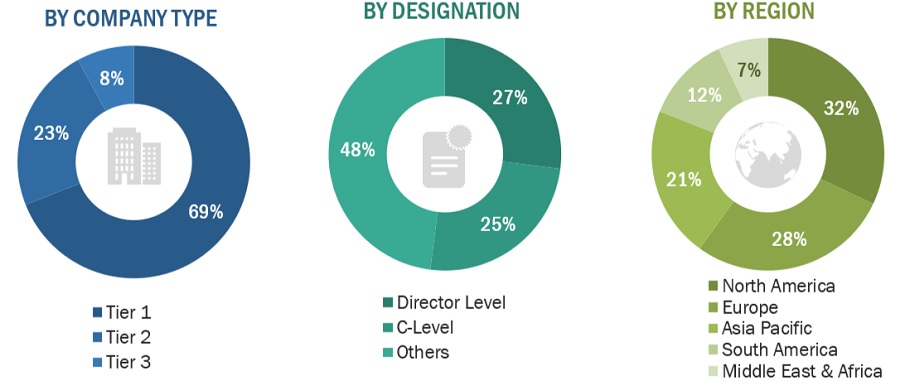
Secondary sources used in this study included annual reports, press releases, and investor presentations of companies; white papers; certified publications; articles from recognized authors; and gold standard & silver standard websites such as Factiva, ICIS, Bloomberg, and others. The findings of this study were verified through primary research by conducting extensive interviews with key officials such as CEOs, VPs, directors, and other executives. The breakdown of profiles of the primary interviewees is illustrated in the figure below:
Primary Research
The flow meter market comprises several stakeholders, such as raw material suppliers, end-product manufacturers, and regulatory organizations in the supply chain. The demand side of this market is characterized from key opinion leaders in various applications for the flow meter. The supply side is characterized by advancements in technology and diverse application industries. Various primary sources from both the supply and demand sides of the market were interviewed to obtain qualitative and quantitative information.
To know about the assumptions considered for the study, download the pdf brochure
|
COMPANY NAME |
DESIGNATION |
|
Emerson Electric Co. |
Global Strategy & Innovation Manager |
|
Siemens AG |
Technical Sales Manager |
|
ABB Ltd. |
Senior Supervisor |
|
Endress+Hauser Management AG |
Production Supervisor |
|
Badger Meter, Inc. |
Production Manager |
Market Size Estimation
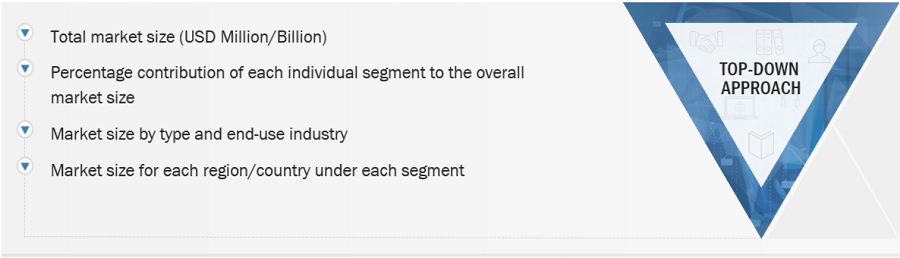
Both top-down and bottom-up approaches were used to estimate and validate the total size of the flow meter market. These methods were also used extensively to estimate the size of various subsegments in the market. The research methodology used to estimate the market size includes the following:
- The key players in the industry have been identified through extensive secondary research.
- The supply chain of the industry has been determined through primary and secondary research.
- All percentage shares, splits, and breakdowns have been determined using secondary sources and verified through primary sources.
- All possible parameters that affect the markets covered in this research study have been accounted for, viewed in extensive detail, verified through primary research, and analyzed to obtain the final quantitative and qualitative data.
Flow meter market: Bottom-Up Approach
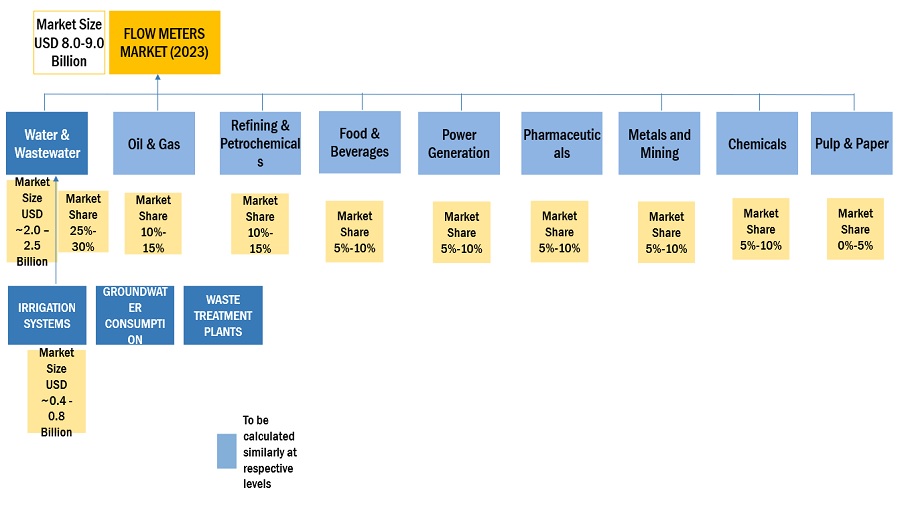
Flow meter market: Top-Down Approach
Data Triangulation
After arriving at the overall market size—using the market size estimation processes as explained above—the market was split into respective segments and subsegments. To realize the overall market engineering process and arrive at the exact statistics of each market segment and subsegment, the data triangulation, and market breakdown procedures were employed, wherever applicable. The data was triangulated by studying several factors and trends from both the demand and supply sides in the flow meter industry.
Market Definition
According to OMEGA Engineering Inc., a flow meter (or flow meter) is an instrument used to measure linear, nonlinear, volumetric, or mass flow rate of a liquid or a gas. Flow meters are used for the quantification of liquid and gas flowing through a pipe or system. The flow of liquid and gas can be measured by volumetric or mass flow rates.
Key Stakeholders
- Flow meter manufacturers
- Raw material manufacturers
- Government planning commissions and research organizations
- Industry associations
- End-use industries
- R&D institutions
Report Objectives
- To analyze and forecast the size of the flow meter market in terms of value
- To provide detailed information regarding key factors, such as drivers, restraints, challenges, and opportunities influencing the growth of the market
- To define, describe, and segment the flow meter market based on type and end-use industry
- To forecast the size of the market segments for regions such as Asia Pacific, North America, Europe, Middle East & Africa, and South America
- To strategically analyze the segmented markets with respect to individual growth trends, prospects, and contribution to the overall market
- To identify and analyze opportunities for stakeholders in the market
- To strategically profile key players and comprehensively analyze their core competencies
Available Customizations
Along with the given market data, MarketsandMarkets offers customizations according to the company’s specific needs. The following customization options are available for the report:
Regional Analysis
- Further breakdown of a region with respect to a particular country or additional application
Company Information
- Detailed analysis and profiles of additional market players (up to five)
Flow Sensor Market Overview
Flow Sensor Market Trends
Top Companies in Flow Sensor Market
Flow Sensor Market Impact on Different Industries
Speak to our Analyst today to know more about Flow Sensor Market!
Get the Full Flow Meter Market Report
Full forecast, segment splits, and company analysis for all Flow Meter Market.
- China Flow Meter Market
- Japan Flow Meter Market
- India Flow Meter Market
- South Korea Flow Meter Market
- Malaysia Flow Meter Market
- US Flow Meter Market
- Canada Flow Meter Market
- Mexico Flow Meter Market
- Germany Flow Meter Market
- France Flow Meter Market
- UK Flow Meter Market
- Italy Flow Meter Market
- Spain Flow Meter Market
- Brazil Flow Meter Market
- Argentina Flow Meter Market
- Iran Flow Meter Market
- Rest Of Europe Flow Meter Market
- Scandinavia Flow Meter Market
- Rest Of Asia Pacific Flow Meter Market
- GCC Flow Meter Market
- -Rest Of GCC Flow Meter Market
- Rest Of South America Flow Meter Market
Need a Tailored Report?
Customize this report to your needs
Get 10% FREE Customization
Customize This Report
