
Indonesia Polymer Foam Market (2024-2029)

The Indonesia Polymer Foam Market was valued at $1234.1 Million in 2024 and projected to reach to $1731.6 Million by 2029, representing a compound annual growth rate of 5.8%. Indonesia's polymer foam market is poised for sustained growth through 2029, driven by accelerating industrialization and rising consumer spending in Southeast Asia's largest economy.


| Market Size in | USD 26.32 MN |
| Market Forecast in | |
| CAGR | |
| Forecast Period | |
| Units Considered | Value (USD MN) |
Indonesia Polymer Foam Market Trends and Insights
- This growth trajectory reflects Indonesia's rising demand across packaging, automotive, construction, and consumer goods sectors, driven by increasing industrialization and urbanization.
- Indonesia's strategic position in Southeast Asia and growing manufacturing capabilities position the country as a key market for polymer foam applications. The Indonesian polymer foam market benefits from expanding end-use industries and rising consumer spending.
- Between 2024 and 2029, Indonesia is expected to maintain a compound annual growth rate of 5.8%, outpacing global averages.
- Indonesia's growing middle class and infrastructure development initiatives are fueling demand for lightweight, cost-effective foam materials in insulation, cushioning, and protective packaging applications. Indonesia's polymer foam sector is characterized by increasing local production capacity and foreign investment.
- The market's growth is supported by Indonesia's competitive labor costs, abundant raw materials, and improving regulatory frameworks that encourage manufacturing expansion in the region..
Key Market Statistics
- CAGR (2024-2029) 5.8% CAGR
- Market Size, 2024 ~USD 1234.1 Million
- Forecast, 2029 ~USD 1731.6 Million
- Country Indonesia
Indonesia Polymer Foam Market Overview
Market Valuation :
Indonesia's polymer foam market reached USD 1,234.1 million in 2024, with projections to expand to USD 1,731.6 million by 2029, representing a robust 5.8% CAGR.
Key Growth Drivers :
Rapid industrialization, urbanization, and expanding middle-class consumption are fueling demand for polymer foam across packaging, automotive, construction, and consumer goods sectors in Indonesia.
Regional Strategic Position :
Indonesia's strategic location in Southeast Asia positions it as a critical manufacturing and distribution hub, attracting regional and global polymer foam producers and investors.
Sector Diversification :
Growth is distributed across multiple end-use industries including e-commerce packaging, automotive components, building insulation, and household appliances, reducing market concentration risk.
Indonesia Polymer Foam Market Dynamics
- The expanding e-commerce sector, coupled with increased automotive production and construction activity, creates substantial demand for lightweight, cost-effective foam solutions.
- Government infrastructure investments and foreign direct investment in manufacturing further support market expansion.
- However, environmental regulations and sustainability pressures are prompting manufacturers to innovate toward eco-friendly alternatives, reshaping the competitive landscape and creating opportunities for bio-based and recyclable polymer foam products..
Market Ecosystem
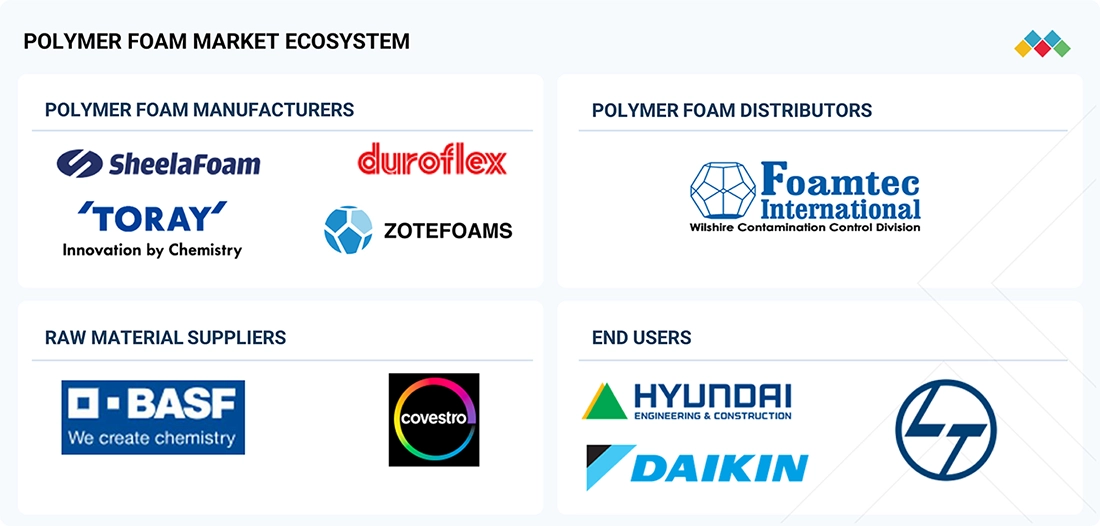
POLYMER FOAMS MARKET: COMMERCIAL USE CASES ACROSS INDUSTRIES
| COMPANY | USE CASE DESCRIPTION | BENEFITS |
|---|---|---|
 |
Polyurethane foam used in car seats, headrests, armrests, dashboard padding, and NVH insulation | Lightweight improves vehicle fuel efficiency | Enhanced comfort and durability | Better acoustic absorption and vibration control | Cost-effective mass production |
 |
PU and polystyrene foams used in wall insulation, roofing boards, HVAC insulation, sealing, and structural panels | Superior thermal insulation, reducing energy bills by 20-40% | Improved fire resistance and moisture control | High mechanical strength for structural applications | Meets green building and energy-saving standards |
 |
Flexible PU foam used for mattresses, sofas, cushions, pillows, and ergonomic bedding | High comfort and pressure relief | Long product life and shape retention | Wide density range for premium comfort products | Lightweight and easy to fabricate |
 |
Expanded polyethylene (EPE), expanded polystyrene (EPS), and EPP foam used for packaging electronics, appliances, and fragile goods | Excellent shock absorption and drop protection | Lightweight reduces logistics cost | Reusable and recyclable in many formats | Suitable for precision electronics due to anti-static options |
 |
EVA, PU, and PE foams used in midsoles, protective gear, helmets, and yoga mats | Superior cushioning and energy return | Impact resistance for sports safety | Lightweight for performance products | High flexibility and comfort |
Logos and trademarks shown above are the property of their respective owners. Their use here is for informational and illustrative purposes only.
Related Ecosystem
Foam And Insulation
- Fiberglass
- Acoustic Insulation
- Elastomeric Foam
- HVAC System
- Flexible Foam
- Basf se
- Saint-gobain
- ARMACELL INTERNATIONAL
- THE WOODBRIDGE GROUP
- Sekisui Chemical Co., Ltd.
Resins And Polymers
- Polycarbonate
- Acrylonitrile Butadiene Styrene (ABS)
- Epoxy Resin
- Light Commercial Vehicles (LCVs)
- Polypropylene (PP)
- Basf se
- DOW CHEMICAL COMPANY
- Solvay sa
- Saudi arabia basic industries corporation (sabic)
- DuPont de Nemours, Inc.
Building And Construction
- HVAC System
- Acoustic Insulation
- Alkyd Resins
- Fiberglass
- Thermal Insulation
- Snc-lavalin group inc.
- Saint-gobain
- LHOIST S.A
- USG CORPORATION
- Basf se
Key Takeaways
- Indonesia's polymer foam market is valued at USD 1,234.1 million in 2024 and is forecast to reach USD 1,731.6 million by 2029, representing a 5.8% CAGR.
- Indonesia's growing automotive and construction sectors are primary drivers of polymer foam demand, supported by rapid urbanization and infrastructure development.
- Indonesia benefits from competitive manufacturing advantages including lower labor costs and proximity to regional supply chains, attracting foreign investment in foam production.
- Indonesia's polymer foam market is expected to outpace global growth rates, driven by rising consumer spending and expanding middle-class demographics through 2029.
Polymer Foam Market Report Scope
| Report Metric | Details |
|---|---|
| Base Year | 2024 |
| Fastest Growing Segment | OTHER END-USE INDUSTRIES (End-Use Industry) |
| Forecast Period | 2024–2029 |
| Growth Rate | CAGR of 5.6% from 2024 to 2029 |
| Largest Segment | POLYURETHANE (Resin Type) |
| Market Size Base Year (Billions) | ~USD 102.42 (2024) |
| Revenue Forecast (Billions) | ~USD 134.49 (2029) |
| Segments Covered | Resin Type, End-Use Industry, Insulation Type |
Indonesia Polymer Foam Market Report Segmentation
3 segment dimensions are covered across the global market.
By Resin Type
- Other Resin Types
- Phenolic
- Polyolefin
- Polystyrene
- Polyurethane
By End-Use Industry
- Automotive
- Building & Construction
- Footwear, Sports & Recreational
- Furniture & Bedding
- Other End-Use Industries
- Other Resin Types
- Packaging
- Phenolic
- Polyolefin
- Polystyrene
- Polyurethane
By Insulation Type
- Acoustic & Other Insulation
- Thermal Insulation
Target Audience
- Polymer Foam Manufacturers : Manufacturers need Indonesia-specific market data to assess production capacity requirements, identify distribution channels, and develop localized product portfolios for packaging, automotive, and construction applications.
- Packaging & Logistics Companies : E-commerce and logistics firms require insights into Indonesia's foam packaging demand trends to optimize supply chain strategies, negotiate supplier contracts, and meet growing protective packaging needs.
- Automotive & Construction OEMs : Original equipment manufacturers operating in Indonesia need market intelligence on foam component demand, local supplier capabilities, and cost competitiveness to support production planning and sourcing decisions.
- Private Equity & Investment Firms : Investors evaluating opportunities in Indonesia's chemicals and materials sector require detailed market sizing, growth projections, and competitive analysis to assess acquisition targets and portfolio companies.
- Government & Trade Organizations : Indonesian government agencies and trade bodies need market data to inform industrial policy, support domestic manufacturers, and attract foreign investment in the polymer foam sector.
Key Companies in the Indonesia Polymer Foam Market
| Company | HQ | Ownership | Strongest segments |
|---|---|---|---|
| SEKISUI CHEMICAL CO., LTD | Japan | Public Company | High performance plastics, films, and industrial tapes,Urban infrastructure and pipe systems,Housing, construction materials, and related services, |
| LG CHEM LTD. | South Korea | Public Company | Ethylene- and propylene-based synthetic resins (PE, PP, EVA, POE, PVC),Styrene-based resins and rubbers (ABS, EPS, PS, SAN, SBR, NBR),High-performance plastics and engineering materials, |
| SHEELA FOAM LIMITED | India | Public Company | Branded mattresses (Sleepwell, Kurl-on, spring, latex, bonded, coir),Technical and specialty foams (automotive, acoustics, filtration, industrial, custom),Comfort foam and home care (pillows, bed sheets, foam sheets/blocks, furniture cushioning), |
| OWENS CORNING | United States | Public Company | Roofing,Insulation,Doors, |
| ZOTEFOAMS PLC | United Kingdom | Public Company | AZOTE polyolefin foams (Plastazote, Evazote, Supazote, Ecozote),ZOTEK high-performance technical foams,T-FIT insulated piping solutions and other cross-linked block foams, |
| SAINT-GOBAIN | France | Public Company | Gypsum plasterboards, plaster systems, and ceilings,Insulation solutions (Isover, CertainTeed, Izocam),Mortars, construction chemicals, and admixtures (Weber, Chryso, GCP), |
| FXI | United States | Public Fund | Core ETF management fees,Securities lending and ancillary income, |
| UFP TECHNOLOGIES, INC. | United States | Public Company | Medical device components and procedure disposables,Medical and biopharma packaging,Defense, aerospace, and tactical gear, |
| CARPENTER CO. | United States | Public Company | Specialty Alloys (titanium, stainless, alloy, tool steels),Powder Metals and Additive Feedstock,Performance Engineered Parts and Components, |
| TORAY INDUSTRIES, INC. | Japan | Public Company | Fibers and Textiles (filament, staple, spun yarns, woven/knitted fabrics, non-wovens, apparel),Performance Chemicals (resins, molded products, foams, films, fine chemicals, electronic materials),Carbon Fiber Composite Materials and Molded Products, |
| BOYD | Canada | Public Company | Collision repair centers,Retail auto glass services,Claims administration and mobile scanning/calibration, |
SEKISUI CHEMICAL CO., LTD
Sekisui Chemical Co., Ltd. is a Japanese public company founded in 1947 with 26,752 employees. The company operates as a diversified chemical manufacturer serving various industrial sectors.
LG CHEM LTD.
LG Chem Ltd. is a South Korean public company founded in 1947 with 14,019 employees. The company is a major chemical manufacturer serving global markets.
SHEELA FOAM LIMITED
Sheela Foam Limited is an Indian public company established in 1971 with 3,300 employees. The company is a leading manufacturer of foam products.
OWENS CORNING
Owens Corning is a United States-based public company founded in 1938 with 25,000 employees. The company is a global leader in building materials and composites.
ZOTEFOAMS PLC
Zotefoams PLC is a United Kingdom-based public company founded in 1921 with 679 employees. The company manufactures specialty foam products for industrial applications.
SAINT-GOBAIN
Saint-Gobain is a French public company founded in 1665 with 158,616 employees. The company is a global leader in building materials, glass, and high-performance materials.
FXI
FXI is a United States-based public fund established in 2004. Limited operational details are available for this organization.
UFP TECHNOLOGIES, INC.
UFP Technologies, Inc. is a United States-based public company founded in 1963 with 4,846 employees. The company manufactures foam and specialty materials.
CARPENTER CO.
Carpenter Co. is a United States-based public company founded in 1889 with 4,500 employees. The company operates as a diversified manufacturer.
TORAY INDUSTRIES, INC.
Toray Industries, Inc. is a Japanese public company founded in 1926 with 46,294 employees. The company is a global leader in advanced materials and chemicals.
BOYD
Boyd is a Canadian public company founded in 1990 with 13,424 employees. The company manufactures engineered materials and thermal management solutions.
Reasons to Buy this Report
- Market-Specific Sizing & Forecasts : Access precise valuation data for Indonesia's polymer foam market with country-specific CAGR (5.8%) and detailed projections through 2029, enabling accurate business planning and investment decisions.
- Sector-Level Demand Insights : Understand demand patterns across Indonesia's key end-use sectors—packaging, automotive, construction, and consumer goods—to identify high-growth opportunities and tailor product strategies accordingly.
- Competitive Landscape Intelligence : Gain insights into Indonesia's competitive dynamics, manufacturing capabilities, and regional supply chain positioning to benchmark against competitors and identify market entry or expansion strategies.
- Regulatory & Sustainability Trends : Stay informed on Indonesia-specific environmental regulations, sustainability requirements, and eco-friendly foam adoption trends shaping product development and market opportunities.
- Investment & Growth Opportunity Assessment : Evaluate Indonesia's market potential relative to global trends, assess risk factors, and identify high-potential segments for capital allocation, partnerships, and business development initiatives.
Frequently asked questions
What is the current size of Indonesia's polymer foam market?
Indonesia's polymer foam market was valued at USD 1,234.1 million in 2024 and is projected to grow to USD 1,731.6 million by 2029.
What is the expected growth rate for Indonesia's polymer foam market?
Indonesia's polymer foam market is expected to grow at a compound annual growth rate (CAGR) of 5.8% from 2024 to 2029.
Which industries drive demand for polymer foam in Indonesia?
Indonesia's primary end-use sectors include packaging, automotive, construction, consumer goods, and furniture manufacturing, all experiencing rapid expansion.
Why is Indonesia an attractive market for polymer foam manufacturers?
Indonesia offers competitive labor costs, abundant raw materials, strategic geographic location in Southeast Asia, and improving regulatory frameworks that support manufacturing growth.
How does Indonesia's polymer foam market growth compare to global trends?
Indonesia's 5.8% CAGR outpaces the global polymer foam market CAGR of 5.6%, reflecting stronger regional demand and manufacturing expansion.
RESEARCH METHODOLOGY
The research methodology used to estimate the current size of the polymer foam market consisted of four major activities: a) Extensive secondary research was performed to acquire detailed information about the market, peer markets, and parent markets; b) These findings, assumptions, and metrics were verified through primary research with experts from the demand and supply sides of the polymer foam value chain; c) Both top-down and bottom-up approaches were used to estimate the total market size; and d) The estimation of market sizes for various segments and subsegments in the market was finalized using complete market segmentation and data triangulation techniques.
Secondary Research
The research methodology for estimating and forecasting the polymer foam market begins with gathering data on key vendors’ revenue by doing secondary research. The secondary research process involves consulting a range of secondary sources, including Hoover’s, Bloomberg Businessweek, Factiva, the World Bank, and industry-specific journals. These secondary sources encompass annual reports, press releases, investor presentations, white papers, certified publications, articles from recognized authors, regulatory notifications, trade directories, and databases. Also, vendor offerings are taken into consideration to inform market segmentation.
Primary Research
The polymer foam market comprises several stakeholders, including raw material suppliers, processors, end-product manufacturers, and regulatory organizations, throughout the supply chain. The demand side of this market is characterized by the development of various industries, including building & construction, bedding & furniture, packaging, automotive, footwear, sports & recreational, and others. The supply side is characterized by advancements in technology and a wide range of diverse applications. Various primary sources from the supply and demand sides of the market were interviewed to obtain qualitative and quantitative information.
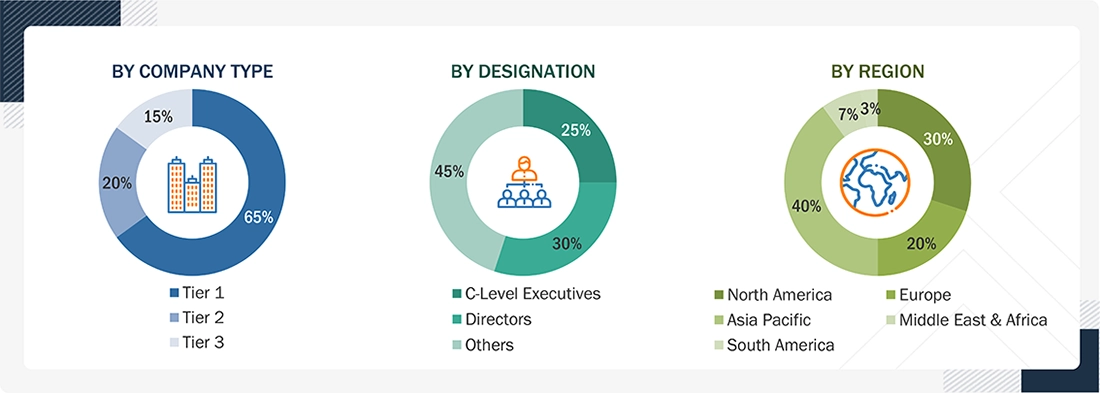
To know about the assumptions considered for the study, download the pdf brochure
Market Size Estimation
The top-down and bottom-up approaches were employed to estimate and validate the total size of the polymer foam market. These approaches were also used extensively to estimate the size of various dependent market subsegments.
The following considerations were made in these approaches:
- Extensive primary research and secondary research were done to identify the key players.
- The value chain and market size of the polymer foam market, in terms of value, were determined through primary and secondary research.
- All percentage shares, splits, and breakdowns were collected through secondary sources and verified through primary sources.
- All possible parameters that affect the market were covered in this research study and are viewed in extensive detail, verified through primary research, and analyzed to obtain the final quantitative and qualitative data.
- The study of reports, reviews, and newsletters of top market players, along with extensive interviews for opinions from key leaders, such as CEOs, directors, and marketing executives, is included in this research.
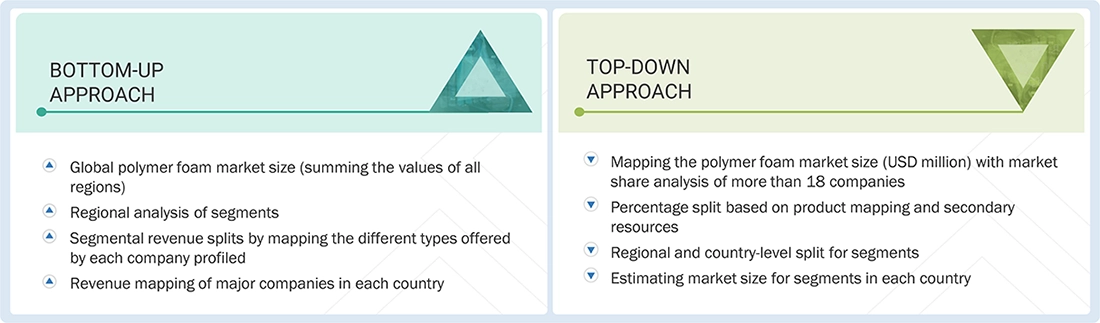
Data Triangulation
After estimating the overall market size, the market was split into various segments and subsegments. Data triangulation and market segmentation techniques, along with the market engineering process, were employed to obtain precise market analysis data for each segment and its subsegments. The research methodology used to estimate and forecast the global market size began by aggregating data and information from various levels, including country-level data.
Market Definition
Polymer foams are made of polymers, blowing agents, and additives. They are produced using different processing methods, such as slab stock by pouring, extrusion, and different molding forms. They are used in various industries such as packaging, furniture & bedding, building & construction, and automotive. These foams are classified based on their structures as closed and open cells. Closed-cell foam is rigid, whereas open-cell foam is flexible.
Key Stakeholders
- Polymer foam manufacturers, processors, and technology providers
- End-use industries, including building & construction, bedding & furniture, packaging, automotive, footwear, and sports & recreational
- Research Institutions, standards organizations, and regulatory agencies such as ASTM, ISO, IAEA, and national materials authorities
- NGOs, governments, investment banks, venture capitalists, and private equity firms
Report Objectives
- To define, describe, and forecast the market size of polymer foam, in terms of value and volume
- To provide detailed information regarding the key factors, such as drivers, restraints, opportunities, and industry-specific challenges, influencing the growth of the market
- To analyze and forecast the size of various segments (resin type and end-use industry) of the market based on five major regions: North America, Europe, Asia Pacific, South America, and the Middle East & Africa, along with key countries in each of these regions
- To analyze recent developments and competitive strategies, including acquisition, product launch, and others, to understand the market's competitive landscape
- To strategically profile the key players in the market and comprehensively analyze their core competencies
Available customizations:
With the given market data, MarketsandMarkets offers customizations according to the client-specific needs.
The following customization options are available for the report:
- Additional country-level analysis of the polymer foam market
- Profiling of additional market players (up to 5)
Product Analysis
- Product matrix, which provides a detailed comparison of each company's product portfolio
Get the Full Polymer Foam Market Report
Full forecast, segment splits, and company analysis for all Polymer Foam Market.
- China Polymer Foam Market
- Japan Polymer Foam Market
- India Polymer Foam Market
- South Korea Polymer Foam Market
- Thailand Polymer Foam Market
- Malaysia Polymer Foam Market
- Italy Polymer Foam Market
- Spain Polymer Foam Market
- Germany Polymer Foam Market
- France Polymer Foam Market
- UK Polymer Foam Market
- Turkey Polymer Foam Market
- Russia Polymer Foam Market
- Mexico Polymer Foam Market
- Canada Polymer Foam Market
- US Polymer Foam Market
- Saudi Arabia Polymer Foam Market
- UAE Polymer Foam Market
- South Africa Polymer Foam Market
- Brazil Polymer Foam Market
- Argentina Polymer Foam Market
- Chile Polymer Foam Market
- South America Polymer Foam Market
- Rest Of Europe Polymer Foam Market
- Middle East Polymer Foam Market
- Rest Of Asia Pacific Polymer Foam Market
Need a Tailored Report?
Customize this report to your needs
Get 10% FREE Customization
Customize This Report
