
Germany Food Encapsulation Market (2022-2027)

The Germany Food Encapsulation Market was valued at $903.4 Million in 2022 and projected to reach to $1404.9 Million by 2027, representing a compound annual growth rate of 9.2%. Germany's food encapsulation market is poised for sustained growth through 2027, driven by the country's robust food processing infrastructure and consumer demand for premium, health-focused products.


| Market Size in | USD 26.32 MN |
| Market Forecast in | |
| CAGR | |
| Forecast Period | |
| Units Considered | Value (USD MN) |
Germany Food Encapsulation Market Trends and Insights
- This expansion reflects Germany's strong position as a leading food technology innovator within Europe, driven by increasing demand for functional foods, dietary supplements, and advanced preservation solutions.
- Germany's pharmaceutical and nutraceutical sectors have accelerated adoption of microencapsulation and nanoencapsulation technologies to enhance product efficacy and shelf life. The German market benefits from stringent food safety regulations and consumer preference for premium, science-backed food products that drive investment in encapsulation technologies.
- Germany's established food processing infrastructure and R&D capabilities position the country as a hub for encapsulation innovation.
- The 9.2% compound annual growth rate in Germany outpaces the global average of 8.2%, underscoring the country's accelerating market penetration and technological advancement in this sector through 2027..
Key Market Statistics
- CAGR (2022-2027) 9.2% CAGR
- Market Size, 2022 ~USD 903.4 Million
- Forecast, 2027 ~USD 1404.9 Million
- Country Germany
Germany Food Encapsulation Market Overview
Market Expansion :
Germany's food encapsulation market is projected to grow from $903.4 million in 2022 to $1,404.9 million by 2027, representing a robust 9.2% CAGR, outpacing the global average of 8.2%.
Innovation Leadership :
Germany maintains its position as Europe's leading food technology innovator, with strong investments in advanced encapsulation technologies for functional foods and dietary supplements.
Functional Foods Demand :
Rising consumer preference for functional foods and health-oriented products in Germany is driving significant adoption of encapsulation solutions for nutrient delivery and bioavailability enhancement.
Preservation Solutions :
German food manufacturers increasingly leverage encapsulation for advanced preservation, shelf-life extension, and flavor masking applications across diverse food and beverage categories.
Germany Food Encapsulation Market Dynamics
- The market benefits from strong regulatory frameworks supporting food innovation and a highly educated consumer base seeking functional benefits.
- German manufacturers are increasingly adopting microencapsulation and nanoencapsulation technologies to meet evolving market demands. Key growth drivers include expanding dietary supplement markets, rising demand for clean-label products, and technological advancements in encapsulation methods.
- The country's position within the EU provides access to broader European markets, while domestic innovation capabilities ensure competitive advantage.
- Investment in R&D and strategic partnerships with food technology providers will continue to accelerate market penetration across premium and mainstream segments..
Market Ecosystem
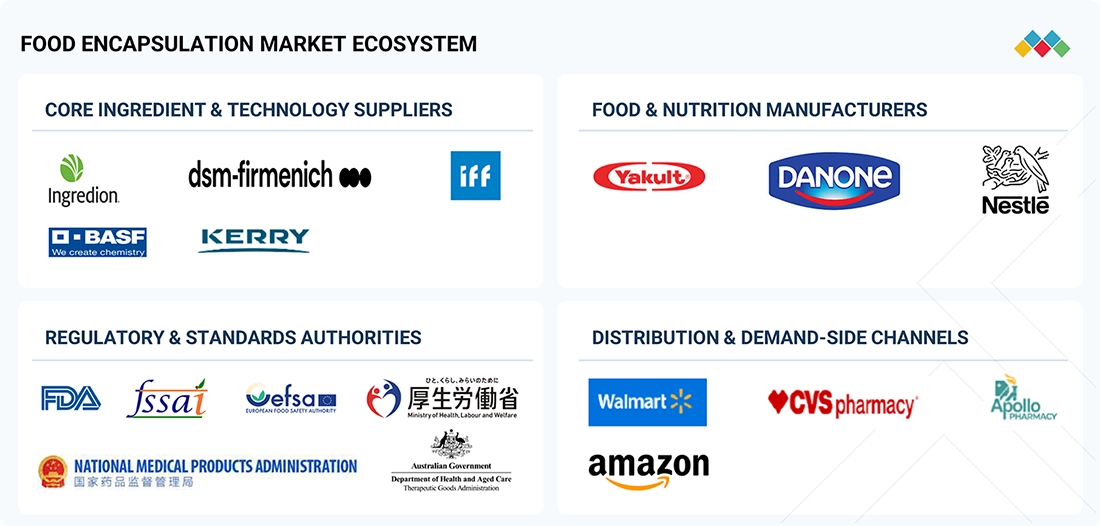
FOOD ENCAPSULATION MARKET: COMMERCIAL USE CASES ACROSS INDUSTRIES
| COMPANY | USE CASE DESCRIPTION | BENEFITS |
|---|---|---|
 |
Use of encapsulation technologies to protect sensitive bioactive components in fermented food products, ensuring stability of functional ingredients during processing, storage, and distribution under varied temperature conditions. | Improved ingredient stability, consistent functional performance, extended shelf life, and reliable quality in mass-consumption functional foods. |
 |
Encapsulation of vitamins, minerals, and functional lipids in dairy and plant-based food products to enable fortification without affecting taste, texture, or product appearance. | Enhanced nutrient protection, uniform dispersion in food matrices, clean-label fortification, and improved consumer acceptance. |
 |
Application of encapsulated micronutrients, flavors, and bioactive ingredients in fortified foods, infant nutrition, and ready-to-consume products to maintain nutritional value throughout product shelf life. | Better nutrient retention, controlled release, sensory consistency, and compliance with stringent food safety and nutrition standards. |
 |
Integration of encapsulated nutrients in dairy-based functional foods to preserve efficacy during heat processing and long-term storage, particularly for products targeting digestive and immune health. | Improved product stability, enhanced bioavailability, longer shelf life, and reduced degradation of sensitive ingredients. |
Logos and trademarks shown above are the property of their respective owners. Their use here is for informational and illustrative purposes only.
Related Ecosystem
Fandb Ingredients
- Dairy Products
- Bakery Products
- Microorganism
- Polydextrose
- Carbohydrates
- AZELIS HOLDINGS SA
- Archer-Daniels-Midland Company
- Kerry Group plc
- Amway
- DSM FIRMMENICH
Key Takeaways
- Germany's food encapsulation market is valued at $903.4 million in 2022 and is projected to reach $1,404.9 million by 2027, representing a 9.2% CAGR.
- Germany's growth rate of 9.2% exceeds the global average of 8.2%, reflecting strong regional demand for advanced food technology solutions.
- Germany's robust regulatory framework and consumer focus on functional foods drive accelerated adoption of microencapsulation and nanoencapsulation technologies.
- Germany's established pharmaceutical, nutraceutical, and food processing sectors position it as a European leader in encapsulation innovation and market expansion.
Food Encapsulation Market Report Scope
| Report Metric | Details |
|---|---|
| Base Year | 2022 |
| Fastest Growing Segment | PREBIOTICS (Type) |
| Forecast Period | 2022–2027 |
| Growth Rate | CAGR of 8.2% from 2022 to 2027 |
| Largest Segment | PROBIOTICS (Type) |
| Market Size Base Year (Billions) | ~USD 11.46 (2022) |
| Revenue Forecast (Billions) | ~USD 17 (2027) |
| Segments Covered | Core Phase, Type, Technology, Shell Material, Method, Application |
Germany Food Encapsulation Market Report Segmentation
6 segment dimensions are covered across the global market.
By Core Phase
- Amino Acids
- Colors
- Enzymes
- Flavors
- Nutritional Lipids
- Organic Acids
- Other Core Phases
- Prebiotics
- Preservatives
- Probiotics
- Proteins
- Sweeteners
- Vitamins & Minerals
By Type
- Acetic Acid
- Antimicrobial
- Antioxidants
- Artificial
- Ascorbic Acid
- Atomization
- Bacteria
- Carbohydrases
- Chocolate & Browns
- Citric Acid
- Co-Acervation
- Cyclodextrins
- Dairy
- Evaporation-Solvent Diffusion Method
- Extrusion
- Fat-Soluble
- Fluid Bed
- Fruits & Nuts
- Fumaric Acid
- Inulin
- Lactic Acid
- Layer-By-Layer Encapsulation
- Lipases
- Liposomes
- Malic Acid
- Minerals
- Natural
- Oligosaccharides
- Other Enzymes
- Other Flavors
- Other Organic Acids
- Other Physical Methods
- Other Physico-Chemical Methods
- Other Prebiotics
- Other Preservatives
- Polydextrose
- Polymerization
- Propionic Acid
- Proteases
- Sol-Gel Method
- Spices
- Spinning Disk
- Spray Chilling
- Spray Drying
- Vanilla
- Vitamin A
- Vitamin B Complex
- Vitamin C
- Vitamin D
- Vitamin E
- Vitamin K
- Vitamins
- Water-Soluble
- Yeast
By Technology
- Hybrid Encapsulation
- Microencapsulation
- Nanoencapsulation
By Shell Material
- Emulsifiers
- Lipids
- Polysaccharides
- Proteins
By Method
- Chemical
- Physical
- Physico-Chemical
By Application
- Bakery Products
- Beverages
- Confectionery
- Confectionery Products
- Dairy Products
- Dietary Supplements
- Frozen Products
- Functional Food Products
- Other Applications
Target Audience
- Food & Beverage Manufacturers : German F&B producers need market intelligence to evaluate encapsulation technology adoption, identify supplier opportunities, and understand competitive positioning in functional foods and supplements.
- Encapsulation Technology Providers : Suppliers of microencapsulation and nanoencapsulation solutions require Germany-specific market data to assess growth potential, identify customer segments, and develop localized go-to-market strategies.
- Investment & Private Equity Firms : Investors evaluating opportunities in German food technology need detailed market sizing, growth forecasts, and segment analysis to support acquisition, funding, and portfolio decisions.
- Regulatory & Compliance Consultants : Consultants advising food companies on German and EU regulations need market context and industry trends to guide clients through encapsulation technology implementation and compliance requirements.
- Market Research & Strategy Teams : Corporate strategy and R&D teams require Germany-specific encapsulation market data to inform product development, innovation roadmaps, and competitive benchmarking initiatives.
Key Companies in the Germany Food Encapsulation Market
| Company | HQ | Ownership | Strongest segments |
|---|---|---|---|
| AMWAY | Malaysia | Public Company | Health & wellness (NUTRILITE, body key, XS),Beauty & personal care (ARTISTRY, G&H, GLISTER, SATINIQUE),Home living & home care (eSpring, ATMOSPHERE, Amway Home), |
| VENTURA FOODS, LLC | United States | Private Company | Shortenings, oils, margarines, and spreads,Dressings, mayonnaises, and sauces,Bases, dairy dips, and ingredients, |
| CARGILL, INCORPORATED | United States | Private Company | Grains and oilseeds origination, trading, and processing,Animal nutrition and aquaculture,Meat and poultry products, |
| BASF SE | Germany | Public Company | Chemicals (petrochemicals and intermediates),Materials (isocyanates, polyamides, inorganic basic products),Industrial Solutions (dispersions, resins, additives, catalysts, electronic materials), |
| KERRY | Ireland | Public Company | Taste solutions (flavours, extracts, modulations),Nutrition solutions (enzymes, proteins, lipids, fibre, wellness),Functional ingredients, food and beverage solutions, |
| DSM | Switzerland | Public Company | Perfumery & Beauty,Taste, Texture & Health,Health, Nutrition & Care, |
| INGREDION | United States | Public Company | Sweeteners (HFCS, glucose syrups, dextrose, polyols, maltodextrin),Food starches and texture & healthful solutions,Industrial starches and biomaterial solutions, |
| SYMRISE | Germany | Public Company | Taste, Nutrition & Health – Food & Beverage,Taste, Nutrition & Health – Pet Food & Aquafeed,Taste, Nutrition & Health – Probiotics & Dietary Supplements, |
| SENSIENT TECHNOLOGIES CORPORATION | United States | Public Company | Flavors & Extracts,Color,Asia Pacific (regional segment), |
| BALCHEM INC. | United States | Public Company | Human Nutrition & Health,Animal Nutrition & Health,Specialty Products, |
| INTERNATIONAL FLAVORS & FRAGRANCES INC. | United States | Public Company | |
| FIRMENICH SA | Switzerland | Private Company | Fine and consumer fragrances,Flavor solutions for savory, sweet, and beverages,Alternative proteins, nutrition and functional solutions, |
| FRIESLANDCAMPINA | Netherlands | Private Company | Milk, Yogurt & Dairy Drinks,Cheese & Butter,Infant & Specialized Nutrition, |
AMWAY
AMWAY is a public company based in Malaysia, founded in 1976, with 308 employees.
VENTURA FOODS, LLC
VENTURA FOODS, LLC is a private company based in the United States, founded in 1867, with 2,534 employees.
CARGILL, INCORPORATED
CARGILL, INCORPORATED is a private company based in the United States, founded in 1865, with 155,000 employees.
BASF SE
BASF SE is a public company based in Germany, founded in 1865, with 106,428 employees.
KERRY
KERRY is a public company based in Ireland, founded in 1972, with 19,284 employees.
DSM
DSM is a public company based in Switzerland, founded in 1902, with 26,873 employees.
INGREDION
INGREDION is a public company based in the United States, founded in 1906, with 11,200 employees.
SYMRISE
SYMRISE is a public company based in Germany, founded in 1874, with 12,697 employees.
SENSIENT TECHNOLOGIES CORPORATION
SENSIENT TECHNOLOGIES CORPORATION is a public company based in the United States, founded in 1882, with 4,070 employees.
BALCHEM INC.
BALCHEM INC. is a public company based in the United States, founded in 1967, with 1,368 employees.
INTERNATIONAL FLAVORS & FRAGRANCES INC.
INTERNATIONAL FLAVORS & FRAGRANCES INC. is a public company based in the United States, founded in 1909, with 21,500 employees.
FIRMENICH SA
FIRMENICH SA is a private company based in Switzerland, founded in 1895, with 10,332 employees.
FRIESLANDCAMPINA
FRIESLANDCAMPINA is a private company based in the Netherlands, founded in 1871, with 18,998 employees.
Reasons to Buy this Report
- Market-Specific Sizing : Access precise market valuation data for Germany ($903.4M in 2022, $1,404.9M in 2027) with country-specific CAGR of 9.2% to benchmark against global trends and regional competitors.
- Competitive Intelligence : Understand Germany's position as Europe's food technology leader and identify competitive advantages in encapsulation innovation, regulatory compliance, and manufacturing capabilities specific to the German market.
- Segment Opportunities : Identify high-growth segments within Germany including functional foods, dietary supplements, and preservation solutions with localized demand drivers and consumer preferences.
- Strategic Market Entry : Develop informed market entry strategies for Germany with insights into local manufacturing infrastructure, regulatory environment, and distribution channels for encapsulation products.
- Investment Decision Support : Make data-driven investment and expansion decisions in Germany's food encapsulation sector with comprehensive forecasts, growth trajectories, and market dynamics through 2027.
Frequently asked questions
What is the current market size of food encapsulation in Germany?
Germany's food encapsulation market was valued at $903.4 million in 2022 and is expected to grow to $1,404.9 million by 2027.
What is the projected growth rate for Germany's food encapsulation market?
Germany's food encapsulation market is projected to grow at a compound annual growth rate (CAGR) of 9.2% from 2022 to 2027.
How does Germany's growth rate compare to the global market?
Germany's 9.2% CAGR outpaces the global food encapsulation market growth rate of 8.2%, indicating stronger regional market momentum.
What factors are driving growth in Germany's food encapsulation market?
Growth in Germany is driven by increasing demand for functional foods, dietary supplements, stringent food safety regulations, and advanced preservation technologies in the pharmaceutical and nutraceutical sectors.
Why is Germany a key market for food encapsulation technology?
Germany's established food processing infrastructure, strong R&D capabilities, regulatory excellence, and consumer preference for premium, science-backed products position it as a European leader in encapsulation innovation.
RESEARCH METHODOLOGY
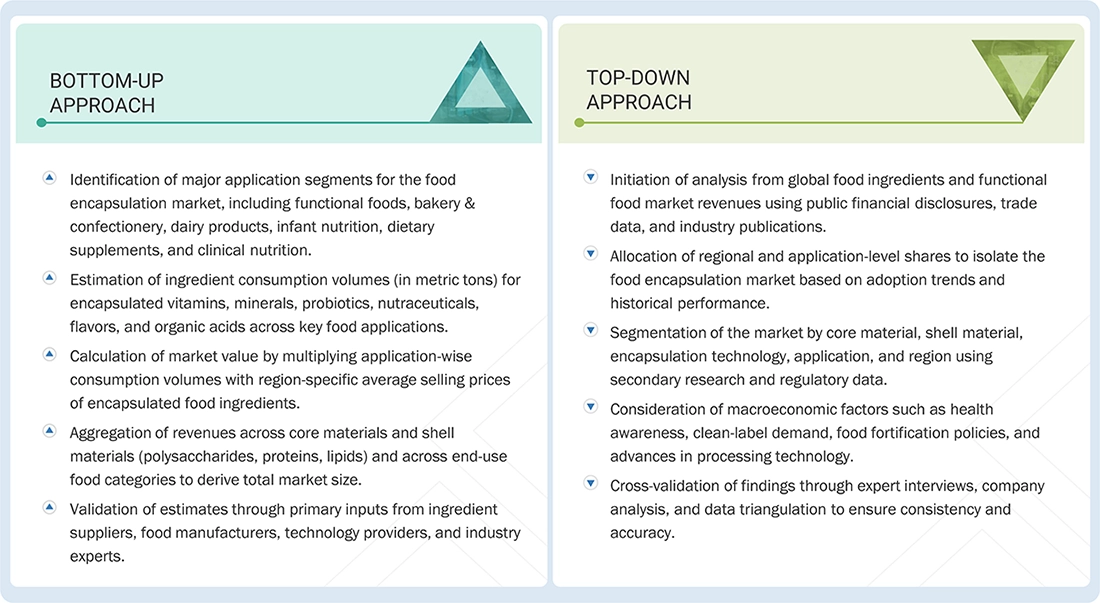
The study employed two primary approaches to estimate the current size of the food encapsulation market. Exhaustive secondary research was conducted to gather information on the market, peer markets, and parent markets. The next step was to validate these findings, assumptions, and sizing with industry experts across the value chain through primary research. Both top-down and bottom-up approaches were employed to estimate the complete market size. After that, market breakdown and data triangulation were used to estimate the market size of segments and subsegments.
Secondary Research
This research study involved the extensive use of secondary sources—directories and databases such as Bloomberg Businessweek and Factiva—to identify and collect information useful for a technical, market-oriented, and commercial study of the market.
In the secondary research process, various sources such as annual reports, press releases & investor presentations of companies, white papers, food journals, certified publications, articles from recognized authors, directories, and databases were referred to, to identify and collect information.
Secondary research was mainly used to obtain key information about the industry’s supply chain, the total pool of key players, and market classification and segmentation as per the industry trends to the bottom-most level, regional markets, and key developments from both market- and technology-oriented perspectives.
Primary Research
Extensive primary research was conducted after obtaining information regarding the food encapsulation market scenario through secondary research. Several primary interviews were conducted with market experts from both the demand and supply sides across major countries of North America, Europe, Asia Pacific, South America, and RoW. Primary data was collected through questionnaires, emails, and telephonic interviews. The primary sources from the supply side included various industry experts, such as Chief X Officers (CXOs), Vice Presidents (VPs), directors from business development, marketing, research, and development teams, and key opinion leaders. Primary interviews were conducted to gather insights such as market statistics, data on revenue collected from the products and services, market breakdowns, market size estimations, market forecasting, and data triangulation. Primary research also helped in understanding the various trends related to food encapsulation’s core material, shell material, method, technology, and application. Stakeholders from the demand side, such as research institutions and universities, and third-party vendors, were interviewed to understand the buyer’s perspective on the service, and their current usage of encapsulation and the outlook of their business, which will affect the overall market.
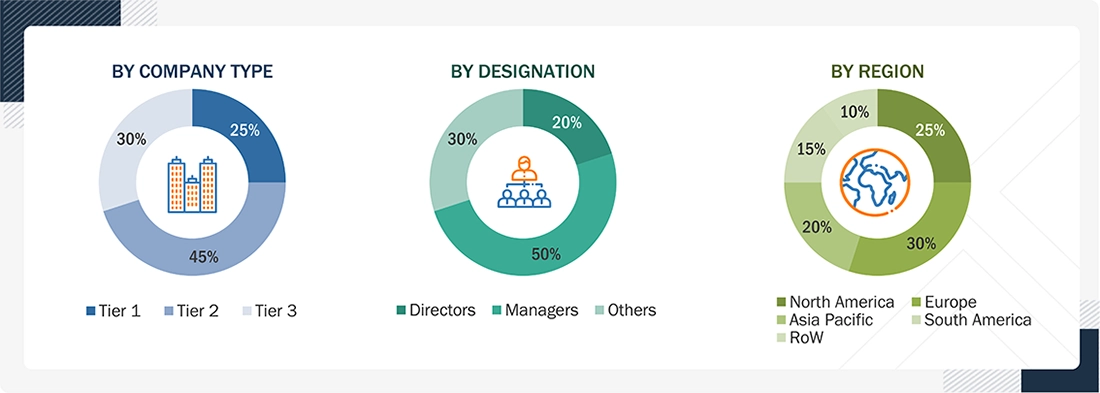
Note: The three tiers of the companies are defined based on their total revenues in 2023 or 2024, as per the availability of financial data: Tier 1: Revenue >USD 1 billion; Tier 2: USD 100 million ≤ Revenue ≤ USD 1 billion; Tier 3: Revenue USD 100 million.
To know about the assumptions considered for the study, download the pdf brochure
|
COMPANY NAME |
DESIGNATION |
|
ADM (US) |
R&D Expert |
|
BASF SE (Germany) |
Sales Manager |
|
Tate & Lyle PLC (UK) |
Manager |
|
TasteTech (US) |
Sales Manager |
|
Microcaps (US) |
Marketing Manager |
Market Size Estimation
Both the top-down and bottom-up approaches were used to estimate and validate the total size of the food encapsulation market. These approaches were also used extensively to determine the size of various subsegments in the market. The research methodology used to estimate the market size includes the following details:
- The key players in the industry and the overall markets were identified through extensive secondary research.
- All shares, splits, and breakdowns were determined using secondary sources and verified through primary sources.
- All possible parameters that affect the market covered in this research study were accounted for, viewed in extensive detail, verified through primary research, and analyzed to obtain final quantitative and qualitative data.
- The research included the study of reports, reviews, and newsletters of top market players, along with extensive interviews for opinions from leaders, such as CEOs, directors, and marketing executives.
Food Encapsulation Market : Top-Down and Bottom-Up Approach
Data Triangulation
After arriving at the overall market size from the estimation process explained above, the total market was split into several segments and subsegments. The data triangulation and market breakdown procedures were employed, wherever applicable, to estimate the overall food encapsulation market and arrive at the exact statistics for all segments and subsegments. The data was triangulated by studying various factors and trends from the demand and supply sides. The market size was also validated using both the top-down and bottom-up approaches.
Market Definition
According to the National Library of Medicine, “encapsulation involves the incorporation of food ingredients, enzymes, cells, or other materials in small capsules. Applications for this technique have increased in the food industry since the encapsulated materials can be protected from moisture, heat, or other extreme conditions, thus enhancing their stability, and maintaining viability. Encapsulation in foods is also utilized to mask odors or tastes. The encapsulating or wall materials used generally consist of starch, starch derivatives, proteins, gums, lipids, or any combination of them. This technology enables a coat of food particles or ingredients such as flavors, fats, antioxidants, nutraceutical ingredients, and colors, among others, to ensure the bioavailability of such ingredients.
Key Stakeholders
- Encapsulation raw material suppliers
- Food encapsulation manufacturers
- Food & beverage companies
- Encapsulation technology providers
- Intermediate suppliers, such as ingredient distributors, traders, and formulation service providers
- Government and research organizations
-
Associations, regulatory bodies, and other industry-related bodies:
- Food and Agriculture Organization (FAO)
- European Food Safety Authority (EFSA)
- US Food and Drug Administration (FDA
- United States Department of Agriculture (USDA)
- Food Safety and Standards Authority of India (FSSAI)
- Food Standards Australia New Zealand (FSANZ)
- Trade associations and professional bodies
- Institute of Food Technologists (IFT)
- European Federation of Food Science and Technology (EFFoST)
- International Union of Food Science and Technology (IUFoST)
- National and regional food ingredient associations
Report Objectives
- To determine, define, and project the size of the food encapsulation market, with respect to core material, shell material, method, technology, application, and regional markets, over a five-year period, ranging from 2025 to 2030
- To identify the attractive opportunities in the market by determining the largest and fastest-growing segments across regions
- To provide detailed information about the key factors influencing the growth of the market (drivers, restraints, opportunities, and challenges)
- To analyze the micromarkets with respect to individual growth trends, prospects, and their contribution to the total market
- To strategically profile key market players and comprehensively analyze their core competencies in each segment
- To track and analyze competitive developments, such as alliances, joint ventures, product developments, mergers, and acquisitions, in the food encapsulation market
Customization Options:
With the given market data, MarketsandMarkets offers customizations according to company-specific scientific needs.
The following customization options are available for the report:
Product Analysis
- Products Matrix, which gives a detailed comparison of the service portfolio of each company.
Geographic Analysis
With the given market data, MarketsandMarkets offers customizations according to company-specific scientific needs.
- Further breakdown of the Rest of Europe food encapsulation market into key countries.
- Further breakdown of the Rest of Asia Pacific food encapsulation market into key countries.
- Further breakdown of the Rest of South America food encapsulation market into key countries.
Company Information
- Detailed analyses and profiling of additional market players (up to five)
Get the Full Food Encapsulation Market Report
Full forecast, segment splits, and company analysis for all Food Encapsulation Market.
- US Food Encapsulation Market
- Canada Food Encapsulation Market
- Mexico Food Encapsulation Market
- UK Food Encapsulation Market
- France Food Encapsulation Market
- Italy Food Encapsulation Market
- Spain Food Encapsulation Market
- China Food Encapsulation Market
- Japan Food Encapsulation Market
- India Food Encapsulation Market
- Brazil Food Encapsulation Market
- Argentina Food Encapsulation Market
Need a Tailored Report?
Customize this report to your needs
Get 10% FREE Customization
Customize This Report
