
South America Fungicides Market (2024-2029)

The South America Fungicides Market was valued at $4381.8 Million in 2024 and projected to reach to $5974 Million by 2029, representing a compound annual growth rate of 6.4%. South America's fungicides market is positioned for robust growth through 2029, supported by the region's dominant position in global agricultural production.


| Market Size in | USD 26.32 MN |
| Market Forecast in | |
| CAGR | |
| Forecast Period | |
| Units Considered | Value (USD MN) |
South America Fungicides Market Trends and Insights
- South America's agricultural sector, driven by large-scale crop production and increasing disease pressure, continues to fuel demand for fungicide solutions across the region.
- The market in South America is supported by rising awareness of crop protection and the adoption of advanced fungicide formulations to combat fungal diseases in major crops including soybeans, corn, and sugarcane. Growth in South America's fungicides market is underpinned by expanding agricultural acreage, climate variability that increases fungal disease incidence, and regulatory support for sustainable farming practices.
- South America's position as a global agricultural powerhouse ensures consistent investment in crop protection technologies.
- The region's fungicides market is expected to maintain a compound annual growth rate of 6.4% through 2029, reflecting strong fundamentals in agricultural production and pest management demand..
Key Market Statistics
- CAGR (2024-2029) 6.4% CAGR
- Market Size, 2024 ~USD 4381.8 Million
- Forecast, 2029 ~USD 5974 Million
- Geography South America
South America Fungicides Market Overview
Brazil Dominates Regional Market :
Brazil accounts for the largest share of South America's fungicides market, valued at USD 3,910.2 million in 2024, driven by extensive sugarcane, coffee, and soybean cultivation requiring robust disease management solutions.
Steady 6.4% Regional Growth :
South America's fungicides market is projected to expand from USD 4,381.8 million in 2024 to USD 5,974.0 million by 2029, outpacing the global CAGR of 6.2% and reflecting strong agricultural investment across the region.
Rising Disease Pressure Drives Demand :
Increasing fungal disease incidence in South American crops, coupled with climate variability and intensive farming practices, is accelerating fungicide adoption among growers seeking to protect yields and crop quality.
Argentina's Growing Agricultural Market :
Argentina's fungicides market, valued at USD 626.4 million, is expanding as wheat, corn, and soybean producers invest in advanced crop protection technologies to enhance productivity and meet export quality standards.
South America Fungicides Market Dynamics
- Brazil's massive agricultural footprint, combined with Argentina's expanding crop protection investments, creates substantial demand for fungicide solutions.
- The region's exposure to tropical and subtropical climates increases fungal disease pressure, necessitating consistent fungicide applications across major crops including sugarcane, soybeans, coffee, and grains. Market expansion will be further catalyzed by rising farmer awareness of integrated pest management practices, improving access to advanced fungicide formulations, and increasing adoption of precision agriculture technologies.
- Government support for agricultural modernization and growing export-oriented production will sustain fungicide demand.
- However, regulatory pressures regarding chemical residues and environmental sustainability may drive shifts toward bio-based and sustainable fungicide alternatives in the coming years..
Market Ecosystem
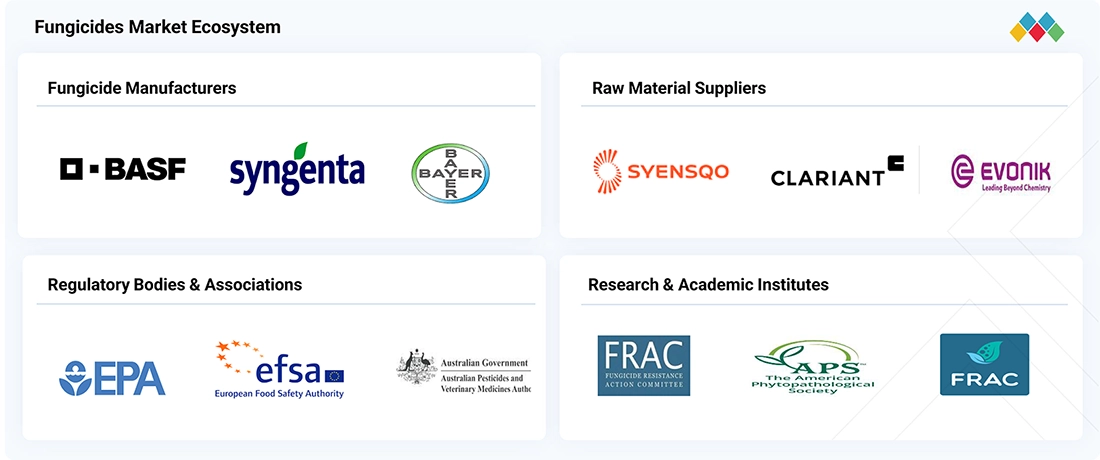
FUNGICIDES MARKET: COMMERCIAL USE CASES ACROSS INDUSTRIES
| COMPANY | USE CASE DESCRIPTION | BENEFITS |
|---|---|---|
 |
Development and commercialization of chemical and biological fungicides for the prevention and control of fungal diseases across cereals, fruits, vegetables, and other field crops. | Improves disease control efficacy, protects crop yield and quality, supports resistance management, and enhances crop productivity through targeted disease protection solutions. |
 |
Development of fungicide active ingredients and formulated products for foliar disease control, seed treatment, and disease management across major agricultural crops. | Enhances disease suppression, supports consistent crop performance, improves yield protection, and provides farmers with effective solutions for managing fungicide resistance. |
 |
Commercialization of chemical and biological fungicides for integrated disease management in cereals, fruits, vegetables, and specialty crops. | Strengthens crop protection, reduces fungal disease-related yield losses, supports integrated crop management, and improves crop quality and production reliability. |
 |
Development and supply of conventional and biological fungicides for managing fungal diseases across field crops, horticultural crops, and plantation crops. | Broadens disease management options, supports integrated and sustainable crop protection, helps maintain crop health and yield, and provides solutions for diverse farming systems. |
Logos and trademarks shown above are the property of their respective owners. Their use here is for informational and illustrative purposes only.
Related Ecosystem
Agrochemicals
- Phosphatic Fertilizers
- Potassic Fertilizers
- Fungicides
- Ammonium Nitrate
- Anticoagulant Rodenticides
- AZELIS HOLDINGS SA
- Basf se
- Origin Enterprises plc
- MITSUI AGRO BUSINESS SACO
- SNF HOLDING COMPANY INC.
Key Takeaways
- South America's fungicides market is valued at USD 4,381.8 million in 2024 and will reach USD 5,974.0 million by 2029, growing at a 6.4% CAGR.
- South America's large-scale agricultural production and climate-driven disease pressure are primary growth drivers for fungicide adoption.
- Advanced fungicide formulations and sustainable farming practices are reshaping South America's crop protection landscape.
- South America's strategic importance in global agriculture ensures sustained investment and market expansion through 2029.
Fungicides Market Report Scope
| Report Metric | Details |
|---|---|
| Base Year | 2024 |
| Fastest Growing Segment | MICROBIALS (Source) |
| Forecast Period | 2024-2029 |
| Growth Rate | CAGR of 6.2% from 2024 to 2029 |
| Largest Segment | CHEMICAL FUNGICIDES (Type) |
| Market Size Base Year (Billions) | ~USD 23.91 (2024) |
| Revenue Forecast (Billions) | ~USD 32.3 (2029) |
| Segments Covered | Type, Subtype, Microbial, Biochemical, Formulation, Mode Of Action, Mode Of Application, Crop Type, Source |
South America Fungicides Market Report Segmentation
9 segment dimensions are covered across the global market.
By Type
- Biological Fungicides
- Chemical Fungicides
- Fertilizers
- Fungicides & Bactericides
- Herbicides
- Insecticides
- Other Types
- Pesticides
- Water-Dispersible Granules
- Wettable Powder
By Subtype
- Benzimidazoles
- Berries
- Biochemicals
- Carboxamides
- Chloronitriles
- Citrus Fruits
- Corn
- Dithiocarbamates
- Emulsifiable Concentrates
- Leafy Vegetables
- Macrobials
- Microbials
- Other Cereals & Grains
- Other Chemical Fungicides
- Other Fruits & Vegetables
- Other Oilseeds & Pulses
- Phenylamides
- Pome Fruits
- Rice
- Root & Tuber Vegetables
- Soluble Liquid Flowable
- Soybean
- Strobilurins
- Sunflower
- Suspension Concentrates
- Triazole
- Wheat
By Microbial
- Bacterial-Based Microbials
- Fungal-Based Microbials
- Other Microbials
By Biochemical
- Alginates
- Chitosan
- Essential Oils
- Other Biochemicals
- Plant-Derived Compounds
By Formulation
- Dry
- Liquid
By Mode Of Action
- Contact Fungicides
- Systemic Fungicides
By Mode Of Application
- Foliar Spray
- Other Modes Of Application
- Seed Treatment
- Soil Treatment
By Crop Type
- Cereals & Grains
- Fruits & Vegetables
- Oilseeds & Pulses
- Other Crop Types
By Source
- Botanical
- Microbials
- Non-Organic
- Other Sources
Target Audience
- Agricultural Chemical Manufacturers : Require detailed South America market data to guide product launches, capacity expansion, and regional distribution strategies in the world's leading agricultural production zone.
- Agrochemical Distributors & Retailers : Need country-level market insights for Brazil and Argentina to optimize inventory, forecast demand, and identify high-potential crop segments for fungicide sales growth.
- Crop Protection Consultants : Utilize regional market trends and forecasts to advise farmers and agricultural cooperatives on fungicide selection, application strategies, and cost-benefit analysis for disease management.
- Investment & Private Equity Firms : Evaluate South America fungicides market potential for acquisition targets, portfolio companies, and new investment opportunities in the high-growth agricultural sector.
- Agricultural Policy & Trade Organizations : Monitor South America fungicides market dynamics to inform trade policy, sustainability standards, and agricultural development initiatives across the region.
Countries within South America - compare and drill down
| Country | 2025 size (native) |
|---|---|
| Brazil | USD 3910.2 Million |
| Argentina | USD 626.4 Million |
| Rest Of South America | USD 1437.4 Million |
Country market size visualization
Reasons to Buy this Report
- Identify High-Growth Opportunities : Pinpoint emerging fungicide segments and geographic pockets within South America experiencing accelerated adoption, enabling strategic market entry and expansion planning for agricultural chemical suppliers.
- Competitive Benchmarking : Analyze market share dynamics, product positioning, and competitive strategies specific to South America's fungicides landscape to inform product development and go-to-market approaches.
- Demand Forecasting Accuracy : Leverage region-specific projections through 2029 to optimize inventory management, supply chain planning, and sales forecasting for fungicide distribution and manufacturing operations.
- Regulatory & Sustainability Insights : Understand South America-specific regulatory requirements, environmental compliance trends, and farmer preferences for sustainable fungicide solutions to align product portfolios accordingly.
- Investment Decision Support : Access comprehensive market sizing and growth trajectories for Brazil and Argentina to support capital allocation decisions, partnership evaluations, and M&A strategy in the region.
Frequently asked questions
What is the current size of the fungicides market in South America?
The South America fungicides market was valued at USD 4,381.8 million in 2024 and is projected to reach USD 5,974.0 million by 2029.
What is the expected growth rate for fungicides in South America?
South America's fungicides market is expected to grow at a compound annual growth rate (CAGR) of 6.4% from 2024 to 2029.
Which crops drive fungicide demand in South America?
Major crops driving fungicide demand in South America include soybeans, corn, sugarcane, and other staple crops vulnerable to fungal diseases.
What factors are driving growth in South America's fungicides market?
Key growth drivers in South America include expanding agricultural acreage, climate variability increasing fungal disease incidence, and adoption of advanced crop protection technologies.
How does South America's fungicides market compare to global trends?
South America's fungicides market growth rate of 6.4% slightly exceeds the global CAGR of 6.2%, reflecting the region's strong agricultural fundamentals and disease management needs.
RESEARCH METHODOLOGY
The study involved four major activities in estimating the current size of the fungicides market. Exhaustive secondary research was done to collect information on the market, peer market, and parent market. The next step was to validate these findings, assumptions, and sizing with industry experts across the value chain through primary research. Both the top-down and bottom-up approaches were employed to estimate the complete market size. After that, data triangulation was used to estimate the market size of segments and subsegments.
Secondary Research
This research study involved the extensive use of secondary sources—directories and databases such as Bloomberg Businessweek and Factiva—to identify and collect information useful for a technical, market-oriented, and commercial study of the fungicides market.
In the secondary research process, various sources such as annual reports, press releases & investor presentations of companies, white papers, certified publications, articles from recognized authors, gold & silver standard websites, directories, and databases were referred to identify and collect information.
Secondary research was mainly used to obtain key information about the industry’s supply chain, the total pool of key players, and market classification and segmentation as per industry trends to the bottom-most level, regional markets, and key developments from both market- and technology-oriented perspectives.
Primary Research
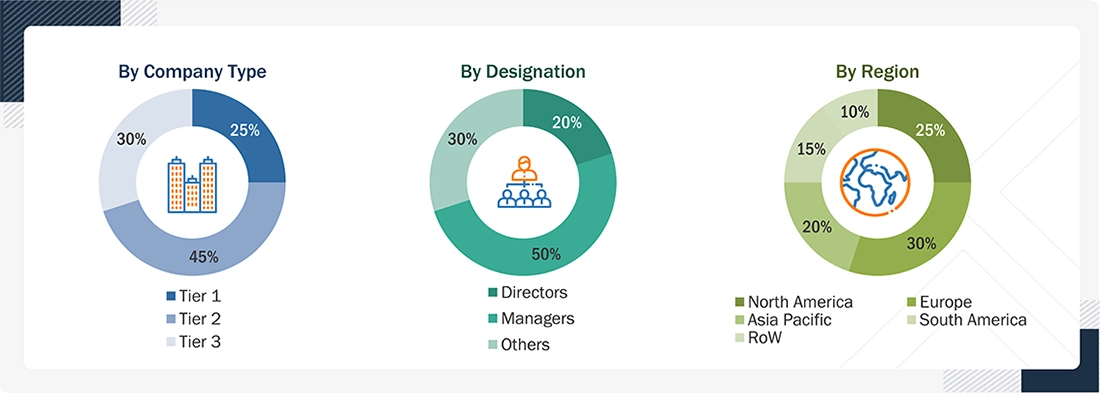
Extensive primary research was conducted after obtaining information regarding the fungicides market scenario through secondary research. Several primary interviews were conducted with market experts from both the demand and supply sides across major countries of North America, Europe, Asia Pacific, the Middle East & Africa, and South America. Primary data were collected through questionnaires, emails, and telephonic interviews. The primary sources from the supply side included various industry experts, such as Chief X Officers (CXOs), Vice Presidents (VPs), Directors from business development, marketing, research, and development teams, and related key executives from distributors and key opinion leaders. Primary interviews were conducted to gather insights such as market statistics, data on revenue collected from the products and services, market breakdowns, market size estimations, market forecasting, and data triangulation. Primary research also helped in understanding the various trends related to type, crop type, mode of application, mode of action, formulation, and region.
To know about the assumptions considered for the study, download the pdf brochure
Market Size Estimation
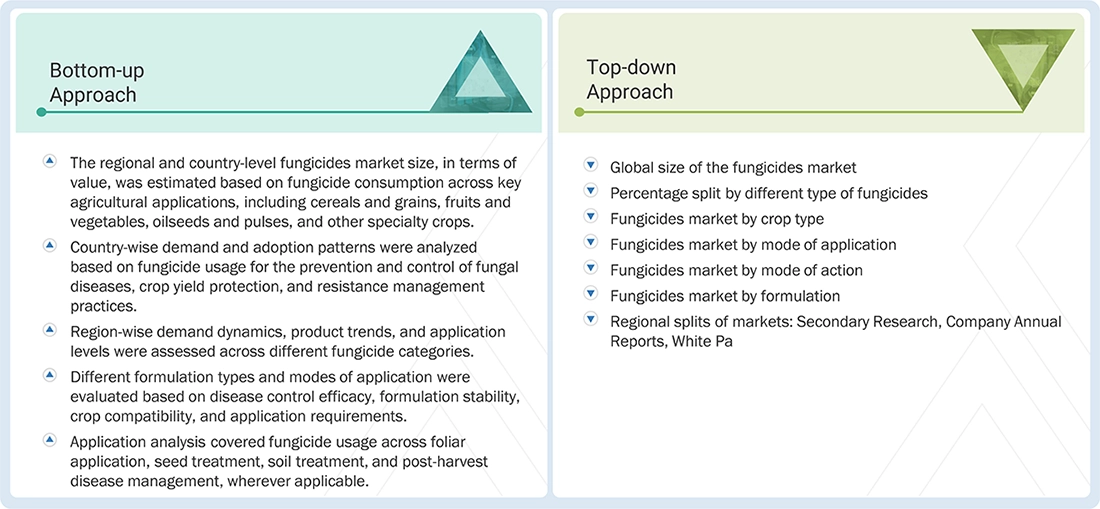
Both the top-down and bottom-up approaches were used to estimate and validate the total size of the fungicides market. These approaches were also used extensively to estimate the size of various dependent submarkets. The research methodology used to estimate the market size includes the following:
- Key players were identified through extensive secondary research.
- The industry’s value chain and market size were determined through primary and secondary research.
- All percentage share splits and breakdowns were determined using secondary sources and verified through primary sources.
- All the possible parameters that affect the markets covered in this research study were accounted for, viewed in extensive detail, verified through primary research, and analyzed to obtain the final quantitative and qualitative data.
- The following figure provides an illustrative representation of the complete market size estimation process implemented in this research study for an overall estimation of the fungicides market in a consolidated format.
The following sections (bottom-up & top-down) depict the overall market size estimation process employed for the purpose of this study.
Global Fungicides Market: Top-Down & Bottom-Up Approach
Data Triangulation
After arriving at the overall market size from the estimation process explained above, the total market was split into several segments and subsegments. Data triangulation and market breakdown procedures were employed, wherever applicable, to estimate the overall fungicides market and arrive at the exact statistics for all segments and subsegments. The data were triangulated by studying various factors and trends from the demand and supply sides. Along with this, the market size was validated using both the top-down and bottom-up approaches.
Market Definition
Fungicides are a type of pesticide used to destroy or prevent the growth of fungi and their spores. They are applied to crops to protect them from fungi, such as rust, mildew, mold, and blight. They function in different ways, though most damage fungal cell membranes or interfere with energy production within fungal cells.
Key Stakeholders
- Fungicide manufacturers, formulators, and blenders
- Pesticide traders, suppliers, distributors, importers, and exporters
- Raw material suppliers and technology providers to manufacturers
- Agricultural cooperative societies
- Fungicide associations and industry bodies:
- Food and Agriculture Organization (FAO)
- European Crop Protection Association (ECPA)
- Pesticides Manufacturers and Formulators Association (PMFAI)
- China Crop Protection Industry Association (CCPIA)
- Government agricultural departments and regulatory bodies:
- US Environmental Protection Agency (EPA)
- Canadian Food Inspection Agency (CFIA)
- US Department of Agriculture (USDA)
- European Chemicals Agency (ECHA)
- European Food Safety Authority (EFSA)
Report Objectives
MARKET INTELLIGENCE
- Determining and projecting the size of the fungicides market with respect to type, crop type, mode of application, mode of action, formulation, and region
- Identifying the attractive opportunities in the market by determining the largest and fastest-growing segments
- Providing detailed information about the key factors influencing the market growth (drivers, restraints, opportunities, and industry-specific challenges)
- Providing the regulatory framework and market entry process related to the fungicides market
- Analyzing the micro markets with respect to individual growth trends, prospects, and their contribution to the total market
COMPETITIVE INTELLIGENCE
- Identifying and profiling the key players in the fungicides market
- Providing a comparative analysis of market leaders based on the following:
- Product offerings
- Business strategies
- Strengths and weaknesses
- Key financials
- Understanding the competitive landscape and identifying the major growth strategies adopted by players across the country
- Providing insights on key product innovations and investments in the fungicides market
Available customizations:
With the given market data, MarketsandMarkets offers customizations according to company-specific scientific needs
The following customization options are available for the report:
PRODUCT ANALYSIS
- Product Matrix, which gives a detailed comparison of the product portfolio of each company
GEOGRAPHIC ANALYSIS
With the given market data, MarketsandMarkets offers customizations according to company-specific scientific needs
- Further breakdown of the Rest of Europe into Belgium, Poland, and Portugal
- Further breakdown of the Rest of Asia Pacific into Malaysia, South Korea, and Vietnam
- Further breakdown of the Rest of South America into Peru, Colombia, and Paraguay
COMPANY INFORMATION
- Detailed analyses and profiling of additional market players (up to five)
Get the Full Fungicides Market Report
Full forecast, segment splits, and company analysis for all Fungicides Market.
- Japan Fungicides Market
- Australia Fungicides Market
- Indonesia Fungicides Market
- Brazil Fungicides Market
- Argentina Fungicides Market
- Rest Of Europe Fungicides Market
- Rest Of Asia Pacific Fungicides Market
- Rest Of South America Fungicides Market
- US Fungicides Market
- Canada Fungicides Market
- Mexico Fungicides Market
- Germany Fungicides Market
- UK Fungicides Market
- France Fungicides Market
- Spain Fungicides Market
- Italy Fungicides Market
- Russia Fungicides Market
- China Fungicides Market
- India Fungicides Market
Need a Tailored Report?
Customize this report to your needs
Get 10% FREE Customization
Customize This Report
