
Asia Pacific Polyamide Market (2026-2031)

The Asia Pacific Polyamide Market was valued at $21389.7 Million in 2026 and projected to reach to $27182.3 Million by 2031, representing a compound annual growth rate of 4.9%. The Asia Pacific polyamide market is experiencing accelerated expansion, with the region's 4.9% CAGR reflecting strong demand from automotive, electronics, and consumer goods sectors.


| Market Size in | USD 26.32 MN |
| Market Forecast in | |
| CAGR | |
| Forecast Period | |
| Units Considered | Value (USD MN) |
Asia Pacific Polyamide Market Trends and Insights
- Valued at USD 21,389.7 million in 2026, Asia Pacific is expected to expand to USD 27,182.3 million by 2031, reflecting a compound annual growth rate (CAGR) of 4.9%.
- This robust expansion in Asia Pacific is driven by rising demand from automotive, electronics, and consumer goods industries across the region's rapidly industrializing economies. Asia Pacific's polyamide market growth outpaces the global average of 4.3%, underscoring the region's strategic importance in the polyamide supply chain.
- Between 2026 and 2031, Asia Pacific will benefit from increased manufacturing capacity, technological innovation, and sustained investment in high-performance polymer applications.
- The region's dominance in electronics production and automotive manufacturing continues to fuel polyamide consumption, particularly in engineering plastics and fiber applications. Key markets within Asia Pacific, including China, India, and Southeast Asia, are experiencing accelerated adoption of polyamide-based solutions across diverse end-use sectors.
- Asia Pacific's competitive advantage in cost-effective production and proximity to major consumer markets positions the region for sustained market leadership through 2031..
Key Market Statistics
- CAGR (2026-2031) 4.9% CAGR
- Market Size, 2026 ~USD 21389.7 Million
- Forecast, 2031 ~USD 27182.3 Million
- Geography Asia Pacific
Asia Pacific Polyamide Market Overview
Market Leadership by China :
China dominates the Asia Pacific polyamide market with USD 7,748.9 million in 2026, driven by robust manufacturing capacity, automotive production, and electronics demand across the region's largest economy.
Japan's Strong Position :
Japan represents the second-largest market at USD 5,575 million in 2026, supported by advanced automotive and electronics industries requiring high-performance polyamide materials for precision applications.
Accelerated Regional Growth :
Asia Pacific's 4.9% CAGR outpaces the global 4.3% rate, positioning the region as the fastest-growing polyamide market driven by industrialization, rising consumer goods demand, and automotive electrification.
Emerging Market Expansion :
India and Indonesia show significant growth potential with markets valued at USD 1,322.4 million and USD 2,300 million respectively, fueled by manufacturing expansion and increasing domestic consumption.
Asia Pacific Polyamide Market Dynamics
- China and Japan lead market growth, while emerging economies like India and Indonesia present substantial opportunities for polyamide applications in manufacturing and consumer products.
- The region's expanding middle class and industrial infrastructure investments are driving sustained demand for high-performance materials. By 2031, the Asia Pacific market is projected to reach USD 27,182.3 million, representing a USD 5.8 billion increase from 2026.
- This growth trajectory is supported by automotive electrification trends, increasing electronics production, and rising adoption of polyamide in packaging and consumer applications.
- Strategic investments in manufacturing capacity and technological innovation across the region will further strengthen Asia Pacific's position as a critical growth engine for the global polyamide market..
Market Ecosystem
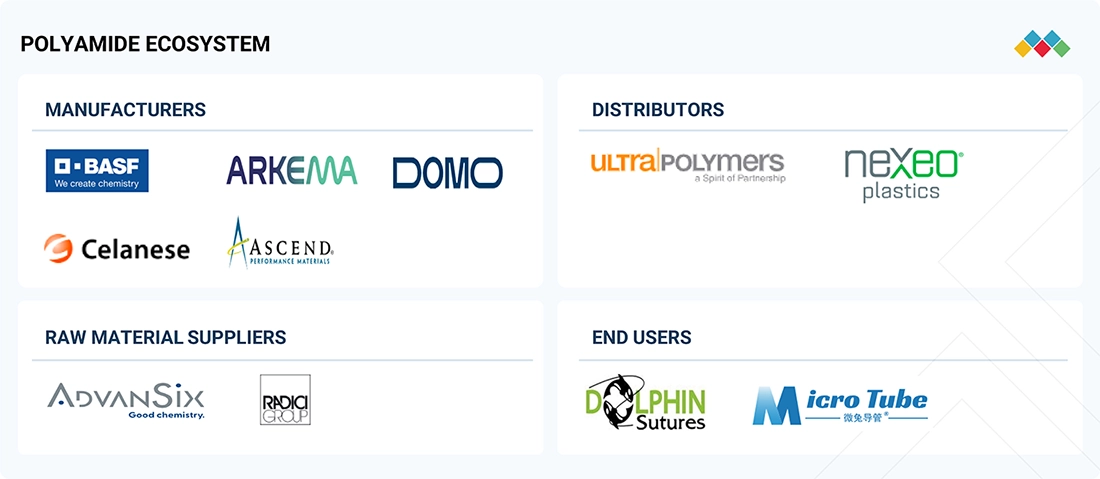
POLYAMIDE MARKET: COMMERCIAL USE CASES ACROSS INDUSTRIES
| COMPANY | USE CASE DESCRIPTION | BENEFITS |
|---|---|---|
 |
Supplies Polyamide 6 materials for lightweight automotive components | Provides engineering plastics for electrical & electronics housings | Supports industrial molded component manufacturing | Helps reduce overall component weight | Maintains performance under high-temperature conditions | Improves durability and mechanical strength |
 |
Manufactures polyamide solutions for automotive systems | Develops materials for electrical connectors and electronic applications | Supplies polymers for precision industrial components | Enhances dimensional stability in complex applications | Improves chemical and heat resistance | Supports long-term mechanical reliability. |
 |
Develops bio-based and specialty polyamides for automotive applications | Supplies advanced materials for sports equipment manufacturing | Supports industrial engineering plastic applications | Contributes toward sustainability goals | Provides lightweight and flexible material performance | Enhances efficiency in high-performance applications |
 |
Produces Polyamide 66 materials for automotive engineering applications | Supplies polyamide compounds for electrical & electronics systems | Supports industrial and consumer goods manufacturing | Provides high thermal and mechanical stability | Improves processability in engineered applications | Enhances durability and operational efficiency |
 |
Manufactures Polyamide 66 compounds for wire & cable systems | Supplies materials for automotive component production | Develops polyamide resins for consumer product applications | Enhances thermal and electrical insulation properties | Supports lightweight product manufacturing | Improves safety and performance in high-temperature applications |
Logos and trademarks shown above are the property of their respective owners. Their use here is for informational and illustrative purposes only.
Related Ecosystem
Automotive Systems
- Light Commercial Vehicles (LCVs)
- Battery Electric Vehicle (BEV)
- Hybrid Electric Vehicle (HEV)
- Agricultural Tractors
- Fuel Cell Electric Vehicle (FCEV)
- BOSCH LIMITED
- DENSO Corporation
- ZF FRIEDRICHSHAFEN AG
- Continental ag
- GORKOVSKY AVTOMOBILNY ZAVOD
Resins And Polymers
- Polycarbonate
- Acrylonitrile Butadiene Styrene (ABS)
- Epoxy Resin
- Light Commercial Vehicles (LCVs)
- Polypropylene (PP)
- Basf se
- DOW CHEMICAL COMPANY
- Solvay sa
- Saudi arabia basic industries corporation (sabic)
- DuPont de Nemours, Inc.
Yarns Fabric And Textile
- Agrotech
- Clothtech
- Indutech
- Oekotech
- Packtech
- MILLIKEN & COMPANY
- Toray Industries, Inc.
- 3M COMPANY
- DuPont de Nemours, Inc.
- Kimberly-Clark Corporation
Key Takeaways
- Asia Pacific polyamide market will grow from USD 21.4B (2026) to USD 27.2B (2031) at a 4.9% CAGR, outpacing global growth.
- Asia Pacific's automotive and electronics sectors are primary demand drivers for polyamide consumption through 2031.
- The region's manufacturing infrastructure and cost competitiveness position Asia Pacific as the dominant global polyamide market.
- Technological innovation and capacity expansion across Asia Pacific will sustain above-average growth relative to global trends.
Polyamide Market Report Scope
| Report Metric | Details |
|---|---|
| Base Year | 2026 |
| Fastest Growing Segment | BIO-BASED & SPECIALTY POLYAMIDE (Type) |
| Forecast Period | 2026–2031 |
| Growth Rate | CAGR of 4.3% from 2026 to 2031 |
| Largest Segment | POLYAMIDE 6 (Type) |
| Market Size Base Year (Billions) | ~USD 46.04 (2026) |
| Revenue Forecast (Billions) | ~USD 56.83 (2031) |
| Segments Covered | Application, Sub-Application, Type |
Asia Pacific Polyamide Market Report Segmentation
3 segment dimensions are covered across the global market.
By Application
- Engineering Plastics
- Fiber
By Sub-Application
- Automotive
- Carpet
- Consumer Goods & Appliances
- Electrical & Electronics
- Industrial
- Industrial/Machinery
- Packaging/Film
- Staple
- Textile
- Wire & Cable
By Type
- Bio-Based & Specialty Polyamide
- Polyamide 6
- Polyamide 66
Target Audience
- Polyamide Manufacturers : Manufacturers need Asia Pacific market data to optimize production capacity, identify growth markets, and develop region-specific strategies for automotive, electronics, and consumer goods applications.
- Automotive & Electronics OEMs : Original equipment manufacturers require detailed polyamide market insights to secure supply chains, evaluate material costs, and plan product development aligned with Asia Pacific demand trends.
- Chemical Distributors & Traders : Distributors need country-level market sizing and growth forecasts to optimize inventory management, identify high-potential markets, and develop targeted sales strategies across Asia Pacific.
- Investment & Private Equity Firms : Investors require comprehensive Asia Pacific polyamide market analysis to evaluate acquisition targets, assess growth potential, and make capital allocation decisions in the chemicals and materials sector.
- Strategic Consultants & Analysts : Consultants need detailed regional market data to support client strategy development, competitive benchmarking, and market entry planning for polyamide-related businesses in Asia Pacific.
Key Companies in the Asia Pacific Polyamide Market
| Company | HQ | Ownership | Strongest segments |
|---|---|---|---|
| KANEKA CORPORATION | Japan | Public Company | PVC and vinyl-related polymers/additives,Engineering resins, films, foams, and advanced materials,Healthcare, medical devices, and biopharma inputs, |
| BOREALIS AG | Austria | Private Company | Polyethylene solutions,Polypropylene solutions,Recyclates and circular polyolefin materials, |
| LG CHEM LTD. | South Korea | Public Company | Ethylene-based synthetic resins (EVA, HDPE, LDPE, LLDPE, POE, metallocene PE, UNIQABLE),Styrene-based resins (ABS, ASA, EPS, PS, SAN),Polycarbonate and polypropylene, |
| KAO CORPORATION | Japan | Public Company | Fabric, kitchen, home, and sanitary care,Health and beauty care (facial, body, hair, oral, in-bathroom, warming),Cosmetics and salon (including self-selection and counseling services), |
| MOL GROUP | Hungary | Public Company | Refined fuels (gasoline, diesel, heating oil, bunker, JET A-1, LPG),Petrochemicals and black products (bitumen, HFO, petrolcoke, residues),Retail convenience and Fresh Corner, |
| BASF | Germany | Public Company | Chemicals,Materials,Industrial Solutions, |
| ASCEND PERFORMANCE MATERIALS | United States | Private Company | PA66 base resin and intermediates,Engineered compounds and specialty polyamides,Performance additives, masterbatches, and chemicals, |
| LEALEA ENTERPRISE CO., LTD. | Taiwan | Public Company | Polyester precursors (e.g., PTA/related intermediates),Processed yarns,Polyester granules (chips/resin), |
| EVONIK INDUSTRIES AG | Germany | Public Company | Advanced Technologies,Custom Solutions,Infrastructure, |
| ARKEMA | France | Public Company | Advanced Materials (specialty polyamides, PVDF, PEKK, polyimides, fluorospecialties),Adhesive Solutions (construction, renovation, DIY, packaging, non-woven, durable goods),Coating Solutions (acrylics, coating resins, photocure and rheology additives, decorative paints), |
| CELANESE CORPORATION | United States | Public Company | Acetyl Chain (acetic acid, anhydride, VAM, acetates, emulsion polymers),Engineered Materials – Engineering Thermoplastics (POM, LCP, polyesters, nylon compounds),Engineered Elastomers and TPEs (TPE, TPV, ethylene acrylic elastomers, Vamac, Santoprene, Hytrel), |
| EMS-CHEMIE HOLDING AG | Switzerland | Public Company | High-performance polyamide granulate and related engineering polymers,Bonding, coating, sealing, damping systems and hotmelt adhesives,Fibers, fusible adhesives, adhesive yarns, and fusible bonding granules, |
| ASAHI KASEI CORPORATION | Japan | Public Company | Electronic materials (Pimel, Sunfort, glass fabric, photopolymers, sensors),Battery separators and energy materials (Hipore, Celgard, Aqualyzer-related membranes),Membranes and process systems (Microza, Aciplex, industrial systems), |
| SABIC | Saudi Arabia | Public Company | Base petrochemicals (olefins, methanol, aromatics, glycols, MTBE, CO2),Polyolefins (PE and PP, including compounds),Engineering plastics and specialties (NORYL, ULTEM, EXTEM, SILTEM, PC, ABS, etc.), |
| KURARAY CO., LTD. | Japan | Public Company | Vinyl Acetate (PVOH, PVB, EVOH resins and films, methacrylic and polyamide resins),Isoprene (isoprene chemicals, thermoplastic elastomers),Functional Materials (medical/dental, activated carbon, membranes, lipids, CMP pads, plastic hose), |
| TORAY INDUSTRIES, INC. | Japan | Public Company | Fibers and Textiles (filament, staple, nonwovens, apparel),Performance Chemicals (resins, films, fine chemicals, electronic materials),Carbon Fiber Composite Materials, |
| UBE CORPORATION | United States | Public Company | Mobility,Delivery,Freight, |
KANEKA CORPORATION
Kaneka Corporation is a Japanese public company founded in 1949, employing 11,762 people. The company operates as a diversified chemical and materials manufacturer.
BOREALIS AG
Borealis AG is an Austrian private company founded in 1994 with 5,887 employees. The company operates in the chemical and materials sector.
LG CHEM LTD.
LG Chem Ltd. is a South Korean public company established in 1947, employing 14,019 people. The company is a major chemical and advanced materials manufacturer.
KAO CORPORATION
Kao Corporation is a Japanese public company founded in 1887 with 31,514 employees. The company operates as a diversified manufacturer of chemical and consumer products.
MOL GROUP
MOL Group is a Hungarian public company founded in 1991 with 24,744 employees. The company operates in the energy and chemical sectors.
BASF
BASF is a German public company founded in 1865 with 106,428 employees, making it one of the world's largest chemical manufacturers. The company operates globally across diverse chemical and materials sectors.
ASCEND PERFORMANCE MATERIALS
Ascend Performance Materials is a private company based in the United States founded in 2009. The company operates in the advanced materials and chemicals industry.
LEALEA ENTERPRISE CO., LTD.
Lealea Enterprise Co., Ltd. is a Taiwanese public company founded in 1968 with 1,770 employees. The company operates in the chemical and materials manufacturing industry.
EVONIK INDUSTRIES AG
Evonik Industries AG is a German public company founded in 1847 with 30,643 employees. The company is a major specialty chemicals and advanced materials manufacturer.
ARKEMA
Arkema is a French public company founded in 2003 with 20,648 employees. The company operates as a specialty chemicals and advanced materials manufacturer.
CELANESE CORPORATION
Celanese Corporation is a United States public company founded in 1912 with 11,434 employees. The company manufactures specialty chemicals and advanced engineered materials.
EMS-CHEMIE HOLDING AG
EMS-Chemie Holding AG is a Swiss public company founded in 1936 with 2,657 employees. The company specializes in specialty chemicals and advanced materials.
ASAHI KASEI CORPORATION
Asahi Kasei Corporation is a Japanese public company founded in 1922 with 47,895 employees. The company operates as a diversified manufacturer of chemicals, materials, and consumer products.
SABIC
SABIC is a Saudi Arabian public company founded in 1976 with 35,000 employees. The company is a major global petrochemical and specialty chemicals manufacturer.
KURARAY CO., LTD.
Kuraray Co., Ltd. is a Japanese public company founded in 1926 with 12,117 employees. The company manufactures specialty chemicals and advanced materials.
TORAY INDUSTRIES, INC.
Toray Industries, Inc. is a Japanese public company founded in 1926 with 46,294 employees. The company is a diversified manufacturer of advanced fibers, chemicals, and materials.
UBE CORPORATION
Ube Corporation is a United States public company founded in 2009 with 35,000 employees. The company operates in the chemical and advanced materials manufacturing sector.
Countries within Asia Pacific - compare and drill down
| Country | 2025 size (native) |
|---|---|
| China | USD 7748.9 Million |
| Japan | USD 5575 Million |
| South Korea | USD 2528.6 Million |
| Indonesia | USD 2300 Million |
| Taiwan | USD 1820.8 Million |
| India | USD 1322.4 Million |
| Rest Of Asia Pacific | USD 5670.7 Million |
Country market size visualization
Reasons to Buy this Report
- Regional Market Segmentation : Gain detailed insights into Asia Pacific's polyamide market dynamics, including country-level analysis of China, Japan, South Korea, India, and Indonesia to identify high-growth opportunities.
- Competitive Landscape Intelligence : Understand market positioning across Asia Pacific's key manufacturing hubs and identify strategic entry points for polyamide suppliers targeting automotive, electronics, and consumer goods sectors.
- Growth Driver Analysis : Access comprehensive data on Asia Pacific-specific growth catalysts including automotive electrification, electronics expansion, and rising consumer demand driving the 4.9% CAGR through 2031.
- Investment Decision Support : Leverage market forecasts and regional trends to make informed investment decisions in Asia Pacific's polyamide sector, with projections extending to 2031 and country-level market sizing.
- Supply Chain Optimization : Identify optimal sourcing and distribution strategies across Asia Pacific's polyamide markets, with insights into regional manufacturing capabilities and demand patterns by end-use industry.
Frequently asked questions
What is the projected market size of polyamide in Asia Pacific by 2031?
Asia Pacific's polyamide market is projected to reach USD 27,182.3 million by 2031, up from USD 21,389.7 million in 2026.
What is the CAGR for the Asia Pacific polyamide market?
Asia Pacific's polyamide market is expected to grow at a CAGR of 4.9% between 2026 and 2031.
Which industries drive polyamide demand in Asia Pacific?
Automotive, electronics, consumer goods, and engineering plastics sectors are the primary demand drivers for polyamide in Asia Pacific.
How does Asia Pacific's growth compare to the global polyamide market?
Asia Pacific's 4.9% CAGR exceeds the global average of 4.3%, reflecting the region's strategic importance and faster market expansion.
What factors support polyamide market growth in Asia Pacific?
Manufacturing capacity expansion, technological innovation, cost competitiveness, and rising demand from automotive and electronics industries support Asia Pacific's polyamide market growth.
RESEARCH METHODOLOGY
The study involved four major activities in estimating the current size of the polyamide market. Exhaustive secondary research was done to collect information on the market, peer markets, and parent market. The next step was to validate these findings, assumptions, and sizing with the industry experts across the polyamide value chain through primary research. Both top-down and bottom-up approaches were employed to estimate the complete market size. Thereafter, market breakdown and data triangulation were used to estimate the market size of segments and subsegments.
Secondary Research
Secondary sources for this research study include annual reports, press releases, and investor presentations of companies; white papers; certified publications; and articles by recognized authors; gold- and silver-standard websites; polyamide manufacturing companies, regulatory bodies, trade directories, and databases. The secondary research was mainly used to obtain key information about the industry’s supply chain, the total pool of key players, market classification, and segmentation according to industry trends to the bottom-most level and regional markets. It has also been used to obtain information about key developments from a market-oriented perspective.
Primary Research
The polyamide market comprises several stakeholders, such as such as raw material suppliers, technology support providers, lithium-ion battery recyclers, and regulatory organizations in the supply chain. Various primary sources from both the supply and demand sides of the market were interviewed to obtain qualitative and quantitative information. Primary sources from the supply side included industry experts such as Chief Executive Officers (CEOs), vice presidents, marketing directors, technology and innovation directors, and related key executives from various key companies and organizations operating in the Polyamide market. Primary sources from the demand side included directors, marketing heads, and purchase managers from various sourcing industries. Following is the breakdown of the primary respondents:
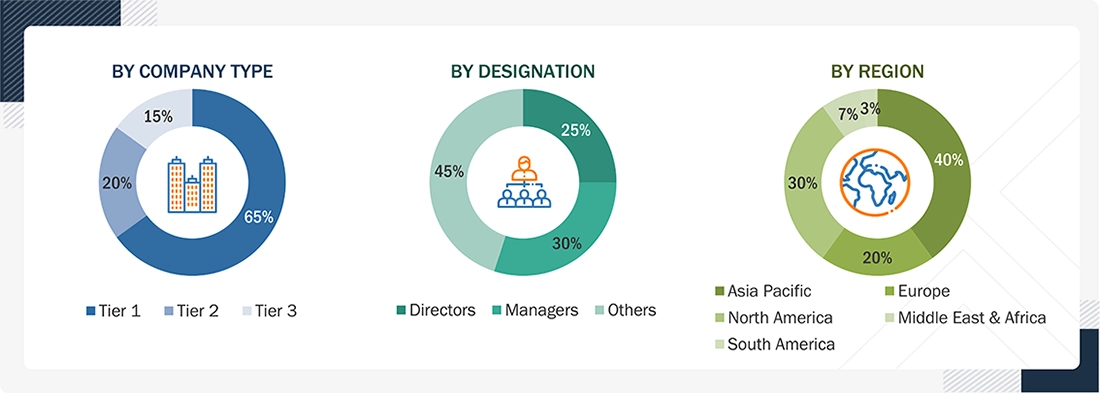
To know about the assumptions considered for the study, download the pdf brochure
Market Size Estimation
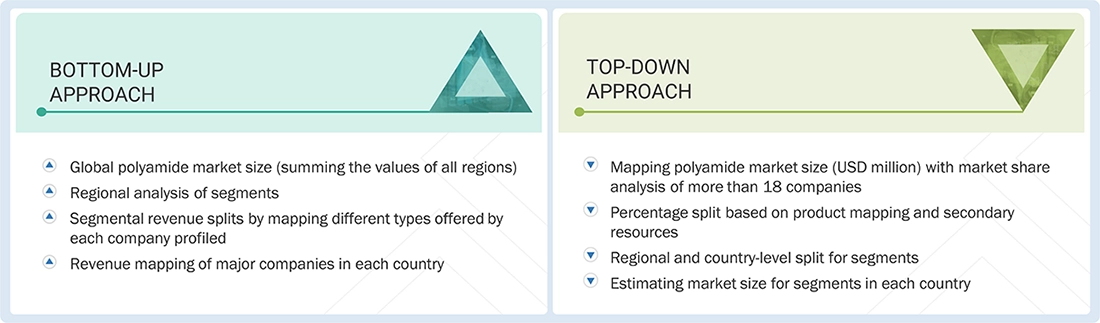
The top-down and bottom-up approaches have been employed to estimate and validate the total size of the Polyamide market. These approaches have also been used extensively to estimate the size of various dependent market subsegments. The research methodology used to estimate the market size included the following:
The following segments provide details about the overall market size estimation process employed in this study:
- Extensive primary and secondary research was done to identify the key players.
- The value chain and market size of the Polyamide market, in terms of value, were determined through primary and secondary research.
- All percentage shares, splits, and breakdowns were collected through secondary sources and verified through primary sources.
- All possible parameters that affect the market were covered in this research study and are viewed in extensive detail, verified through primary research, and analyzed to obtain the final quantitative and qualitative data.
- The study of reports, reviews, and newsletters of top market players, along with extensive interviews for opinions from key leaders, such as CEOs, directors, and marketing executives, is included in this research.
Data Triangulation
After arriving at the overall market size using the market size estimation processes as explained above, the market was split into several segments and sub-segments. To complete the overall market engineering process and arrive at the exact statistics of each market segment and subsegment, the data triangulation and market breakdown procedures were employed, wherever applicable. The data was triangulated by studying various factors and trends from both the demand and supply sides.
Market Definition
Polyamides are engineering thermoplastics characterized by repeating amide bonds in their molecular structure. Known for their high mechanical strength, thermal stability, and chemical resistance, they are widely used in demanding applications. Common types include PA6 and PA66, along with high-performance variants tailored for specific requirements. Their versatility makes them suitable for use in automotive, electrical, industrial, and consumer goods. Polyamides can be reinforced or modified to enhance properties like impact strength or flame resistance.
Key Stakeholders
- Polyamide Manufacturers, Processors, and Recyclning Technology Providers
- Research Institutions, Standards Organizations, and Regulatory Agencies such as ASTM, EDQM, and Others
- NGOs, Governments, Investment Banks, Venture Capitalists, and Private Equity Firms
Report Objectives
- To define, describe, and forecast the market size of polyamide in terms of value and volume
- To provide detailed information regarding the key factors, such as drivers, restraints, opportunities, and industry-specific challenges, influencing the growth of the Polyamide market
- To analyze and forecast the global Polyamide market on the basis of type, application, process, and region
- To analyze the opportunities in the market for stakeholders and provide details of a competitive landscape for market leaders
- To forecast the size of various market segments based on four major regions: North America, Asia Pacific, Europe, Middle East & Africa and South America along with their respective key countries
- To track and analyze the competitive developments, such as acquisitions, partnerships, collaborations, agreements and expansions in the market
- To strategically profile the key players and comprehensively analyze their market shares and core competencies
Available customizations:
With the given market data, MarketsandMarkets offers customizations according to the client-specific needs.
The following customization options are available for the report:
- Additional country-level analysis of the Polyamide market
- Profiling of additional market players (up to 5)
Product Analysis
- Product matrix, which provides a detailed comparison of each company's product portfolio.
Get the Full Polyamide Market Report
Full forecast, segment splits, and company analysis for all Polyamide Market.
- China Polyamide Market
- South Korea Polyamide Market
- Japan Polyamide Market
- India Polyamide Market
- Taiwan Polyamide Market
- Indonesia Polyamide Market
- Germany Polyamide Market
- France Polyamide Market
- UK Polyamide Market
- Italy Polyamide Market
- Russia Polyamide Market
- Canada Polyamide Market
- Mexico Polyamide Market
- US Polyamide Market
- Brazil Polyamide Market
- Argentina Polyamide Market
- Rest Of Europe Polyamide Market
- Rest Of Asia Pacific Polyamide Market
- GCC Countries Polyamide Market
- –Rest Of GCC Countries Polyamide Market
- Rest Of South America Polyamide Market
Need a Tailored Report?
Customize this report to your needs
Get 10% FREE Customization
Customize This Report
