
Spain Transplant Diagnostics Market (2026-2031)

The Spain Transplant Diagnostics Market was valued at $91.5 Million in 2026 and projected to reach to $104.4 Million by 2031, representing a compound annual growth rate of 6.3%. Spain's transplant diagnostics market is positioned for steady growth through 2031, supported by the country's robust organ transplant program and increasing clinical focus on improving graft survival rates.


| Market Size in | USD 26.32 MN |
| Market Forecast in | |
| CAGR | |
| Forecast Period | |
| Units Considered | Value (USD MN) |
Spain Transplant Diagnostics Market Trends and Insights
- This steady expansion in North America is driven by increasing organ transplant volumes, rising demand for immunosuppressive monitoring, and advances in diagnostic technologies that enhance transplant outcomes.
- North America maintains a mature healthcare infrastructure with strong adoption of precision diagnostics, positioning the region as a key market for transplant-related testing solutions. The North America transplant diagnostics sector benefits from robust reimbursement frameworks, high healthcare spending, and a growing patient population requiring post-transplant monitoring.
- North America's regulatory environment supports rapid innovation and commercialization of new diagnostic assays, including HLA typing, donor-specific antibody detection, and organ function monitoring.
- Between 2026 and 2031, North America is expected to see increased investment in personalized transplant medicine and real-time monitoring technologies that improve graft survival rates and reduce rejection episodes..
Key Market Statistics
- CAGR (2026-2031) 6.3% CAGR
- Market Size, 2026 ~USD 91.5 Million
- Forecast, 2031 ~USD 104.4 Million
- Country Spain
Spain Transplant Diagnostics Market Overview
Market Size & Growth :
Spain's transplant diagnostics market is valued at $91.5 million in 2026 and is projected to reach $104.4 million by 2031, growing at a CAGR of 6.3%, outpacing broader European averages.
Organ Transplant Infrastructure :
Spain maintains one of Europe's highest organ donation rates and transplant volumes, driving consistent demand for advanced diagnostic solutions and immunosuppressive monitoring technologies.
Healthcare Investment :
Increased Spanish healthcare spending on transplant centers and diagnostic capabilities is accelerating adoption of next-generation testing platforms and real-time monitoring systems.
Regulatory Environment :
Spain's alignment with EU medical device regulations and strong healthcare governance creates a stable market for transplant diagnostic innovation and product launches.
Spain Transplant Diagnostics Market Dynamics
- Rising investments in hospital infrastructure and diagnostic laboratories across major Spanish cities are expanding market accessibility.
- The adoption of personalized medicine approaches and HLA typing technologies is accelerating, particularly in leading transplant centers in Madrid, Barcelona, and Valencia.
- Regulatory support for innovative diagnostics and growing awareness of immunosuppressive drug monitoring will further propel market expansion, with Spain emerging as a key European hub for transplant diagnostic advancement..
Market Ecosystem
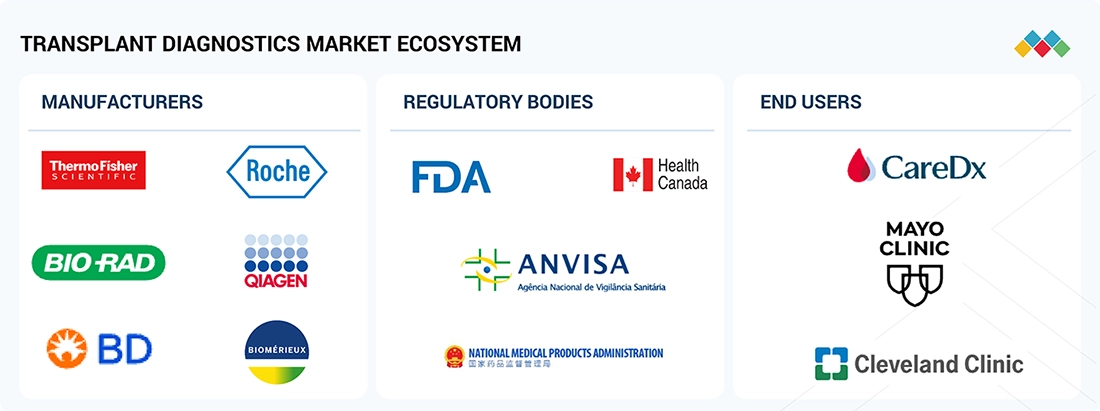
TRANSPLANT DIAGNOSTICS MARKET: COMMERCIAL USE CASES ACROSS INDUSTRIES
| COMPANY | USE CASE DESCRIPTION | BENEFITS |
|---|---|---|
 |
Provides PCR- and sequencing-based transplant diagnostic solutions for compatibility and infectious disease testing. | Accurate testing, rapid compatibility assessment, and efficient laboratory workflows. |
 |
Offers automated molecular diagnostic and donor screening solutions for transplantation procedures. | Fast turnaround time, automated workflows, and high-throughput testing. |
 |
Supplies molecular assay technologies and reagents for histocompatibility testing and blood profiling. | Reliable testing, improved precision, and efficient laboratory operations. |
 |
Provides molecular assays and sample preparation solutions for transplant diagnostics. | Efficient sample processing, accurate testing, and streamlined workflows. |
 |
Offers molecular diagnostic and infectious disease testing solutions for transplantation procedures. | Rapid pathogen detection, reliable testing, and improved patient management. |
Logos and trademarks shown above are the property of their respective owners. Their use here is for informational and illustrative purposes only.
Related Ecosystem
In Vitro Diagnostics
- Polymerase Chain Reaction (PCR)
- Enzyme-Linked Immunosorbent Assay (ELISA)
- Dna Microarrays
- Assay Kits
- Microarrays
- ROCHE HOLDINGS AG
- Thermo Fisher Scientific Inc.
- Danaher Corporation
- Abbott Laboratories
- Biomerieux s.a.
Medical Devices
- Polymerase Chain Reaction (PCR)
- Magnetic Resonance Imaging (MRI)
- Disposable Autoinjectors
- Pulse Oximeters
- Blood Pressure Monitors
- Medtronic plc
- Abbott Laboratories
- Stryker Corporation
- Becton, Dickinson and Company
- JOHNSON & JOHNSON
Key Takeaways
- North America's transplant diagnostics market is valued at $91.5 million in 2026 and will reach $104.4 million by 2031, growing at 6.3% CAGR.
- North America benefits from advanced healthcare infrastructure, strong reimbursement policies, and high adoption of precision diagnostic technologies.
- North America is experiencing increased demand for HLA typing, donor-specific antibody testing, and immunosuppressive drug monitoring solutions.
- North America's regulatory environment and investment in personalized transplant medicine are accelerating innovation in diagnostic assays through 2031.
Transplant Diagnostics Market Report Scope
| Report Metric | Details |
|---|---|
| Base Year | 2026 |
| Fastest Growing Segment | NEXT-GENERATION SEQUENCING (NGS) (Application) |
| Forecast Period | 2026–2031 |
| Growth Rate | CAGR of 7.8% from 2026 to 2031 |
| Largest Segment | INDEPENDENT REFERENCE LABORATORIES (Type) |
| Market Size Base Year (Billions) | ~USD 5.59 (2026) |
| Revenue Forecast (Billions) | ~USD 8.14 (2031) |
| Segments Covered | Product & Service, Application, End User, Type, Transplant Type, Technology |
Spain Transplant Diagnostics Market Report Segmentation
6 segment dimensions are covered across the global market.
By Product & Service
- Instruments
- Reagents & Consumables
- Software & Services
By Application
- Blood Profiling
- Diagnostic Applications
- Histocompatibility Testing
- Infectious Disease Testing
- Post-Transplantation Diagnostics
- Research Applications
By End User
- Hospitals & Surgical Centers
- Hospitals & Transplant Centers
- Independent Reference Laboratories
- Research Laboratories & Academic Institutes
By Type
- Blood Profiling
- Bone Marrow Transplantation
- Heart
- Heart Transplantation
- Histocompatibility Testing
- Infectious Disease Testing
- Kidney
- Kidney Transplantation
- Liver
- Liver Transplantation
- Lung
- Lung Transplantation
- Next-Generation Sequencing (Ngs)
- Ngs
- Other Organs
- Other Pcr-Based Molecular Assays
- Other Sequencing Technologies
- Other Sequencing-Based Molecular Assays
- Other Solid Organ Transplantation
- Pancreas
- Pancreas Transplantation
- Post-Transplantation Diagnostics
- Pre-Transplantation Diagnostics
- Real-Time Pcr
- Sanger Sequencing
- Sequence-Specific Oligonucleotide-Pcr (Sso-Pcr)
- Sequence-Specific Primer-Pcr (Ssp-Pcr)
- Soft Tissue Transplantation
- Solid Organ Transplantation
- Stem Cell Transplantation
By Transplant Type
- Bone Marrow Transplantation
- Heart
- Kidney
- Liver
- Lung
- Other Organs
- Pancreas
- Soft Tissue Transplantation
- Solid Organ Transplantation
- Stem Cell Transplantation
By Technology
- Non-Molecular Assay Technologies
- Pcr-Based Molecular Assays
- Sequencing-Based Molecular Assays
SPAIN: TRANSPLANT DIAGNOSTICS MARKET, BY END USER, 2024–2031
| Segment | 2024 | 2025 | 2026 | 2027 | 2028 | 2029 | 2030 | 2031 | CAGR (%) |
|---|---|---|---|---|---|---|---|---|---|
| HOSPITALS & TRANSPLANT CENTERS | 34 | 35.5 | 37.2 | 39.1 | 41.2 | 43.6 | 46.2 | 49.1 | 5.7 |
| INDEPENDENT REFERENCE LABORATORIES | 62.7 | 65.5 | 68.8 | 72.5 | 76.6 | 81.2 | 86.1 | 91.7 | 5.9 |
| RESEARCH LABORATORIES & ACADEMIC INSTITUTES | 6.2 | 6.5 | 6.7 | 7.1 | 7.5 | 7.9 | 8.3 | 8.8 | 5.5 |
| TOTAL | 102.9 | 107.5 | 112.7 | 118.6 | 125.3 | 132.6 | 140.6 | 149.6 | 5.8 |
Target Audience
- In Vitro Diagnostics (IVD) Manufacturers : Need Spain market data to assess commercial viability, competitive positioning, and regulatory requirements for launching transplant diagnostic assays and HLA typing solutions in Spanish healthcare systems.
- Hospital & Transplant Center Administrators : Require market insights to benchmark diagnostic spending, evaluate technology investments, and optimize transplant program outcomes through evidence-based procurement of diagnostic solutions.
- Healthcare Investment & Private Equity Firms : Seek Spain-specific market intelligence to identify acquisition targets, assess growth potential in transplant diagnostics, and evaluate investment returns in the Spanish healthcare sector.
- Medical Device Distributors & Suppliers : Need localized market data to understand demand patterns, identify distribution opportunities, and develop sales strategies for transplant diagnostic products across Spanish regions.
- Healthcare Policy & Government Agencies : Require market analysis to inform healthcare policy decisions, budget allocation for transplant programs, and strategic planning for improving transplant outcomes across Spain's healthcare network.
Key Companies in the Spain Transplant Diagnostics Market
| Company | HQ | Ownership | Strongest segments |
|---|---|---|---|
| KINDRED HEALTHCARE INC. | United States | Private Company | Long-term acute care hospitals (LTACH) – drug-intensive episodes,Inpatient rehabilitation facilities – medically complex rehab,Contract rehabilitation services in third-party facilities, |
| UNILABS | Switzerland | Private Company | Core laboratory testing,Medical imaging,Pathology and centres of excellence, |
| THERMO FISHER SCIENTIFIC INC. | United States | Public Company | Life Sciences Solutions,Analytical Instruments,Specialty Diagnostics, |
| BIO-RAD LABORATORIES, INC. | United States | Public Company | Clinical Diagnostics,Life Science, |
| QIAGEN N.V. | Netherlands | Public Company | Sample technology consumables and instruments,Molecular diagnostics (immune response, oncology, sexual and reproductive health),PCR and enzymes (research and applied testing), |
| BIOMéRIEUX | France | Public Company | Clinical microbiology (VITEK, BACT/ALERT, culture media, ETEST, API),Molecular diagnostics (BIOFIRE, SPOTFIRE, ARGENE, EMAG/NUCLISENS),Immunoassay and biomarkers (VIDAS, Hybiome CLIA), |
| ILLUMINA, INC. | United States | Public Company | Sequencing instruments,Sequencing consumables (reagents, flow cells, library prep),Array-based instruments and consumables, |
| BECTON, DICKINSON AND COMPANY | United States | Public Company | Medical Essentials (syringes, needles, vascular access, sharps, basic disposables),Connected Care (infusion therapy, medication management, pharmacy automation, informatics),BioPharma Systems (prefillable drug delivery, closed-system transfer devices), |
| CAREDX, INC. | United States | Public Company | dd-cfDNA transplant surveillance (AlloSure Kidney/Heart/Lung, AlloSeq cfDNA, AlloHome),Gene expression and multimodal testing (AlloMap Heart, HeartCare, HistoMap Kidney, AlloHeme),HLA typing and transplant lab solutions (QTYPE, Olerup SSP, AlloSeq Tx, AlloSeq HCT, Allocell), |
| DIASORIN S.P.A. | Italy | Public Company | Immunodiagnostics – Infectious and Gastrointestinal Diseases,Immunodiagnostics – Endocrinology and Metabolic Disorders,Oncology and Tumor Markers, |
| MERCK KGAA | Germany | Public Company | Life Science (reagents, consumables, instruments, bioprocessing, CDMO),Healthcare (oncology, neurology & immunology, fertility, rare diseases),Electronics (semiconductor and display materials, specialty gases, equipment), |
| HOLOGIC, INC. | United States | Private Company | Diagnostics (Aptima, Panther, ThinPrep, fetal fibronectin),Breast Health (3D mammography, biopsy, localization, software),GYN Surgical (MyoSure, NovaSure, Fluent, Acessa, CoolSeal), |
| EUROBIO SCIENTIFIC | France | Public Company | Infectious disease & molecular biology (EBX, EurobioPlex, biosafety),Transplantation & immunology (AlloMap, GenDx, immunology products),Oncology diagnostics (EndoPredict, Prolaris), |
KINDRED HEALTHCARE INC.
Kindred Healthcare Inc. is a large private healthcare services company founded in 1985 in the United States, employing 64,200 people. The company operates in the healthcare and medical services sector.
UNILABS
Unilabs is a private laboratory and diagnostics company founded in 1987 in Switzerland with 1,897 employees. The company offers clinical laboratory and diagnostic testing services.
THERMO FISHER SCIENTIFIC INC.
Thermo Fisher Scientific Inc. is a public multinational life sciences company founded in 1956 in the United States with 125,000 employees. The company provides laboratory equipment, reagents, and analytical instruments globally.
BIO-RAD LABORATORIES, INC.
Bio-Rad Laboratories, Inc. is a public life sciences and clinical diagnostics company founded in 1952 in the United States with 7,450 employees. The company manufactures and distributes products for the clinical laboratory and life sciences research markets.
QIAGEN N.V.
QIAGEN N.V. is a public molecular diagnostics and life sciences company founded in 1984 in the Netherlands with 5,500 employees. The company provides sample and assay technologies for molecular diagnostics and research.
BIOMéRIEUX
bioMérieux is a public in vitro diagnostics company founded in 1963 in France with 14,894 employees. The company specializes in microbiology and immunoassay diagnostic solutions.
ILLUMINA, INC.
Illumina, Inc. is a public genomics and life sciences company founded in 1998 in the United States with 8,625 employees. The company develops and manufactures DNA sequencing and genetic analysis systems.
BECTON, DICKINSON AND COMPANY
Becton, Dickinson and Company is a public medical technology company founded in 1897 in the United States with 72,000 employees. The company manufactures and sells medical devices, laboratory equipment, and diagnostic products worldwide.
CAREDX, INC.
CareDx, Inc. is a public molecular diagnostics company founded in 1998 in the United States with 763 employees. The company develops and offers diagnostic solutions for transplant patients.
DIASORIN S.P.A.
DiaSorin S.p.A. is a public in vitro diagnostics company founded in 1968 in Italy with 3,242 employees. The company manufactures and distributes diagnostic products for clinical laboratories.
MERCK KGAA
Merck KGaA is a public pharmaceutical, chemical, and life sciences company founded in 1668 in Germany with 59,077 employees. The company operates globally in healthcare, life sciences, and performance materials sectors.
HOLOGIC, INC.
Hologic, Inc. is a private medical technology company founded in 1985 in the United States with 7,070 employees. The company develops and manufactures diagnostic and medical imaging products.
EUROBIO SCIENTIFIC
Eurobio Scientific is a public in vitro diagnostics company founded in 1997 in France with 343 employees. The company specializes in diagnostic reagents and laboratory solutions.
Reasons to Buy this Report
- Market-Specific Sizing & Forecasts : Obtain precise Spain-focused market valuations ($91.5M in 2026, $104.4M in 2031) with localized CAGR data to support investment decisions and business planning in the Spanish transplant diagnostics sector.
- Competitive Landscape Intelligence : Identify leading diagnostic providers, emerging players, and market share distribution specific to Spain's transplant centers, enabling targeted partnership and expansion strategies.
- Regulatory & Reimbursement Insights : Understand Spain's unique healthcare reimbursement policies, EU compliance requirements, and regulatory pathways for transplant diagnostic products to accelerate market entry and commercialization.
- Growth Driver Analysis : Analyze Spain-specific factors driving market growth including transplant volume trends, healthcare spending patterns, and adoption of advanced diagnostic technologies in Spanish hospitals.
- Strategic Market Entry Planning : Leverage Spain-specific data to develop localized go-to-market strategies, identify key opinion leaders, and prioritize regions with highest transplant diagnostic demand and growth potential.
Frequently asked questions
What is the current size of the transplant diagnostics market in North America?
North America's transplant diagnostics market is valued at $91.5 million in 2026 and is expected to grow to $104.4 million by 2031.
What is the projected growth rate for North America's transplant diagnostics market?
North America's transplant diagnostics market is projected to grow at a compound annual growth rate (CAGR) of 6.3% from 2026 to 2031.
What are the main drivers of growth in North America's transplant diagnostics market?
Key drivers in North America include increasing organ transplant volumes, rising demand for immunosuppressive monitoring, advances in diagnostic technologies, robust reimbursement frameworks, and investment in personalized transplant medicine.
Which diagnostic tests are most in demand in North America's transplant market?
North America shows strong demand for HLA typing, donor-specific antibody (DSA) detection, organ function monitoring assays, and immunosuppressive drug level testing.
How does North America's regulatory environment support transplant diagnostics innovation?
North America's regulatory framework enables rapid innovation and commercialization of new diagnostic assays, supported by strong healthcare infrastructure and favorable reimbursement policies that encourage development of advanced testing solutions.
RESEARCH METHODOLOGY
The objective of this study is to analyze the key market dynamics, including drivers, opportunities, constraints, challenges, and strategies employed by key players. We will track developments within companies, such as acquisitions, product launches, expansions, agreements, and partnerships, to assess the competitive landscape of the transplant diagnostics market. This analysis will evaluate market players across various parameters within the broader categories of business and product strategy.
To estimate the market size, both top-down and bottom-up approaches were utilized. The market breakdown and data triangulation were employed to determine the sizes of segments and subsegments.
The four steps involved in estimating the market size are:
Secondary Research
In the secondary research process, various secondary sources such as annual reports, press releases & investor presentations of companies, white papers, certified publications, articles by recognized authors, gold-standard & silver-standard websites, regulatory bodies, and databases (such as D&B Hoovers, Bloomberg Business, and Factiva) were referred to identify and collect information for this study.
Primary Research
In the primary research process, various sources from both the supply and demand sides were interviewed to obtain qualitative and quantitative information for this report. Primary sources were mainly industry experts from the core and related industries, as well as preferred suppliers, manufacturers, distributors, service providers, technology developers, researchers, and organizations across all segments of this industry’s value chain. In-depth interviews were conducted with various primary respondents, including key industry participants, subject-matter experts, C-level executives at key market players, and industry consultants, to obtain and verify critical qualitative and quantitative information and to assess prospects.
The following is a breakdown of the primary respondents:
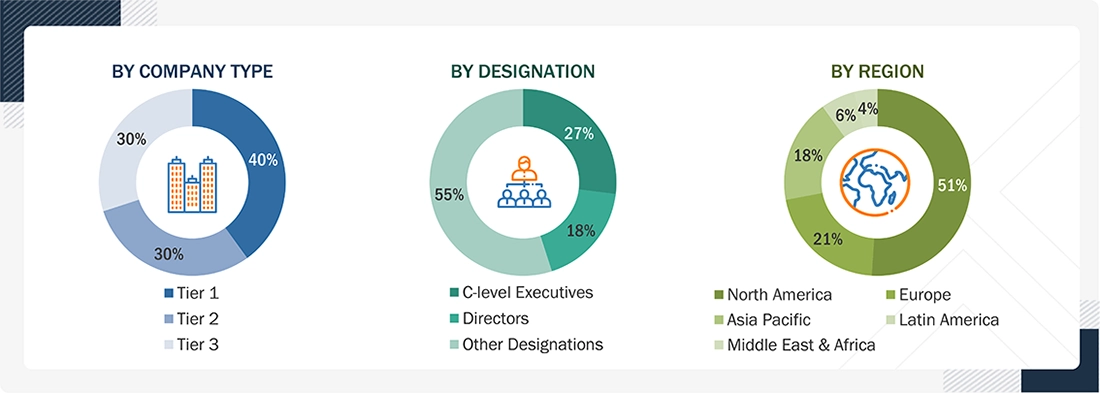
Note 1: Other designations include sales, marketing, and product managers.
Note 2: Companies are classified into tiers based on their total revenues. As of 2025, Tier 1 = >USD 100 million, Tier 2 = USD 10 million to USD 100 million, and Tier 3 = <USD 10 million.
|
COMPANY NAME |
DESIGNATION |
|
Thermo Fisher Scientific Inc. (US) |
Sales Manager |
|
F. Hoffmann-La Roche AG (Switzerland) |
Product Manager |
To know about the assumptions considered for the study, download the pdf brochure
Market Size Estimation
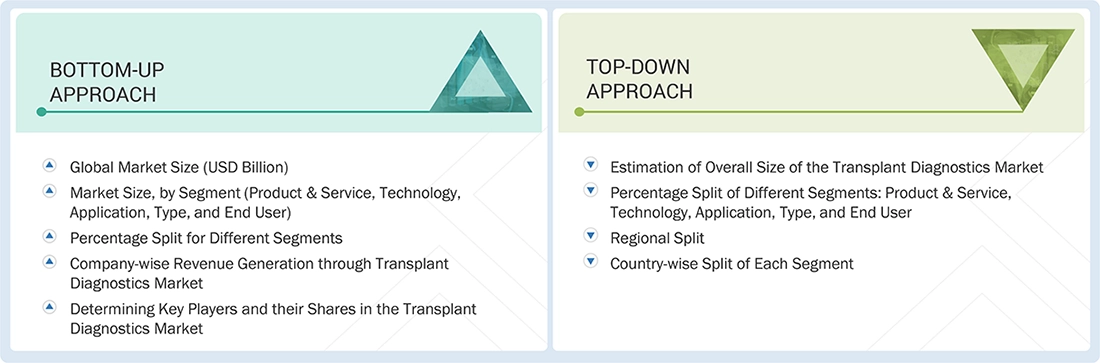
Both top-down and bottom-up approaches were used to estimate and validate the total size of the transplant diagnostics market. These methods were also used extensively to estimate the size of various subsegments in the market. The research methodology used to estimate the market size includes the following:
- The key players in the industry have been identified through extensive secondary research.
- The revenues generated by leading players operating in the transplant diagnostics market have been determined through primary and secondary research.
- All percentage shares, splits, and breakdowns have been determined using secondary sources and verified through primary sources.
The research methodology used to estimate the market size includes the following:
Transplant Diagnostics Market : Top-Down and Bottom-Up Approach
Data Triangulation
After arriving at the overall market size using the process described above, the total market was split into several segments and subsegments. To complete the overall market engineering process and obtain the exact statistics for all segments and subsegments, data triangulation and market breakdown procedures were employed wherever applicable. The data was triangulated by studying various factors and trends from both the demand and supply sides.
Market Definition
Transplant diagnostic procedures are used to determine donor-recipient compatibility to avoid the risk of immune rejection in a recipient. These procedures are adopted for donor-recipient cross-matching, subject profiling, genotyping, and other related diagnostic tests. Advanced genomic techniques (such as PCR and NGS) are increasingly used in transplant diagnostic procedures, alongside serological and other conventional techniques for immunocompatibility testing (such as antibody-antigen reactions and leucocyte assays).
Key Stakeholders
- Transplant diagnostic product manufacturing companies
- Healthcare service providers (including hospitals, transplant centers, and blood transfusion centers)
- Blood, tissue, and stem cell banks
- Government organizations
- Independent associations & regulatory authorities
- R&D companies
- Independent reference laboratories
- Diagnostic laboratories
- Clinical research organizations
Report Objectives
- To define, segment, and forecast the transplant diagnostics market by product & service, technology, application, type, end user, and region
- To provide detailed information regarding the major factors influencing market growth (such as drivers, restraints, opportunities, and challenges)
- To analyze micromarkets with respect to individual growth trends, prospects, and contributions to the overall market
- To analyze market opportunities for stakeholders and provide details of the competitive landscape for key players
- To forecast the size of the market segments with respect to five regions: North America, Europe, the Asia Pacific, Latin America, and the Middle East & Africa.
- To profile key players and comprehensively analyze their product portfolios, market positions, and core competencies
- To benchmark players within the market using the proprietary Company Evaluation Matrix framework, which analyzes market players on various parameters within the broad categories of business and product excellence
- To study the impact of AI on the market, along with the macroeconomic outlook for each region
Available customizations:
MarketsandMarkets offers the following customizations for this market report.
Product Analysis
- Product matrix, which provides a detailed comparison of the product portfolio of each company in the transplant diagnostics market
Company Profiles
- Additional five company profiles of players operating in the transplant diagnostics market.
Country Information
- Additional country-level analysis of the transplant diagnostics market
Get the Full Transplant Diagnostics Market Report
Full forecast, segment splits, and company analysis for all Transplant Diagnostics Market.
- Italy Transplant Diagnostics Market
- China Transplant Diagnostics Market
- Japan Transplant Diagnostics Market
- India Transplant Diagnostics Market
- Australia Transplant Diagnostics Market
- US Transplant Diagnostics Market
- Canada Transplant Diagnostics Market
- Germany Transplant Diagnostics Market
- UK Transplant Diagnostics Market
- France Transplant Diagnostics Market
Need a Tailored Report?
Customize this report to your needs
Get 10% FREE Customization
Customize This Report
