
GCC Countries Graphite Market (2024-2029)

The GCC Countries Graphite Market was valued at $428.5 Million in 2024 and projected to reach to $695 Million by 2029, representing a compound annual growth rate of 8.4%. The GCC Countries graphite market is positioned for steady growth driven by regional industrialization and the transition toward renewable energy storage solutions.


| Market Size in | USD 26.32 MN |
| Market Forecast in | |
| CAGR | |
| Forecast Period | |
| Units Considered | Value (USD MN) |
GCC Countries Graphite Market Trends and Insights
- GCC Countries' graphite sector is driven by rising demand from battery manufacturing, refractories, and industrial applications across the region.
- The 8.4% compound annual growth rate reflects GCC Countries' strategic positioning in energy storage and advanced materials sectors, supported by regional investments in renewable energy infrastructure and electric vehicle adoption. GCC Countries' graphite market benefits from proximity to key petrochemical and manufacturing hubs, as well as government initiatives promoting industrial diversification.
- Between 2024 and 2029, GCC Countries is expected to capture increasing market share through enhanced production capacity and supply chain integration.
- The region's focus on sustainability and technological advancement positions GCC Countries as a critical player in the Middle East Africa graphite landscape, with applications spanning lithium-ion batteries, thermal management, and specialty chemicals..
Key Market Statistics
- CAGR (2024-2029) 8.4% CAGR
- Market Size, 2024 ~USD 428.5 Million
- Forecast, 2029 ~USD 695 Million
- Country GCC Countries
GCC Countries Graphite Market Overview
Market Size & Growth :
GCC Countries' graphite market reached $428.5 million in 2024 and is projected to grow to $695.0 million by 2029, representing an 8.4% CAGR, demonstrating robust regional expansion.
Battery Manufacturing Surge :
Rising EV adoption and energy storage initiatives across GCC nations are driving significant demand for graphite in battery production, positioning the region as a key growth market.
Refractories & Industrial Applications :
GCC Countries' steel, cement, and petrochemical industries are major consumers of graphite refractories, supporting sustained demand from established industrial sectors.
Strategic Regional Position :
GCC Countries' geographic location, oil & gas infrastructure, and investment in diversification initiatives create unique opportunities for graphite market expansion through 2029.
GCC Countries Graphite Market Dynamics
- Government initiatives promoting battery manufacturing and electric vehicle adoption are creating new demand vectors for graphite applications.
- The region's established refractories sector continues to provide a stable revenue base, while emerging battery and advanced materials applications represent significant growth opportunities. By 2029, GCC Countries is expected to capture increasing market share within the broader Middle East region.
- Strategic investments in manufacturing capabilities, coupled with proximity to key energy markets, will enhance the region's competitive positioning.
- The 8.4% CAGR reflects moderate but consistent expansion, supported by both traditional industrial demand and emerging technology-driven applications in energy storage and advanced materials..
Market Ecosystem
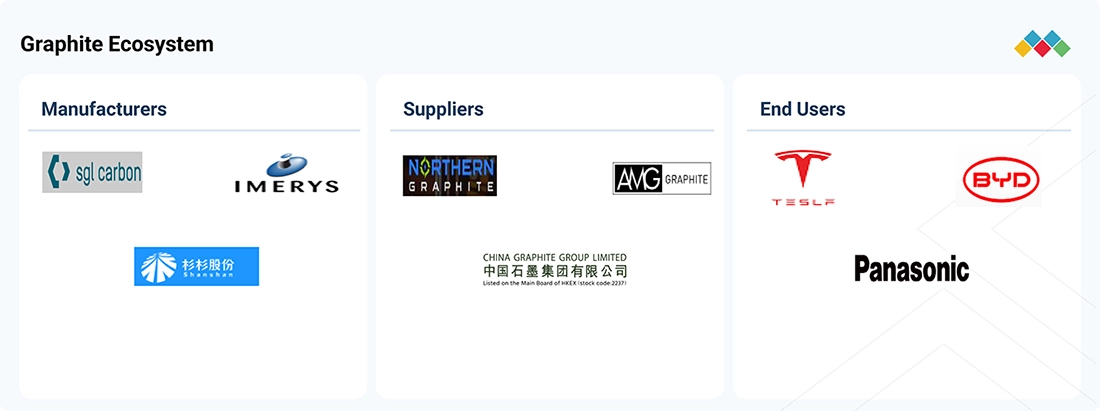
GRAPHITE MARKET SIZE, SHARE & FORECAST 2024-2030: COMMERCIAL USE CASES ACROSS INDUSTRIES
| COMPANY | USE CASE DESCRIPTION | BENEFITS |
|---|---|---|
 |
Shanshan supplies synthetic graphite, natural graphite, and graphite composite materials used as anode materials in lithium-ion batteries for electric vehicles, consumer electronics, and battery energy storage systems. | Supports high energy and power density in lithium-ion batteries, enabling their use in electric vehicles and energy storage systems | Supports battery performance across consumer electronics and other applications requiring reliable energy storage |
 |
SGL Carbon supplies specialty graphite materials, including battery felts, bipolar plates, and expanded graphite products for redox flow batteries, other electrochemical energy storage systems, and battery thermal management applications. | Facilitates efficient charging and discharging in energy storage systems | Supports electrical conductivity, corrosion protection, and heat dissipation | Helps improve battery system functionality and thermal management |
 |
Resonac supplies graphite electrodes for electric arc furnaces used in steel production and recycling, as well as artificial graphite anode materials for lithium-ion batteries. Its graphite products also serve non-ferrous metal smelting applications | Electrical conductivity and heat resistance required to melt scrap steel efficiently in electric arc furnaces | Supports lithium-ion storage capacity, discharge performance, and battery operation at low temperatures |
 |
GrafTech manufactures UCAR graphite electrodes for electric arc furnace steelmaking, offering multiple grades and sizes for different furnace operating conditions, including high-power and ultra-high-power applications. | Conducts high electrical currents | Withstands extreme furnace temperatures, enabling steelmakers to melt scrap metal and produce new steel | GrafTech's electrode solutions and technical services help furnace operators improve productivity, manage electrode consumption, and reduce operating costs |
 |
Imerys supplies natural and synthetic graphite, graphite-based active materials, and conductive carbon additives for lithium-ion batteries. Its product portfolio supports battery anodes and electrode formulations used in electric vehicles and other energy storage applications. | Helps enhance battery conductivity, charging performance, and energy storage characteristics | Selected graphite grades improve reversible capacity and low-temperature performance | Conductive additives support electrode stability and help optimize battery performance |
Logos and trademarks shown above are the property of their respective owners. Their use here is for informational and illustrative purposes only.
Related Ecosystem
Bulk Chemicals And Inorganics
- Corrosion Inhibitors
- Glycol Ethers
- Acetic Acid
- Acetone
- Ammonium Nitrate
- Basf se
- DOW CHEMICAL COMPANY
- Exxon Mobil Corporation
- AZELIS HOLDINGS SA
- Sinopec limited
Key Takeaways
- GCC Countries' graphite market is valued at $428.5 million in 2024 and is forecast to grow to $695.0 million by 2029, representing an 8.4% CAGR.
- Battery manufacturing and energy storage applications are primary growth drivers for GCC Countries' graphite demand.
- GCC Countries benefits from strategic geographic positioning and government-backed industrial diversification initiatives.
- The region's focus on renewable energy and EV infrastructure creates sustained long-term demand for graphite in GCC Countries.
Graphite Market Report Scope
| Report Metric | Details |
|---|---|
| Base Year | 2024 |
| Fastest Growing Segment | BATTERY (Application) |
| Forecast Period | 2024-2029 |
| Growth Rate | CAGR of 15.1% from 2024 to 2029 |
| Largest Segment | HIGH (Voltage) |
| Market Size Base Year (Billions) | ~USD 15.65 (2024) |
| Revenue Forecast (Billions) | ~USD 31.62 (2029) |
| Segments Covered | Application, Purity, Type, Form, Voltage |
GCC Countries Graphite Market Report Segmentation
5 segment dimensions are covered across the global market.
By Application
- Battery
- Electrode
- Friction Product
- Friction Products
- Lubricant
- Other Applications
- Refractory & Foundry
By Purity
- High Purity
- Low Purity
By Type
- Natural Graphite
- Synthetic Graphite
By Form
- Amorphous
- Flake
- Vein
By Voltage
- High
- Low
- Medium
Target Audience
- Graphite Producers & Suppliers : Need regional market data to identify GCC Countries as a growth market, assess demand from battery and refractories sectors, and plan supply chain strategies.
- Battery & EV Manufacturers : Require insights into GCC Countries' graphite availability and pricing to support battery production expansion and secure reliable sourcing for regional operations.
- Industrial & Refractories Companies : Seek market intelligence on graphite demand from steel, cement, and petrochemical sectors in GCC Countries to optimize product offerings and market positioning.
- Investment & Private Equity Firms : Need comprehensive market analysis to evaluate investment opportunities in graphite-related businesses and manufacturing ventures across GCC Countries.
- Government & Economic Development Agencies : Require market data to support industrial policy decisions, identify sector growth potential, and attract foreign investment in graphite and advanced materials sectors.
Reasons to Buy this Report
- Regional Market Sizing : Obtain precise market valuation data specific to GCC Countries, enabling accurate budget allocation and investment decisions for regional operations and expansion strategies.
- Growth Trajectory Analysis : Understand the 8.4% CAGR dynamics and forecast to 2029, allowing stakeholders to anticipate market evolution and plan capacity investments accordingly.
- Sector-Specific Demand Drivers : Identify key demand sources including battery manufacturing, refractories, and industrial applications unique to GCC Countries' economic landscape and industrial base.
- Competitive Positioning : Benchmark your operations against regional market trends and understand GCC Countries' position relative to global graphite markets for strategic advantage.
- Investment & Expansion Planning : Leverage detailed GCC-specific insights to evaluate market entry opportunities, partnership potential, and resource allocation for manufacturing and distribution initiatives.
Frequently asked questions
What is the current market size of graphite in GCC Countries?
The graphite market in GCC Countries was valued at $428.5 million in 2024.
What is the projected market size for graphite in GCC Countries by 2029?
GCC Countries' graphite market is projected to reach $695.0 million by 2029.
What is the CAGR for graphite in GCC Countries?
The graphite market in GCC Countries is expected to grow at a compound annual growth rate of 8.4% from 2024 to 2029.
Which applications drive graphite demand in GCC Countries?
Primary applications in GCC Countries include lithium-ion battery manufacturing, refractories, thermal management, and specialty chemicals.
What factors support graphite market growth in GCC Countries?
Growth in GCC Countries is supported by renewable energy investments, electric vehicle adoption, industrial diversification initiatives, and proximity to petrochemical hubs.
RESEARCH METHODOLOGY
The estimation of the current size of the graphite market involved a four-step methodology. Initially, secondary research included all pertinent information about the market itself, as well as related and parent markets. These results, along with assumptions and metrics, were validated with primary research that involved experts from both the supply and demand sides of the graphite value chain. Total market size was determined through a top-down and bottom-up approach. Finally, the market sizes for various segments and subsegments were found using comprehensive market segmentation and data triangulation techniques.
Secondary Research
The research methodology followed in estimating the current graphite market size consisted of four significant activities. Extensive secondary research was conducted to provide information on the market, peer markets, and parent markets. These findings, assumptions, and metrics were validated through primary research undertaken with experts from the demand side of the graphite value chain. Both top-down and bottom-up approaches were followed for the estimation of the total market size. The complete market segmentation and data triangulation techniques were applied for the final estimation of various segments and subsegments.
Primary Research
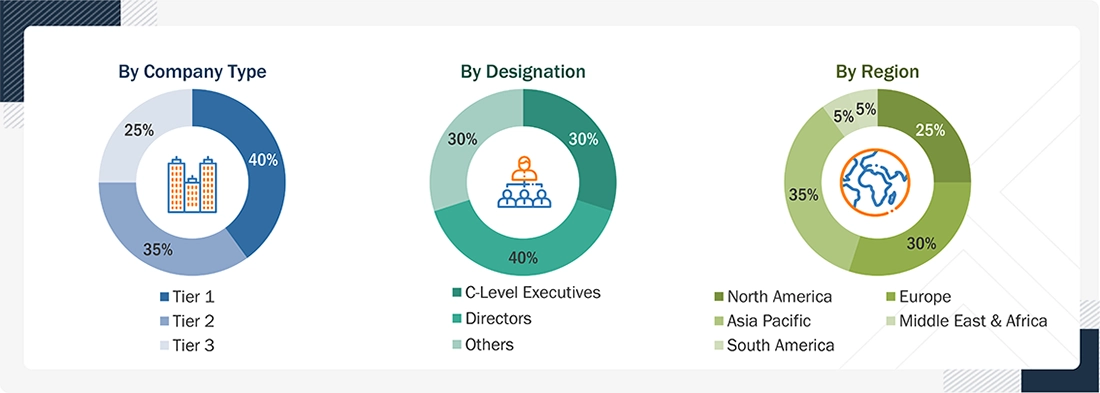
The graphite market comprises several stakeholders in the supply chain, such as graphite producers and Miners, graphite processing and refining companies, manufacturers, distributors and traders, government and regulatory bodies, and end users. The development of EVs, metallurgy, electronics, textiles, and construction defines the demand side of this market. Interviews were conducted with various primary sources on both the supply and demand sides of the market to gather qualitative and quantitative data.
To know about the assumptions considered for the study, download the pdf brochure
Market Size Estimation
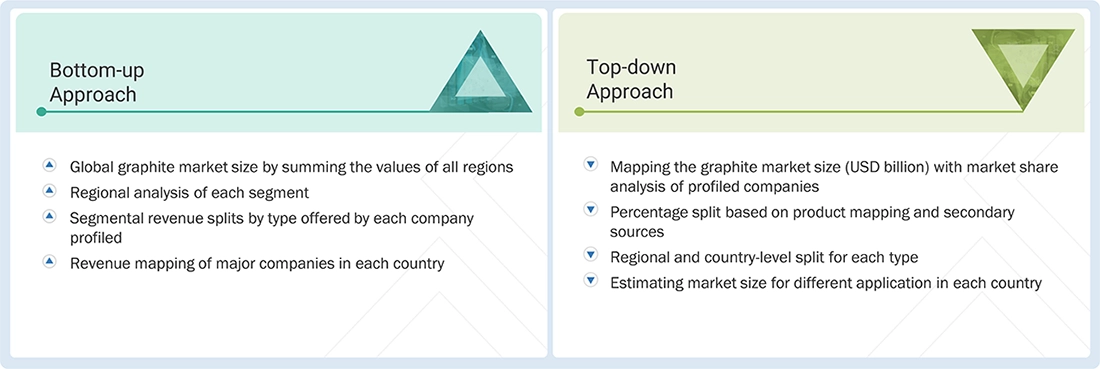
Top-down and bottom-up approaches were used to estimate and validate the size of the graphite market. These methods were used to determine the market size of various segments
The research methodology used for the market size estimation is as follows:
- Extensive primary and secondary research was done to identify the key players.
- The value chain and market size of the graphite market, in terms of value, were determined through primary and secondary research.
- All percentage shares, splits, and breakdowns were collected through secondary sources and verified through primary sources.
- All possible parameters that affect the market were covered in this research study and are viewed in extensive detail, verified through primary research, and analyzed to obtain the final quantitative and qualitative data.
- This research includes the study of reports, reviews, and newsletters of top market players, along with extensive interviews for opinions from key leaders, such as CEOs, directors, and marketing executives.
Graphite Market Size: Bottom-Up & Top-Down Approach
Data Triangulation
After estimating the overall market size using the above estimation, the market was split into various segments and subsegments. Data triangulation, market breakup techniques, and the market engineering process were used to reach the exact market analysis data for each segment and subsegment. Data triangulation and market breakdown procedures were used wherever applicable. The data was triangulated by studying various factors and trends from the demand and supply sides. The market size was also validated using the top-down and bottom-up approaches.
Market Definition
Graphite is a semimetal and possesses good electrical conductivity properties. It is a form of crystalline carbon, in which carbon atoms are densely arranged in parallel-stacked, planar honeycomb lattice sheets. The demand for graphite is directly dependent on the growth of its application industries, including electric vehicles, energy storage devices, refractories, foundry, batteries, friction products, and lubricants. Graphite is used across various end-use industries, such as aerospace & defense, steel, and automotive, since it is lightweight and has excellent strength. Graphite-based composites are used in the manufacturing of automotive parts, such as exterior body parts, hoods, bonnets, test plates, suspension struts, and chassis, among others. There has been a growing demand for graphite, particularly in battery technologies in electric vehicles
Key Stakeholders
- Graphite Producers and Miners
- Graphite Processing and Refining Companies
- Electric Vehicle (EV) Manufacturers
- Distributors and Traders
- Research and Development Institutions
- Regulatory Bodies
- NGOs, Governments, Investment Banks, Venture Capitalists, and Private Equity Firms
- Consumers and End Users
Report Objectives
- To define, describe, and forecast the size of the global graphite market in terms of value and volume
- To provide detailed information regarding the key factors, such as drivers, restraints, opportunities, and industry-specific challenges, influencing the market growth
- To analyze and forecast the size of various segments (type, purity, and application) of the market based on five major regions—North America, Europe, Asia Pacific, Middle East & Africa, and South America—along with key countries in each region
- To analyze recent developments and competitive strategies, such as expansions, new product developments, partnerships, and acquisitions, to draw the market's competitive landscape
- To strategically profile the key players in the market and comprehensively analyze their core competencies
Available customizations:
With the given market data, MarketsandMarkets offers customizations according to client-specific needs.
The following customization options are available for the report:
- Additional country-level analysis of the graphite market
- Profiling of additional market players (up to 5)
Product Analysis
- Product matrix, which gives a detailed comparison of the product portfolio of each company.
Get the Full Graphite Market Report
Full forecast, segment splits, and company analysis for all Graphite Market.
- China Graphite Market
- India Graphite Market
- Japan Graphite Market
- South Korea Graphite Market
- Canada Graphite Market
- Mexico Graphite Market
- US Graphite Market
- Germany Graphite Market
- UK Graphite Market
- France Graphite Market
- Italy Graphite Market
- Spain Graphite Market
- Brazil Graphite Market
- Chile Graphite Market
- Argentina Graphite Market
- South Africa Graphite Market
- Rest Of Europe Graphite Market
- Rest Of Asia Pacific Graphite Market
- -Rest Of GCC Countries Graphite Market
- Rest Of South America Graphite Market
Need a Tailored Report?
Customize this report to your needs
Get 10% FREE Customization
Customize This Report
