
Rest of World Haptic Technology Market (2025-2030)

The Rest of World Haptic Technology Market was valued at $1879.9 Million in 2025 and projected to reach to $2053.1 Million by 2030, representing a compound annual growth rate of 1.8%. The Rest of World haptic technology market demonstrates steady but conservative growth, expanding from $1,879.9 million in 2025 to $2,053.1 million by 2030 at a 1.8% CAGR.


| Market Size in | USD 26.32 MN |
| Market Forecast in | |
| CAGR | |
| Forecast Period | |
| Units Considered | Value (USD MN) |
Rest of World Haptic Technology Market Trends and Insights
- Force feedback technology enables tactile responses through mechanical resistance and pressure simulation, enhancing user immersion across gaming, automotive, and industrial applications.
- This segment is projected to grow to $2,053.1 million by 2030, reflecting steady adoption driven by increasing demand for realistic haptic experiences in consumer electronics and professional equipment. Force feedback mechanisms are integral to next-generation user interfaces, particularly in gaming controllers, steering wheels, and robotic systems where precise tactile communication is essential.
- The segment's modest 1.8% CAGR between 2025 and 2030 indicates a maturing market with consistent but measured expansion.
- Force technology continues to benefit from advancements in actuator design and integration capabilities, though market growth remains constrained by cost considerations and technical complexity compared to simpler vibration-based alternatives..
Key Market Statistics
- CAGR (2025-2030) 1.8% CAGR
- Market Size, 2025 ~USD 1879.9 Million
- Forecast, 2030 ~USD 2053.1 Million
- Geography Rest of World
Rest of World Haptic Technology Market Overview
Modest Growth Trajectory :
Rest of World haptic technology market is expanding at 1.8% CAGR, significantly below the global average of 4.5%, indicating emerging adoption patterns and untapped market potential in developing regions.
Force Feedback Dominance :
Force feedback technology commands the Rest of World segment, valued at $1,879.9 million in 2025, driven by increasing demand in gaming consoles, automotive haptic systems, and industrial automation across emerging economies.
Conservative Market Expansion :
The segment is projected to reach $2,053.1 million by 2030, representing a $173.2 million incremental gain, reflecting steady but cautious market penetration in regions with developing consumer electronics infrastructure.
Regional Opportunity Gap :
Rest of World's lower CAGR compared to global benchmarks suggests significant untapped opportunities for haptic technology adoption in emerging markets, particularly in Asia-Pacific, Latin America, and Africa regions.
Rest of World Haptic Technology Market Dynamics
- This slower growth rate compared to the global 4.5% CAGR reflects the region's developing market maturity, limited consumer awareness, and infrastructure constraints in emerging economies.
- However, increasing smartphone penetration, rising gaming adoption, and automotive electrification initiatives present substantial growth catalysts. Key drivers include growing demand for immersive gaming experiences, expanding automotive haptic applications in emerging markets, and industrial automation adoption.
- Regional challenges such as price sensitivity, limited technology awareness, and fragmented distribution channels continue to moderate growth.
- Strategic investments in consumer education, localized product development, and partnerships with regional manufacturers are essential for accelerating market penetration and capturing the significant long-term potential in Rest of World markets..
Market Ecosystem
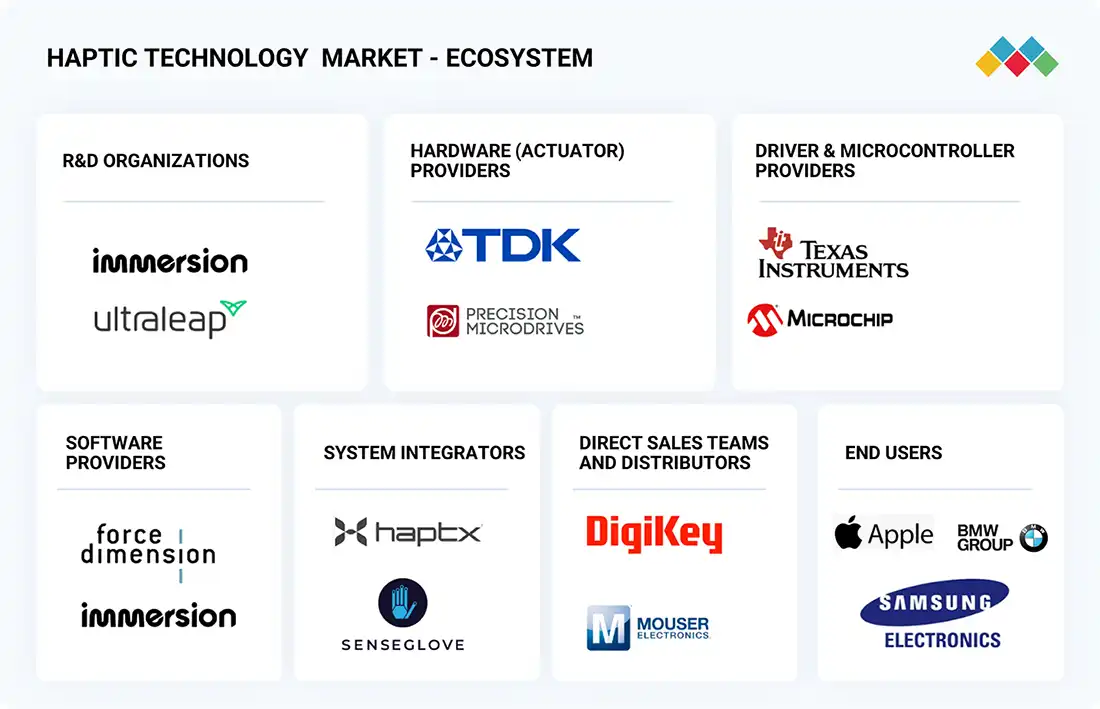
HAPTIC TECHNOLOGY MARKET: COMMERCIAL USE CASES ACROSS INDUSTRIES
| COMPANY | USE CASE DESCRIPTION | BENEFITS |
|---|---|---|
 |
Integration of haptic feedback in iPhones, Apple Watches, and trackpads using the Taptic Engine to provide precise vibrations and tactile responses for notifications, gestures, and immersive app experiences. | Enhanced user interaction, improved accessibility, more immersive notifications, and enriched gaming and app experiences, leading to higher user engagement and satisfaction. |
 |
Deployment of haptic-enabled smartphones, tablets, and wearables with advanced X-axis linear motors and vibration feedback systems for immersive touch, gaming, and AR experiences. | Improved tactile response, enhanced gaming and AR/VR experiences, better user satisfaction, and differentiated product offerings in competitive consumer electronics markets. |
 |
Incorporation of haptic feedback in automotive dashboards, steering wheels, and infotainment systems to deliver tactile alerts, enhance driver assistance, and improve in-car navigation. | Increased driver safety, reduced distraction, enhanced user interface experience, and improved customer perception of advanced technology in vehicles. |
 |
Use of haptic-enabled surgical tools and robotic systems to provide force feedback during minimally invasive procedures for enhanced precision and control. | Improved surgical accuracy, reduced risk of errors, better tactile perception for surgeons, and enhanced patient safety and procedure outcomes. |
Logos and trademarks shown above are the property of their respective owners. Their use here is for informational and illustrative purposes only.
Related Ecosystem
Automotive Electronics And Electrical Equipment
- Battery Electric Vehicle (BEV)
- Light Commercial Vehicles (LCVs)
- Fuel Cell Electric Vehicle (FCEV)
- Sensors
- Hybrid Electric Vehicle (HEV)
- BOSCH LIMITED
- DENSO Corporation
- Continental ag
- Panasonic Holdings Corporation
- Texas Instruments Incorporated
Augmented Virtual Reality
- Sensors
- Virtual Reality Devices
- Augmented Reality
- Virtual Reality
- Augmented Reality Devices
- MICROSOFT CORPORATION
- Lenovo
- VIVITEK CORPORATION
- Apple Inc.
Electronics System And Components
- Sensors
- Temperature Sensors
- Pressure Sensors
- Actuators
- Image Sensors
- Lenovo
- Samsung
- Texas Instruments Incorporated
- HONEYWELL INTERNATIONAL INC.
- Teledyne Technologies Incorporated
Key Takeaways
- Force feedback market valued at $1,879.9M in 2025, growing to $2,053.1M by 2030 at 1.8% CAGR
- Force technology dominates premium gaming and automotive segments requiring precise tactile control
- Force feedback adoption accelerating in professional robotics and surgical simulation applications
- Cost and complexity barriers limit Force segment growth compared to vibration-based alternatives
Haptic Technology Market Report Scope
| Report Metric | Details |
|---|---|
| Base Year | 2025 |
| Fastest Growing Segment | SOFTWARE (Component) |
| Forecast Period | 2025–2030 |
| Growth Rate | CAGR of 4.5% from 2025 to 2030 |
| Largest Segment | HARDWARE (Component) |
| Market Size Base Year (Billions) | ~USD 6.59 (2025) |
| Revenue Forecast (Billions) | ~USD 8.21 (2030) |
| Segments Covered | Feedback Type, Component, Hardware Type, Vertical, Actuator Type, Component 2021–2024, Hardware Type 2021–2024, Actuator Type 2021–2024 |
Rest of World Haptic Technology Market Report Segmentation
8 segment dimensions are covered across the global market.
By Feedback Type
- Force
- Tactile
By Component
- Hardware
- Software
By Hardware Type
- Actuators
- Drivers & Microcontrollers
By Vertical
- Automotive & Transportation
- Commercial
- Consumer Electronics
- Education & Research
- Healthcare
- Other Verticals
By Actuator Type
- Erm Actuators & Lras
- Piezoelectric Actuators
By Component 2021–2024
- Hardware
- Software
By Hardware Type 2021–2024
- Actuators
- Drivers & Microcontrollers
By Actuator Type 2021–2024
- Erm Actuators & Lras
- Piezoelectric Actuators
Target Audience
- Emerging Market Manufacturers : Haptic technology producers targeting Rest of World expansion need regional market sizing, growth forecasts, and competitive dynamics to optimize product localization and distribution strategies.
- Regional Electronics OEMs : Automotive, gaming, and consumer electronics manufacturers in emerging markets require Rest of World-specific haptic adoption trends and demand projections to inform component sourcing and product roadmaps.
- Investment & Private Equity Firms : Investors evaluating haptic technology opportunities in developing regions need detailed Rest of World market analysis, growth potential assessment, and regional risk factors for portfolio decisions.
- Technology Distributors & Resellers : Regional distribution partners require Rest of World market intelligence, segment valuations, and growth trajectories to identify high-potential product categories and geographic expansion opportunities.
- Strategic Business Planners : Corporate strategists developing emerging market initiatives need Rest of World haptic market data, competitive positioning insights, and regional growth drivers for long-term business planning.
Key Companies in the Rest of World Haptic Technology Market
| Company | HQ | Ownership | Strongest segments |
|---|---|---|---|
| JABIL | United States | Public Company | Regulated Industries (Healthcare, Automotive, Industrial),Intelligent Infrastructure (5G, Cloud, Networking, Storage),Connected Living & Digital Commerce, |
| TEXAS INSTRUMENTS INCORPORATED | United States | Public Company | Analog – Power,Analog – Signal Chain,Embedded Processing, |
| JOHNSON ELECTRIC HOLDINGS LIMITED | Hong Kong | Public Company | Automotive actuators, pumps, valves, and starters,AC, DC, and EC motors (incl. gearmotors and gearboxes),Switches, relays, solenoids, and haptic motion products, |
| AAC TECHNOLOGIES | China | Public Company | Acoustics Products,Electromagnetic Drives and Precision Mechanics (incl. haptics, casings),Optics Products (lenses, camera modules, actuators), |
| TDK CORPORATION | Japan | Public Company | Passive Components,Sensor Application Products,Magnetic Application Products, |
| MICROCHIP TECHNOLOGY INC. | United States | Public Company | Microcontrollers & Microprocessors,Analog, Power & Interface,FPGA & Aerospace/ASIC, |
| IMMERSION | United States | Public Company | Mobile devices and wearables IP licensing,Console gaming and mobile entertainment,Automotive, medical, and commercial interfaces, |
| SYNAPTICS INCORPORATED | United States | Public Company | Human Interface (touch, display, biometrics),Connectivity (Wi-Fi, Bluetooth, UWB, GNSS, Matter/Zigbee/Thread),Multimedia and Processor SoCs (DisplayLink, multimedia SoCs, video interface ICs), |
| ALPS ALPINE | Japan | Public Company | Component (TACT switches, potentiometers, actuators, microfluidic devices),Sensor and Communication (current, pressure, mmWave, magnetic, communication modules),Mobility Business (integrated displays, sound systems, shifters, controllers, car products), |
| CIRRUS LOGIC INC. | United States | Public Company | |
| INFINEON TECHNOLOGIES AG | Germany | Public Company |
JABIL
Jabil is a global manufacturing services company founded in 1966 that provides electronics design, production, and logistics solutions. With 135,000 employees, the publicly traded company serves diverse industries including automotive, healthcare, and consumer electronics.
TEXAS INSTRUMENTS INCORPORATED
Texas Instruments Incorporated is a semiconductor company founded in 1930 that designs and manufactures analog and embedded processing chips. The publicly traded company employs 33,000 people and serves markets including industrial, automotive, and communications.
JOHNSON ELECTRIC HOLDINGS LIMITED
Johnson Electric Holdings Limited is a Hong Kong-based manufacturer founded in 1959 specializing in electric motors and motion control products. The publicly traded company operates with 30,000 employees and serves automotive, industrial, and consumer applications.
AAC TECHNOLOGIES
AAC Technologies is a Chinese company founded in 1993 that manufactures acoustic components, haptic feedback systems, and precision parts. With 41,674 employees, the publicly traded company supplies major consumer electronics and telecommunications manufacturers.
TDK CORPORATION
TDK Corporation is a Japanese electronics company founded in 1935 that manufactures passive components, sensors, and magnetic materials. The publicly traded company employs 106,545 people and serves automotive, industrial, and consumer electronics markets.
MICROCHIP TECHNOLOGY INC.
Microchip Technology Inc. is a semiconductor company founded in 1989 that designs and manufactures microcontrollers and analog semiconductors. The publicly traded company employs 17,900 people and serves automotive, industrial, and consumer markets.
IMMERSION
Immersion is a United States-based company founded in 1993 that develops haptic feedback and tactile technology solutions. The publicly traded company employs 3,040 people and licenses its technology to consumer electronics, gaming, and automotive manufacturers.
SYNAPTICS INCORPORATED
Synaptics Incorporated is a United States company founded in 1986 that develops human interface solutions including touchpads and display drivers. The publicly traded company employs 1,700 people and supplies technology to consumer electronics manufacturers.
ALPS ALPINE
Alps Alpine is a Japanese company founded in 1948 that manufactures electronic components including switches, sensors, and connectors. The publicly traded company employs 25,924 people and serves automotive, industrial, and consumer electronics industries.
CIRRUS LOGIC INC.
Cirrus Logic Inc. is a United States semiconductor company founded in 1984 that designs audio and voice signal processing chips. The publicly traded company employs 1,660 people and supplies technology to consumer electronics and mobile device manufacturers.
INFINEON TECHNOLOGIES AG
Infineon Technologies AG is a German semiconductor company founded in 1952 that manufactures microcontrollers, power semiconductors, and sensors. The publicly traded company employs 56,500 people and serves automotive, industrial, and consumer markets globally.
Countries within Rest of World - compare and drill down
| Country | 2025 size (native) |
|---|
Country market size visualization
Reasons to Buy this Report
- Regional Market Differentiation : Gain exclusive insights into Rest of World haptic dynamics distinct from North American markets, enabling targeted strategies for emerging economy expansion and competitive positioning in underpenetrated regions.
- Growth Opportunity Identification : Identify high-potential emerging markets within Rest of World where haptic adoption is accelerating, supported by detailed CAGR analysis and market size projections through 2030.
- Competitive Intelligence : Understand regional competitive landscapes, market gaps, and localization requirements specific to Rest of World, informing product development and market entry strategies for emerging territories.
- Investment Decision Support : Access comprehensive market valuation data ($1,879.9M baseline) and growth forecasts to support capital allocation decisions, partnership evaluations, and expansion planning in Rest of World regions.
- Strategic Planning Insights : Leverage detailed segment analysis and regional outlook to develop long-term strategies addressing the 1.8% CAGR growth environment and identifying catalysts for accelerated market penetration.
Frequently asked questions
What is Force feedback in haptic technology?
Force feedback is a haptic technology that provides tactile responses through mechanical resistance and pressure simulation, allowing users to feel directional forces and weight in digital interactions.
What is the market size of Force feedback in 2025?
The Force feedback segment is valued at $1,879.9 million in 2025 and is projected to reach $2,053.1 million by 2030.
What is the CAGR for Force feedback technology?
The Force feedback segment is expected to grow at a compound annual growth rate (CAGR) of 1.8% from 2025 to 2030.
Which industries use Force feedback technology?
Force feedback is widely used in gaming controllers, automotive steering systems, robotic applications, surgical simulation, and professional training equipment.
Why is Force feedback growth slower than other haptic types?
Force feedback growth is constrained by higher manufacturing costs, technical complexity, and power requirements compared to simpler vibration-based haptic alternatives.
RESEARCH METHODOLOGY
The research study involved four major activities in estimating the haptic technology market size. Exhaustive secondary research has been done to collect important information about the market and peer markets. The next step has been to validate these findings and assumptions and size them with the help of primary research with industry experts across the value chain. Both top-down and bottom-up approaches have been used to estimate the market size. The market breakdown and data triangulation have been adopted to estimate the market sizes of segments and sub-segments.
Secondary Research
Various secondary sources were consulted in the secondary research process to identify and collect information required for this study. These sources include annual reports, press releases, investor presentations of companies, white papers, and articles from recognized authors. Secondary research has been mainly done to obtain key information about the market’s value chain, the pool of key market players, market segmentation according to industry trends, regional outlook, and developments from both market and technology perspectives.
Primary Research
In primary research, various sources from both the supply and demand sides have been interviewed to obtain the qualitative and quantitative insights required for this report. Primary sources from the supply side include experts such as CEOs, vice presidents, marketing directors, manufacturers, technology and innovation directors, end users, and related executives from multiple key companies and organizations operating in the haptic technology market ecosystem. After interacting with industry experts, brief sessions were conducted with highly experienced independent consultants to reinforce the findings from our primary research. This, along with the in-house subject matter experts’ opinions, has led us to the findings as described in the report. The breakdown of primary respondents is as follows:
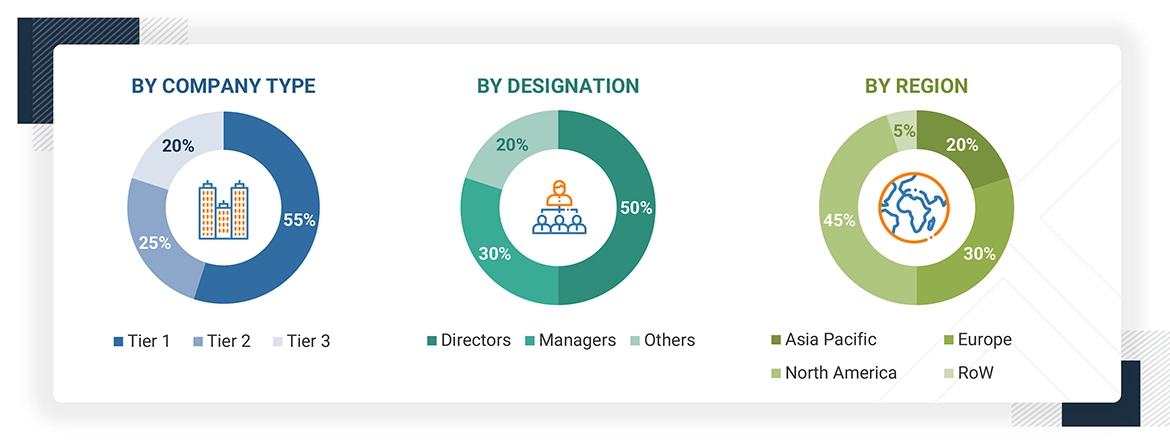
Note: Others include sales, marketing, and product managers
To know about the assumptions considered for the study, download the pdf brochure
Market Size Estimation
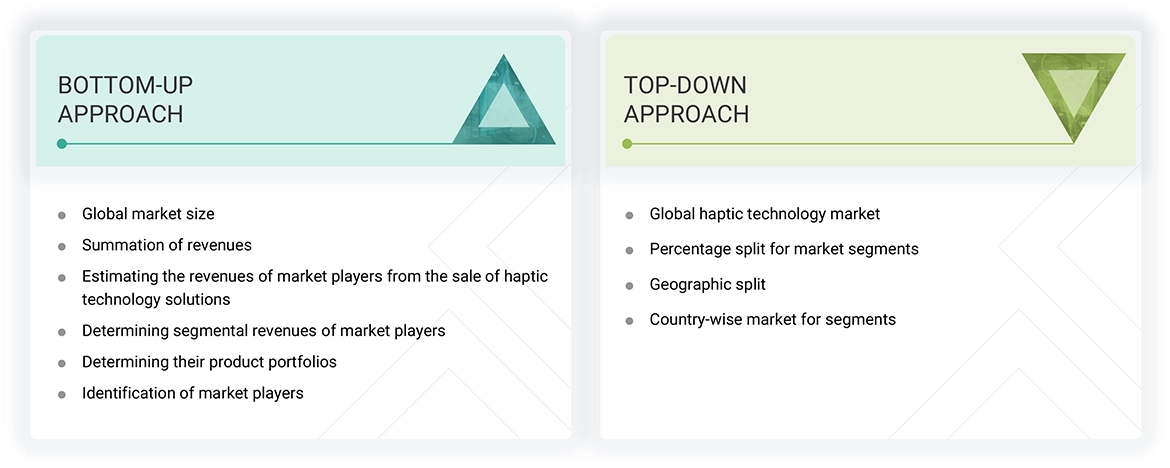
In the market engineering process, both top-down and bottom-up approaches and data triangulation methods have been used to estimate and validate the size of the haptic technology market and other dependent submarkets. The research methodology used to estimate the market sizes includes the following:
The bottom-up procedure has been employed to arrive at the overall size of the haptic technology market.
- Major companies that provide haptic technology components were identified. This included analyzing company portfolios, product offerings, and presence across various regions.
- The segment-specific revenues of the companies, particularly those related to haptic technology, were determined.
- The product-specific revenues of the companies, particularly those related to haptic technology, were determined.
- These individual revenue figures were compiled to determine the total revenue generated across the identified companies within the sector.
- The global market size for haptic technology was obtained using this consolidated data.
The top-down approach has been used to estimate and validate the total size of the haptic technology market.
- Identified top-line investments and spending in the ecosystem and major market developments to consider segment-level splits
- Estimated the overall haptic technology market size, then segmented the global market by allocating shares based on the segments considered
- Distributed the segment-level markets into regions and countries by aligning regional haptic technology activity with economic indicators, haptic technology manufacturing presence, and national development initiatives
Haptic Technology Market : Top-Down and Bottom-Up Approach
Data Triangulation
After arriving at the overall market size using the market size estimation processes as explained above, the market has been split into several segments and subsegments. Data triangulation and market breakdown procedures have been employed to complete the entire market engineering process and arrive at the exact statistics of each market segment and subsegment. The data has been triangulated by studying various factors and trends from the demand and supply sides of the haptic technology market.
Market Definition
The haptic technology involves designing, developing, and integrating tactile feedback systems that simulate the sense of touch by applying forces, vibrations, or motions to the user. This technology enhances human–machine interaction by enabling users to perceive and manipulate virtual objects or interface elements through realistic tactile sensations. Haptic systems combine actuators, sensors, controllers, and haptic software to deliver feedback across applications such as consumer electronics, automotive, healthcare, industrial, and gaming. They are essential for improving usability, accessibility, and immersion in both physical and virtual environments. Key components of haptic technology include tactile feedback, force feedback, and kinesthetic feedback systems, often integrated with advanced control algorithms for precise and responsive performance. The adoption of haptic technology is driven by rising demand for immersive user experiences, growing penetration of smart devices, and advancements in VR, AR, and XR platforms. With the increasing proliferation of connected devices, miniaturized actuators, and energy-efficient designs, haptic technology is evolving to enable high-definition touch interactions, enhance safety in automotive systems, improve surgical simulations in healthcare, and deliver engaging experiences in gaming and entertainment. Haptics plays a vital role in bridging the gap between digital and physical interactions, enriching user engagement, and supporting the growth of next-generation interactive technologies.
Key Stakeholders
- Haptic component manufacturers
- Haptic software providers
- Raw material and manufacturing equipment suppliers
- End users
- Technology standards organizations, forums, alliances, and associations
- Governments, financial institutions, and investment communities
- Research organizations
- Analysts and strategic business planners
- Venture capitalists, private equity firms, and startups
Report Objectives
- To define, describe, segment, and forecast the haptic technology market size by feedback type, component, vertical, and region, in terms of value
- To assess the market size in four key regions: North America, Europe, Asia Pacific, and RoW, in terms of value
- To provide detailed information regarding the key factors such as drivers, restraints, opportunities, and challenges influencing the growth of the market
- To analyze the haptic technology value chain and ecosystem, along with the average selling price by component and region
- To strategically study the regulatory landscape, tariff, standards, patents, Porter’s Five Forces, import & export scenarios, trade values, and case studies pertaining to the market under study
- To understand micromarkets with regard to individual growth trends, prospects, and contributions to the overall market
- To assess opportunities in the market for stakeholders by identifying high-growth segments
- To provide details of the competitive landscape for market leaders
- To present the impact of AI/Gen AI on the haptic technology market
- To outline the macroeconomic outlook for the regions under study
- To analyze strategies such as product launches, collaborations, acquisitions, and partnerships adopted by players in the haptic technology market
- To profile key market players and comprehensively analyze their ranking based on their revenue, market share, and core competencies
Available Customizations
With the given market data, MarketsandMarkets offers customizations according to the specific requirements of companies. The following customization options are available for the report:
Country-wise Information:
- Country-wise breakdown for North America, Europe, Asia Pacific, and Rest of the World
Company Information:
- Detailed analysis and profiling of additional market players (up to five)
Get the Full Haptic Technology Market Report
Full forecast, segment splits, and company analysis for all Haptic Technology Market.
Need a Tailored Report?
Customize this report to your needs
Get 10% FREE Customization
Customize This Report
