
Saudi Arabia NLP in Healthcare & Life Sciences Market (2026-2031)

The Saudi Arabia NLP in Healthcare & Life Sciences Market was valued at $47.8 Million in 2026 and projected to reach to $181 Million by 2031, representing a compound annual growth rate of 30.5%. Saudi Arabia's NLP in healthcare and life sciences market is poised for exceptional growth through 2031, driven by government initiatives, increased healthcare spending, and digital transformation priorities.


| Market Size in | USD 26.32 MN |
| Market Forecast in | |
| CAGR | |
| Forecast Period | |
| Units Considered | Value (USD MN) |
Saudi Arabia NLP in Healthcare & Life Sciences Market Trends and Insights
- This robust growth trajectory reflects Saudi Arabia's strategic investments in digital health infrastructure and AI-driven clinical solutions.
- The Kingdom's Vision 2030 initiative has accelerated adoption of advanced NLP technologies across Saudi Arabia's healthcare ecosystem, positioning the nation as a regional leader in healthcare innovation. The 30.5% compound annual growth rate underscores strong momentum in Saudi Arabia's healthcare digitalization efforts.
- Between 2026 and 2031, Saudi Arabia is expected to witness significant deployment of NLP applications in clinical documentation, patient data analysis, and diagnostic support systems.
- Saudi Arabia's healthcare providers are increasingly leveraging NLP to enhance operational efficiency and improve patient outcomes, driving sustained market expansion throughout the forecast period..
Key Market Statistics
- CAGR (2026-2031) 30.5% CAGR
- Market Size, 2026 ~USD 47.8 Million
- Forecast, 2031 ~USD 181 Million
- Country Saudi Arabia
Saudi Arabia NLP in Healthcare & Life Sciences Market Overview
Vision 2030 Digital Health Acceleration :
Saudi Arabia's Vision 2030 initiative is driving substantial investments in AI and digital health infrastructure, positioning the Kingdom as a regional leader in healthcare technology adoption and NLP-driven clinical solutions.
Rapid Market Expansion :
The Saudi Arabian NLP in healthcare market is projected to grow from $47.8 million in 2026 to $181.0 million by 2031, representing a 30.5% CAGR, significantly outpacing global growth rates.
Government-Backed Healthcare Modernization :
Saudi Arabia's Ministry of Health and major healthcare institutions are actively implementing NLP technologies for clinical documentation, patient data analysis, and diagnostic support systems across public and private sectors.
Regional Hub for Life Sciences Innovation :
The Kingdom's strategic focus on becoming a regional biotech and life sciences hub is creating substantial demand for NLP solutions in drug discovery, clinical trials management, and medical research applications.
Saudi Arabia NLP in Healthcare & Life Sciences Market Dynamics
- The Kingdom's investment in smart hospitals, telemedicine platforms, and AI-enabled diagnostic systems is creating robust demand for advanced NLP solutions.
- Major healthcare providers are adopting natural language processing for clinical workflow optimization, patient engagement, and evidence-based medicine.
- The convergence of Vision 2030 objectives, rising healthcare expenditure, and growing awareness of AI benefits positions Saudi Arabia as a high-growth market within the Middle East region.
- Strategic partnerships between local healthcare institutions and global technology providers are accelerating market penetration and innovation adoption across the Kingdom's healthcare ecosystem..
Market Ecosystem
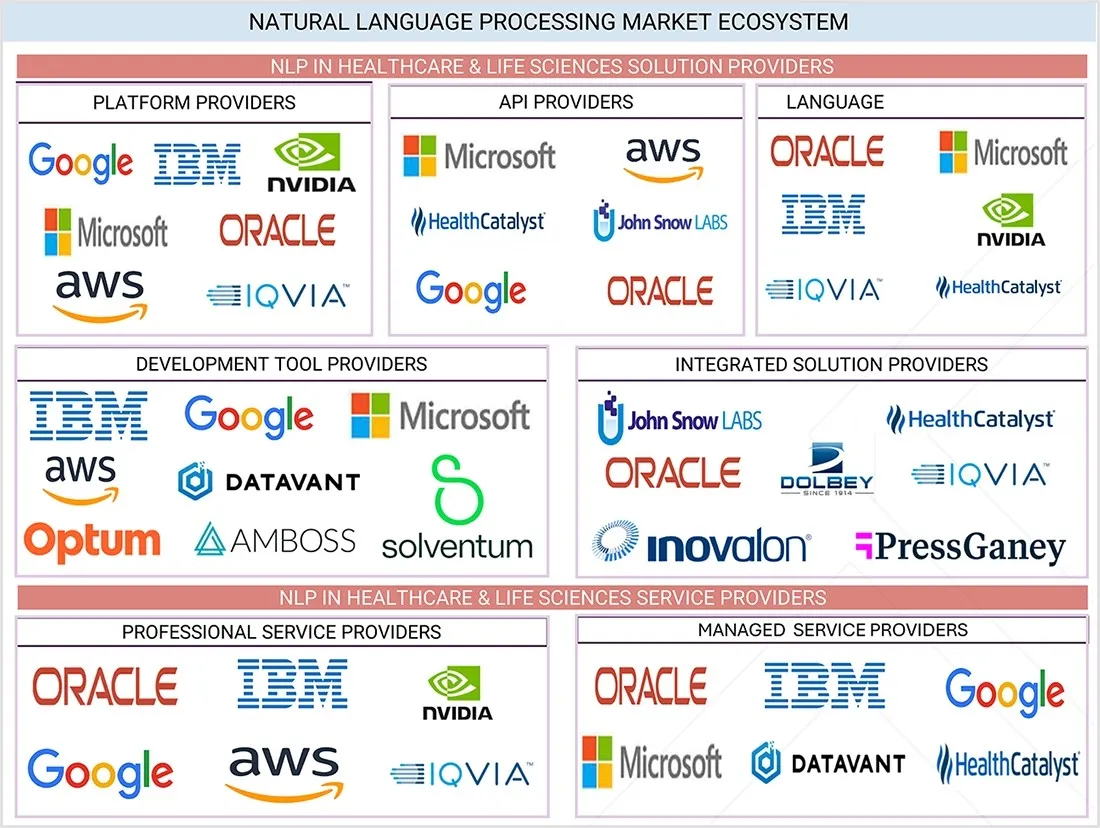
NLP IN HEALTHCARE & LIFE SCIENCES MARKET: COMMERCIAL USE CASES ACROSS INDUSTRIES
| COMPANY | USE CASE DESCRIPTION | BENEFITS |
|---|---|---|
 |
Microsoft deployed Dragon Copilot (formerly Nuance DAX Copilot) across healthcare organizations to automatically generate structured clinical documentation from physician-patient conversations, integrate ambient AI into EHR workflows, summarize clinical encounters, and reduce manual documentation while supporting clinician decision-making. | Reduced physician documentation time and administrative burden | Improved clinician productivity and workflow efficiency | Enhanced patient engagement through reduced screen time during consultations | Lower clinician burnout and improved documentation quality |
 |
Abridge deployed its AI-powered ambient clinical documentation platform integrated with Epic to convert clinician-patient conversations into structured clinical notes, automatically generate visit summaries, and streamline documentation across multiple care settings. | Faster clinical documentation turnaround | Reduced administrative workload for physicians | Improved documentation accuracy and coding efficiency | Increased clinician satisfaction and patient interaction quality |
 |
Oracle Health integrated clinical NLP capabilities within its electronic health record platform to summarize patient records, automate clinical documentation, extract key medical information, and support evidence-based clinical decision-making across hospitals and health systems. | Improved clinical workflow efficiency | Faster access to patient information | Reduced manual documentation effort | Enhanced care coordination and clinical decision support |
 |
John Snow Labs deployed healthcare-specific NLP models for clinical entity extraction, ICD coding assistance, de-identification of protected health information (PHI), biomedical literature mining, and medical text analytics across healthcare providers and life sciences organizations. | Higher biomedical NLP accuracy | Accelerated AI deployment for clinical applications | Improved regulatory compliance through automated de-identification | Enhanced extraction of insights from unstructured medical data |
 |
IQVIA deployed NLP across clinical trial documentation, real-world evidence (RWE), pharmacovigilance, medical literature analysis, and regulatory intelligence to accelerate drug development, improve safety monitoring, and generate evidence from diverse healthcare data sources. | Faster clinical research and evidence generation | Improved pharmacovigilance and drug safety monitoring | Accelerated regulatory submissions and medical review | Enhanced decision-making across pharmaceutical R&D and commercialization |
Logos and trademarks shown above are the property of their respective owners. Their use here is for informational and illustrative purposes only.
Related Ecosystem
Healthcare Analytics
- Machine Learning
- Natural Language Processing (NLP)
- Blood Pressure Monitors
- Computed Tomography (CT)
- Magnetic Resonance Imaging (MRI)
- Oracle Corporation
- PHILIPS HEALTHCARE
- Siemens healthineers
- Zensar Technologies Limited
- EPIC SYSTEMS CORPORATION
Healthcare It
- Computed Tomography (CT)
- Machine Learning
- Magnetic Resonance Imaging (MRI)
- Natural Language Processing (NLP)
- Predictive Analytics
- CERNER CORPORATION
- PHILIPS HEALTHCARE
- Oracle Corporation
- GE HealthCare Technologies Inc.
- Siemens healthineers
Key Takeaways
- Saudi Arabia's NLP healthcare market will grow from $47.8M (2026) to $181.0M (2031) at a 30.5% CAGR.
- Saudi Arabia's Vision 2030 initiative is a primary catalyst driving NLP adoption in healthcare and life sciences.
- Clinical documentation and diagnostic support systems represent the fastest-growing NLP applications in Saudi Arabia.
- Saudi Arabia is emerging as the Middle East's leading market for AI-powered healthcare solutions and NLP technologies.
NLP in Healthcare & Life Sciences Market Report Scope
| Report Metric | Details |
|---|---|
| Base Year | 2026 |
| Fastest Growing Segment | RAG-ENABLED NLP (Technology) |
| Forecast Period | 2026-2031 |
| Growth Rate | CAGR of 29.9% from 2026 to 2031 |
| Largest Segment | SOFTWARE (Offering) |
| Market Size Base Year (Billions) | ~USD 8.13 (2026) |
| Revenue Forecast (Billions) | ~USD 30.06 (2031) |
| Segments Covered | Offering, Software, Service, Professional Service, Technology, Application, End User |
Saudi Arabia NLP in Healthcare & Life Sciences Market Report Segmentation
7 segment dimensions are covered across the global market.
By Offering
- Services
- Software
By Software
- Clinical Nlp Platforms
- Language Model Platforms
- Nlp Apis
- Nlp Developer Tools & Apis
- Nlp Developers Tools & Apis
- Nlp Platforms
- Pre-Trained Language Model
- Pre-Trained Language Models
By Service
- Managed Services
- Professional Services
By Professional Service
- Consulting
- Custom AI/Nlp Development
- Custom Model Development Services
- Implementation & Integration
- Model Fine-Tuning Services
- Support & Maintenance
- System Integration Services
By Technology
- Deep Learning & Neural Nlp
- Rag-Enabled Nlp
- Rule-Based & Symbolic Nlp
- Statistical & Classical Machine Learning Nlp
- Transformer-Based Generative AI & Medical Llms
By Application
- Administrative & Operational Intelligence
- Clinical Care Intelligence
- Clinical Information Extraction & De-Identification
- Clinical Research Intelligence
- Compliance, Legal, & Risk Intelligence
- Customer Experience & Support
- Knowledge Management & Discovery
- Life Sciences R&D Intelligence
- Marketing & Brand Intelligence
- Other Applications
- Patient Engagement & Consumer Health
- Research & Information Intelligence
- Translation & Localization
- Workforce Productivity & Automation
By End User
- Bfsi
- Contract Research Organizations
- Government & Public Health
- Healthcare & Life Sciences
- Healthcare Payers
- Healthcare Providers
- Life Sciences Organizations
- Media & Entertainment
- Patients & Consumers
- Retail & E-Commerce
- Software & Technology
- Telecommunications
Target Audience
- Healthcare Technology Vendors : NLP solution providers and healthcare IT companies need Saudi Arabia-specific market data to develop localized products, establish partnerships with local healthcare institutions, and capture market share in this high-growth region.
- Healthcare Providers & Hospital Networks : Saudi hospitals, clinics, and healthcare networks require market intelligence to evaluate NLP technology investments, benchmark against regional peers, and align procurement strategies with Vision 2030 objectives.
- Investment & Private Equity Firms : Investors targeting healthcare technology in the Middle East need validated market sizing and growth projections for Saudi Arabia to assess portfolio opportunities and make informed funding decisions.
- Government & Healthcare Policy Makers : Saudi Ministry of Health officials and healthcare policy bodies need market data to inform digital health strategy, allocate resources effectively, and evaluate technology adoption roadmaps aligned with national priorities.
- Pharmaceutical & Life Sciences Companies : Drug manufacturers and biotech firms require NLP market insights for Saudi Arabia to optimize clinical trial operations, enhance drug discovery processes, and identify partnership opportunities with local research institutions.
Reasons to Buy this Report
- Market Size & Growth Validation : Obtain precise market valuation ($47.8M in 2026) and verified 30.5% CAGR projections through 2031 to support investment decisions and business planning in Saudi Arabia's high-growth healthcare NLP sector.
- Vision 2030 Alignment Strategy : Understand how Saudi Arabia's strategic initiatives translate into concrete market opportunities, enabling companies to align product development and market entry strategies with government priorities and healthcare modernization goals.
- Competitive Landscape Intelligence : Gain insights into regional market dynamics, key players, adoption barriers, and growth drivers specific to Saudi Arabia to identify competitive advantages and market positioning opportunities.
- Healthcare Institution Targeting : Access detailed information on major Saudi healthcare providers, government agencies, and private sector organizations actively implementing NLP solutions for precise customer identification and sales strategy development.
- Risk Mitigation & Forecasting : Leverage comprehensive market analysis to identify regulatory requirements, implementation challenges, and market trends specific to Saudi Arabia, reducing investment risk and improving forecast accuracy.
Frequently asked questions
What is the current market size of NLP in healthcare in Saudi Arabia?
Saudi Arabia's NLP in healthcare and life sciences market was valued at $47.8 million in 2026, with strong growth anticipated through 2031.
What is the projected market size for Saudi Arabia by 2031?
Saudi Arabia's NLP healthcare market is forecasted to reach $181.0 million by 2031, representing a 30.5% compound annual growth rate.
What factors are driving NLP adoption in Saudi Arabia's healthcare sector?
Saudi Arabia's Vision 2030 initiative, increased healthcare digitalization, government investments in AI infrastructure, and demand for improved clinical efficiency are primary growth drivers.
Which NLP applications are most prevalent in Saudi Arabia's healthcare market?
Clinical documentation automation, patient data analysis, diagnostic support systems, and medical record management are leading NLP applications in Saudi Arabia.
How does Saudi Arabia's NLP market growth compare to global trends?
Saudi Arabia's 30.5% CAGR slightly exceeds the global average of 29.9%, reflecting the Kingdom's accelerated digital health transformation and strategic AI investments.
RESEARCH METHODOLOGY
The research methodology for the natural language processing (NLP) in healthcare & life sciences market consisted of extensive secondary and primary research, followed by market size estimation, market breakdown, and data triangulation. Secondary sources, including annual reports, investor presentations, company websites, regulatory publications, government databases, healthcare organizations, scientific journals, and industry associations, were used to identify key market participants, technology trends, product developments, and market dynamics. Interviews were then conducted with industry experts from both the supply and demand sides to validate market assumptions, growth trends, competitive developments, and segment-level estimates.
Secondary Research
The secondary research process involved collecting information from publicly available sources to understand the healthcare NLP ecosystem, competitive landscape, value chain, market segmentation, technological advancements, and regulatory environment. Key information was gathered from annual reports, investor presentations, product documentation, peer-reviewed scientific publications, healthcare journals, government agencies, healthcare associations, and regulatory organizations. Secondary sources included publications from the World Health Organization (WHO), US Food and Drug Administration (FDA), National Institutes of Health (NIH), Office of the National Coordinator for Health Information Technology (ONC), Centers for Medicare & Medicaid Services (CMS), European Medicines Agency (EMA), European Commission, OECD, National Library of Medicine (NLM), HL7 International, SNOMED International, HIMSS, AHIMA, Healthcare Information and Management Systems Society, company annual reports, investor presentations, SEC filings, product documentation, clinical publications, and healthcare technology journals. Information obtained through secondary research was used to identify key market players, estimate market segmentation, understand adoption trends, analyze regional developments, and assess emerging opportunities across healthcare providers, payers, life sciences organizations, and research institutions.
The secondary research also provided insights into the industry's value chain, market dynamics, pricing trends, technological advancements, regulatory landscape, competitive positioning, and investment activities. It helped establish preliminary market estimates that were subsequently validated through primary interviews.
Primary Research
In the primary research process, a diverse range of stakeholders from both the supply and demand sides of the NLP in healthcare & life sciences market were interviewed to gather qualitative and quantitative insights specific to this market. From the supply side, key industry experts, including executives (CEOs), vice presidents (VPs), marketing directors, technology & innovation directors, as well as technical leads from vendors offering healthcare NLP software, medical LLMs, AI platforms, cloud services, and healthcare IT solutions, were consulted. Additionally, system integrators, implementation partners, consulting firms, and service providers supporting NLP deployment across healthcare organizations were included in the study. On the demand side, input was collected from hospitals, healthcare providers, healthcare payers, pharmaceutical and biotechnology companies, contract research organizations (CROs), academic medical centers, government & public health organizations, and research institutions. AI leaders, chief information officers (CIOs), chief medical information officers (CMIOs), chief digital officers (CDOs), healthcare informatics professionals, clinical researchers, and healthcare operations executives were interviewed to understand current adoption trends and future investment priorities.
The primary research ensured that all critical parameters affecting the NLP in healthcare & life sciences market including advancements in generative AI, medical large language models (LLMs), ambient clinical intelligence, clinical documentation, medical coding, biomedical text mining, pharmacovigilance, interoperability standards (HL7 FHIR), healthcare regulations (HIPAA, GDPR), AI governance, cloud adoption, deployment models, and application adoption were considered. Each factor was thoroughly analyzed, validated through primary research, and used to obtain precise qualitative and quantitative data for this market.
Once the initial phase of market engineering was completed, including detailed calculations for market statistics, segment-specific growth forecasts, and data triangulation, an additional round of primary research was undertaken. This step was crucial for refining and validating critical data points such as market offerings (software and services), deployment trends, software adoption, application-wise demand, end-user adoption, competitive landscape, pricing strategies, vendor positioning, regional market dynamics, purchasing behavior, and future investment outlook. Key market drivers—including increasing adoption of AI-powered clinical documentation, physician productivity solutions, biomedical research intelligence, and medical LLMs—along with challenges such as data privacy, interoperability, explainability, regulatory compliance, and integration complexity, were assessed to ensure accurate market estimates.
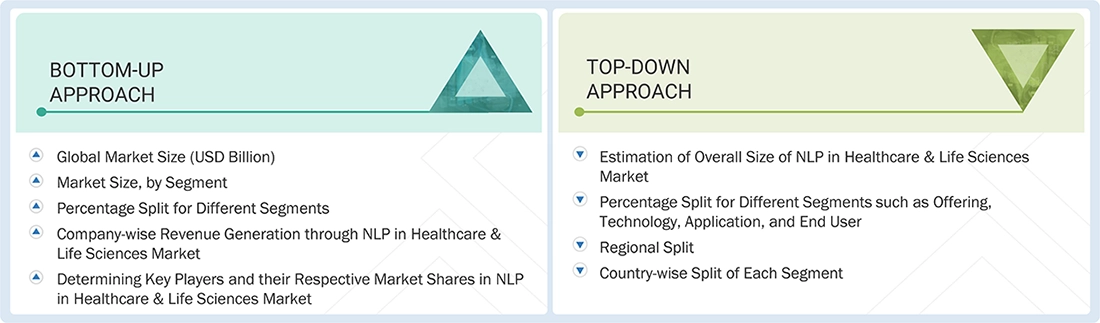
In the comprehensive market engineering process, the top-down and bottom-up approaches, along with several data triangulation methods, were extensively employed to perform market estimation and forecasting for the overall market and its subsegments covered in this report. Extensive qualitative and quantitative analyses were conducted throughout the market engineering process to capture critical market insights and ensure the accuracy of the final market estimates.
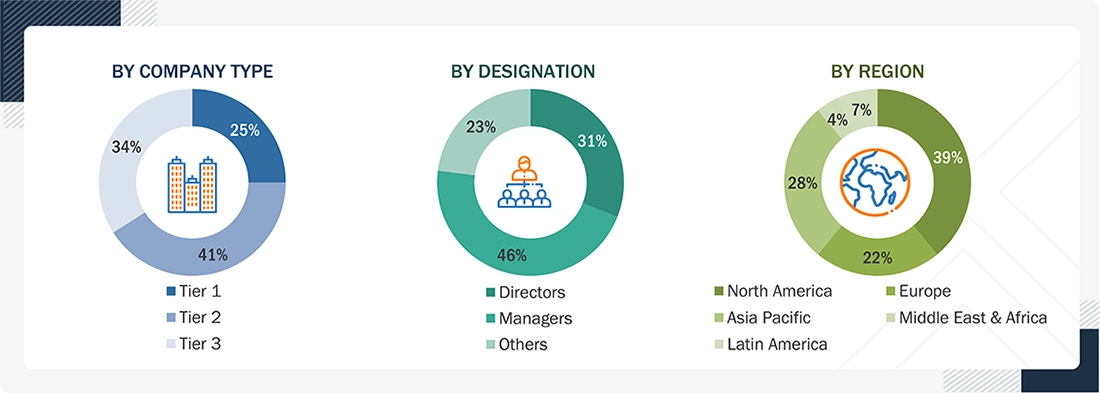
Note: Three tiers of companies are defined based on total annual revenue. Tier 1 companies generate more than USD 1 billion in annual revenue; Tier 2 companies generate between USD 500 million and USD 1 billion; and Tier 3 companies generate less than USD 500 million in annual revenue.
Source: MarketsandMarkets Analysis
To know about the assumptions considered for the study, download the pdf brochure
Market Size Estimation
The top-down and bottom-up approaches were employed to estimate and forecast the NLP in healthcare & life sciences market, as well as its dependent submarkets. This multi-layered analysis was further reinforced through data triangulation, which incorporated primary and secondary research inputs. The market figures were also validated against the existing MarketsandMarkets repository for accuracy.
NLP in Healthcare & Life Sciences Market : Top-Down and Bottom-Up Approach
Data Triangulation
The market was divided into several segments and subsegments after determining the overall market size using the market size estimation processes described above. To complete the overall market engineering process and determine the exact statistics for each market segment and subsegment, data triangulation and market segmentation procedures were employed, wherever applicable. The overall market size was then used in the top-down approach to estimate the size of other individual markets by applying percentage splits to the market segmentation.
Market Definition
Natural Language Processing (NLP) in Healthcare & Life Sciences refers to the application of artificial intelligence (AI), machine learning (ML), and computational linguistics to analyze, interpret, and generate human language from structured and unstructured healthcare data. It enables healthcare providers, payers, pharmaceutical companies, biotechnology firms, and research organizations to extract meaningful insights from electronic health records (EHRs), clinical notes, pathology reports, radiology reports, biomedical literature, clinical trial data, and patient interactions. NLP supports applications such as clinical documentation, medical coding, clinical decision support, patient engagement, pharmacovigilance, biomedical research, and administrative workflow automation. By transforming complex medical information into actionable intelligence, NLP improves clinical outcomes, operational efficiency, research productivity, and evidence-based decision-making across the healthcare ecosystem.
Key Stakeholders
- NLP in Healthcare & Life Sciences Software Providers
- NLP Implementation and Consulting Service Providers
- Medical Large Language Model (LLM) Developers
- Healthcare AI Platform Providers
- Electronic Health Record (EHR) Solution Providers
- Cloud Service Providers
- Healthcare Analytics and Data Platform Providers
- System Integrators (SIs)/Implementation Service Providers
- Healthcare Providers (Hospitals, Health Systems, & Clinics)
- Healthcare Payers
- Pharmaceutical and Biotechnology Companies
- Contract Research Organizations (CROs)
- Government and Public Health Organizations
- Academic and Research Institutions
- Investors & Venture Capital Firms
- Healthcare Regulatory Bodies
Report Objectives
- To define, describe, and forecast the natural language processing (NLP) in healthcare & life sciences market by offering (software and services), technology, application, end user, and region
- To provide detailed information related to the major factors (drivers, restraints, opportunities, and challenges) influencing market growth
- To analyze the micro markets with respect to individual growth trends, prospects, and their contribution to the total market
- To analyze the opportunities in the market for stakeholders by identifying the high-growth segments of the market
- To analyze opportunities in the market and provide details of the competitive landscape for stakeholders and market leaders
- To forecast the market size of segments for five major regions: North America, Europe, Asia Pacific, the Middle East & Africa, and Latin America
- To profile the key players and comprehensively analyze their market ranking and core competencies
- To analyze competitive developments, such as partnerships, product launches, mergers & acquisitions, collaborations, and investments, in the market
- To analyze the impact of various macroeconomic and regulatory factors on the market across all regions
Available customizations:
With the given market data, MarketsandMarkets offers customizations based on the company’s specific needs. The following customization options are available for the report.
Brand/Product Comparative Analysis
- Brand/product comparative analysis of additional vendors
Regional Analysis
- Breakup of additional European countries by offering, technology, application, and end user
- Breakup of additional Asia Pacific countries by offering, technology, application, and end user
- Breakup of additional Middle Eastern & African countries by offering, technology, application, and end user
- Breakup of additional Latin American countries by offering, technology, application, and end user
Company Information
- Detailed analysis and profiling of additional market players (up to five)
Get the Full NLP in Healthcare & Life Sciences Market Report
Full forecast, segment splits, and company analysis for all NLP in Healthcare & Life Sciences Market.
- Canada NLP in Healthcare & Life Sciences Market
- US NLP in Healthcare & Life Sciences Market
- UK NLP in Healthcare & Life Sciences Market
- Germany NLP in Healthcare & Life Sciences Market
- France NLP in Healthcare & Life Sciences Market
- Italy NLP in Healthcare & Life Sciences Market
- Spain NLP in Healthcare & Life Sciences Market
- Netherlands NLP in Healthcare & Life Sciences Market
- China NLP in Healthcare & Life Sciences Market
- India NLP in Healthcare & Life Sciences Market
- Japan NLP in Healthcare & Life Sciences Market
- South Korea NLP in Healthcare & Life Sciences Market
- UAE NLP in Healthcare & Life Sciences Market
- South Africa NLP in Healthcare & Life Sciences Market
- Turkey NLP in Healthcare & Life Sciences Market
- Qatar NLP in Healthcare & Life Sciences Market
- Brazil NLP in Healthcare & Life Sciences Market
- Mexico NLP in Healthcare & Life Sciences Market
- Argentina NLP in Healthcare & Life Sciences Market
- Rest Of Europe NLP in Healthcare & Life Sciences Market
- Asean NLP in Healthcare & Life Sciences Market
- Rest Of Asia Pacific NLP in Healthcare & Life Sciences Market
- Rest Of Latin America NLP in Healthcare & Life Sciences Market
Need a Tailored Report?
Customize this report to your needs
Get 10% FREE Customization
Customize This Report
