
Germany Healthcare Quality Management (QMS) Market (2025-2030)

The Germany Healthcare Quality Management (QMS) Market was valued at $119.7 Million in 2025 and projected to reach to $216.9 Million by 2030, representing a compound annual growth rate of 12.6%. Germany's Healthcare Quality Management market is poised for sustained expansion through 2030, driven by increasing regulatory pressures from EU directives and national healthcare reforms.


| Market Size in | USD 26.32 MN |
| Market Forecast in | |
| CAGR | |
| Forecast Period | |
| Units Considered | Value (USD MN) |
Germany Healthcare Quality Management (QMS) Market Trends and Insights
- Germany's strong regulatory framework, driven by stringent EU compliance requirements and national healthcare standards, positions the country as a leader in QMS adoption across European healthcare institutions.
- The market growth reflects Germany's commitment to enhancing patient safety, operational efficiency, and clinical outcomes through advanced quality management systems. The German healthcare sector's investment in digital transformation and process optimization is accelerating QMS implementation across hospitals, clinics, and diagnostic centers.
- Germany's aging population and increasing healthcare complexity are driving demand for integrated quality solutions that streamline compliance, reduce medical errors, and improve care delivery.
- With a 12.6% compound annual growth rate through 2030, Germany's QMS market demonstrates strong momentum as healthcare providers prioritize quality assurance and regulatory adherence..
Key Market Statistics
- CAGR (2025-2030) 12.6% CAGR
- Market Size, 2025 ~USD 119.7 Million
- Forecast, 2030 ~USD 216.9 Million
- Country Germany
Germany Healthcare Quality Management (QMS) Market Overview
Market Valuation & Growth :
Germany's Healthcare QMS market is valued at $119.7 million in 2025, with a robust CAGR of 12.6%, projected to reach $216.9 million by 2030, outpacing the global growth rate of 12.1%.
Regulatory Compliance Driver :
Stringent EU compliance requirements and national healthcare standards create a strong regulatory foundation, positioning Germany as a European leader in QMS adoption and implementation across healthcare institutions.
Digital Healthcare Transformation :
Germany's advanced healthcare infrastructure and digitalization initiatives drive demand for integrated quality management solutions, particularly among hospitals, clinics, and specialized medical facilities.
Industry Leadership Position :
German healthcare institutions prioritize quality assurance and patient safety standards, creating sustained demand for comprehensive QMS platforms and continuous improvement methodologies.
Germany Healthcare Quality Management (QMS) Market Dynamics
- The country's commitment to patient safety, operational efficiency, and digital health integration creates a favorable environment for QMS solution adoption.
- Healthcare providers are investing in advanced quality management technologies to meet compliance requirements and improve clinical outcomes.
- The market will benefit from growing awareness of quality management's role in reducing medical errors and enhancing patient satisfaction across German healthcare systems..
Market Ecosystem
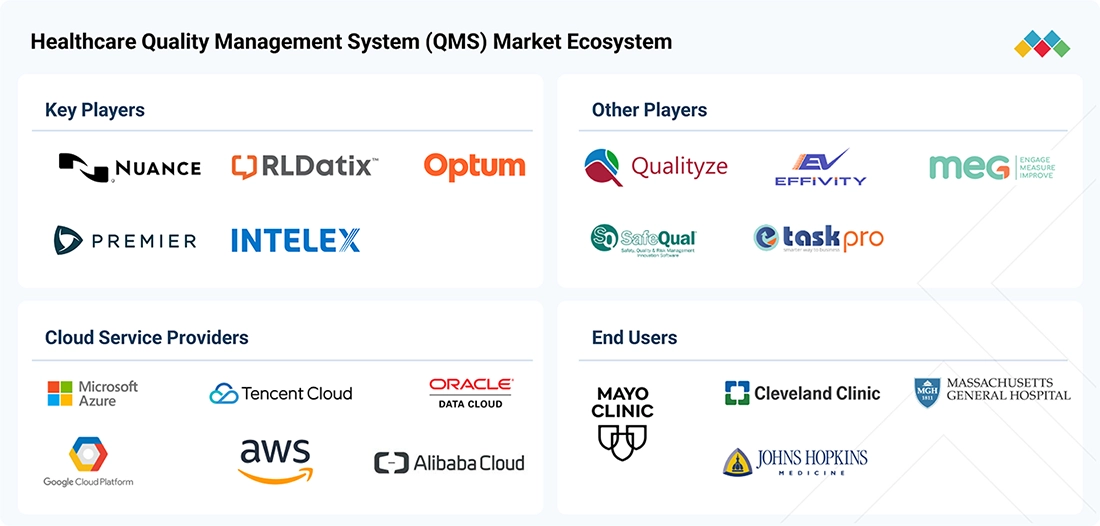
HEALTHCARE QUALITY MANAGEMENT SYSTEM MARKET: COMMERCIAL USE CASES ACROSS INDUSTRIES
| COMPANY | USE CASE DESCRIPTION | BENEFITS |
|---|---|---|
 |
AI-powered clinical documentation improvement and quality reporting solutions (Clintegrity) | More accurate clinical documentation | Reduced claim denials | Real-time compliance with eCQMs | Improved patient outcomes |
 |
Data-driven quality improvement and benchmarking platform for hospitals and health systems | Lower care variation | Reduced readmission rates | Cost savings through shared best practices | Enhanced patient safety outcomes |
 |
Predictive analytics and population health management solutions for quality performance improvement | Higher quality scores (HEDIS, STAR ratings) | Improved care coordination | Reduced gaps in care | Optimized value-based care revenue |
 |
Cloud-based healthcare quality and compliance management system | Automated regulatory reporting | Proactive risk mitigation | Improved operational efficiency | Centralized quality performance tracking |
 |
Accreditation, certification, and quality management services & software supporting hospitals and healthcare providers with risk-based, data-driven quality improvement frameworks. | Improved compliance with international standards (ISO, NIAHO) | Enhanced patient safety culture | Continuous quality improvement | Reduced clinical risks | Strengthened organizational resilience |
Logos and trademarks shown above are the property of their respective owners. Their use here is for informational and illustrative purposes only.
Related Ecosystem
Healthcare It
- Computed Tomography (CT)
- Machine Learning
- Magnetic Resonance Imaging (MRI)
- Natural Language Processing (NLP)
- Predictive Analytics
- CERNER CORPORATION
- PHILIPS HEALTHCARE
- Oracle Corporation
- GE HealthCare Technologies Inc.
- Siemens healthineers
Key Takeaways
- Germany's Healthcare QMS Market is valued at $119.7M in 2025, expanding to $216.9M by 2030 at a 12.6% CAGR.
- Germany's stringent EU regulatory requirements and national healthcare standards drive widespread QMS adoption across healthcare institutions.
- Digital transformation initiatives in Germany's healthcare sector are accelerating demand for integrated quality management solutions.
- Germany's aging population and complex healthcare needs create sustained demand for advanced QMS platforms through 2030.
Healthcare Quality Management (QMS) Market Report Scope
| Report Metric | Details |
|---|---|
| Base Year | 2025 |
| Fastest Growing Segment | INTEGRATED SUITES (Type) |
| Forecast Period | 2025–2030 |
| Growth Rate | CAGR of 12.1% from 2025 to 2030 |
| Largest Segment | SOFTWARE (Offering) |
| Market Size Base Year (Billions) | ~USD 1.42 (2025) |
| Revenue Forecast (Billions) | ~USD 2.51 (2030) |
| Segments Covered | Offering, Type |
Germany Healthcare Quality Management (QMS) Market Report Segmentation
2 segment dimensions are covered across the global market.
By Offering
- Services
- Software
By Type
- Integrated Suites
- Point Solutions
GERMANY: HEALTHCARE QUALITY MANAGEMENT (QMS) MARKET, BY END USER, 2023–2030
| Segment | 2023 | 2024 | 2025 | 2026 | 2027 | 2028 | 2029 | 2030 | CAGR (%) |
|---|---|---|---|---|---|---|---|---|---|
| HEALTHCARE PAYERS | 24.4 | 27.5 | 30.8 | 34.4 | 38.4 | 42.6 | 47.1 | 51.8 | 10.9 |
| HEALTHCARE PROVIDERS | 67.6 | 77.8 | 88.9 | 101.2 | 115.2 | 130.4 | 147 | 165.1 | 13.2 |
| TOTAL | 91.9 | 105.3 | 119.7 | 135.6 | 153.6 | 173.1 | 194.1 | 216.9 | 12.6 |
Target Audience
- QMS Solution Providers : Software vendors and healthcare IT companies need Germany-specific market data to develop localized solutions, understand competitive dynamics, and identify expansion opportunities in this regulated market.
- Healthcare Institution Leaders : Hospital administrators, clinic directors, and healthcare network managers require insights into QMS market trends and best practices to make informed procurement decisions and improve quality outcomes.
- Healthcare Consultants : Management and healthcare consultants need detailed German market analysis to advise clients on quality management strategies, regulatory compliance, and technology implementation roadmaps.
- Investment & Private Equity Firms : Investors evaluating healthcare IT and QMS companies need Germany-specific market sizing and growth projections to assess investment opportunities and portfolio company potential in this expanding sector.
- Healthcare Regulatory Bodies : Government agencies and healthcare authorities require market intelligence on QMS adoption and compliance trends to inform policy development and ensure alignment with EU and national healthcare standards.
Key Companies in the Germany Healthcare Quality Management (QMS) Market
| Company | HQ | Ownership | Strongest segments |
|---|---|---|---|
| CYNERGISTEK | United States | Private Company | Security, privacy, and compliance risk assessments & IT audits,Technical testing (penetration testing, vulnerability assessments, red teaming),Program development (policies, procedures, playbooks, risk management design), |
| COGNIZANT TECHNOLOGY SOLUTIONS | United States | Public Company | Consulting and Systems Integration,Application Development, Maintenance, and ER&D,Infrastructure, Security, and Managed Services, |
| FIRSTSOURCE | India | Public Company | Healthcare (payer and provider, including RCM and BPaaS),Banking and Financial Services (core banking, cards, lending, fraud),Communications, Media and Technology, |
| LEIDOS | United States | Public Company | National Security & Digital (defense, intel, cyber, AI/ML),Health & Civil (air traffic control, health mission, civil IT),Defense Systems (air/missile defense, space payloads, ISR), |
| ORION HEALTH LTD | New Zealand | Private Company | Population Health & Precision Medicine (Amadeus, Discover, OH intelligence, data science consulting),Enterprise Clinicals & Administration (EMR, PAS, clinical applications),Interoperability, Care Coordination & Pathways (Coordinate, Consult, integration), |
| THE ADVISORY BOARD COMPANY | United States | Private Company | Research Memberships and Subscriptions,Custom Research and Consulting,Events, Roundtables, and Webinars, |
| TRUVEN HEALTH ANALYTICS | United States | Private Company | Population health analytics platforms,Payment integrity and claims analytics,Provider performance and quality benchmarking, |
| PREMIER INC. | United Kingdom | Public Company | Flavourings, seasonings, and accompaniments (Bisto, OXO, Paxo, SAXA, Merchant Gourmet),Cooking sauces and world foods (Sharwood’s, Loyd Grossman, Homepride, Spice Tailor),Quick and easy meals, noodles, and ambient meals (Batchelors, Nissin, FUEL10K, Merchant Gourmet), |
| RLDATIX | United States | Private Company | Incident Reporting and Risk Management,Accreditation and Policy Management,Workforce Compliance and Credentialing, |
| HCI | United States | Public Company | Homeowners’ property and casualty insurance,Insurance technology platforms (Exzeo, Harmony, ClaimColony, SAMSTM, AtlasViewer),Reciprocal exchange operations and real estate, |
| IDEAGEN | United Kingdom | Private Company | Operational performance and regulatory compliance software,Risk management and GRC solutions,Workplace health and safety (including Reactec), |
CYNERGISTEK
Cynergistek is a United States-based private company founded in 1995 with 89 employees. The company specializes in healthcare cybersecurity and compliance solutions.
COGNIZANT TECHNOLOGY SOLUTIONS
Cognizant Technology Solutions is a publicly traded company founded in 1988 and headquartered in the United States. With 356,700 employees, it is a major global provider of IT services, consulting, and business process outsourcing.
FIRSTSOURCE
FirstSource is a publicly traded company founded in 2000 and headquartered in India. With 33,592 employees, the company provides business process outsourcing and customer engagement services.
LEIDOS
Leidos is a publicly traded company founded in 1969 and headquartered in the United States. With 50,000 employees, the company provides engineering, IT, and scientific solutions primarily to government and commercial clients.
ORION HEALTH LTD
Orion Health Ltd is a private company founded in 1993 and headquartered in New Zealand. With 1,000 employees, the company develops healthcare IT and clinical information systems.
THE ADVISORY BOARD COMPANY
The Advisory Board Company is a United States-based private company founded in 1979 with 3,800 employees. The company provides research, advisory services, and technology solutions to healthcare organizations.
TRUVEN HEALTH ANALYTICS
Truven Health Analytics is a United States-based private company founded in 1996 with 2,650 employees. The company provides healthcare data analytics, research, and consulting services.
PREMIER INC.
Premier Inc. is a publicly traded company founded in 1975 and headquartered in the United Kingdom. With 4,385 employees, the company provides healthcare supply chain and performance improvement solutions.
RLDATIX
RLDatix is a United States-based private company founded in 2018. The company provides risk management and patient safety solutions for healthcare organizations.
HCI
HCI is a publicly traded company founded in 2006 and headquartered in the United States. With 594 employees, the company operates in the healthcare or technology sector.
IDEAGEN
Ideagen is a private company founded in 1993 and headquartered in the United Kingdom. With 697 employees, the company provides software solutions for quality, risk, and compliance management.
Reasons to Buy this Report
- Market-Specific Growth Intelligence : Gain detailed insights into Germany's 12.6% CAGR trajectory and understand the unique drivers propelling the market from $119.7M to $216.9M by 2030, enabling informed investment decisions.
- Regulatory Landscape Analysis : Understand Germany's stringent EU compliance framework and national healthcare standards that shape QMS adoption, helping you align solutions with local regulatory requirements and institutional priorities.
- Competitive Positioning Strategy : Identify market opportunities specific to German healthcare institutions, including hospitals, clinics, and specialized facilities, to develop targeted go-to-market strategies and competitive advantages.
- Digital Transformation Insights : Leverage data on Germany's advanced healthcare digitalization initiatives to understand technology adoption patterns and integration requirements for QMS platforms in the German market.
- Risk Mitigation & Forecasting : Access comprehensive market forecasts and trend analysis specific to Germany to mitigate business risks, optimize resource allocation, and plan long-term strategic initiatives in this high-growth market.
Frequently asked questions
What is the current size of Germany's Healthcare QMS Market?
Germany's Healthcare QMS Market is valued at $119.7 million in 2025 and is projected to grow to $216.9 million by 2030.
What is the growth rate of Germany's Healthcare QMS Market?
Germany's Healthcare QMS Market is growing at a compound annual growth rate (CAGR) of 12.6% from 2025 to 2030.
What factors are driving QMS adoption in Germany?
Germany's QMS market is driven by stringent EU regulatory compliance, national healthcare standards, digital transformation initiatives, and the need to improve patient safety and operational efficiency.
Which healthcare sectors in Germany are adopting QMS solutions?
Hospitals, clinics, diagnostic centers, and other healthcare institutions across Germany are implementing QMS solutions to enhance quality assurance and regulatory adherence.
How does Germany's QMS market compare to other European countries?
Germany's 12.6% CAGR and strong regulatory framework position it as a leading market for Healthcare QMS adoption in Europe, driven by its commitment to quality and compliance standards.
RESEARCH METHODOLOGY
This market research study primarily relied on secondary sources, directories, and databases to collect information for this technical, market-oriented, and financial analysis of the healthcare quality management system market. In-depth interviews were conducted with various primary respondents, including key industry participants, subject-matter experts (SMEs), C-level executives from major market players, and industry consultants, among others, to gather and verify critical qualitative and quantitative data and assess market prospects. The size of the healthcare quality management system market was estimated using multiple secondary research methods and confirmed with primary research inputs to determine the final market size.
Secondary Research
The secondary research process involved extensively using secondary sources, including directories, databases (such as Bloomberg Businessweek, Factiva, and D&B Hoovers), white papers, annual reports, company house documents, investor presentations, and SEC filings of companies. Some non-exclusive secondary sources include the World Health Organization (WHO), the Organization for Economic Co-operation and Development (OECD), Healthcare Information and Management Systems Society (HIMSS), and Centers for Disease Control and Prevention (CDC).
Secondary research was conducted to gather information for the detailed, technical, market-focused, and commercial analysis of the healthcare quality management system market. It was also used to collect key information about major players, market classification, and segmentation based on industry trends, down to the most detailed level, along with significant developments related to market and technology perspectives. Additionally, a database of leading industry players was compiled using secondary research.
Primary Research
During the primary research process, various sources from both the supply and demand sides were interviewed to gather qualitative and quantitative information for this report. Primary sources mainly include industry experts from core and related industries, preferred suppliers, manufacturers, distributors, technology developers, researchers, and organizations involved in all segments of this industry’s value chain. In-depth interviews were conducted with various primary respondents, such as key industry participants, subject-matter experts (SMEs), C-level executives of leading market players, and industry consultants, among other specialists, to obtain and verify critical qualitative and quantitative information as well as assess prospects.
Primary research was conducted to identify segmentation types, industry trends, key players, and key market dynamics such as drivers, restraints, opportunities, challenges, and strategies adopted by key players.
After completing the market engineering process, which includes calculations for market statistics, market breakdown, size estimations, forecasting, and data triangulation, extensive primary research was carried out. This research aimed to gather information and verify the key numbers obtained during the market analysis. Additionally, primary research was used to identify different types of market segmentation, analyze industry trends, evaluate the competitive landscape of healthcare quality management systems offered by various players, and understand key market dynamics such as drivers, restraints, opportunities, challenges, and strategies employed by key market players.
In the complete market engineering process, the top-down and bottom-up approaches, along with several data triangulation methods, were extensively used to estimate and forecast the market segments and subsegments listed in this report. Extensive qualitative and quantitative analysis was conducted on the entire market engineering process to identify key information and insights throughout the report.
Breakdown of Primary Interviews
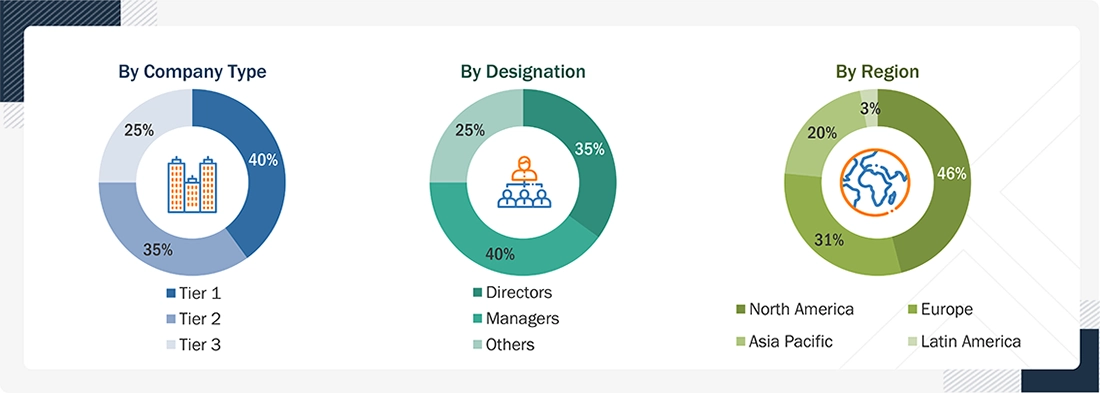
Note 1: Others include sales, marketing, and product managers.
Note 2: Tiers are defined based on a company’s total revenue, as of 2025: Tier 1 = >USD 1 billion, Tier 2 = USD 500 million to USD 1 billion, and Tier 3 = <USD 500 million.
To know about the assumptions considered for the study, download the pdf brochure
Market Size Estimation
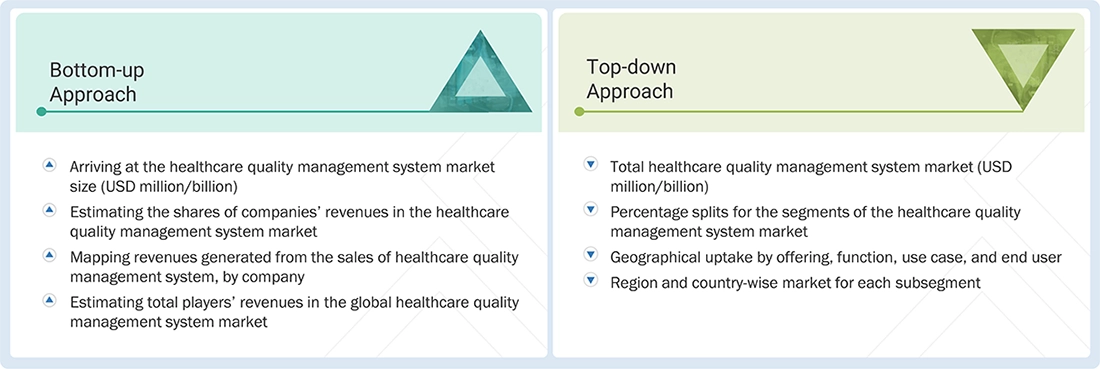
The market size estimates and forecasts in this study are based on a combination of the bottom-up approach (revenue share analysis of leading players) and the top-down approach (evaluation of utilization, adoption, and penetration trends by offering, function, use case, end user, and region).
Data Triangulation
After determining the overall market size from the estimation process described above, the healthcare quality management system market was divided into various segments and subsegments. To finalize the overall market analysis and obtain accurate statistics for all segments and subsegments, data triangulation and market breakdown techniques were used whenever applicable. The data was cross-verified by examining different factors and trends from both the demand and supply sides of the healthcare quality management system market.
Market Definition
The healthcare quality management system market comprises software and services that provide a structured framework that enables healthcare organizations to comply with regulatory standards while delivering high-quality patient care. It encompasses policies, processes, and procedures designed to monitor, evaluate, and continuously improve healthcare services and patient outcomes. By integrating evidence-based practices, fostering a culture of continuous improvement, and leveraging data-driven insights, the healthcare quality management system market supports the reduction of medical errors, enhances patient safety, and optimizes overall healthcare delivery.
Key Stakeholders
- Healthcare quality management system vendors
- Healthcare Providers (hospitals, outpatient settings, ambulatory surgical centers and specialty clinics, and other healthcare providers)
- Clinical research organizations (CROs)
- R&D companies
- Business research & consulting service providers
- Academic medical centers/universities/hospitals/research institutes
- Regulatory bodies (FDA, EMA)
- AI & algorithm developers
- Venture capitalists
- Advocacy groups
- Investors & financial institutions
- Contract manufacturing organizations (CMOs)
- Contract research organizations (CROs)
Report Objectives
- To define, describe, and forecast the healthcare quality management system market by offering, function, use case, end user, and region
- To provide detailed information regarding the major drivers, restraints, opportunities, and challenges influencing market growth
- To strategically analyze micromarkets with respect to individual growth trends, prospects, and contributions to the overall healthcare quality management system market
- To analyze market opportunities for stakeholders and provide details of the competitive landscape for key players
- To forecast the size of the healthcare quality management system market in five main regions (and their respective countries): North America, Europe, the Asia Pacific, the Middle East & Africa, and Latin America
- To provide key industry insights, such as the value chain, regulatory, patent, and impact of Gen AI
- To profile the key players in the market and comprehensively analyze their core competencies
- To track and analyze competitive developments, such as product launches & upgrades, collaborations, partnerships, acquisitions, investments, contracts, agreements, alliances, mergers, funding, and expansions of the leading players in the market
- To benchmark players within the market using the company evaluation matrix, which analyzes market players on various parameters within the broad categories of business strategy, market share, and product offering
Available customizations:
With the given market data, MarketsandMarkets offers customizations to meet the company’s specific needs. The following customization options are available for the report:
GEOGRAPHIC ANALYSIS
- Further breakdown of the Rest of Europe healthcare quality management system market into Denmark, Norway, and others
- Further breakdown of the Rest of Asia Pacific healthcare quality management system market into Vietnam, Pakistan, New Zealand, and others
- Further breakdown of the Rest of Latin America healthcare quality management system market into Argentina, Chile, Colombia, and others
- Further breakdown of the Rest of Middle East & Africa healthcare quality management system market into Egypt, Nigeria, Israel, and others
Get the Full Healthcare Quality Management (QMS) Market Report
Full forecast, segment splits, and company analysis for all Healthcare Quality Management (QMS) Market.
- US Healthcare Quality Management (QMS) Market
- Canada Healthcare Quality Management (QMS) Market
- UK Healthcare Quality Management (QMS) Market
- France Healthcare Quality Management (QMS) Market
- Italy Healthcare Quality Management (QMS) Market
- Spain Healthcare Quality Management (QMS) Market
- Japan Healthcare Quality Management (QMS) Market
- China Healthcare Quality Management (QMS) Market
- India Healthcare Quality Management (QMS) Market
- South Korea Healthcare Quality Management (QMS) Market
- Australia Healthcare Quality Management (QMS) Market
- Brazil Healthcare Quality Management (QMS) Market
- Mexico Healthcare Quality Management (QMS) Market
- Saudi Arabia Healthcare Quality Management (QMS) Market
- UAE Healthcare Quality Management (QMS) Market
Need a Tailored Report?
Customize this report to your needs
Get 10% FREE Customization
Customize This Report
