
North America Coagulation Analyzer Market (2025-2030)

The North America Coagulation Analyzer Market was valued at $539.4 Million in 2025 and projected to reach to $679.5 Million by 2030, representing a compound annual growth rate of 4.7%. North America's coagulation analyzer market is positioned for steady expansion through 2030, supported by continuous technological innovation, integration of AI-driven diagnostics, and increasing adoption in both hospital and outpatient settings.


| Market Size in | USD 26.32 MN |
| Market Forecast in | |
| CAGR | |
| Forecast Period | |
| Units Considered | Value (USD MN) |
North America Coagulation Analyzer Market Trends and Insights
- North America's mature healthcare infrastructure, high adoption of advanced diagnostic technologies, and strong regulatory frameworks support steady market expansion.
- In North America, the demand for coagulation analyzers is driven by an aging population, increased prevalence of cardiovascular and bleeding disorders, and the shift toward point-of-care testing in clinical settings. North America's coagulation analyzer market benefits from significant investments in healthcare automation and laboratory modernization.
- The region's emphasis on patient safety, quality control, and standardized testing protocols creates favorable conditions for analyzer adoption.
- North America continues to lead in technological innovation, with manufacturers introducing integrated systems that enhance workflow efficiency and reduce turnaround times for critical coagulation test results..
Key Market Statistics
- CAGR (2025-2030) 4.7% CAGR
- Market Size, 2025 ~USD 539.4 Million
- Forecast, 2030 ~USD 679.5 Million
- Geography North America
North America Coagulation Analyzer Market Overview
Mature Market Leadership :
North America commands a significant share of the global coagulation analyzer market, driven by established healthcare infrastructure, high diagnostic spending, and widespread adoption of automated laboratory systems across hospitals and diagnostic centers.
Steady Growth Trajectory :
The region is projected to grow from $539.4 million in 2025 to $679.5 million by 2030 at a 4.7% CAGR, reflecting consistent demand for advanced coagulation testing in clinical settings and the shift toward point-of-care diagnostics.
Regulatory Excellence & Standards :
Strong FDA oversight and stringent quality standards in North America ensure high-quality coagulation analyzer products, fostering trust among healthcare providers and supporting premium pricing for advanced diagnostic solutions.
Aging Population Demand :
Rising prevalence of cardiovascular diseases, thrombotic disorders, and anticoagulation therapy management in North America's aging demographic drives sustained demand for reliable coagulation testing and monitoring solutions.
North America Coagulation Analyzer Market Dynamics
- The region's mature healthcare ecosystem and high reimbursement rates create favorable conditions for premium product adoption and market consolidation among leading manufacturers. Key growth drivers include the rising burden of anticoagulation therapy management, expansion of point-of-care testing networks, and increasing demand for rapid turnaround diagnostics in emergency and surgical departments.
- However, market growth remains moderate compared to emerging regions due to market saturation and established competitive dynamics, with opportunities concentrated in next-generation analyzer platforms and integrated laboratory information systems..
Market Ecosystem
Related Ecosystem
Analytical And Scientific Instrumentation
- Environmental Testing
- Gas Chromatography
- Polymerase Chain Reaction (PCR)
- Automated Liquid Handling Systems
- Flow Cytometry
- Thermo Fisher Scientific Inc.
- Danaher Corporation
- Agilent Technologies, Inc.
- Merck KGaA
- Shimadzu Corporation
Key Takeaways
- North America's coagulation analyzer market is valued at $539.4 million in 2025 and will reach $679.5 million by 2030, growing at 4.7% CAGR.
- North America's aging population and rising cardiovascular disease prevalence are primary drivers of coagulation analyzer demand.
- North America leads in laboratory automation adoption, with hospitals and diagnostic centers investing in integrated analyzer systems.
- North America's stringent regulatory environment and focus on quality assurance support sustained market growth through 2030.
Coagulation Analyzer Market Report Scope
| Report Metric | Details |
|---|---|
| Base Year | 2025 |
| Fastest Growing Segment | ANTI-FACTOR XA TESTS (Test) |
| Forecast Period | 2025–2030 |
| Growth Rate | CAGR of 7.2% from 2025 to 2030 |
| Largest Segment | CLINICAL LABORATORY ANALYZERS (Product) |
| Market Size Base Year (Billions) | ~USD 3.77 (2025) |
| Revenue Forecast (Billions) | ~USD 5.34 (2030) |
| Segments Covered | Product, Type, Test, Testing Site, Technology, End User, Site Of Testing |
North America Coagulation Analyzer Market Report Segmentation
7 segment dimensions are covered across the global market.
By Product
- Clinical Laboratory Analyzers
- Point-Of-Care Testing Analyzers
By Type
- Automated Systems
- Consumables
- Manual Systems
- Reagents
- Semi-Automated Systems
- Standards, Controls, And Calibrators
- Systems
By Test
- Activated Clotting Time Testing
- Activated Partial Thromboplastin Time Testing
- Anti-Factor Xa Tests
- D-Dimer Testing
- Fibrinogen Testing
- Heparin & Protamine Dose Response Tests For Act
- Other Coagulation Tests
- Platelet Function Tests
- Prothrombin Time/International Normalized Ratio (Pt/Nr)
By Testing Site
- Laboratory Testing
- Point-Of-Care Testing
By Technology
- Electrochemical Technology
- Mechanical Technology
- Optical Technology
- Other Technologies
By End User
- Clinical Laboratories
- Hospitals
- Other End Users
By Site Of Testing
- Laboratory Testing
- Point-Of-Care Testing
Target Audience
- Medical Device Manufacturers : Coagulation analyzer manufacturers need North America market data to assess market size, competitive positioning, regulatory requirements, and growth opportunities in the world's most mature diagnostic market.
- Healthcare Providers & Hospitals : Hospital administrators and laboratory directors require market intelligence to benchmark equipment investments, evaluate supplier options, and plan capital expenditures for coagulation testing infrastructure.
- Diagnostic Laboratory Networks : Independent and hospital-affiliated diagnostic labs need regional market insights to optimize analyzer selection, negotiate supplier contracts, and align testing capabilities with market demand.
- Investment & Private Equity Firms : Investors evaluating healthcare diagnostics opportunities require North America market data to assess growth potential, competitive dynamics, and valuation benchmarks for coagulation analyzer companies.
- Healthcare Consultants & Analysts : Management consultants and market analysts need comprehensive North America coagulation analyzer data to support client strategy, market entry planning, and competitive intelligence initiatives.
Key Companies in the North America Coagulation Analyzer Market
| Company | HQ | Ownership | Strongest segments |
|---|---|---|---|
| SYSMEX CORPORATION | Japan | ||
| SIEMENS HEALTHINEERS AG | Germany | ||
| F. HOFFMANN-LA ROCHE LTD. | United States | ||
| THERMO FISHER SCIENTIFIC INC. | United States | Public Company | Clinical Laboratory Analyzers,Consumables,Reagents, |
| NIHON KOHDEN CORPORATION | Japan | Public Company | Clinical Laboratory Analyzers,Reagents,Consumables, |
| BIOSYNEX SA | France | Public Company | Clinical Laboratory Analyzers,Consumables,Reagents, |
| ABBOTT | United States | Public Company | Clinical Laboratory Analyzers,Consumables,Reagents, |
| DANAHER | United States | Public Company | Clinical Laboratory Analyzers,Consumables,Reagents, |
| HORIBA, LTD. | Japan | Public Company | Clinical Laboratory Analyzers,Reagents,Consumables, |
| MACCURA BIOTECHNOLOGY CO., LTD. | China | Public Company | Clinical Laboratory Analyzers (Coagulation Systems),Consumables & Reagents (PT, APT, D-Dimer and related),Systems & Automation (integration, software, service), |
SYSMEX CORPORATION
Sysmex Corporation is a Japanese diagnostics company manufacturing hematology, hemostasis, and urinalysis analyzers.
SIEMENS HEALTHINEERS AG
Siemens Healthineers AG is a German medical technology company offering diagnostic imaging, laboratory diagnostics, and point-of-care solutions.
F. HOFFMANN-LA ROCHE LTD.
F. Hoffmann-La Roche Ltd. is a Swiss pharmaceutical and diagnostics company developing medicines, vaccines, and in vitro diagnostic tests.
THERMO FISHER SCIENTIFIC INC.
Thermo Fisher Scientific Inc. is a leading provider of laboratory equipment, reagents, and services for research, diagnostics, and bioproduction, founded in 1956 with approximately 125,000 employees.
NIHON KOHDEN CORPORATION
Nihon Kohden Corporation is a Japanese medical device manufacturer specializing in patient monitoring, diagnostic imaging, and clinical laboratory equipment, founded in 1951 with 6,116 employees.
BIOSYNEX SA
Biosynex SA is a French in vitro diagnostics company founded in 2005, publicly traded with 397 employees specializing in rapid diagnostic tests.
ABBOTT
Abbott is a diversified U.S. healthcare company founded in 1888 with approximately 115,000 employees, providing pharmaceuticals, diagnostics, nutritional products, and medical devices.
DANAHER
Danaher is a U.S. conglomerate founded in 1969 with 59,000 employees operating across diagnostics, life sciences, environmental, and industrial segments.
HORIBA, LTD.
Horiba, Ltd. is a Japanese public company founded in 1945 with 9,101 employees manufacturing analytical and measurement instruments for automotive, medical, and environmental applications.
MACCURA BIOTECHNOLOGY CO., LTD.
Maccura Biotechnology Co., Ltd. is a Chinese diagnostics company founded in 1994 with 2,875 employees producing clinical laboratory analyzers and reagents.
Countries within North America - compare and drill down
| Country | 2025 size (native) |
|---|---|
| US | USD 585.2 Million |
| Canada | USD 180.1 Million |
Country market size visualization
Reasons to Buy this Report
- Country-Level Market Breakdown : Access detailed market sizing for US ($585.2M) and Canada ($180.1M), enabling precise market entry strategies and competitive positioning within North America's largest coagulation analyzer markets.
- Regulatory & Reimbursement Insights : Understand FDA approval pathways, CPT coding structures, and insurance reimbursement trends specific to North American coagulation analyzers, critical for product commercialization and pricing strategies.
- Competitive Landscape Analysis : Identify leading manufacturers, market consolidation trends, and competitive gaps in North America's coagulation analyzer segment to inform partnership, acquisition, and product development decisions.
- Growth Opportunity Mapping : Discover high-growth segments including point-of-care testing, integrated laboratory systems, and AI-enabled diagnostics within North America's mature but evolving coagulation analyzer market.
- Clinical & Hospital Adoption Trends : Gain insights into hospital procurement patterns, clinical laboratory modernization initiatives, and adoption rates of next-generation coagulation analyzers across North American healthcare institutions.
Frequently asked questions
What is the current size of the coagulation analyzer market in North America?
The North America coagulation analyzer market is valued at $539.4 million in 2025 and is expected to grow to $679.5 million by 2030.
What is the projected growth rate for coagulation analyzers in North America?
North America's coagulation analyzer market is projected to grow at a CAGR of 4.7% from 2025 to 2030.
What factors are driving growth in North America's coagulation analyzer market?
Key drivers in North America include an aging population, increased prevalence of cardiovascular disorders, healthcare automation investments, and the adoption of point-of-care testing technologies.
How does North America's coagulation analyzer market compare to other regions?
North America maintains a mature, well-established market with strong regulatory standards, advanced healthcare infrastructure, and high technology adoption rates compared to emerging markets.
What role does automation play in North America's coagulation analyzer market?
North America's healthcare facilities are increasingly adopting integrated, automated coagulation analyzer systems to improve workflow efficiency, reduce testing turnaround times, and enhance laboratory productivity.
RESEARCH METHODOLOGY
This study extensively utilized both primary and secondary sources. Initially, secondary research methods were employed to gather data about the market, including its parent and peer markets. The next phase involved conducting primary research to validate these conclusions and assumptions by engaging with industry experts throughout the value chain. A combination of top-down and bottom-up approaches was applied to assess the overall market size. Subsequently, the market sizes of segments and subsegments were estimated using data triangulation techniques and market breakdown analysis.
Secondary Research
The secondary research process extensively utilizes a variety of secondary sources, including directories and databases such as Bloomberg Business, Factiva, and D&B Hoovers. It incorporates white papers, annual reports, investor presentations, and SEC filings from companies, along with publications from government bodies like the National Institutes of Health (NIH), the US Food and Drug Administration (FDA), the US Census Bureau, the World Health Organization (WHO), the International Trade Administration (ITA), the International Society on Thrombosis and Haemostasis (ISTH), the European Hematology Association (EHA), and the World Federation of Hemophilia (WFH). These resources were accessed to gather and analyze information for the global coagulation analyzers market study. The research aimed to identify key players in the market, categorize and segment the information according to industry trends, and capture important developments related to the market and technology perspectives. Additionally, a database of leading industry figures was created using secondary research.
Primary Research
In the primary research process, various sources from both the supply and demand sides were interviewed to gather qualitative and quantitative information for this report. The primary sources from the supply side included industry experts such as CEOs, vice presidents, marketing and sales directors, technology and innovation directors, and other key executives from important companies and organizations in the coagulation analyzers market. On the demand side, primary sources included hospitals, clinical laboratories, and other end users. This primary research was conducted to validate market segmentation, identify key players, and collect insights on significant industry trends and market dynamics.
A breakdown of the primary respondents is provided below:
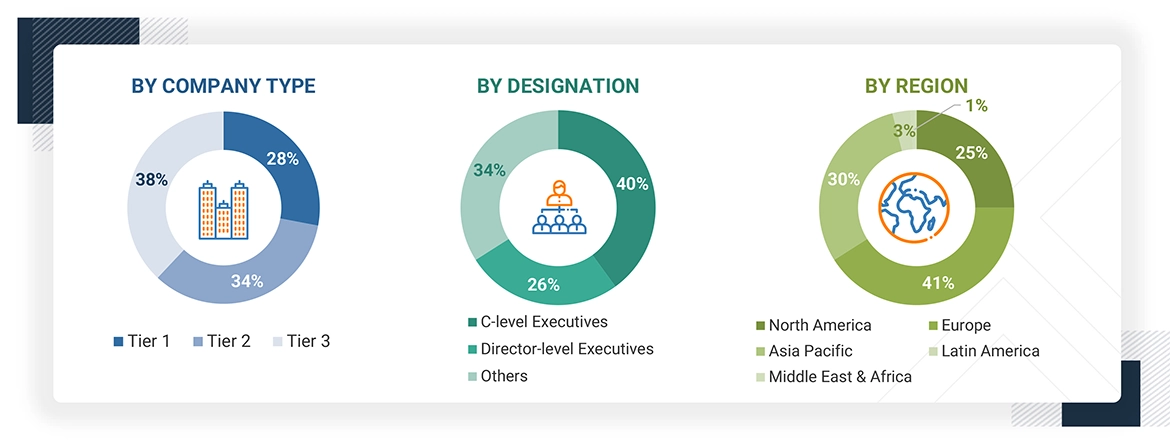
Note 1: C-level executives include CEOs, CFOs, COOs, and VPs.
Note 2: Others include sales managers, marketing managers, business development managers, product managers, distributors, and suppliers.
Note 3: Tiers are defined based on a company’s total revenue. As of 2024, Tier 1= >USD 10 billion, Tier 2 = USD 1 billion to USD 10 billion, and Tier 3 = < USD 1 billion.
Source: MarketsandMarkets Analysis
To know about the assumptions considered for the study, download the pdf brochure
Market Size Estimation
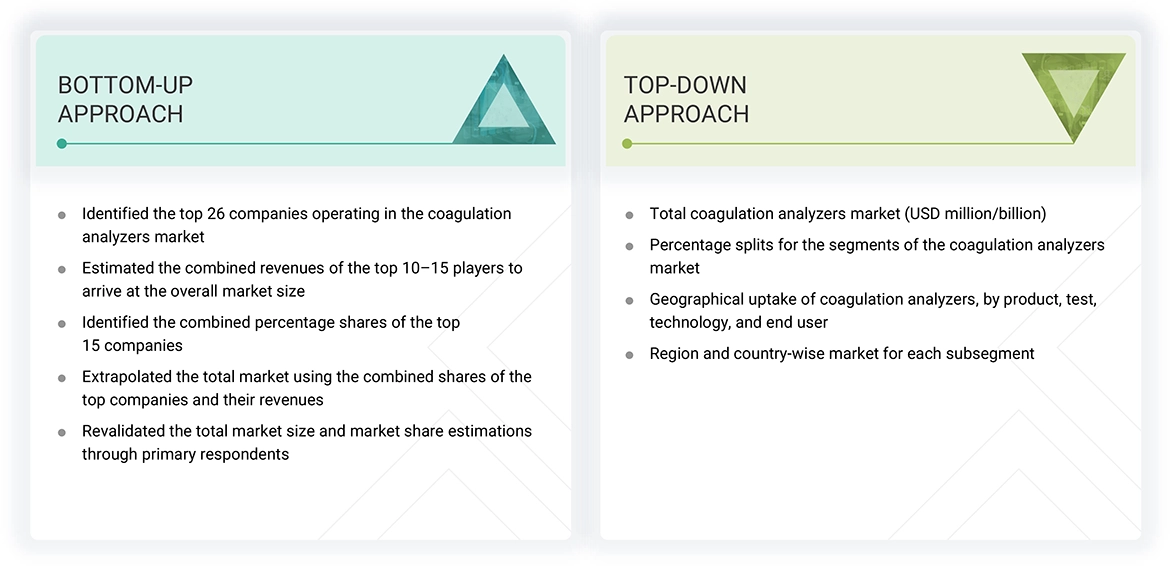
Annual revenues were calculated based on revenue data from major product manufacturers and OEMs involved in the global coagulation analyzers market to determine the global market value. Key manufacturers were identified at both the global and regional levels. Revenue mapping for their respective business segments and subsegments was conducted for these leading players.
The global coagulation analyzers market was categorized into various segments and subsegments based on the following criteria:
- A list of major players operating in the product market at the regional and country levels.
- Product mapping of various coagulation analyzer manufacturers at the regional and country levels.
- Mapping of annual revenues generated by the listed major players, specifically from coagulation analyzers or related business units/products.
- Extrapolation of the revenue data from these major players to estimate the global market value for the respective segments and subsegments.
- Summation of the market values of all segments and subsegments to establish the total value of the global coagulation analyzers market.
This data was consolidated, along with detailed inputs and analysis from MarketsandMarkets, and presented in this report.
Market Size Estimation (Bottom-up Approach & Top-down Approach)
Data Triangulation
After arriving at the overall size of the global coagulation analyzers market through the above-mentioned methodology, this market was split into several segments and subsegments. Where applicable, the data triangulation and market breakdown procedures were employed to complete the overall market engineering process and arrive at the exact market value data for the key segments and subsegments. Examining several macrovariables and regional trends from demand- and supply-side players helped triangulate the extrapolated market data.
Market Definition
A coagulation analyzer is an important medical diagnostic tool that checks how well blood can clot by measuring several key factors, including prothrombin time (PT), activated partial thromboplastin time (aPTT), thrombin time (TT), and fibrinogen levels. This device plays a crucial role in diagnosing bleeding disorders like hemophilia, monitoring anticoagulant therapies with drugs such as aspirin, heparin, or warfarin, and managing patients during surgeries. Coagulation analyzers provide fast and accurate evaluations of clotting efficiency and platelet counts, which helps healthcare providers make quick clinical decisions in both hospital and lab environments.
Stakeholders
- Coagulation analyzer instrument manufacturers
- Coagulation analyzer reagent manufacturers
- Group purchasing organizations (GPOs)
- Original equipment manufacturers (OEMs)
- Pharmaceutical & biotechnology companies
- Academic research institutes related to coagulation studies
- Venture capitalists and investors
- Healthcare facilities (hospitals, clinical laboratories, and other end users)
- Research & consulting firms
- Research institutes
Report Objectives
- To define, describe, and forecast the coagulation analyzers market based on product, test, technology, end user, and region
- To provide detailed information regarding the major factors influencing market growth (such as drivers, restraints, opportunities, and industry-specific challenges)
- To assess the coagulation analyzers market with respect to Porter’s Five Forces, regulatory landscape, the value chain, the supply chain, patent analysis, pricing assessment, key stakeholders, and buying criteria
- To strategically analyze micromarkets with respect to individual growth trends, prospects, and contributions to the overall market
- To analyze the opportunities in the coagulation analyzers market for stakeholders and provide details of the competitive landscape for market leaders
- To forecast the size of the coagulation analyzers market in five primary regions (along with countries): North America, Europe, the Asia Pacific, Latin America, and the Middle East & Africa
- To profile the key players operating in the coagulation analyzers market and comprehensively analyze their core competencies and market shares
- To track and analyze competitive developments such as partnerships, agreements, collaborations, acquisitions, expansions, product/technology developments, and product approvals
- To benchmark players within the coagulation analyzers market using the Company Evaluation Matrix framework, which analyzes market players on various parameters within categories of business strategies, market share, and product offerings
- To understand the impact of AI/generative AI on the market
Get the Full Coagulation Analyzer Market Report
Full forecast, segment splits, and company analysis for all Coagulation Analyzer Market.
- Canada Coagulation Analyzer Market
- US Coagulation Analyzer Market
- Germany Coagulation Analyzer Market
- UK Coagulation Analyzer Market
- France Coagulation Analyzer Market
- Italy Coagulation Analyzer Market
- Spain Coagulation Analyzer Market
- China Coagulation Analyzer Market
- Japan Coagulation Analyzer Market
- India Coagulation Analyzer Market
- Australia Coagulation Analyzer Market
- Brazil Coagulation Analyzer Market
- Mexico Coagulation Analyzer Market
- Rest Of Europe Coagulation Analyzer Market
- Rest Of Asia Pacific Coagulation Analyzer Market
- Rest Of Latin America Coagulation Analyzer Market
Need a Tailored Report?
Customize this report to your needs
Get 10% FREE Customization
Customize This Report
