
North America Human Organoids Market (2024-2029)

The North America Human Organoids Market was valued at $526.4 Million in 2024 and projected to reach to $1038.7 Million by 2029, representing a compound annual growth rate of 14.6%. North America's human organoids market is poised for sustained expansion, driven by increasing adoption in pharmaceutical development, regenerative medicine applications, and disease modeling.


| Market Size in | USD 26.32 MN |
| Market Forecast in | |
| CAGR | |
| Forecast Period | |
| Units Considered | Value (USD MN) |
North America Human Organoids Market Trends and Insights
- This growth trajectory reflects North America's leadership in regenerative medicine research, advanced biotech infrastructure, and substantial investment in organ-on-chip and tissue engineering technologies.
- North America benefits from a concentration of leading research institutions, pharmaceutical companies, and venture capital funding that accelerate organoid development and commercialization. The North America market is driven by increasing demand for personalized medicine, drug testing alternatives, and disease modeling applications across the region.
- North America's regulatory environment, particularly in the United States and Canada, supports innovation while maintaining rigorous safety standards for organoid-based therapies.
- The region's strong intellectual property framework and collaborative ecosystem between academia and industry further position North America as a global hub for human organoid advancement through 2029..
Key Market Statistics
- CAGR (2024-2029) 14.6% CAGR
- Market Size, 2024 ~USD 526.4 Million
- Forecast, 2029 ~USD 1038.7 Million
- Geography North America
North America Human Organoids Market Overview
Market Leadership Position :
North America commands 45.8% of the global human organoids market, driven by the US contribution of $398.1 million in 2024, establishing the region as the primary innovation and commercialization hub for organoid technologies.
Accelerated Growth Trajectory :
With a CAGR of 14.6% through 2029, North America's market is expanding faster than the global average of 14.4%, reflecting strong institutional support, FDA regulatory pathways, and venture capital investment in regenerative medicine.
Advanced Biotech Infrastructure :
North America benefits from world-class research institutions, established organ-on-chip platforms, and tissue engineering ecosystems concentrated in biotech hubs including Boston, San Francisco, and Toronto, accelerating commercialization timelines.
Substantial Investment Ecosystem :
Significant R&D funding from NIH, NSF, and private biotech firms supports North American organoid development for drug discovery, toxicology testing, and personalized medicine applications, creating sustained market momentum.
North America Human Organoids Market Dynamics
- The region's regulatory clarity through FDA frameworks and strong intellectual property protections create favorable conditions for commercialization.
- Investment in organ-on-chip technologies and tissue engineering platforms continues to accelerate, with major biotech companies and academic institutions collaborating to advance clinical applications. The forecast growth to $1,038.7 million by 2029 reflects rising demand from contract research organizations, pharmaceutical companies seeking alternatives to animal testing, and healthcare providers exploring regenerative therapies.
- North America's leadership in precision medicine and personalized healthcare further supports market expansion, positioning the region as the global benchmark for organoid innovation and clinical translation through 2029..
Market Ecosystem
Related Ecosystem
Biotechnology
- Reagents
- Polymerase Chain Reaction (PCR)
- Stem Cells
- Assay Kits
- Flow Cytometers
- Thermo Fisher Scientific Inc.
- Merck KGaA
- Danaher Corporation
- Agilent Technologies, Inc.
- Bio-Rad Laboratories, Inc.
Key Takeaways
- North America's human organoids market will nearly double from $526.4M (2024) to $1,038.7M (2029), representing a 14.6% CAGR.
- North America leads globally in organoid research infrastructure, with major pharmaceutical and biotech companies investing heavily in drug discovery and development applications.
- North America's regulatory frameworks and intellectual property protections create a favorable environment for organoid commercialization and clinical translation.
- North America's market growth is fueled by demand for alternatives to animal testing, personalized medicine platforms, and disease modeling for rare genetic disorders.
Human Organoids Market Report Scope
| Report Metric | Details |
|---|---|
| Base Year | 2024 |
| Fastest Growing Segment | DEVELOPMENTAL BIOLOGY (Application) |
| Forecast Period | 2024-2029 |
| Growth Rate | CAGR of 14.4% from 2024 to 2029 |
| Largest Segment | READY-TO-USE PRODUCTS (Type) |
| Market Size Base Year (Billions) | ~USD 1.19 (2024) |
| Revenue Forecast (Billions) | ~USD 2.33 (2029) |
| Segments Covered | Product, Type, Source, Culture Method, Disease Area, Application, End User |
North America Human Organoids Market Report Segmentation
7 segment dimensions are covered across the global market.
By Product
- Colorectal Models
- Heart Models
- Kidney Models
- Liver Models
- Lung Models
- Other Products
- Pancreatic Models
By Type
- 2D Colorectal Models
- 2D Heart Models
- 2D Kidney Models
- 2D Liver Models
- 2D Lung Models
- 2D Models (Other Products)
- 2D Pancreatic Models
- 3D Bioprinted Colorectal Models
- 3D Bioprinted Heart Models
- 3D Bioprinted Kidney Models
- 3D Bioprinted Liver Models
- 3D Bioprinted Lung Models
- 3D Bioprinted Models (Other Products)
- 3D Bioprinted Pancreatic Models
- 3D Colorectal Models
- 3D Heart Models
- 3D Kidney Models
- 3D Liver Models
- 3D Lung Models
- 3D Models (Other Products)
- 3D Pancreatic Models
- Colorectal Organoids
- Colorectal Spheroids
- Cryopreserved Cells (Other Products)
- Cryopreserved Colorectal Cells
- Cryopreserved Heart Cells
- Cryopreserved Hepatocytes
- Cryopreserved Kidney Cells
- Cryopreserved Lung Cells
- Cryopreserved Pancreatic Cells
- Customizable Products
- Fresh Cells (Other Products)
- Fresh Colorectal Cells
- Fresh Heart Cells
- Fresh Hepatocytes
- Fresh Kidney Cells
- Fresh Lung Cells
- Fresh Pancreatic Cells
- Heart Organoids
- Heart Spheroids
- Kidney Organoids
- Kidney Spheroids
- Liver Organoids
- Liver Spheroids
- Liver-On-A-Chip
- Lung Organoids
- Lung Spheroids
- Organoids (Other Products)
- Other 2D Colorectal Models
- Other 2D Heart Models
- Other 2D Kidney Models
- Other 2D Liver Models
- Other 2D Lung Models
- Other 2D Models (Other Products)
- Other 2D Pancreas Models
- Other 3D Colorectal Models
- Other 3D Heart Models
- Other 3D Kidney Models
- Other 3D Liver Models
- Other 3D Lung Models
- Other 3D Models (Other Products)
- Other 3D Pancreatic Models
- Pancreatic Organoids
- Pancreatic Spheroids
- Ready-To-Use Products
- Spheroids (Other Products)
By Source
- Adult Stem Cells
- Escs
- Ipscs
- Other Sources
By Culture Method
- 3D Bioprinting Culture
- Air-Liquid Interface Culture
- Matrigel Matrix Culture
- Other Culture Methods
- Suspension Culture
By Disease Area
- Cardiovascular Diseases
- Gastrointestinal Diseases
- Infectious Diseases
- Liver Diseases
- Neurological Disorders
- Oncology
- Other Disease Areas
By Application
- Developmental Biology
- Disease Pathology
- Drug Toxicity & Efficacy Testing
- Other Applications
- Personalized Medicine
- Regenerative Medicine
By End User
- Academic & Research Institutes
- Cros
- Other End Users
- Pharmaceutical & Biotechnology Companies
Target Audience
- Pharmaceutical & Biotech Companies : Require North American market data to evaluate organoid adoption for drug discovery, toxicology testing, and clinical development, with insights into regulatory pathways and competitive positioning in the region's leading biotech markets.
- Contract Research Organizations (CROs) : Need detailed North American market intelligence to expand organoid service offerings, identify client acquisition opportunities, and benchmark service pricing against regional competitors in the growing regenerative medicine sector.
- Venture Capital & Private Equity Firms : Seek North America-specific market data to identify high-growth organoid startups, evaluate investment opportunities in tissue engineering platforms, and assess exit potential within the region's robust biotech ecosystem.
- Academic & Research Institutions : Require regional market insights to secure funding, commercialize organoid research, establish industry partnerships, and understand translational pathways from North American research institutions to clinical applications.
- Healthcare Providers & Hospital Systems : Need North American market analysis to evaluate organoid-based regenerative therapies, assess adoption timelines for personalized medicine applications, and plan integration of organoid technologies into clinical practice.
Countries within North America - compare and drill down
| Country | 2025 size (native) |
|---|---|
| US | USD 398.1 Million |
| Canada | USD 79.5 Million |
Country market size visualization
Reasons to Buy this Report
- Regional Market Dominance Data : Gain detailed insights into North America's 45.8% global market share, with granular breakdowns of US ($398.1M) and Canadian ($79.5M) markets to identify regional growth opportunities and competitive positioning.
- Investment & Funding Intelligence : Access comprehensive analysis of venture capital flows, NIH/NSF funding trends, and institutional R&D spending driving North American organoid innovation, enabling strategic investment decisions and partnership identification.
- Regulatory & Commercial Pathway Clarity : Understand FDA approval frameworks, clinical translation timelines, and commercialization strategies specific to North America, reducing market entry risks for biotech companies and pharmaceutical organizations.
- Competitive Landscape Mapping : Identify leading North American organoid developers, contract research organizations, and pharmaceutical adopters through detailed competitive analysis tailored to regional market dynamics and innovation hubs.
- Forecast-Driven Strategic Planning : Leverage North America-specific projections (14.6% CAGR to 2029) to develop targeted business strategies, resource allocation plans, and market entry timelines aligned with regional growth trajectories.
Frequently asked questions
What is the projected market size for human organoids in North America by 2029?
North America's human organoids market is projected to reach $1,038.7 million by 2029, growing from $526.4 million in 2024 at a 14.6% CAGR.
What are the primary applications driving North America's organoid market growth?
North America's market is driven by drug discovery and toxicity testing, disease modeling for rare genetic disorders, personalized medicine development, and regenerative medicine research applications.
How does North America's regulatory environment support organoid market development?
North America's FDA and Health Canada frameworks provide clear pathways for organoid-based therapeutic approval while maintaining safety standards, and strong IP protections encourage private sector investment and commercialization.
Which sectors are investing most heavily in organoid technology across North America?
Pharmaceutical companies, biotechnology firms, academic research institutions, and venture capital investors are the primary drivers of organoid innovation and commercialization in North America.
What competitive advantages does North America hold in the global organoid market?
North America's advantages include world-class research institutions, concentrated biotech expertise, substantial R&D funding, favorable regulatory pathways, and a robust ecosystem connecting academia, industry, and investors.
RESEARCH METHODOLOGY
The study involved major activities in estimating the current market size for the human organoids market. Exhaustive secondary research was done to collect information on the human organoids industry. The next step was to validate these findings, assumptions, and sizing with industry experts across the value chain using primary research. Different approaches, such as top-down and bottom-up, were employed to estimate the total market size. After that, the market breakup and data triangulation procedures were used to estimate the market size of the segments and subsegments of the human organoids market.
The four steps involved in estimating the market size are
Secondary Research
In the secondary research process, various secondary sources such as annual reports, press releases & investor presentations of companies, white papers, certified publications, articles by recognized authors, gold-standard & silver-standard websites, regulatory bodies, and databases (such as D&B Hoovers, Bloomberg Business, and Factiva) were referred to identify and collect information for this study.
Primary Research
In the primary research process, various sources from both the supply and demand sides were interviewed to obtain qualitative and quantitative information for this report. Primary sources were mainly industry experts from the core and related industries and preferred suppliers, manufacturers, distributors, service providers, technology developers, researchers, and organizations related to all segments of this industry’s value chain. In-depth interviews were conducted with various primary respondents, including key industry participants, subject-matter experts, C-level executives of key market players, and industry consultants, to obtain and verify critical qualitative and quantitative information as well as assess prospects.
The following is a breakdown of the primary respondents:
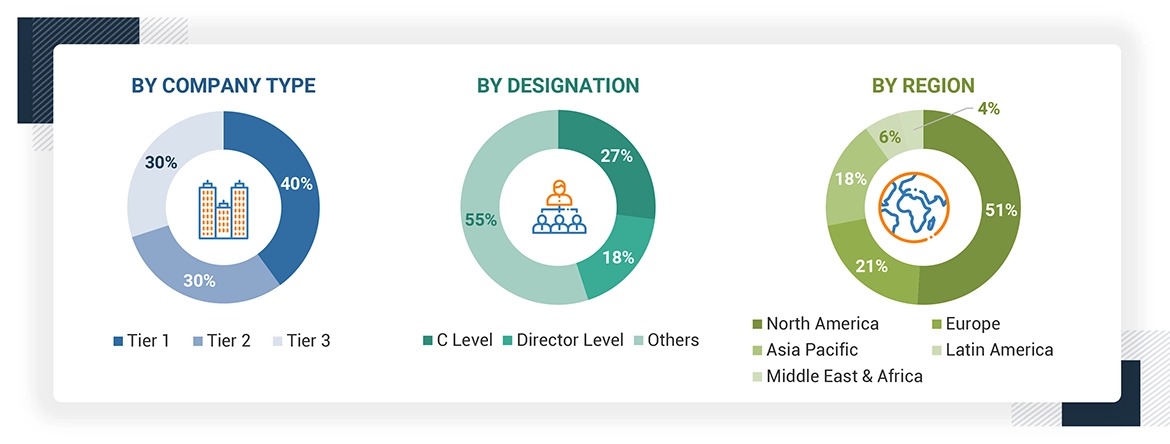
Note 1: Others include sales managers, marketing managers, and product managers.
Note 2: Companies are classified into tiers based on their total revenues. As of 2022/2023, Tier 1 = >USD 100 million, Tier 2 = USD 10 million to USD 100 million, and Tier 3 = < USD 10 million.
To know about the assumptions considered for the study, download the pdf brochure
| COMPANY NAME | DESIGNATION |
|---|---|
| Thermo Fisher Scientific Inc. | Director of sales |
| Merck KGaA | Sales Executive |
Market Size Estimation
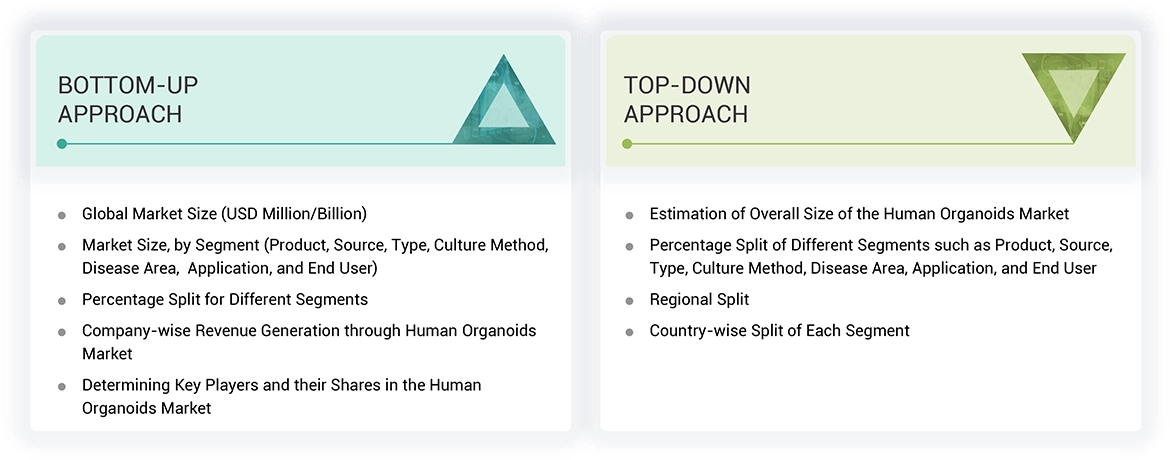
Both top-down and bottom-up approaches were used to estimate and validate the human organoids market's total size. These methods were also used extensively to estimate the size of various subsegments in the market. The research methodology used to estimate the market size includes the following:
- The key players in the industry have been identified through extensive secondary research
- The revenues generated by leading players operating in the human organoids market have been determined through primary and secondary research.
- All percentage shares, splits, and breakdowns have been determined using secondary sources and verified through primary sources.
The research methodology used to estimate the market size includes the following:
Data Triangulation
After arriving at the overall market size by applying the process mentioned above, the total market was split into several segments and subsegments. To complete the overall market engineering process and arrive at the exact statistics for all segments and subsegments, data triangulation and market breakdown procedures were employed, wherever applicable. The data was triangulated by studying various factors and trends from both the demand and supply sides.
Market Definition
An organoid is a miniaturized and simplified version of an organ produced in vitro in three dimensions that shows realistic microanatomy. Organoids are derived from one or a few cells from tissue, embryonic stem cells, or induced pluripotent stem cells, which can self-organize in three-dimensional culture owing to their self-renewal and differentiation capacities.
Stakeholders
- Senior Management
- End User
- Finance/Procurement Department
- R&D Department
Report Objectives
- To define, describe, segment, and forecast the global human organoids market, by product, source, type, culture method, disease area, application, end user, and region
- To provide detailed information regarding the major factors influencing the market growth (such as drivers, restraints, opportunities, and challenges)
- To analyze the micromarkets1 with respect to individual growth trends, prospects, and contributions to the overall human organoids market
- To analyze market opportunities for stakeholders and provide details of the competitive landscape for key players
- To forecast the size of the market segments with respect to six regions, namely, North America, Europe, the Asia Pacific, Middle East & Africa, Latin America, and GCC Countries
- To profile the key players and comprehensively analyze their product portfolios, market positions, and core competencies
- To track and analyze company developments such as product launches & approvals, partnerships, acquisitions, agreements, and other developments
- To benchmark players within the market using the proprietary Competitive Leadership Mapping framework, which analyzes market players on various parameters within the broad categories of business and product excellence
Get the Full Human Organoids Market Report
Full forecast, segment splits, and company analysis for all Human Organoids Market.
- Rest Of Latin America Human Organoids Market
- Canada Human Organoids Market
- US Human Organoids Market
- Germany Human Organoids Market
- UK Human Organoids Market
- France Human Organoids Market
- Italy Human Organoids Market
- Spain Human Organoids Market
- China Human Organoids Market
- Japan Human Organoids Market
- India Human Organoids Market
- Australia Human Organoids Market
- South Korea Human Organoids Market
- Brazil Human Organoids Market
- Mexico Human Organoids Market
- Rest Of Europe Human Organoids Market
- Rest Of Asia Pacific Human Organoids Market
Need a Tailored Report?
Customize this report to your needs
Get 10% FREE Customization
Customize This Report
