
Canada Hyperspectral Imaging Systems Market (2025-2030)

The Canada Hyperspectral Imaging Systems Market was valued at $102.2 Million in 2025 and projected to reach to $162.7 Million by 2030, representing a compound annual growth rate of 14.5%. Canada's hyperspectral imaging systems market is poised for sustained expansion through 2030, driven by increasing investments in precision agriculture and resource extraction technologies.


| Market Size in | USD 26.32 MN |
| Market Forecast in | |
| CAGR | |
| Forecast Period | |
| Units Considered | Value (USD MN) |
Canada Hyperspectral Imaging Systems Market Trends and Insights
- This 14.5% compound annual growth rate reflects Canada's increasing adoption of advanced imaging technologies across agriculture, mining, environmental monitoring, and aerospace sectors.
- Canada's strong research institutions and technology-driven economy are positioning the country as a key player in hyperspectral innovation within North America. The Canadian market benefits from significant investments in remote sensing applications and industrial automation.
- Canada's natural resource industries, particularly forestry and mineral exploration, are driving demand for hyperspectral solutions that enhance operational efficiency and environmental compliance.
- Between 2025 and 2030, Canada is expected to see accelerated deployment in precision agriculture and climate monitoring initiatives, supported by government funding and private sector collaboration. Canada's geographic advantages and technical expertise create a favorable environment for hyperspectral imaging adoption.
- The market's growth trajectory reflects both domestic demand and Canada's role as a technology hub serving broader North American markets..
Key Market Statistics
- CAGR (2025-2030) 14.5% CAGR
- Market Size, 2025 ~USD 102.2 Million
- Forecast, 2030 ~USD 162.7 Million
- Country Canada
Canada Hyperspectral Imaging Systems Market Overview
Market Valuation Growth :
Canada's hyperspectral imaging systems market is valued at $102.2 million in 2025, with projections reaching $162.7 million by 2030, representing a strong 14.5% CAGR driven by technological advancement and sector diversification.
Key Industry Adoption :
Agriculture, mining, environmental monitoring, and aerospace sectors are leading adoption in Canada, leveraging hyperspectral imaging for precision farming, mineral exploration, climate assessment, and aircraft inspection applications.
Research & Innovation Hub :
Canada's robust research institutions and technology infrastructure position the country as a leader in hyperspectral imaging development, fostering innovation partnerships between academia and commercial enterprises.
Competitive CAGR Performance :
Canada's 14.5% CAGR closely aligns with the global market growth rate of 14.7%, indicating strong market maturity and consistent demand trajectory comparable to international benchmarks.
Canada Hyperspectral Imaging Systems Market Dynamics
- The country's advanced research ecosystem and government support for technology innovation create favorable conditions for market penetration.
- Key growth catalysts include rising environmental monitoring requirements, aerospace sector modernization, and digital transformation initiatives across Canadian industries.
- The market's near-global CAGR alignment suggests Canada maintains competitive positioning within international markets, with opportunities for both domestic manufacturers and technology integrators to capture emerging applications in climate science and sustainable resource management..
Market Ecosystem
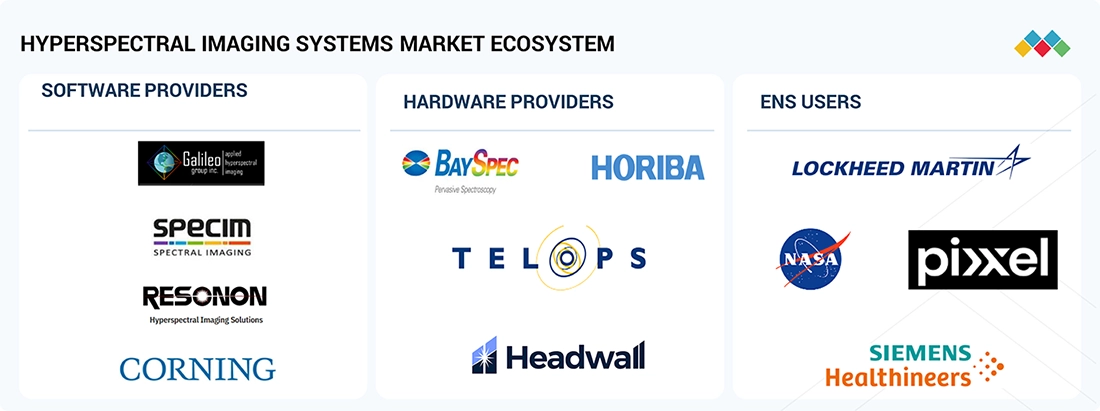
HYPERSPECTRAL IMAGING SYSTEMS MARKET SIZE, SHARE: COMMERCIAL USE CASES ACROSS INDUSTRIES
| COMPANY | USE CASE DESCRIPTION | BENEFITS |
|---|---|---|
 |
Google-backed space tech startup launching hyperspectral imaging satellites (Firefly constellation) to serve agriculture, mining, environmental monitoring, and defense applications from orbit. | Provides high-resolution spectral data for crop health, resource tracking, environmental analysis, and national security. |
 |
Hyperspectral imaging systems deployed for precision agriculture, environmental monitoring, mining/ prospecting, industrial inspection, and defense applications using airborne, ground, and benchtop configurations. | Enables detection of crop stress and contaminants, non-destructive mineral mapping, environmental change tracking, and infrastructure inspection, improving operational insights and safety. |
 |
Hyperspectral cameras deployed across agriculture, food processing, waste sorting, and research contexts, including universities using systems for mineral and food quality studies. | Provides detailed material identification and classification, enabling precise crop health analysis, contaminant detection, and academic research outcomes. |
Logos and trademarks shown above are the property of their respective owners. Their use here is for informational and illustrative purposes only.
Related Ecosystem
Aviation
- Narrow Body Aircraft
- Wide Body Aircraft
- Military Helicopters
- Special Mission Aircraft
- Fighter Aircraft
- HONEYWELL INTERNATIONAL INC.
- COLLINS AEROSPACE
- Thales group
- Safran group
- HEICO Corporation
Medical Devices
- Polymerase Chain Reaction (PCR)
- Magnetic Resonance Imaging (MRI)
- Disposable Autoinjectors
- Pulse Oximeters
- Blood Pressure Monitors
- Medtronic plc
- Stryker Corporation
- Abbott Laboratories
- Becton, Dickinson and Company
- JOHNSON & JOHNSON
Electronics System And Components
- Sensors
- Temperature Sensors
- Pressure Sensors
- Actuators
- Image Sensors
- Lenovo
- Samsung
- Texas Instruments Incorporated
- HONEYWELL INTERNATIONAL INC.
- Teledyne Technologies Incorporated
Key Takeaways
- Canada's hyperspectral imaging market is valued at $102.2 million in 2025 and will reach $162.7 million by 2030, representing a 14.5% CAGR.
- Canada's natural resource sectors, including mining and forestry, are primary drivers of hyperspectral imaging adoption and market expansion.
- Canada's research institutions and government support are accelerating innovation in remote sensing and precision agriculture applications.
- Canada's strategic position in North America positions it as a technology hub for hyperspectral imaging solutions serving regional markets.
Hyperspectral Imaging Systems Market Report Scope
| Report Metric | Details |
|---|---|
| Base Year | 2025 |
| Fastest Growing Segment | CAMERAS (Offering) |
| Forecast Period | 2025–2030 |
| Growth Rate | CAGR of 14.7% from 2025 to 2030 |
| Largest Segment | SERVICES (Offering) |
| Market Size Base Year (Billions) | ~USD 0.92 (2025) |
| Revenue Forecast (Billions) | ~USD 1.83 (2030) |
| Segments Covered | Offering, Wavelength, Technology, End-Use Application, Remote Sensing & Mapping End-Use Application |
Canada Hyperspectral Imaging Systems Market Report Segmentation
5 segment dimensions are covered across the global market.
By Offering
- Cameras
- Services
By Wavelength
- Lwir
- Mwir
- Swir
- Visible & Nir
By Technology
- Other Technologies
- Pushbroom/Line Scan
- Snapshot
By End-Use Application
- Machine Vision & Optical Sorting
- Monitoring & Surveillance
- Other End-Use Applications
- Remote Sensing & Mapping
- Research & Diagnostics
By Remote Sensing & Mapping End-Use Application
- Agriculture
- Environmental Monitoring
- Mining/Mineral Mapping
- Other Remote Sensing & Mapping End-Use Applications
- Others Remote Sensing & Mapping Applications
Target Audience
- Technology Manufacturers : Hyperspectral imaging system developers need Canada-specific market data to assess demand, identify sector opportunities, and plan product localization and distribution strategies.
- Agricultural Technology Providers : Precision agriculture companies require detailed insights into Canadian farm adoption rates, regional preferences, and competitive dynamics to optimize precision imaging solutions for Canadian markets.
- Mining & Resource Companies : Exploration and extraction firms need market intelligence on hyperspectral imaging adoption in Canadian mining to evaluate technology investments and operational efficiency improvements.
- Investment & Private Equity Firms : Investors evaluating Canadian technology and agtech opportunities require market forecasts, growth trajectories, and sector analysis to support due diligence and portfolio decisions.
- Government & Policy Organizations : Canadian government agencies and environmental bodies need market data to inform technology adoption policies, environmental monitoring initiatives, and innovation funding priorities.
Key Companies in the Canada Hyperspectral Imaging Systems Market
| Company | HQ | Ownership | Strongest segments |
|---|---|---|---|
| LATTICE SEMICONDUCTOR | United States | Public Company | Cameras (FPGA content in hyperspectral cameras),System Integrator / Edge Compute in integrated systems, |
| TELEDYNE TECHNOLOGIES | United States | Public Company | Hyperspectral Cameras,System Integrator / Integrated Systems, |
| MEDIATEK INC | Taiwan | Public Company | Cameras (via IC content in OEM devices),System Integrator solutions (boards, reference designs, software), |
| KONICA MINOLTA, INC. | Japan | Public Company | Hyperspectral Cameras,System Integrator / Solutions,Measurement Instruments & Sensors (Hyperspectral-Enabled), |
| CORNING INCORPORATED | United States | Public Company | Optical substrates and specialty glass for hyperspectral cameras,Optical components and couplers for telecom-style hyperspectral links and sensing,Life sciences labware and imaging platform components, |
| HORIBA | Japan | Public Company | Cameras,System Integrator,Pushbroom, |
| NORSK ELEKTRO OPTIKK AS | Norway | Private Company | Cameras,System Integrator, |
| EXOSENS | France | Public Company | Cameras,System Integrator, |
LATTICE SEMICONDUCTOR
Lattice Semiconductor is a United States-based public company founded in 1983 that employs 1,174 people. The company operates in the semiconductor industry.
TELEDYNE TECHNOLOGIES
Teledyne Technologies is a United States-based public company founded in 1960 with 15,800 employees. The company operates across multiple technology and engineering sectors.
MEDIATEK INC
MediaTek Inc. is a Taiwan-based public company founded in 1997 with 17,449 employees. The company operates in the semiconductor and technology industry.
KONICA MINOLTA, INC.
Konica Minolta, Inc. is a Japan-based public company founded in 1873 with 34,363 employees. The company operates in imaging, optical, and business technology sectors.
CORNING INCORPORATED
Corning Incorporated is a United States-based public company founded in 1851 with 67,200 employees. The company is a global leader in materials science and specialty glass manufacturing.
HORIBA
HORIBA is a Japan-based public company founded in 1945 with 9,101 employees. The company operates in measurement and analysis technology sectors.
NORSK ELEKTRO OPTIKK AS
Norsk Elektro Optikk AS is a Norway-based private company founded in 1985.
EXOSENS
Exosens is a France-based public company founded in 1937 with 1,499 employees. The company operates in the optics and photonics technology sector.
Reasons to Buy this Report
- Market-Specific Growth Data : Access detailed Canada-focused market sizing, CAGR analysis, and 5-year forecasts to inform strategic planning and investment decisions specific to the Canadian hyperspectral imaging landscape.
- Sector-Level Insights : Understand adoption patterns across Canada's key verticals—agriculture, mining, environmental monitoring, and aerospace—with tailored intelligence for targeting high-growth segments.
- Competitive Positioning : Benchmark Canada's market performance against global trends (14.5% vs. 14.7% global CAGR) to identify competitive advantages and market opportunities for Canadian and international players.
- Research & Innovation Landscape : Leverage insights into Canada's research institution ecosystem and technology infrastructure to identify partnership opportunities and innovation hubs driving market advancement.
- Strategic Market Entry : Develop informed go-to-market strategies for Canada with comprehensive data on market maturity, regional demand drivers, and sector-specific adoption timelines through 2030.
Frequently asked questions
What is the current market size of hyperspectral imaging systems in Canada?
Canada's hyperspectral imaging systems market is valued at $102.2 million in 2025, with expectations to grow to $162.7 million by 2030.
What is the projected growth rate for Canada's hyperspectral imaging market?
Canada's hyperspectral imaging market is projected to grow at a compound annual growth rate (CAGR) of 14.5% from 2025 to 2030.
Which industries are driving hyperspectral imaging adoption in Canada?
Canada's primary growth drivers include mining, forestry, agriculture, environmental monitoring, and aerospace sectors leveraging hyperspectral technology for operational efficiency.
How is Canada positioned in the North American hyperspectral imaging market?
Canada serves as a key technology hub in North America, with strong research capabilities and government support enabling innovation and regional market leadership in hyperspectral imaging.
What factors are supporting hyperspectral imaging growth in Canada?
Canada's growth is supported by government funding, research institution investments, natural resource industry demand, and increasing adoption in precision agriculture and climate monitoring applications.
RESEARCH METHODOLOGY
The study involved four major activities in estimating the current size of the hyperspectral imaging systems market. Exhaustive secondary research collected information on the market, peer, and parent markets. The next step was to validate these findings, assumptions, and sizing with industry experts across the value chain through primary research. Both top-down and bottom-up approaches were employed to estimate the complete market size. After that, market breakdown and data triangulation were used to estimate the market size of segments and subsegments.
Secondary Research
Various secondary sources have been referred to in the secondary research process to identify and collect information important for this study. The secondary sources include annual reports, press releases, and investor presentations of companies; white papers; journals and certified publications; and articles from recognized authors, websites, directories, and databases. Secondary research has been conducted to obtain key information about the industry’s supply chain, the market’s value chain, the total pool of key players, market segmentation according to the industry trends (to the bottom-most level), regional markets, and key developments from market- and technology-oriented perspectives. The secondary data has been collected and analyzed to determine the overall market size, further validated by primary research.
List of major secondary sources
|
Sources |
Web Link |
|
Company Blogs |
What is hyperspectral Imaging?: A Comprehensive Guide - Specim Spectral Imaging |
|
Industry Journals |
|
|
Environmental Protection Agency |
Primary Research
Extensive primary research was conducted after gaining knowledge about the current scenario of the hyperspectral imaging systems market through secondary research. Several primary interviews were conducted with experts from both the demand and supply sides across four major regions—North America, Europe, Asia Pacific and RoW. This primary data was collected through questionnaires, emails, and telephonic interviews.
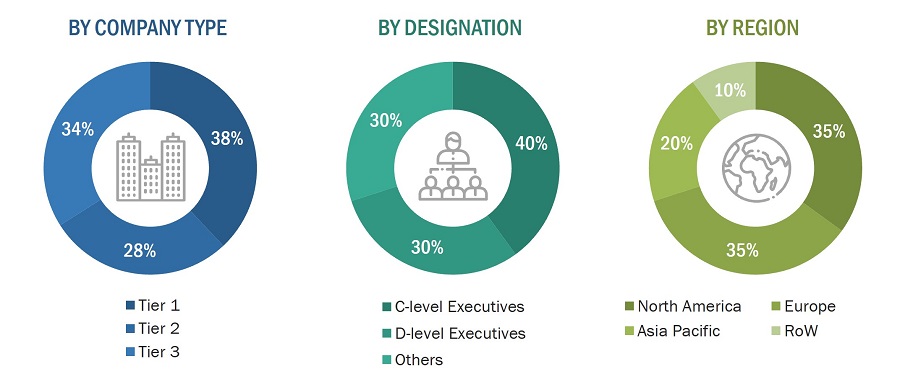
To know about the assumptions considered for the study, download the pdf brochure
Market Size Estimation
In the complete market engineering process, both top-down and bottom-up approaches have been used, along with several data triangulation methods, to perform market estimation and forecasting for the overall market segments and subsegments listed in this report. Key players in the market have been identified through secondary research, and their market shares in the respective regions have been determined through primary and secondary research. This entire procedure includes the study of annual and financial reports of the top market players and extensive interviews for key insights (quantitative and qualitative) with industry experts (CEOs, VPs, directors, and marketing executives).
All percentage shares, splits, and breakdowns have been determined using secondary sources and verified through primary sources. All the parameters affecting the markets covered in this research study have been accounted for, viewed in detail, verified through primary research, and analyzed to obtain the final quantitative and qualitative data. This data has been consolidated and supplemented with detailed inputs and analysis from MarketsandMarkets and presented in this report. The following figure represents this study’s overall market size estimation process.
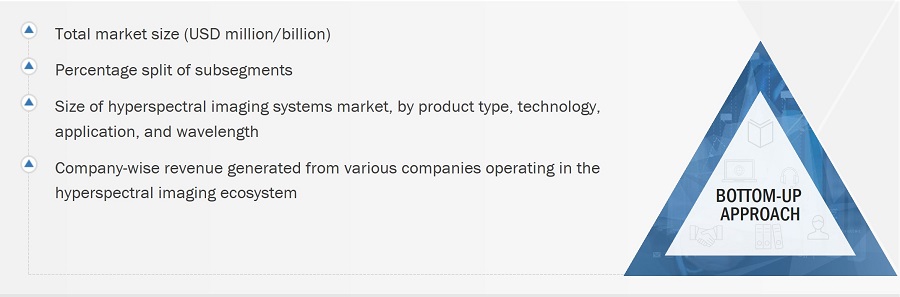
Bottom-Up Approach
- Identifying various wavelengths using hyperspectral imaging systems
- Analyzing the penetration of each type of wavelength through secondary and primary research
- Analyzing the penetration of hyperspectral imaging systems based on different applications and technologies through secondary and primary research
- Conducting multiple discussion sessions with key opinion leaders to understand the detailed working of hyperspectral imaging systems and their implementation in numerous applications; this helped analyze the break-up of the scope of work carried out by each major company
- Verifying and cross-checking the estimates at every level with key opinion leaders, including CEOs, directors, operation managers, and finally with MarketsandMarkets domain experts
- Studying various paid and unpaid sources of information, such as annual reports, press releases, white papers, and databases
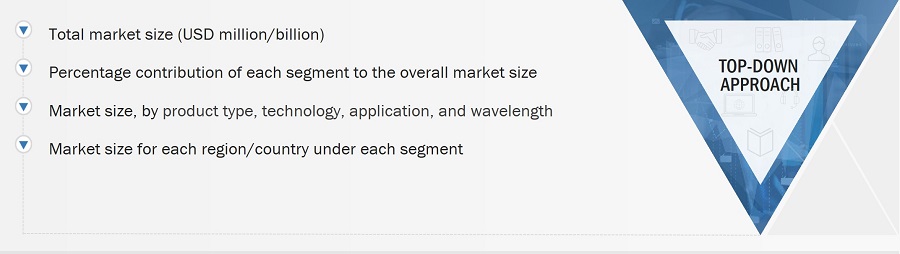
Top-Down Approach
- Focusing initially on the top-line investments and expenditures being made in the ecosystem of the hyperspectral imaging systems market; further, splitting the key market areas based on product type, technology, wavelength, application, and region, and listing the key developments.
- Identifying all leading players and applications in the hyperspectral imaging systems market based on region through secondary research and thoroughly verifying them through a brief discussion with industry experts
- Analyzing revenues, product mix, geographic presence, and critical applications served by all identified players to estimate and arrive at percentage splits for all key segments
- Discussing splits with the industry experts to validate the information and identify critical growth pockets across all key segments
- Breaking down the total market based on verified splits and critical growth pockets across all segments
Data Triangulation
After arriving at the overall market size from the estimation process explained in the previous section, the total market was split into several segments and subsegments. Where applicable, the data triangulation procedure was employed to complete the overall market engineering process and arrive at the exact statistics for all segments and subsegments. The data was triangulated by studying various factors and trends from the demand and supply sides, and the market size was validated using top-down and bottom-up approaches.
Market Definition
Hyperspectral imaging systems are utilized to capture specific spectral bands across a continuous spectrum. Hyperspectral imaging systems are advanced imaging technologies that capture and process information across a wide range of the electromagnetic spectrum. Unlike traditional imaging systems, which typically capture images in three spectral bands (red, green, and blue), hyperspectral imaging systems collect spectral data across hundreds or thousands of narrow contiguous bands. These systems consist of hyperspectral cameras along with their accompanying systems. They are widely used in fields such as agriculture, environmental monitoring, mining etc.
Key Stakeholders
- Hyperspectral imaging systems providers
- Original equipment manufacturers (OEMs)
- Research organisations and consulting firms
- Technology standards organisationa
- Raw material suppliers
- Allaince and associations related to hyperspectral imaging technology
- Technology solution providers and design contractors
- Electronics and semiconductor companies
- Technology standards organizations, forums, alliances, and associations
- Analysts and strategic business planners
- Associations, organizations, and alliances related to hyperspectral imaging technology
- Universities and research organizations
- Government bodies
Report Objectives
- To describe and forecast the hyperspectral imaging systems market by offering, technology, wavelength, application, and region.
- To forecast the market size for various segments concerning four key regions, namely, North America, Europe, Asia Pacific, and Rest of the World (RoW), in terms of value
- To provide detailed information regarding the major factors influencing the market growth (drivers, restraints, opportunities, and challenges).
- To forecast the size of the hyperspectral cameras deployed in the hyperspectral imaging systems market.
- To provide a detailed overview of the value chain of hyperspectral imaging system ecosystems, along with the average selling price for hyperspectral cameras and other systems
- To strategically profile key players and comprehensively analyze their position in the hyperspectral imaging systems market regarding their ranking and core competencies and detail the competitive landscape for market leaders.
- To strategically analyze the ecosystem, regulatory landscape, patent landscape, Porter’s five forces, import and export scenarios, tariff analysis, and case studies about the market under study.
- To analyze strategic developments, such as product launches, related developments, acquisitions, expansions, and agreements, in the market
Customization Options
With the given market data, MarketsandMarkets offers customizations according to the company’s specific needs. The following customization options are available for the report:
Company Information
- Detailed analysis and profiling of additional market players (up to five)
Geographic Analysis
- Further breakdown of regions into respective countries
Get the Full Hyperspectral Imaging Systems Market Report
Full forecast, segment splits, and company analysis for all Hyperspectral Imaging Systems Market.
- US Hyperspectral Imaging Systems Market
- Mexico Hyperspectral Imaging Systems Market
- Germany Hyperspectral Imaging Systems Market
- France Hyperspectral Imaging Systems Market
- UK Hyperspectral Imaging Systems Market
- Italy Hyperspectral Imaging Systems Market
- Spain Hyperspectral Imaging Systems Market
- China Hyperspectral Imaging Systems Market
- Japan Hyperspectral Imaging Systems Market
- India Hyperspectral Imaging Systems Market
Need a Tailored Report?
Customize this report to your needs
Get 10% FREE Customization
Customize This Report
