
Japan Immersion Cooling Market (2025-2030)

The Japan Immersion Cooling Market was valued at $25.3 Million in 2025 and projected to reach to $127.5 Million by 2030, representing a compound annual growth rate of 26.0%. Japan's immersion cooling market is poised for substantial growth, expanding from $25.3 million in 2025 to $127.5 million by 2030, representing a robust 26% CAGR.


| Market Size in | USD 26.32 MN |
| Market Forecast in | |
| CAGR | |
| Forecast Period | |
| Units Considered | Value (USD MN) |
Japan Immersion Cooling Market Trends and Insights
- Japan is emerging as a critical hub for advanced cooling technologies, driven by the nation's leadership in semiconductor manufacturing, data center infrastructure, and high-performance computing applications.
- The 26.0% compound annual growth rate reflects Japan's strategic investments in thermal management solutions to support energy-efficient operations across industrial and IT sectors. The immersion cooling sector in Japan is benefiting from increasing demand for sustainable cooling alternatives in data centers and electronics manufacturing.
- Japan's commitment to reducing carbon emissions and improving operational efficiency has accelerated adoption of immersion cooling technologies among major technology and manufacturing enterprises.
- Between 2025 and 2030, Japan is expected to solidify its position as a regional leader in immersion cooling innovation, supported by strong R&D capabilities and government initiatives promoting green technology adoption..
Key Market Statistics
- CAGR (2025-2030) 26.0% CAGR
- Market Size, 2025 ~USD 25.3 Million
- Forecast, 2030 ~USD 127.5 Million
- Country Japan
Japan Immersion Cooling Market Overview
Semiconductor Manufacturing Leadership :
Japan's dominance in semiconductor production drives immersion cooling adoption, with major fabrication plants requiring advanced thermal management solutions to maintain competitive edge in chip manufacturing.
Data Center Infrastructure Expansion :
Japanese data centers are increasingly deploying immersion cooling systems to enhance energy efficiency and reduce operational costs, particularly in Tokyo and Osaka metropolitan regions hosting major cloud service providers.
High-Performance Computing Investment :
Japan's commitment to supercomputing and AI research facilities necessitates cutting-edge immersion cooling technologies, positioning the nation as a key adopter of next-generation thermal solutions.
Energy Efficiency Regulations :
Stringent Japanese environmental standards and energy conservation mandates accelerate immersion cooling market growth, as businesses seek sustainable alternatives to traditional air-cooling systems.
Japan Immersion Cooling Market Dynamics
- This expansion is underpinned by Japan's technological prowess in semiconductor manufacturing, where immersion cooling provides critical thermal management for advanced chip production.
- The nation's data center operators are increasingly recognizing the cost and energy benefits of immersion solutions, driving widespread adoption across enterprise and cloud infrastructure segments. Looking ahead, Japan's immersion cooling market will benefit from continued investments in AI infrastructure, supercomputing capabilities, and digital transformation initiatives.
- Government support for green technology and energy-efficient solutions further accelerates market penetration.
- As Japanese manufacturers and technology companies expand globally, domestic demand for immersion cooling will strengthen, positioning Japan as a regional innovation hub and key market for cooling technology providers..
Market Ecosystem
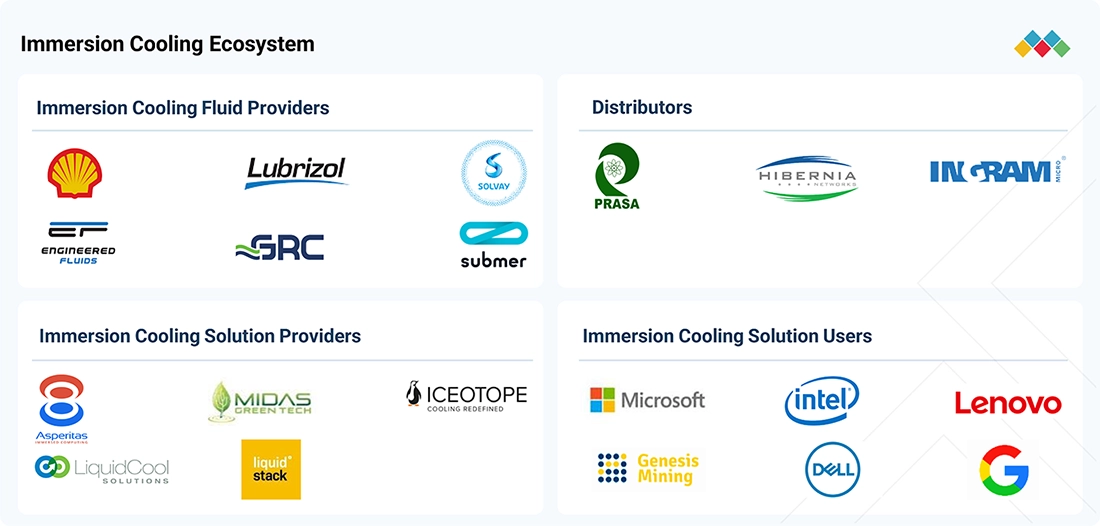
IMMERSION COOLING MARKET: COMMERCIAL USE CASES ACROSS INDUSTRIES
| COMPANY | USE CASE DESCRIPTION | BENEFITS |
|---|---|---|
 |
Deployed two-phase immersion cooling in Azure data centers to support AI and high-density GPU workloads. Immersed entire servers in dielectric fluid for enhanced thermal control. | •Reduced server power consumption by 5-15% through lower fan usage. •Achieved PUE < 1.07 in pilot facilities. •Enabled higher rack densities (>80 kW/rack). |
 |
Evaluated immersion cooling for AI training clusters and next-gen data centers to manage extreme GPU heat loads. | •Improved thermal uniformity across racks. •Lower operational noise and footprint. •Supports sustainable compute scaling for AI infrastructure. |
 |
Developed SmartPod single-phase immersion cooling systems adopted by multiple colocation and enterprise clients (including Telefónica and Orange). | •Up to 50% reduction in cooling energy vs. air-cooled systems. •Space savings up to 45%. •Simplified maintenance (no air filters, fewer moving parts). |
 |
Supplies ICEraQ and ICEtank systems for edge, enterprise, and hyperscale data centers (e.g., with Dell, HPE, and Intel partnerships). | •Modular retrofit design. •Density up to 100 kW/rack. •30-50% reduction in cooling OPEX. •Easier deployment for HPC and AI clusters. |
 |
Uses immersion cooling in Japan’s data centers for HPC and enterprise workloads; testing multi-phase fluids for energy reuse. | •Energy efficiency improvements of 30-40%. •Reuse of waste heat for facility heating. •Reduced chiller requirements in dense compute setups. |
Logos and trademarks shown above are the property of their respective owners. Their use here is for informational and illustrative purposes only.
Related Ecosystem
Equipment Machine And Tooling
- Wastewater Treatment
- Air Cooled Heat Exchangers
- Diaphragm Pumps
- HVAC System
- Membrane Separation
- Alfa Laval Corporate AB
- Veolia
- Daikin Industries,Ltd.
- Johnson Controls International plc
- Carrier Global Corporation
Key Takeaways
- Japan's immersion cooling market is valued at $25.3 million in 2025 and is forecast to grow to $127.5 million by 2030, representing a 26.0% CAGR.
- Japan's advanced semiconductor and data center sectors are primary drivers of immersion cooling adoption and technological innovation.
- Japan's focus on energy efficiency and carbon reduction is accelerating the transition to immersion cooling solutions across industrial applications.
- Japan is positioned as a regional leader in immersion cooling technology development, supported by strong manufacturing capabilities and government green initiatives.
Immersion Cooling Market Report Scope
| Report Metric | Details |
|---|---|
| Base Year | 2025 |
| Fastest Growing Segment | SINGLE-PHASE IMMERSION COOLING (Type) |
| Forecast Period | 2025–2030 |
| Growth Rate | CAGR of 24.2% from 2025 to 2030 |
| Largest Segment | COLD PLATE LIQUID COOLING (Type Of Cooling) |
| Market Size Base Year (Billions) | ~USD 0.57 (2025) |
| Revenue Forecast (Billions) | ~USD 1.69 (2030) |
| Segments Covered | Type, Application, Component, Type Of Cooling |
Japan Immersion Cooling Market Report Segmentation
4 segment dimensions are covered across the global market.
By Type
- Single-Phase Immersion Cooling
- Two-Phase Immersion Cooling
By Application
- Artificial Intelligence
- Cryptocurrency Mining
- Edge Computing
- High-Performance Computing
- Other Applications
By Component
- Services
- Solutions
By Type Of Cooling
- Cold Plate Liquid Cooling
- Immersion Liquid Cooling
JAPAN: IMMERSION COOLING MARKET, BY APPLICATION, 2025–2032
| Segment | 2025 | 2026 | 2027 | 2028 | 2029 | 2030 | 2031 | 2032 | CAGR (%) |
|---|---|---|---|---|---|---|---|---|---|
| ARTIFICIAL INTELLIGENCE | 3.6 | 4.6 | 5.8 | 7.4 | 9.5 | 12 | 15.3 | 19.3 | 27.2 |
| CRYPTOCURRENCY MINING | 7.4 | 9.4 | 12.1 | 15.5 | 19.7 | 25.2 | 32 | 40.8 | 27.7 |
| EDGE COMPUTING | 2.7 | 3.2 | 3.8 | 4.4 | 5.2 | 6 | 7.1 | 8.2 | 17.2 |
| HIGH-PERFORMANCE COMPUTING | 7.8 | 10.1 | 13.1 | 17 | 21.9 | 28.3 | 36.5 | 47 | 29.2 |
| OTHER APPLICATIONS | 3.8 | 4.5 | 5.3 | 6.3 | 7.4 | 8.8 | 10.4 | 12.2 | 18.2 |
| TOTAL | 25.3 | 31.9 | 40.2 | 50.6 | 63.8 | 80.3 | 101.2 | 127.5 | 26 |
Target Audience
- Semiconductor Manufacturers : Japanese chip makers require detailed market intelligence on immersion cooling solutions to optimize fabrication plant efficiency, reduce thermal management costs, and maintain manufacturing competitiveness.
- Data Center Operators : Japanese cloud providers and data center operators need market insights to evaluate immersion cooling ROI, energy savings potential, and implementation timelines for their infrastructure modernization initiatives.
- Technology Equipment Suppliers : Cooling system manufacturers and thermal solution providers targeting Japan require market sizing, growth forecasts, and customer segment analysis to prioritize product development and sales strategies.
- Investment & Private Equity Firms : Investors evaluating opportunities in Japan's advanced technology sector need comprehensive market data on immersion cooling growth drivers, market dynamics, and investment potential through 2030.
- Enterprise IT Decision Makers : Japanese corporate IT leaders and infrastructure planners need market research to understand immersion cooling viability, vendor options, and implementation considerations for their data center operations.
Key Companies in the Japan Immersion Cooling Market
| Company | HQ | Ownership | Strongest segments |
|---|---|---|---|
| VERTIV GROUP CORP. | United States | Private Company | Single-phase immersion solutions,Two-phase immersion solutions,Immersion cooling services, |
| DUG TECHNOLOGY | Australia | Public Company | HPCaaS (immersion-enabled),Services (data loading, QC, scientific analysis),Software (DUG Insight, Cluster Software), |
| MODINE | United States | Public Company | Single-phase immersion solutions,Two-phase immersion solutions,Immersion-related services, |
| GIGA-BYTE TECHNOLOGY CO., LTD. | Taiwan | Public Company | Single-phase immersion solutions,Two-phase immersion solutions,High-performance computing applications, |
| WIWYNN CORPORATION | Taiwan | Public Company | Single-phase immersion-ready servers and racks,Two-phase immersion-ready platforms,High-performance computing applications, |
| KAORI HEAT TREATMENT CO., LTD. | Taiwan | Public Company | Single-phase immersion cooling hardware (plate heat exchangers, liquid loops),Two-phase immersion support hardware,Data center liquid cooling solutions (non-immersion, adjacent), |
VERTIV GROUP CORP.
Vertiv Group Corp. is a large U.S.-based private company founded in 1965 with 19,000 employees, providing critical infrastructure and cooling solutions globally.
DUG TECHNOLOGY
DUG Technology is an Australian public company founded in 2003 with 237 employees, operating in the technology and cooling solutions sector.
MODINE
Modine is a U.S.-based public company founded in 1916 with 13,200 employees, providing thermal management and cooling solutions across multiple industries.
GIGA-BYTE TECHNOLOGY CO., LTD.
Giga-Byte Technology Co., Ltd. is a Taiwanese public company founded in 1986 with 7,500 employees, manufacturing computer hardware and related components.
WIWYNN CORPORATION
Wiwynn Corporation is a Taiwanese public company established in 2012 that designs and manufactures server and cooling solutions.
KAORI HEAT TREATMENT CO., LTD.
Kaori Heat Treatment Co., Ltd. is a Taiwanese company founded in 1970 specializing in heat treatment and thermal management services.
Reasons to Buy this Report
- Market Size & Growth Validation : Obtain precise market valuation for Japan ($25.3M in 2025) and verified 26% CAGR projections through 2030, enabling accurate investment planning and resource allocation decisions specific to the Japanese market.
- Semiconductor & Data Center Insights : Access detailed analysis of immersion cooling adoption across Japan's semiconductor fabrication plants and data center infrastructure, identifying key growth drivers and investment opportunities in these critical sectors.
- Competitive Landscape Intelligence : Understand Japan-specific competitive dynamics, local player strategies, and market positioning to develop effective go-to-market approaches and partnership opportunities within the Japanese immersion cooling ecosystem.
- Regulatory & Sustainability Context : Gain insights into Japan's energy efficiency regulations and environmental mandates driving immersion cooling adoption, helping stakeholders align products and strategies with local compliance requirements.
- Regional Expansion Strategy : Leverage Japan market data to inform broader Asia-Pacific expansion strategies, as Japan's advanced adoption patterns often signal emerging trends across the region's immersion cooling landscape.
Frequently asked questions
What is the current market size of immersion cooling in Japan?
Japan's immersion cooling market was valued at $25.3 million in 2025 and is projected to reach $127.5 million by 2030.
What is the growth rate of Japan's immersion cooling market?
Japan's immersion cooling market is growing at a compound annual growth rate (CAGR) of 26.0% from 2025 to 2030.
Which industries are driving immersion cooling adoption in Japan?
Japan's semiconductor manufacturing, data center operations, and high-performance computing sectors are the primary drivers of immersion cooling market growth.
Why is Japan focusing on immersion cooling technologies?
Japan is prioritizing immersion cooling to improve energy efficiency, reduce operational costs, and meet stringent carbon emission reduction targets across industrial and IT sectors.
What role does Japan play in the Asia Pacific immersion cooling market?
Japan is emerging as a regional leader in immersion cooling innovation, leveraging its advanced manufacturing capabilities and strong R&D infrastructure to drive market growth across Asia Pacific.
RESEARCH METHODOLOGY
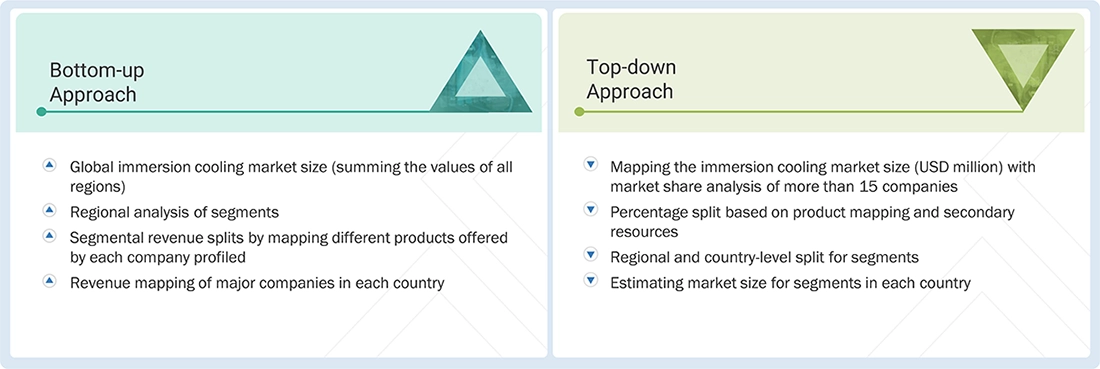
The estimation of the current size of the immersion cooling market was conducted through a structured four-phase approach. Extensive secondary research was undertaken to gather insights across the immersion cooling market, including related peer and parent markets. This phase involved the analysis of industry reports, company filings, investor presentations, white papers, and relevant publications. Preliminary findings, assumptions, and data points were validated through primary research involving in-depth interviews with key stakeholders across the immersion cooling value chain—such as technology providers, system integrators, data center operators, and regulatory experts. A combination of top-down and bottom-up methodologies was used to derive the overall market size. The top-down approach analyzed broader industry trends and macroeconomic indicators, while the bottom-up approach aggregated revenue contributions from key market participants and regional segments. Final estimates were refined using data triangulation techniques, ensuring consistency across various data sources. The market was segmented by type, application, cooling fluid, component, and region to determine the size of individual segments and sub-segments with a high degree of accuracy.
Secondary Research
The research methodology used to estimate and forecast the immersion cooling market begins with capturing data on the revenues of key vendors in the market through secondary research. In the secondary research process, various secondary sources, such as D&B Hoovers, Bloomberg BusinessWeek, Factiva, and Industry Journals, were referred to for identifying and collecting information for this study. These secondary sources included annual reports, press releases & investor presentations of companies, white papers, certified publications, articles by recognized authors, notifications by regulatory bodies, trade directories, and databases. Vendor offerings have also been taken into consideration to determine market segmentation.
Primary Research
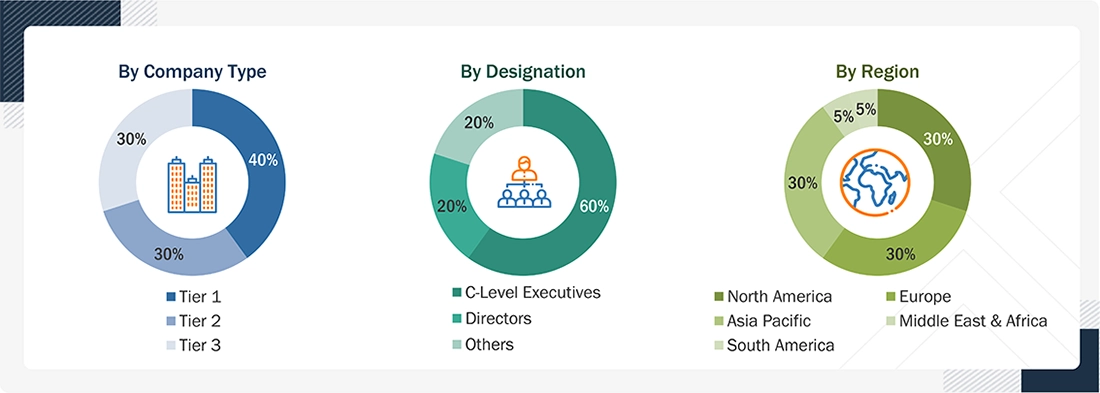
The immersion cooling market comprises several stakeholders in the supply chain, such as immersion cooling fluid providers, technology manufacturers, data center manufacturers, traders, associations, and regulatory organizations. The development of high-performance computing, edge computing, artificial intelligence, cryptocurrency mining, and other applications characterize the demand side of this market. Various primary sources from the supply and demand sides of the market were interviewed to obtain qualitative and quantitative information. The following is the breakdown of the primary respondents:
To know about the assumptions considered for the study, download the pdf brochure
Market Size Estimation
The top-down and bottom-up approaches were used to estimate and validate the total size of the immersion cooling market. These methods were also used extensively to determine the market size of various segments. The research methodology used to estimate the market size included the following:
- The key players were identified through extensive primary and secondary research.
- The value chain and market size of the immersion cooling market, in terms of value, were determined through primary and secondary research.
- All percentage shares, splits, and breakdowns were determined using secondary sources and verified through primary sources.
- All possible parameters that impact the market covered in this research study were accounted for, viewed in extensive detail, verified through primary research, and analyzed to obtain the final quantitative and qualitative data.
- The research included the study of reports, reviews, and newsletters of top market players, along with extensive interviews for opinions from key leaders, such as CEOs, directors, and marketing executives.
Global Immersion Cooling Market Size: Top-Down and Bottom-Up Approaches
Data Triangulation
The market was split into several segments and sub-segments after arriving at the overall market size using the market size estimation processes as explained above. Data triangulation and market breakdown procedures were employed to complete the overall market engineering process and determine each market segment’s and subsegment’s exact statistics. The market size was calculated globally by summing up the country-level and regional-level data.
Market Definition
The global immersion cooling industry centers on the provision of advanced thermal management solutions for high-performance electronic systems, particularly in data centers, supercomputing environments, and other high-density computing applications. The immersion cooling process involves submerging electronic components directly into thermally conductive, dielectric liquids that efficiently absorb and dissipate the heat generated during operation. This innovative cooling approach is gaining widespread adoption because it significantly improves energy efficiency, reduces operational costs, and enhances system performance and reliability. As demand for high-density computing infrastructure continues to escalate—driven by AI, HPC, cloud services, and edge computing—the role of immersion cooling in enabling scalable, sustainable, and efficient data center environments is becoming increasingly critical. The global immersion cooling market is expected to play a foundational role in supporting the next generation of green, energy-efficient digital infrastructure worldwide.
Stakeholders
- Data center operators
- Crypto miners
- Manufacturers of immersion cooling fluids
- Associations and industrial bodies (American National Standards Institute (ANSI), American Society of Heating, Refrigerating, and Air-Conditioning Engineers (ASHRAE), National Electrical Manufacturers Association (NEMA), Telecommunication Industry Association (TIA), Canadian Standards Association Group (CSA Group))
- NGOs, governments, investment banks, venture capitalists, and private equity firms
Report Objectives
- To define, describe, and forecast the size of the global immersion cooling market in terms of value
- To provide detailed information regarding the key factors (drivers, restraints, opportunities, and challenges) influencing the growth of the immersion cooling market
- To analyze and forecast the size of various segments (type, component, cooling fluid, application, and region) of the immersion cooling market based on five major regions—North America, Europe, Asia Pacific, South America, and Middle East & Africa, along with key countries in each of these regions
- To analyze recent developments and competitive strategies, such as expansions, product launches, collaborations, and acquisitions, to draw the competitive landscape of the market
- To strategically profile the key players in the market and comprehensively analyze their core competencies
Get the Full Immersion Cooling Market Report
Full forecast, segment splits, and company analysis for all Immersion Cooling Market.
- China Immersion Cooling Market
- India Immersion Cooling Market
- South Korea Immersion Cooling Market
- Thailand Immersion Cooling Market
- Malaysia Immersion Cooling Market
- Germany Immersion Cooling Market
- France Immersion Cooling Market
- Netherlands Immersion Cooling Market
- UK Immersion Cooling Market
- Russia Immersion Cooling Market
- Spain Immersion Cooling Market
- Canada Immersion Cooling Market
- Mexico Immersion Cooling Market
- US Immersion Cooling Market
- South America Immersion Cooling Market
- Rest Of Europe Immersion Cooling Market
Need a Tailored Report?
Customize this report to your needs
Get 10% FREE Customization
Customize This Report
