
Russia In-vehicle Infotainment Market (2025-2030)

The Russia In-vehicle Infotainment Market was valued at $1321 Million in 2025 and projected to reach to $2008 Million by 2030, representing a compound annual growth rate of 6.2%. Russia's in-vehicle infotainment market is positioned for steady growth as the country's automotive industry continues its modernization trajectory.


| Market Size in | USD 26.32 MN |
| Market Forecast in | |
| CAGR | |
| Forecast Period | |
| Units Considered | Value (USD MN) |
Russia In-vehicle Infotainment Market Trends and Insights
- This growth trajectory reflects Russia's automotive sector's gradual modernization and increasing consumer demand for connected vehicle technologies.
- Russia's market expansion is driven by rising vehicle production, growing middle-class purchasing power, and the integration of advanced digital features in both domestic and imported vehicles. The Russian infotainment market benefits from technological adoption across premium and mid-segment vehicle categories.
- Russia's automotive manufacturers and importers are increasingly incorporating touchscreen displays, smartphone integration, and voice-control systems to meet evolving consumer expectations.
- Between 2025 and 2030, Russia is expected to see accelerated deployment of cloud-connected services and enhanced user interfaces, positioning the country as a significant growth market within the Rest of World segment. Regional supply chain dynamics and localization efforts continue to shape Russia's infotainment landscape.
- Russia's market development is supported by partnerships between global technology providers and local automotive OEMs, ensuring competitive pricing and tailored solutions for Russian consumers..
Key Market Statistics
- CAGR (2025-2030) 6.2% CAGR
- Market Size, 2025 ~USD 1321 Million
- Forecast, 2030 ~USD 2008 Million
- Country Russia
Russia In-vehicle Infotainment Market Overview
Market Valuation :
Russia's in-vehicle infotainment market is valued at USD 1,321 million in 2025, with projected growth to USD 2,008 million by 2030, demonstrating steady expansion in the automotive technology sector.
Growth Rate :
The Russian market exhibits a CAGR of 6.2% from 2025 to 2030, reflecting moderate but consistent growth driven by automotive modernization and increasing consumer adoption of connected vehicle technologies.
Automotive Modernization :
Russia's automotive sector is undergoing gradual modernization, with manufacturers increasingly integrating advanced infotainment systems to meet evolving consumer expectations for connectivity and in-vehicle entertainment.
Consumer Demand Drivers :
Rising disposable incomes and growing preference for connected vehicle features among Russian consumers are propelling demand for sophisticated infotainment solutions in both domestic and imported vehicles.
Russia In-vehicle Infotainment Market Dynamics
- The 6.2% CAGR reflects increasing consumer demand for connected vehicle technologies and enhanced driving experiences, supported by rising vehicle production and sales recovery in the region.
- Domestic manufacturers and international OEMs are investing in infotainment capabilities to remain competitive. Looking ahead, Russia's market will be shaped by technological advancements, smartphone integration, and the gradual shift toward autonomous vehicle features.
- Economic factors and import dynamics will influence market penetration rates, while consumer preferences for premium audio systems, navigation, and connectivity solutions will drive innovation and product development across the infotainment ecosystem..
Market Ecosystem
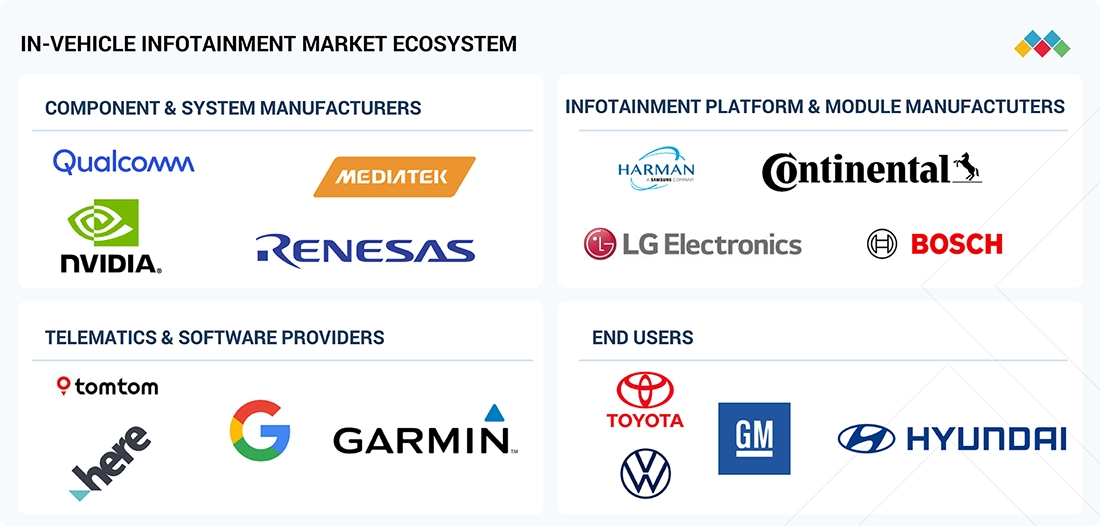
IN-VEHICLE INFOTAINMENT MARKET SIZE, SHARE & ANALYSIS: COMMERCIAL USE CASES ACROSS INDUSTRIES
| COMPANY | USE CASE DESCRIPTION | BENEFITS |
|---|---|---|
 |
Integration of next-gen curved infotainment display and OS 9 in 2024–2025 i series models, combining navigation, media, and ADAS data into a unified cockpit | Faster UI response, reduced driver distraction, improved personalization, and seamless OTA feature upgrades |
 |
Deployment of the ccIC (connected car Integrated Cockpit) architecture in 2025 EV and ICE models, merging cluster, infotainment and telematics into a single high-compute domain | Lower system complexity, reduced hardware cost, enhanced real-time connectivity, and upgraded safety compliance |
 |
Use of MBUX Superscreen and AI-powered interface in EQ electric models and new 2025 premium sedans | Higher consumer engagement, adaptive voice control, better rear-seat digital experience, and stronger luxury differentiation |
 |
Rollout of large-format infotainment systems with Google-embedded services across 2024–2025 global models | Improved navigation accuracy, faster cloud-based search, reduced software fragmentation, and easier OTA maintenance |
 |
Supply of Android Automotive-based infotainment head units for 2024–2025 mass-market vehicles across Europe and Asia | Scalable software platform, lower development time for OEMs, and increased compatibility with third-party apps and services |
Logos and trademarks shown above are the property of their respective owners. Their use here is for informational and illustrative purposes only.
Related Ecosystem
Automotive Advance Technologies
- Battery Electric Vehicle (BEV)
- Light Commercial Vehicles (LCVs)
- Fuel Cell Electric Vehicle (FCEV)
- Hybrid Electric Vehicle (HEV)
- Internal Combustion Engine (ICE)
- BOSCH LIMITED
- Continental ag
- Visteon Corporation
- DENSO Corporation
- ZF FRIEDRICHSHAFEN AG
Automotive Materials
- Light Commercial Vehicles (LCVs)
- Battery Electric Vehicle (BEV)
- Hybrid Electric Vehicle (HEV)
- Fuel Cell Electric Vehicle (FCEV)
- Agricultural Tractors
- GORKOVSKY AVTOMOBILNY ZAVOD
- AISIN CORPORATION
- Continental ag
- Basf se
- BOSCH LIMITED
Key Takeaways
- Russia's in-vehicle infotainment market will expand from USD 1,321M (2025) to USD 2,008M (2030) at a 6.2% CAGR.
- Russia's market growth is driven by increasing vehicle production and rising consumer demand for connected technologies.
- Russia's automotive sector is adopting touchscreen displays, smartphone integration, and voice-control systems across vehicle segments.
- Russia's market development relies on localization partnerships between global tech providers and domestic automotive OEMs.
In-vehicle Infotainment Market Report Scope
| Report Metric | Details |
|---|---|
| Base Year | 2025 |
| Fastest Growing Segment | PHEV (Ev Type) |
| Forecast Period | 2025–2030 |
| Growth Rate | CAGR of 8.4% from 2025 to 2030 |
| Largest Segment | 3G/4G (Connectivity) |
| Market Size Base Year (Billions) | ~USD 23.02 (2025) |
| Revenue Forecast (Billions) | ~USD 34.46 (2030) |
| Segments Covered | Ice Vehicle Type, Ev Type, Vehicle Type, Application, Component, Connectivity, Display Size, Form, Operating System |
Russia In-vehicle Infotainment Market Report Segmentation
9 segment dimensions are covered across the global market.
By Ice Vehicle Type
- Hcv
- Lcv
- Passenger Car
By Ev Type
- Bev
- Fcev
- Phev
By Vehicle Type
- Commercial Vehicle
- Hcv
- Lcv
- Passenger Car
- Pc
By Application
- App Store
- Music
- Navigation
- Rear Seat
- Vpa
By Component
- Digital Instrument Cluster
- Head-Up Display
- Infotainment Unit
- Passenger Display
By Connectivity
- 3G/4G
- 5G
By Display Size
- 5”–10”
- <5”
- >10”
By Form
- Embedded
- Integrated
- Tethered
By Operating System
- Android
- Linux
- Qnx
Target Audience
- Automotive OEMs : Russian and international vehicle manufacturers need detailed market insights to guide infotainment system integration strategies, supplier selection, and product positioning for the Russian automotive market.
- Infotainment Technology Providers : Software and hardware suppliers require Russia-specific market data to identify growth opportunities, assess demand for connected vehicle solutions, and develop localized products for Russian consumers.
- Investment & Private Equity Firms : Investors evaluating opportunities in Russia's automotive technology sector need comprehensive market analysis to assess growth potential, competitive dynamics, and return on investment in infotainment ventures.
- Market Consultants & Analysts : Business consultants and research professionals require Russia-focused infotainment data to support client advisory services, competitive benchmarking, and strategic recommendations in the automotive sector.
- Automotive Suppliers & Distributors : Component suppliers and distribution networks need Russia-specific market forecasts to optimize inventory management, plan expansion strategies, and align supply chain operations with regional demand trends.
Key Companies in the Russia In-vehicle Infotainment Market
| Company | HQ | Ownership | Strongest segments |
|---|---|---|---|
| JABIL | United States | Public Company | Regulated Industries (healthcare, medical devices, packaging, industrial and semi-cap),Intelligent Infrastructure (5G, wireless and cloud, networking, storage, digital print and retail),Connected Living and Digital Commerce (mobility, connected devices, digital commerce ecosystem, smart building controls), |
| NVIDIA CORPORATION | United States | Public Company | Data Center AI Compute & Networking,Gaming GPUs (GeForce),Professional Visualization & Workstation (RTX/Quadro), |
| GAZ | Russia | Public Company | Gas business (upstream, midstream, sales),Oil and refined products,Electric power and heat, |
| ALTEN | France | Public Company | Engineering services (mechanic, materials, systems engineering, PDM, PMO, QA, manufacturing, EHS, electronics),Embedded software and electronics,IT services (application software, cloud, infrastructure, AMOA, business analyst), |
| GOOGLE INC | United States | Public Company | Search and other Google Services ads,YouTube ads and subscriptions,Google Cloud (infrastructure, data, AI, Workspace), |
| ILLINOIS TOOL WORKS INC. | United States | Public Company | Automotive OEM,Food Equipment,Test & Measurement and Electronics, |
| LATTICE SEMICONDUCTOR | United States | Public Company | Small and mid-range FPGA platforms (Nexus, Nexus 2, Avant, Avant-G),Specialized FPGAs (Avant-E, Avant-X, MachXO, iCE, CrossLink families),Design software and solution stacks (Radiant, Propel, Automate, mVision, ORAN, sensAI, Sentry, Drive, Glance), |
| STONERIDGE INC | United States | Public Company | Advanced driver information solutions,Vision systems,Connectivity and compliance solutions, |
| MCLAREN GROUP | United Kingdom | Private Company | Supercars,GT,Ultimate, |
| GRUPO ANTOLIN | Spain | Private Company | Headliners and overhead systems,Door panels and trim components,Cockpit, instrument panel, and HMI, |
| AT&S | Canada | Public Company | Integrated automation systems (design-build-commissioning),Pre- and post-automation services,Software and digital solutions, |
| SES S.A. | Canada | Public Company | Waste Management,Energy Infrastructure, |
| X-FAB | Belgium | Public Company | Automotive analog/mixed-signal and power (incl. SiC/GaN),Industrial and medical analog/MEMS/sensors,Communication and consumer mixed-signal and sensors, |
| ALPS ALPINE CO., LTD. | Japan | Public Company | Component (TACT switches, potentiometers, actuators, microfluidic devices),Sensor and Communication (current, pressure, mmWave, magnetic, communication modules),Mobility Business (integrated displays, sound systems, HMI, car solutions), |
| GARMIN LTD | Switzerland | Public Company | Fitness & Outdoor Wearables and Devices,Aviation Avionics and Services,Marine Electronics and Systems, |
| PIONEER CORPORATION | United States | Private Company | Crude oil,Natural gas liquids (NGLs),Natural gas, |
| HARMAN INTERNATIONAL | United States | Private Company | Automotive infotainment, telematics, and ADAS platforms,Branded in-car and consumer audio (JBL, Harman Kardon, AKG, etc.),Professional audio, lighting, and video systems, |
| PANASONIC CORPORATION | Japan | Public Company | HVAC & CC (air-conditioners, heat pumps, ventilation, commercial refrigeration),Energy (cylindrical EV batteries, other batteries, storage systems),Electric Works (lighting, wiring devices, solar PV, fuel cells, housing solutions), |
| ROBERT BOSCH GMBH | Germany | Private Company | Mobility (powertrain, chassis, electronics, aftermarket, steering),Industrial Technology (drive, control, actuators, packaging),Consumer Goods (power tools, garden, appliances-related tools), |
| MITSUBISHI ELECTRIC CORPORATION | Japan | Public Company | Factory Automation (FA) systems and digital solutions,Building systems (elevators, escalators, building management),Air conditioning, refrigeration, and home equipment, |
| CONTINENTAL AG | Germany | Public Company | Passenger and light truck tires,Truck, bus, and off-highway tires,Industrial rubber products (hoses, conveyor belts, air and drive belts), |
| VISTEON CORPORATION | United States | Public Company | Instrument clusters & information displays,Infotainment & connected car platforms,Domain controllers & software platforms (SmartCore, SmartCore Runtime/Studio, CognitoAI), |
| DENSO CORPORATION | Japan | Public Company | Powertrain systems (gasoline, diesel, hybrid, EV, fuel cell),Thermal and HVAC systems,Safety and cockpit systems, |
| JVCKENWOOD CORPORATION | Japan | Public Company | Mobility & Telematics (car AV, navigation, audio, dashcams, in-vehicle devices, telematics solutions),Safety and Security (professional wireless communications, video surveillance, medical image displays),Entertainment (professional cameras, projectors, headphones, home audio, packaged media, content), |
| FUJITSU | Japan | Public Company | Service Solutions (consulting, cloud, integration, BPO, managed services),Hardware Solutions (computer platforms, infrastructure, networking),Ubiquitous Solutions (devices, edge, collaboration), |
| FORYOU CORPORATION | China | Public Company | In-vehicle infotainment and cockpit electronics,ADAS, cameras, and driver monitoring,Automotive key and EV-related components, |
JABIL
Jabil is a United States-based public company founded in 1966 that employs 135,000 people. The company operates as a global manufacturing and supply chain solutions provider.
NVIDIA CORPORATION
NVIDIA Corporation is a United States-based public company founded in 1993 with 42,000 employees. The company designs and manufactures graphics processing units and system-on-chip units.
GAZ
GAZ is a Russian public company founded in 1993 with 468,000 employees. The company is a major automotive manufacturer and industrial enterprise.
ALTEN
ALTEN is a French public company founded in 1988 with 56,376 employees. The company provides engineering and technology consulting services.
GOOGLE INC
Google Inc is a United States-based public company founded in 1998 with 194,668 employees. The company operates as a global technology and internet services provider.
ILLINOIS TOOL WORKS INC.
Illinois Tool Works Inc. is a United States-based public company founded in 1912 with 43,000 employees. The company manufactures diversified products and engineered systems.
LATTICE SEMICONDUCTOR
Lattice Semiconductor is a United States-based public company founded in 1983 with 1,174 employees. The company designs and manufactures semiconductor products.
STONERIDGE INC
StoneRidge Inc is a United States-based public company founded in 1965 with 4,200 employees. The company manufactures specialized electronic components for the automotive industry.
MCLAREN GROUP
McLaren Group is a United Kingdom-based private company founded in 1963 with 2,627 employees. The company operates in automotive manufacturing and motorsports.
GRUPO ANTOLIN
Grupo Antolin is a Spain-based private company founded in 1959 with 18,444 employees. The company manufactures automotive interior components and systems.
AT&S
AT&S is a Canada-based public company founded in 1978 with 7,000 employees. The company manufactures printed circuit boards and electronic components.
SES S.A.
SES S.A. is a Canada-based public company founded in 2007 with 1,937 employees. The company provides satellite communications and broadcasting services.
X-FAB
X-FAB is a Belgium-based public company founded in 1992 with 4,300 employees. The company operates as a semiconductor foundry and manufacturer.
ALPS ALPINE CO., LTD.
Alps Alpine Co., Ltd. is a Japan-based public company founded in 1948 with 25,924 employees. The company manufactures electronic components and automotive systems.
GARMIN LTD
Garmin Ltd is a Switzerland-based public company founded in 1989 with 23,000 employees. The company designs and manufactures GPS navigation and wireless devices.
PIONEER CORPORATION
Pioneer Corporation is a United States-based private company founded in 1997 with 2,213 employees. The company operates in the technology and electronics sector.
HARMAN INTERNATIONAL
Harman International is a United States-based private company founded in 1980 with 26,000 employees. The company manufactures audio, visual, and connected car systems.
PANASONIC CORPORATION
Panasonic Corporation is a Japan-based public company founded in 1918 with 183,685 employees. The company manufactures electronics, appliances, and industrial products.
ROBERT BOSCH GMBH
Robert Bosch GmbH is a Germany-based private company founded in 1886 with 412,774 employees. The company manufactures automotive components, industrial products, and consumer goods.
MITSUBISHI ELECTRIC CORPORATION
Mitsubishi Electric Corporation is a Japan-based public company founded in 1921 with 150,386 employees. The company manufactures electrical equipment, electronics, and industrial systems.
CONTINENTAL AG
Continental AG is a Germany-based public company founded in 1871 with 22,076 employees. The company manufactures automotive components and industrial products.
VISTEON CORPORATION
Visteon Corporation is a United States-based public company founded in 2000 with 10,500 employees. The company manufactures automotive electronics and connected car solutions.
DENSO CORPORATION
Denso Corporation is a Japan-based public company founded in 1949 with 154,716 employees. The company manufactures automotive components and systems.
JVCKENWOOD CORPORATION
JVCKenwood Corporation is a Japan-based public company founded in 1927 with 15,229 employees. The company manufactures audio, visual, and automotive electronics.
FUJITSU
Fujitsu is a Japan-based public company founded in 1935 with 99,203 employees. The company provides information technology services, products, and solutions.
FORYOU CORPORATION
ForYou Corporation is a China-based public company founded in 1993 with 9,481 employees. The company manufactures automotive and electronic components.
Reasons to Buy this Report
- Market Size & Growth Data : Access precise valuation figures for Russia's infotainment market (USD 1,321M in 2025) and detailed forecasts through 2030, enabling accurate business planning and investment decisions specific to the Russian automotive sector.
- Competitive Intelligence : Understand Russia's unique market dynamics, consumer preferences, and competitive landscape to identify opportunities for market entry, partnerships, or expansion within the Russian in-vehicle infotainment segment.
- Strategic Planning : Leverage Russia-specific growth projections and CAGR analysis to develop targeted strategies for product development, pricing, and distribution aligned with the 6.2% growth trajectory through 2030.
- Investment Justification : Present stakeholders with credible market data and forecasts specific to Russia to justify investments in infotainment technology, manufacturing facilities, or distribution networks in the region.
- Risk Assessment : Evaluate Russia-specific market risks, regulatory environment, and economic factors affecting infotainment adoption to develop contingency plans and mitigate potential business challenges in the automotive sector.
Frequently asked questions
What is the current size of Russia's in-vehicle infotainment market?
Russia's in-vehicle infotainment market is valued at USD 1,321 million in 2025.
What is the projected market size for Russia by 2030?
Russia's in-vehicle infotainment market is forecast to reach USD 2,008 million by 2030.
What is the CAGR for Russia's in-vehicle infotainment market?
Russia's in-vehicle infotainment market is expected to grow at a compound annual growth rate of 6.2% from 2025 to 2030.
What technologies are driving growth in Russia's infotainment market?
Russia's market growth is driven by adoption of touchscreen displays, smartphone integration, voice-control systems, and cloud-connected services.
How does Russia's market compare to global infotainment trends?
Russia's 6.2% CAGR reflects steady regional growth, while the global market grows at 8.4% CAGR, indicating Russia's market is maturing at a slightly slower pace than the worldwide average.
RESEARCH METHODOLOGY
The study involves the use of four main activities to estimate the current size of the in-vehicle infotainment market. Exhaustive secondary research was conducted to gather information on the market segments based on component, operating system, location, connectivity, application, form factor, display size, retrofit by vehicle type, electric by vehicle type, ICE vehicle type, and region. The next step was to validate these findings, assumptions, and market analysis with industry experts across value chains through primary research. Bottom-up and top-down approaches were employed to estimate the complete market size for different segments considered in this study. Thereafter, market breakdown and data triangulation processes were used to estimate the market size of segments and subsegments.
Secondary Research
The secondary sources referred to the in-vehicle infotainment system market is directly dependent on vehicle production volume, which is derived through secondary sources, such as automotive industry organizations [Organisation Internationale des Constructeurs d'Automobiles (OICA)], publications from government sources [country-level automotive associations and organizations, Organisation for Economic Co-operation and Development (OECD), EV Volumes, Marklines, SIAM and others], corporate filings (such as annual reports, investor presentations, and financial statements); and trade & paid repository. Historical production data has been collected and analyzed. The industry trend is considered to inform the forecast, which is further validated by primary research.
Primary Research
During the primary research process, various primary sources from the supply and demand sides were interviewed to gather qualitative and quantitative information on the market. The primary sources from the supply side included various industry experts, such as CXOs, Vice Presidents, directors from business development, marketing, product development/innovation teams, and related key executives from various key companies. Various system integrators, industry associations, independent consultants/industry veterans, as well as key opinion leaders, were also interviewed.
Primary interviews have been conducted to gather insights, including vehicle production forecasts, in-vehicle infotainment system market forecasts, future technology trends, and upcoming technologies in the in-vehicle infotainment system market. Data triangulation was conducted across all these points using information gathered from secondary research and model mapping. Stakeholders from the demand and supply sides have been interviewed to understand their views on the aforementioned points. These interviews have been conducted with market experts from the demand side (original equipment manufacturers, or OEMs) and supply side (in-vehicle infotainment system solution and service providers) players across four major regions, namely North America, Europe, Asia Pacific, and the Rest of the World. Approximately 20% and 80% of primary interviews have been conducted from the demand and supply sides, respectively. The data has been collected through questionnaires, emails, and telephonic interviews. After interacting with industry experts, brief sessions with highly experienced independent consultants have been conducted to reinforce the findings from primaries. This, along with the opinions of our in-house subject matter experts, has led us to the conclusions described in the remainder of this report.
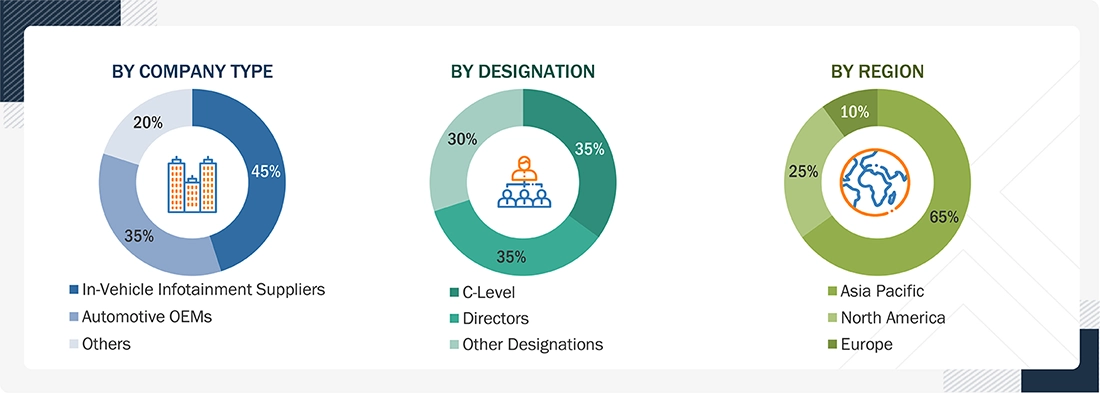
• **Others include Sales, Marketing, and Product Managers.
• Other Designations include Infotainment Component and Technology Providers.
To know about the assumptions considered for the study, download the pdf brochure
Market Size Estimation
A detailed market estimation approach was employed to estimate and validate the value of the in-vehicle infotainment system market, as well as its dependent submarkets, as outlined below. The following considerations were made:
The research methodology used to estimate the market size also includes the following details:
- Key players in the in-vehicle infotainment system market were identified through secondary research, and their global market ranking was determined through primary and secondary research.
- The research methodology included a study of annual and quarterly financial reports and regulatory filings of significant market players (public), as well as interviews with industry experts for detailed market insights.
- All vehicle-level penetration rates, percentage shares, splits, and breakdowns for the in-vehicle infotainment system market were determined using secondary sources and verified through primary sources.
- All key macro indicators affecting the revenue growth of the market segments and subsegments were accounted for, viewed in extensive detail, verified through primary research, and analyzed to obtain validated and verified quantitative and qualitative data.
- The market data gathered was consolidated, enhanced with detailed inputs, analyzed, and presented in this report.
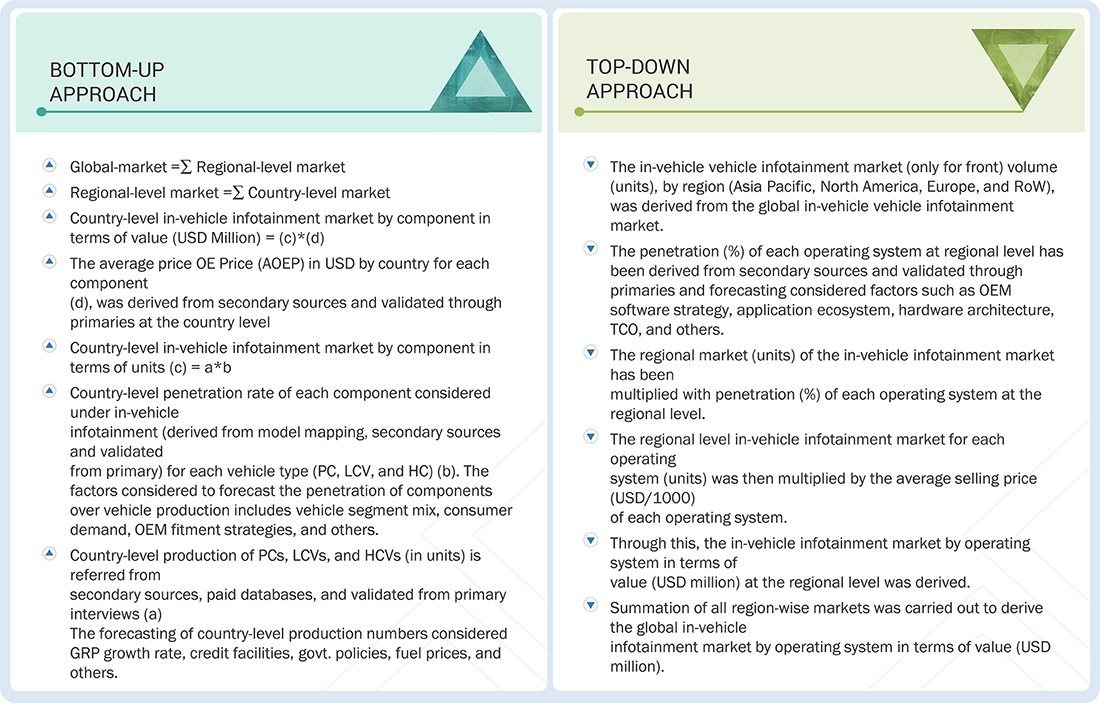
The bottom-up approach has been used to estimate and validate the size of the global market. The market size for components, by volume, of the in-vehicle infotainment system market has been derived by multiplying the penetration rate of each component considered under in-vehicle infotainment systems by the production numbers for PCs, LCVs, and HCVs. Country-level, model-wise mapping has been conducted to identify vehicle models equipped with infotainment systems and related components. Industry experts have further validated this information.
The forecasting of country-level vehicle production considered the analysis of distinct growth vectors, including GDP growth and overall economic outlook, interest rates & vehicle financing availability, government policies & incentives, international trade policies, fuel prices, and others. The installation rate of in-vehicle infotainment components has been implemented by vehicle type for a particular country, considering forecasting factors, which included vehicle segment mix (Entry vs. mid vs premium), OEM feature strategy (Standard vs. optional content), IVI system cost trends & compute availability, consumer demand for connected and digital features, and others. This method will yield the volume of infotainment components at the country level. The next step involved multiplying the volume of components by vehicle type and their respective average OE pricing to generate the country-level market by vehicle type and component. The summation of volume and value for the country-level market provides a regional market, which is then broken down into a global infotainment system market, categorized by component in terms of volume and value. The findings are then verified with various industry participants. All possible parameters that affect the markets covered in this research study have been accounted for, viewed in extensive detail, verified through primary research, and analyzed to get the final quantitative and qualitative data. This data is consolidated and supplemented with detailed inputs and analysis from MarketsandMarkets and is presented in this report.
The top-down approach has been employed to calculate the market for in-vehicle infotainment systems by operating system and connectivity type. The global market for infotainment systems has been segmented by region based on the penetration of specific operating systems and connectivity within each region. These findings are further discussed with primary respondents to validate the data, assumptions, penetrations, and factors that will affect the market in the future.
In-Vehicle Infotainment Market : Top-Down and Bottom-Up Approach
Data Triangulation
After arriving at the overall size of the small satellite market from the estimation process explained above, the total market was split into several segments and subsegments. The data triangulation and market breakdown procedures explained below were implemented, wherever applicable, to complete the overall market engineering process and arrive at the exact statistics for various market segments and subsegments. The data was triangulated by studying various factors and trends from the demand and supply sides. Along with this, the small satellite market size was validated using the top-down and bottom-up approaches.
Market Definition
The in-vehicle infotainment market encompasses a digital device that integrates navigation, media, communication, and connected services into a single interface, serving as the primary software layer connecting users with their vehicle. As OEMs shift toward software-defined architectures, infotainment systems have become a core control point for user experience, data services, and recurring revenue models, positioning them as a strategic pillar in next-generation vehicle programs.
Key Stakeholders
- In-vehicle Infotainment system manufacturers
- Parts and component suppliers
- Automotive OEMs
- Automotive Association and Regulatory Bodies
- Infotainment service providers
- Fleet owners
- Telecom companies
Report Objectives
-
-
To define, describe, and forecast the in-vehicle infotainment market in terms of value (USD million) and volume (thousand units), based on the following segments:
- By ICE Vehicle Type [Passenger Car, Light Commercial Vehicle (LCV), and Heavy Commercial Vehicle (HCV)]
- By Component (Infotainment, Passenger Display, Digital Instrument Cluster, and Head-Up Display)
- By Operating System (Android, Linux, QNX, and Others)
- By Application [Navigation, Virtual Personal Assistant (VPA) Application, App Store, Music, and Rear Seat]
- By Location (Front Row and Rear Row)
- By Connectivity (3G/4G and 5G)
- By Form Factor (Embedded, Tethered, and Integrated)
- By Display Size (< 5”, 5–10”, and > 10”)
- Retrofit Market, By Vehicle Type (Passenger Car and Commercial Vehicle)
- Electric Vehicle, By Vehicle Type (Battery Electric Vehicle, Plug-in Hybrid Electric Vehicle, and Fuel-Cell Electric Vehicle)
- By Region (Asia Pacific, Europe, North America, and RoW)
- To understand the dynamics (drivers, restraints, opportunities, and challenges) of the market
- To analyze the market ranking/share of key players operating in the market
- To understand the dynamics of the market competitors in terms of hardware and software providers, and distinguish them into visionary leaders, innovators, emerging companies, and dynamic differentiators according to their product portfolio and business strategy
- To analyze recent developments, collaborations, joint ventures, mergers & acquisitions, product launches, and other activities carried out by key industry participants in the in-vehicle infotainment market
- To determine the average selling price (ASP) of in-vehicle infotainment and analyze revenue-missed scenarios
- To determine pessimistic scenarios, most likely scenarios, and optimistic scenarios related to the market
- To give a brief understanding of the market in the recommendations chapter
-
To define, describe, and forecast the in-vehicle infotainment market in terms of value (USD million) and volume (thousand units), based on the following segments:
Available customizations:
Along with the given market data, MarketsandMarkets offers customizations in accordance with a company’s specific needs. The following customization options are available:
- In-Vehicle Infotainment Market, By Display Type, at the Country Level (For Countries Covered in the Report)
- In-Vehicle Infotainment Market, By Form Factor, at the Country Level (For Countries Covered in the Report)
- Company Information, Profiling of Additional Market Players (Up to 5)
Get the Full In-vehicle Infotainment Market Report
Full forecast, segment splits, and company analysis for all In-vehicle Infotainment Market.
- China In-vehicle Infotainment Market
- India In-vehicle Infotainment Market
- Japan In-vehicle Infotainment Market
- South Korea In-vehicle Infotainment Market
- UK In-vehicle Infotainment Market
- Germany In-vehicle Infotainment Market
- France In-vehicle Infotainment Market
- Spain In-vehicle Infotainment Market
- Italy In-vehicle Infotainment Market
- Canada In-vehicle Infotainment Market
- Mexico In-vehicle Infotainment Market
- Brazil In-vehicle Infotainment Market
- South Africa In-vehicle Infotainment Market
- US In-vehicle Infotainment Market
- Rest Of Asia Pacific In-vehicle Infotainment Market
Need a Tailored Report?
Customize this report to your needs
Get 10% FREE Customization
Customize This Report
