
Mexico Industrial Hose Market (2025-2030)

The Mexico Industrial Hose Market was valued at $68.9 Million in 2025 and projected to reach to $81.5 Million by 2030, representing a compound annual growth rate of CAGR 3.4%. Mexico's industrial hose market is poised for consistent growth through 2030, supported by expanding semiconductor fabrication facilities and electronics assembly operations.


| Market Size in | USD 26.32 MN |
| Market Forecast in | |
| CAGR | |
| Forecast Period | |
| Units Considered | Value (USD MN) |
Mexico Industrial Hose Market Trends and Insights
- Mexico's position within North America makes it a strategic hub for semiconductor and electronics manufacturing, driving steady demand for specialized industrial hoses used in fluid transfer, pneumatic systems, and coolant applications.
- The market in Mexico benefits from the country's established manufacturing infrastructure and proximity to major supply chains in the region. Growth in Mexico's industrial hose market is supported by increasing semiconductor fabrication activities and electronics assembly operations that require reliable hose solutions for process efficiency and equipment reliability.
- Mexico's competitive labor costs and trade agreements have attracted significant foreign direct investment in the electronics sector, which in turn fuels demand for industrial hoses across production facilities.
- Between 2025 and 2030, Mexico is expected to maintain moderate but consistent growth as manufacturers continue to upgrade equipment and expand capacity to meet regional demand..
Key Market Statistics
- CAGR (2025-2030) CAGR 3.4%
- Market Size, 2025 ~USD 68.9 Million
- Forecast, 2030 ~USD 81.5 Million
- Country Mexico
Mexico Industrial Hose Market Overview
Market Valuation :
Mexico's industrial hose market is valued at USD 68.9 million in 2025, with projections reaching USD 81.5 million by 2030, driven by robust semiconductor and electronics manufacturing activity.
Steady Growth Trajectory :
The Mexican market demonstrates a CAGR of 3.4% from 2025-2030, outpacing the global growth rate of 3%, reflecting Mexico's strategic importance in North American industrial supply chains.
Manufacturing Hub Status :
Mexico's position as a key semiconductor and electronics manufacturing hub in North America creates sustained demand for specialized industrial hoses in fluid transfer, pneumatic systems, and coolant applications.
Regional Supply Chain Integration :
Proximity to the U.S. market and established trade agreements position Mexico as a critical node for industrial hose distribution and localized manufacturing support across North America.
Mexico Industrial Hose Market Dynamics
- The country's strategic geographic location and competitive manufacturing costs continue to attract foreign direct investment in high-tech industries, directly boosting demand for specialized hose solutions.
- Regional trade integration and nearshoring trends further strengthen market fundamentals.
- Growth will be anchored by increasing adoption of advanced pneumatic and fluid transfer systems in semiconductor cleanrooms and electronics production facilities, with particular emphasis on quality-certified hoses meeting international standards..
Market Ecosystem
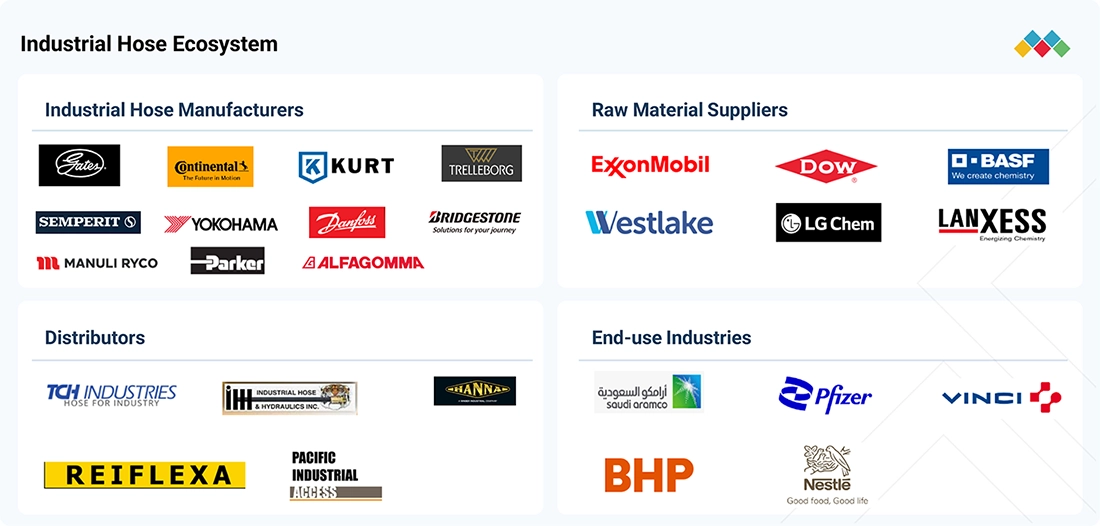
INDUSTRIAL HOSE MARKET SIZE, SHARE & TRENDS: COMMERCIAL USE CASES ACROSS INDUSTRIES
| COMPANY | USE CASE DESCRIPTION | BENEFITS |
|---|---|---|
 |
Parker Hannifin manufactures industrial and hydraulic hose lines using braided elastomer and spiral wire reinforcement. These systems operate across mobile equipment, chemical plants, and oilfield sites to transport pressurized fluids, fuels, and industrial gases through matched fitting assemblies. | Minimizes hydraulic leakage through factory crimped fittings | Resists outer abrasion in heavy equipment environments via protective covers | Maintains structural integrity under pulsating fluid pressures | Provides standardized sizing and pressure ratings for procurement accuracy |
 |
Continental AG manufactures industrial hoses using synthetic rubber compounds and thermoplastic liners for material handling, chemical transfer, and thermal management. The hose platforms transport abrasive slurries, hydrocarbons, and high temperature cleaning fluids across manufacturing facilities and construction projects. | Resists internal chemical degradation during acid and solvent conveyance | Dissipates electrostatic charge during bulk hydrocarbon transfer | Withstands continuous thermal cycling in liquid cooling setups | Resists ozone and weathering in outdoor industrial installations |
 |
Gates Corporation supplies industrial hoses, including the Plant Master and Food Master product series, built with specialized inner tube elastomers. The assemblies serve food processing plants, pharmaceutical blenders, and mining sites to transfer compressed air, potable liquids, and abrasive bulk dry solids. | Prevents media contamination through certified food contact liners | Handles high working pressures without structural wall collapse | Minimizes hose kinking during manual operator routing on plant floors | Facilitates visual line identification through distinct cover colors to prevent media cross contamination |
 |
Trelleborg manufactures engineered polymer, composite, and PTFE hoses for chemical handling, food sanitization, and tanker loading operations. The systems operate in pharmaceutical facilities, marine docks, and beverage plants to convey aggressive chemical solvents, alcohol, and high temperature wash water. | Provides chemical inertness during the transfer of concentrated solvents | Withstands repetitive high pressure washdown cycles during facility sanitation | Ensures secure mechanical connections with integrated food grade couplings | Absorbs mechanical vibrations between processing pumps and static pipework |
 |
Danfoss produces industrial and hydraulic hoses, including the Boston and Winner product lines, integrated with certified crimp fittings. The assemblies operate across agricultural machinery, mining excavation units, and manufacturing plants to convey hydraulic oils, steam, and abrasive materials. | Delivers matched hose and coupling qualification to prevent joint failure | Withstands continuous saturated steam temperatures up to published safety limits | Reduces machinery downtime through standard dimensional fittings | Resists surface corrosion through protective metallic fitting platings |
Logos and trademarks shown above are the property of their respective owners. Their use here is for informational and illustrative purposes only.
Related Ecosystem
Industrial Automation
- Sensors
- Image Sensors
- Manufacturing Execution System (MES)
- Actuators
- Flow Sensors
- ABB India Limited
- Siemens ag
- Emerson Electric Co.
- HONEYWELL INTERNATIONAL INC.
- SCHNEIDER ELECTRIC SE
Key Takeaways
- Mexico's industrial hose market reaches USD 68.9 million in 2025 with projected growth to USD 81.5 million by 2030.
- Mexico's 3.4% CAGR reflects steady demand from semiconductor and electronics manufacturing sectors.
- Mexico's strategic location and manufacturing infrastructure position it as a key North American market for industrial hoses.
- Mexico's market growth is driven by foreign direct investment in electronics assembly and equipment modernization initiatives.
Industrial Hose Market Report Scope
| Report Metric | Details |
|---|---|
| Base Year | 2025 |
| Fastest Growing Segment | POLYURETHANE (Material Type) |
| Forecast Period | 2025-2030 |
| Growth Rate | CAGR of 3% from 2025 to 2030 |
| Largest Segment | NATURAL RUBBER (Material Type) |
| Market Size Base Year (Billions) | ~USD 12.01 (2025) |
| Revenue Forecast (Billions) | ~USD 13.92 (2030) |
| Segments Covered | Material Type, Media Type, Industry |
Mexico Industrial Hose Market Report Segmentation
3 segment dimensions are covered across the global market.
By Material Type
- Natural Rubber
- Nitrile Rubber
- Other Material Types
- Polyurethane
- Polyvinyl Chloride (Pvc)
- Silicone
By Media Type
- Air & Gas
- Chemical
- Food & Beverage
- Hot Water & Steam
- Oil
- Water
By Industry
- Agriculture
- Automotive
- Chemicals
- Food & Beverages
- Infrastructure
- Mining
- Oil & Gas
- Other Industries
- Pharmaceuticals
- Water & Wastewater Treatment
Target Audience
- Industrial Hose Manufacturers : Manufacturers need Mexico-specific market data to identify production capacity requirements, localization opportunities, and competitive positioning within the growing North American semiconductor supply chain.
- Semiconductor Equipment Suppliers : Equipment suppliers require detailed Mexican market insights to forecast hose component demand, optimize supply chain logistics, and support customer facilities expanding in Mexico's manufacturing regions.
- Electronics OEMs & Contract Manufacturers : OEMs and contract manufacturers operating in Mexico need market intelligence to plan procurement strategies, negotiate supplier agreements, and ensure reliable hose supply for production facilities.
- Distribution & Logistics Partners : Distributors and logistics providers require Mexico market data to optimize inventory management, identify growth opportunities in semiconductor hubs, and develop regional supply chain strategies.
- Investment & Strategy Consultants : Consultants advising on Mexico operations need comprehensive market analysis to support client decisions on market entry, expansion feasibility, and competitive positioning in the industrial hose sector.
Reasons to Buy this Report
- Mexico-Specific Market Sizing : Access precise valuation data for Mexico's industrial hose market with verified 2025 baseline (USD 68.9M) and 2030 forecasts, enabling accurate budget allocation and revenue projections for Mexican operations.
- Competitive Growth Intelligence : Understand Mexico's 3.4% CAGR outperformance versus global 3% growth, identifying market expansion opportunities and competitive advantages specific to the Mexican semiconductor and electronics sectors.
- Localized Supply Chain Insights : Gain actionable intelligence on Mexico's role as a North American manufacturing hub, including demand drivers from semiconductor fabrication and electronics assembly that directly impact hose procurement strategies.
- Strategic Investment Decisions : Make informed decisions on market entry, facility expansion, or partnership development in Mexico with comprehensive data on market trajectory, regional manufacturing trends, and sector-specific growth catalysts.
- Regulatory & Standards Compliance : Navigate Mexico-specific requirements for industrial hose applications in semiconductor and electronics manufacturing, including quality certifications and trade compliance relevant to North American supply chains.
Frequently asked questions
What is the current size of Mexico's industrial hose market?
Mexico's industrial hose market is valued at USD 68.9 million in 2025 and is expected to reach USD 81.5 million by 2030.
What is the growth rate for industrial hoses in Mexico?
Mexico's industrial hose market is projected to grow at a CAGR of 3.4% from 2025 to 2030.
Which industries drive demand for industrial hoses in Mexico?
Semiconductor fabrication and electronics assembly operations are the primary drivers of industrial hose demand in Mexico.
Why is Mexico important for the North American industrial hose market?
Mexico's competitive manufacturing costs, established infrastructure, and strategic location make it a critical hub for semiconductor and electronics production in North America, directly supporting industrial hose demand.
What factors support growth in Mexico's industrial hose market through 2030?
Foreign direct investment in electronics, equipment modernization, capacity expansion, and increasing semiconductor fabrication activities support Mexico's industrial hose market growth through 2030.
RESEARCH METHODOLOGY
The research process for this study involved the systematic gathering, recording, and analysis of data on customers and companies operating in the industrial hose market. This process relied extensively on secondary sources, directories, and databases (Factiva and OANDA) to identify and collect valuable information for a comprehensive, technical, market-oriented, and commercial study of the market. In-depth interviews were conducted with primary respondents, including experts from core and related industries, as well as preferred manufacturers, to obtain and verify critical qualitative and quantitative information and to assess growth prospects. Key players were identified through secondary research, and their market rankings were determined through a combination of primary and secondary research. The research also involved studying the annual reports of top players and conducting interviews with key industry experts, including CEOs, directors, and marketing executives.
Secondary Research
Various sources were used in the secondary research process to identify and collect information relevant to this study. These include company annual reports, press releases, investor presentations, white papers, technology journals, certified publications, articles by recognized authors, directories, and databases. Secondary research was primarily used to gather key information on the industry’s value chain, the total pool of market players, market classification by industry trends at the most detailed level, regional markets, and key developments from market- and technology-oriented perspectives.
Primary Research
Primary research was conducted to identify segmentation types, key players, the competitive landscape, and key market dynamics, including drivers, restraints, opportunities, challenges, and industry trends, as well as the key strategies adopted by players operating in the industrial hose market. Extensive qualitative and quantitative analyses were conducted across the entire market engineering process to present key information and insights throughout the report.
Extensive primary research was conducted after secondary research provided insight into the industrial hose market. Several primary interviews were conducted with experts from the demand side (industry and region) and the supply side (material type and media type) across four major geographic regions: North America, Europe, Asia Pacific, and RoW. Approximately 60% of the primary interviews were conducted on the supply side, and 40% on the demand side. These primary data were collected through questionnaires, emails, and telephone interviews.
Breakdown of Primary Participants
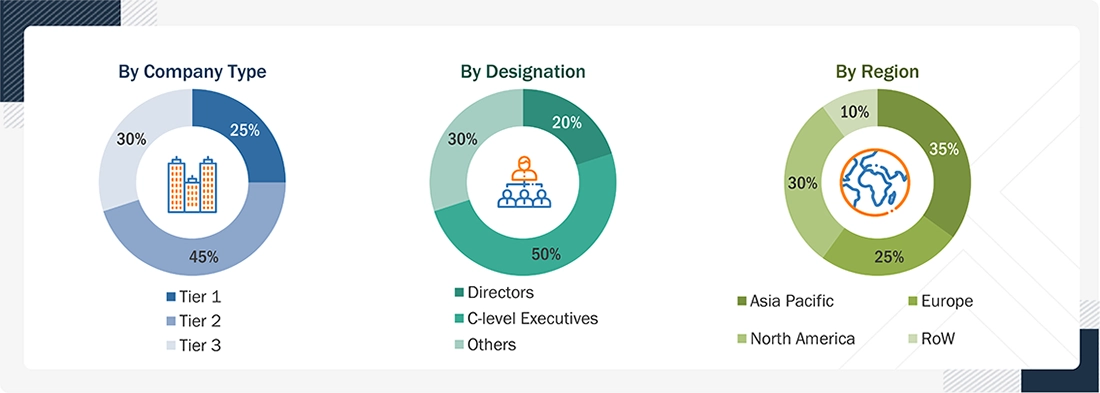
Notes: The three tiers of companies have been defined based on their total/segmental revenue as of 2025: Tier 1 = > USD 1 billion, Tier 2 = USD 1 billion–USD 500 million, and Tier 3 = < USD 500 million.
To know about the assumptions considered for the study, download the pdf brochure
Market Size Estimation
Throughout the market engineering process, top-down and bottom-up approaches, along with several data triangulation methods, were used to estimate and validate the size of the industrial hose market and related submarkets. Key players were identified through secondary research, and their market share in each region was determined through a combination of primary and secondary research. This research methodology involved analyzing the annual and financial reports of the top players and conducting interviews with experts (CEOs, VPs, directors, and marketing executives) to gather key quantitative and qualitative insights.
All percentage shares, splits, and breakdowns were determined using secondary sources and verified through primary sources. All possible parameters affecting the markets covered in this study were accounted for, examined in detail, verified through primary research, and analyzed to obtain final quantitative and qualitative data. This data was consolidated and supplemented with detailed inputs and analysis from MarketsandMarkets, and presented in this report.
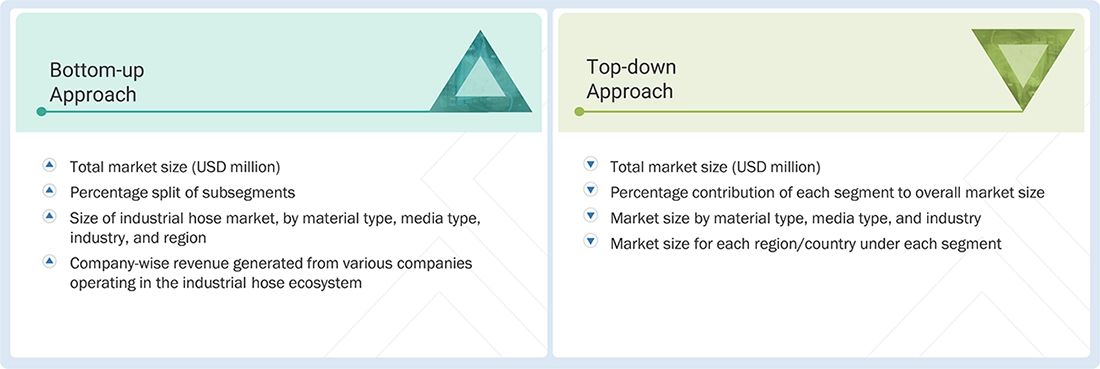
Data Triangulation
After determining the overall market size through the estimation process described above, the total market was divided into several segments and subsegments. To complete the overall market engineering process and obtain precise statistics for all segments and subsegments, the data triangulation procedure was employed, as applicable. The data were triangulated by analyzing various factors and trends from both the demand and supply sides. Additionally, the market has been validated using both top-down and bottom-up approaches.
Market Definition
Industrial hoses are flexible, durable tubes that transfer liquids, gases, or solids from one point to another in industrial operations. They are commonly used in manufacturing, construction, agriculture, oil & gas, food processing, and chemical industries. These hoses are built to withstand high pressure, extreme temperatures, and harsh environmental conditions, making them essential for the safe and efficient transport of water, oil, chemicals, steam, air, or food products.
Key Stakeholders
- Raw material suppliers
- Industrial hose material providers
- Manufacturers and distributors of industrial hoses
- Original equipment manufacturers (OEMs) who demand industrial hoses
- Device suppliers and distributors
- Software application providers
- Manufacturers of hose assembly parts
- System integrators
- Middleware providers
- Assembly, testing, and packaging vendors
- Research institutes and organizations
- Technology standards organizations, forums, alliances, and associations
- Governments, financial institutions, and regulatory bodies
Report Objectives
- To describe and forecast the industrial hose market, by material type, media type, end-use industry, and region, in terms of value
- To forecast the size of the market segments for four major regions, namely North America, Europe, Asia Pacific, and the Rest of the World (RoW), in terms of value
- To provide detailed information regarding the major factors influencing the growth of the market, such as drivers, restraints, opportunities, and challenges
- To offer an ecosystem analysis, case study analysis, patent analysis, technology analysis, pricing analysis, Porter’s Five Forces analysis, and regulations pertaining to the market
- To give a detailed overview of the value chain of the industrial hose ecosystem
- To strategically analyze micromarkets with respect to individual growth trends, prospects, and contributions to the total market
- To strategically profile the key players and comprehensively analyze their market shares and core competencies
- To analyze opportunities in the market for stakeholders and describe the competitive landscape of the market
- To study competitive developments, such as collaborations, partnerships, and product developments, in the market
- To provide the macroeconomic outlook for each region that has been covered in the report.
Available customizations:
With the given market data, MarketsandMarkets offers customizations according to the company’s specific needs. The following customization options are available for the report:
Company Information
- Detailed analysis and profiling of additional market players (up to five)
Get the Full Industrial Hose Market Report
Full forecast, segment splits, and company analysis for all Industrial Hose Market.
- US Industrial Hose Market
- Canada Industrial Hose Market
- Germany Industrial Hose Market
- UK Industrial Hose Market
- France Industrial Hose Market
- Italy Industrial Hose Market
- Rest Of Europe Industrial Hose Market
- China Industrial Hose Market
- Japan Industrial Hose Market
- India Industrial Hose Market
- South Korea Industrial Hose Market
- Rest Of Asia Pacific Industrial Hose Market
Need a Tailored Report?
Customize this report to your needs
Get 10% FREE Customization
Customize This Report
