
Australia Machine Vision Market (2025-2030)

The Australia Machine Vision Market was valued at $255 Million in 2025 and projected to reach to $363.1 Million by 2030, representing a compound annual growth rate of 7.3%. Australia's machine vision market is poised for steady growth driven by increasing automation investments across manufacturing and automotive sectors.


| Market Size in | USD 26.32 MN |
| Market Forecast in | |
| CAGR | |
| Forecast Period | |
| Units Considered | Value (USD MN) |
Australia Machine Vision Market Trends and Insights
- This growth trajectory reflects Australia's increasing adoption of automation and quality control technologies across manufacturing, automotive, and semiconductor sectors.
- Australia's strategic position in the Asia Pacific region positions it as a key market for machine vision solutions, driven by rising demand for precision inspection and process optimization. The Australian machine vision market benefits from strong industrial modernization initiatives and investment in advanced manufacturing capabilities.
- Australia's focus on Industry 4.0 adoption and digital transformation is accelerating the deployment of vision-based systems in production environments.
- Between 2025 and 2030, Australia is expected to see heightened integration of artificial intelligence and deep learning technologies within machine vision applications, further enhancing market expansion and competitive positioning within the region..
Key Market Statistics
- CAGR (2025-2030) 7.3% CAGR
- Market Size, 2025 ~USD 255 Million
- Forecast, 2030 ~USD 363.1 Million
- Country Australia
Australia Machine Vision Market Overview
Market Size & Growth :
Australia's machine vision market is valued at USD 255.0 million in 2025, with projected growth to USD 363.1 million by 2030, representing a 7.3% CAGR, slightly below the global average of 8.3%.
Key Driving Sectors :
Manufacturing, automotive, and semiconductor industries in Australia are increasingly adopting machine vision for automation and quality control, driving market expansion across industrial applications.
Regional Positioning :
Australia's strategic location in the Asia-Pacific region positions it as a hub for technology adoption and integration, with growing demand for advanced inspection and automation solutions.
Technology Adoption Trends :
Australian manufacturers are investing in AI-enabled vision systems and real-time quality assurance technologies to enhance productivity and maintain competitive advantage in global markets.
Australia Machine Vision Market Dynamics
- The country's focus on Industry 4.0 adoption and digital transformation initiatives is accelerating the deployment of advanced vision systems for quality control and process optimization.
- With a 7.3% CAGR through 2030, the market reflects strong demand from semiconductor fabrication facilities and precision manufacturing operations. The Australian market benefits from government support for advanced manufacturing and innovation programs, alongside rising labor costs that incentivize automation adoption.
- Strategic partnerships with Asia-Pacific technology leaders and growing integration of AI and machine learning capabilities in vision systems are expected to further propel market growth.
- Investment in smart factory initiatives and supply chain resilience will continue to drive demand for sophisticated inspection and quality assurance solutions..
Market Ecosystem
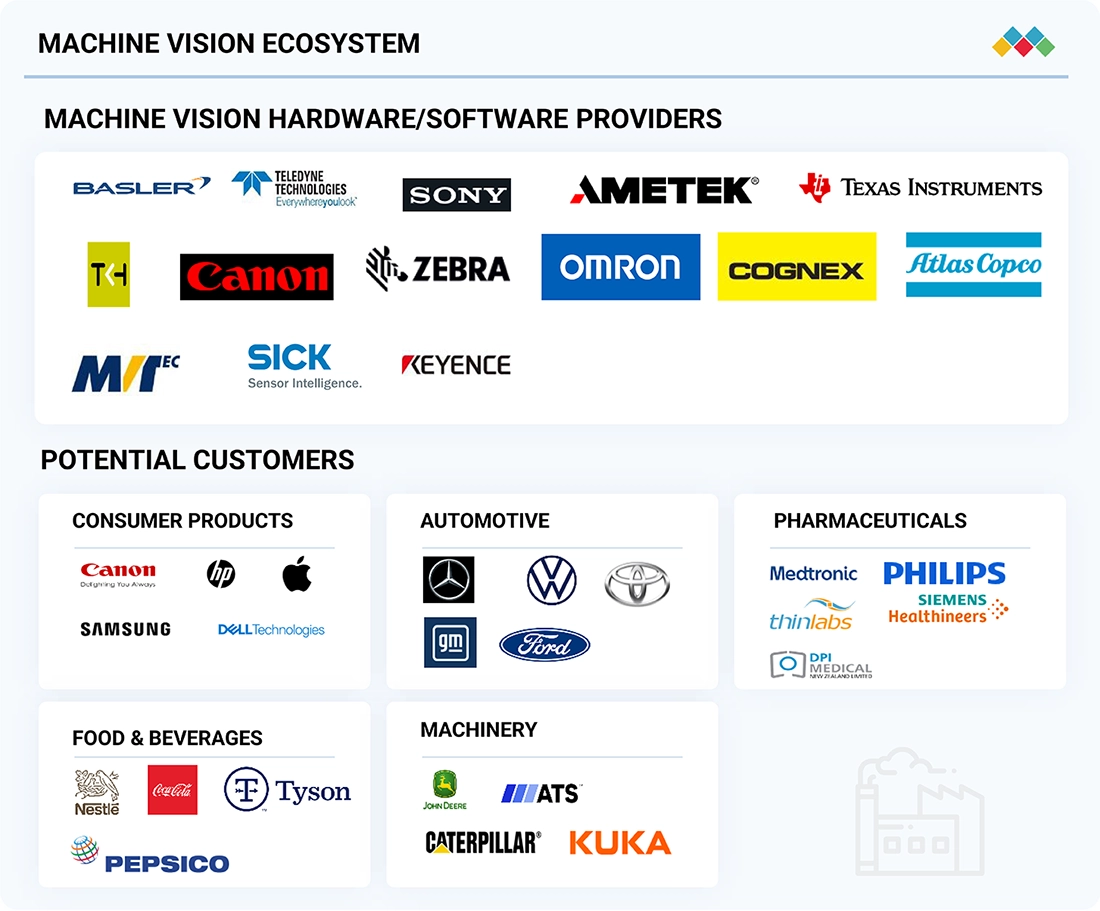
Machine Vision Market: COMMERCIAL USE CASES ACROSS INDUSTRIES
| COMPANY | USE CASE DESCRIPTION | BENEFITS |
|---|---|---|
 |
Advanced cameras (2D, 3D, SWIR, line scan, embedded) and AI-enabled vision software for industrial inspection, robotics, logistics, pharma, automotive, and smart infrastructure | High image accuracy, rapid defect detection, modular systems, reliable AI analysis, broad application coverage, easy integration |
 |
Smart cameras/vision sensors for automated assembly, high-speed quality inspection, and robot guidance, widespread in automotive, electronics, and food industries | Consistent accuracy, quick deployment, flexible setups, robust programming, reduced manual oversight, scalable to diverse industries |
 |
Embedded and AI-powered vision platforms for real-time analytics, defect detection, lab automation, packaging, and automotive components | Reliable imaging for demanding environments, multi-format analytics, easy integration, robust data capture, customizable workflows |
 |
Vision systems (2D/3D/AI) for bin picking, object recognition, production quality control, dynamic factory inspection and automation | Flexible calibration, wide industry support, rapid error-proofing, fast deployment, versatile inspection modes, enhanced productivity |
 |
Vision-guided and deep learning systems for defect detection, traceability, barcode reading, robotic guidance, and yield optimization in manufacturing and logistics | Superior speed, robust accuracy, automated learning, minimal manual configuration, seamless traceability, high operational ROI |
Logos and trademarks shown above are the property of their respective owners. Their use here is for informational and illustrative purposes only.
Related Ecosystem
Analytics
- Natural Language Processing (NLP)
- Machine Learning
- Supply Chain Management
- Predictive Analytics
- Image Sensors
- International Business Machines Corporation
- MICROSOFT CORPORATION
- Oracle Corporation
- SAP SE
Industrial Automation
- Sensors
- Image Sensors
- Manufacturing Execution System (MES)
- Actuators
- Flow Sensors
- Siemens ag
- ABB India Limited
- Emerson Electric Co.
- HONEYWELL INTERNATIONAL INC.
- SCHNEIDER ELECTRIC SE
Industrial Iot
- Sensors
- Pressure Sensors
- Flow Sensors
- Gas Sensors
- Image Sensors
- Siemens ag
- ABB India Limited
- HONEYWELL INTERNATIONAL INC.
- Emerson Electric Co.
- SCHNEIDER ELECTRIC SE
Key Takeaways
- Australia's machine vision market is valued at USD 255.0 million in 2025 and will reach USD 363.1 million by 2030.
- Australia is experiencing a 7.3% CAGR, driven by automation adoption and Industry 4.0 initiatives across manufacturing sectors.
- Australia's machine vision market is benefiting from increased investment in precision inspection and quality control technologies.
- Australia's strategic Asia Pacific location and advanced manufacturing base position it as a growing hub for machine vision solutions.
Machine Vision Market Report Scope
| Report Metric | Details |
|---|---|
| Base Year | 2025 |
| Fastest Growing Segment | FOOD & BEVERAGES (Industry) |
| Forecast Period | 2025–2030 |
| Growth Rate | CAGR of 8.3% from 2025 to 2030 |
| Largest Segment | SMART CAMERA-BASED (System Type) |
| Market Size Base Year (Billions) | ~USD 15.86 (2025) |
| Revenue Forecast (Billions) | ~USD 23.63 (2030) |
| Segments Covered | Component, Hardware Component, Imaging Spectrum, Frame Rate, Format, System Type, Industry |
Australia Machine Vision Market Report Segmentation
7 segment dimensions are covered across the global market.
By Component
- Cameras
- Frame Grabbers
- Led Lighting
- Optics
- Other Hardware Components
- Processors
- Software
By Hardware Component
- Cameras
- Frame Grabbers
- Led Lighting
- Optics
- Other Hardware Components
- Processors
By Imaging Spectrum
- Visible
- Visible+ Ir/Ir
By Frame Rate
- 25-125 Fps
- 25–125 Fps
- <25 Fps
- >125 Fps
By Format
- Area Scan
- Line Scan
By System Type
- Pc-Based
- Smart Camera-Based
By Industry
- Automotive
- Consumer Products
- Electronics & Semiconductors
- Food & Beverages
- Healthcare
- Logistics
- Machinery
- Metals
- Other Industries
- Printing
- Rubber & Plastics
- Solar Panel Manufacturing
AUSTRALIA: MACHINE VISION MARKET, BY INDUSTRY, 2025–2030
| Segment | 2025 | 2026 | 2027 | 2028 | 2029 | 2030 | CAGR (%) |
|---|---|---|---|---|---|---|---|
| AUTOMOTIVE | 33.3 | 35.3 | 37.5 | 40.1 | 43.1 | 46.5 | 6.9 |
| CONSUMER PRODUCTS | 32.2 | 35 | 38.1 | 41.8 | 46 | 50.8 | 9.5 |
| ELECTRONICS & SEMICONDUCTORS | 28.8 | 31.1 | 33.7 | 36.7 | 40.2 | 44.3 | 9 |
| FOOD & BEVERAGES | 28.2 | 30.6 | 33.4 | 36.6 | 40.3 | 44.6 | 9.6 |
| HEALTHCARE | 27.2 | 29.1 | 31.4 | 34 | 36.9 | 40.4 | 8.2 |
| LOGISTICS | 18.9 | 20.4 | 22.2 | 24.3 | 26.7 | 29.5 | 9.4 |
| MACHINERY | 14 | 14.6 | 15.3 | 16 | 16.9 | 18 | 5.1 |
| METALS | 10.2 | 10.6 | 11 | 11.5 | 12 | 12.6 | 4.3 |
| OTHER INDUSTRIES | 31.1 | 32.2 | 33.4 | 34.6 | 36 | 37.4 | 3.8 |
| PRINTING | 10.7 | 11.1 | 11.6 | 12.1 | 12.7 | 13.5 | 4.7 |
| RUBBER & PLASTICS | 8.9 | 9.1 | 9.4 | 9.7 | 10 | 10.4 | 3.1 |
| SOLAR PANEL MANUFACTURING | 11.5 | 12.1 | 12.7 | 13.4 | 14.2 | 15.1 | 5.5 |
| TOTAL | 255 | 271.2 | 289.6 | 310.8 | 335 | 363.1 | 7.3 |
Target Audience
- Machine Vision Equipment Manufacturers : Manufacturers need Australia-specific market data to assess demand, identify growth segments, and develop localized product strategies for the Australian industrial automation market.
- System Integrators & Solution Providers : Integrators require detailed insights into Australian sector adoption rates, customer preferences, and competitive dynamics to design tailored solutions and capture market opportunities.
- Investment & Private Equity Firms : Investors need comprehensive Australia market analysis to evaluate investment opportunities, assess growth potential, and identify acquisition targets in the machine vision ecosystem.
- Manufacturing & Automotive Companies : End-users require market intelligence to benchmark automation investments, understand technology trends, and make informed procurement decisions for quality control systems.
- Market Consultants & Business Strategists : Consultants need Australia-focused data to advise clients on market entry strategies, competitive positioning, and growth opportunities in the machine vision sector.
Key Companies in the Australia Machine Vision Market
| Company | HQ | Ownership | Strongest segments |
|---|---|---|---|
| FANUC CORPORATION | Japan | Public Company | CNC systems and factory automation components (servo motors, lasers),Industrial robots,Robomachine equipment (machining centers, electric injection molding, wire EDM), |
| FOXCONN INDUSTRIAL INTERNET CO LTD | United States | Public Company | Servers and Storage Hardware,Networking Equipment,Industrial Automation Systems, |
| COGNEX CORPORATION | United States | Public Company | Vision systems and In-Sight sensors,DataMan barcode readers and verifiers,VisionPro, OneVision, QuickBuild and software, |
| BASLER AG | United States | Public Company | Area scan cameras and accessories,Line scan, SWIR/UV, and 3D cameras,Lenses, illumination, and opto-mechanical components, |
| KEYENCE CORPORATION | Japan | Public Company | Sensors (photoelectric, fiber, laser, proximity, displacement, flow/pressure/temperature/level),Machine vision and measurement systems (vision, microscopes, 3D profilers, CMM/3D scanners),Control and safety (PLC, micro PLC, HMI, servo, safety light curtains, scanners, interlocks), |
| TELEDYNE TECHNOLOGIES INC. | United States | Public Company | Digital Imaging,Instrumentation,Aerospace and Defense Electronics, |
| OMRON CORPORATION | Japan | Public Company | Industrial Automation (sensors, safety, control, motion, robotics, automation systems),Device & Module Solutions (relays, switches, connectors, components),Healthcare (cardiovascular, respiratory, pain management, remote monitoring), |
| TKH | United States | Public Company | Smart Vision Systems,Smart Manufacturing Systems,Smart Connectivity Systems, |
| SICK AG | Germany | Private Company | Detection and distance sensors,Safety sensors and systems,LiDAR, radar, and outdoor automation, |
| SONY GROUP CORPORATION | Japan | Public Company | Game & Network Services,Music,Pictures, |
| TEXAS INSTRUMENTS INCORPORATED | United States | Public Company | Analog – Power Management,Analog – Signal Chain,Embedded Processing (MCUs, processors, connectivity, radar), |
| ATLAS COPCO AB | Sweden | Public Company | Compressor Technique (compressed air and gas, air treatment, medical air),Vacuum Technique (vacuum pumps, turbomolecular, cryogenic, abatement, integrated systems),Industrial Technique (industrial assembly tools, machine vision, material removal, fastening), |
| AMETEK.INC. | United States | Public Company | Electronic Instruments Group (process, aerospace, power, industrial, lab/test),Electromechanical Group (motors, thermal management, specialty metals, interconnects),Aviation MRO and services network, |
| EMERSON ELECTRIC CO. | United States | Public Company | Final Control,Measurement & Analytical,Discrete Automation, |
| CANON INC. | Japan | Public Company | Printing Business Unit,Medical Business Unit,Imaging Business Unit, |
| ZEBRA TECHNOLOGIES CORP. | United States | Public Company | Rugged mobile computing and accessories,Barcode and RFID printers, supplies, and card printers,Barcode scanners, imagers, and fixed industrial scanners, |
FANUC CORPORATION
FANUC Corporation is a Japanese public company founded in 1950 with 10,040 employees, specializing in industrial automation and robotics.
FOXCONN INDUSTRIAL INTERNET CO LTD
Foxconn Industrial Internet Co Ltd is a United States-based public company established in 2015 with 217,084 employees, operating as a major electronics manufacturing services provider.
COGNEX CORPORATION
Cognex Corporation is a United States public company founded in 1981 with 2,745 employees, focused on machine vision and industrial barcode reading technologies.
BASLER AG
Basler AG is a United States-based public company established in 1988 with 836 employees, specializing in digital camera and imaging solutions.
KEYENCE CORPORATION
Keyence Corporation is a Japanese public company founded in 1972 with 12,784 employees, known for manufacturing sensors, measurement systems, and automation equipment.
TELEDYNE TECHNOLOGIES INC.
Teledyne Technologies Inc. is a United States public company founded in 1960 with 15,800 employees, providing digital imaging, instrumentation, and aerospace and defense products.
OMRON CORPORATION
Omron Corporation is a Japanese public company established in 1933 with 26,050 employees, specializing in automation, sensing, and control technologies.
TKH
TKH is a United States-based public company founded in 1930 with 5,907 employees, operating in industrial technology and infrastructure sectors.
SICK AG
SICK AG is a German private company established in 1946 with 11,804 employees, specializing in sensor technology and industrial automation solutions.
SONY GROUP CORPORATION
Sony Group Corporation is a Japanese public company founded in 1946 with 94,900 employees, operating across electronics, entertainment, gaming, and financial services.
TEXAS INSTRUMENTS INCORPORATED
Texas Instruments Incorporated is a United States public company founded in 1930 with 33,000 employees, designing and manufacturing semiconductors and analog integrated circuits.
ATLAS COPCO AB
Atlas Copco AB is a Swedish public company established in 1873 with 56,520 employees, providing industrial tools, equipment, and services globally.
AMETEK.INC.
AMETEK Inc. is a United States public company founded in 1930 with 22,500 employees, manufacturing electronic instruments and electromechanical devices.
EMERSON ELECTRIC CO.
Emerson Electric Co. is a United States public company established in 1890 with 71,000 employees, providing process management and climate technologies.
CANON INC.
Canon Inc. is a Japanese public company founded in 1933 with 165,547 employees, manufacturing imaging and optical products including cameras, printers, and office equipment.
ZEBRA TECHNOLOGIES CORP.
Zebra Technologies Corp. is a United States public company established in 1969 with 10,700 employees, specializing in automatic identification and data capture solutions.
Reasons to Buy this Report
- Localized Market Intelligence : Gain Australia-specific insights on market size, growth rates, and forecasts to make informed investment and expansion decisions tailored to the local market dynamics.
- Sector-Specific Opportunities : Identify high-growth opportunities within Australia's manufacturing, automotive, and semiconductor sectors with detailed analysis of adoption patterns and technology preferences.
- Competitive Landscape Analysis : Understand the competitive positioning of machine vision providers in Australia, including market share, key players, and differentiation strategies specific to the region.
- Strategic Planning & Forecasting : Leverage 5-year forecasts (2025-2030) to develop long-term strategies, resource allocation plans, and market entry or expansion timelines for the Australian market.
- Regulatory & Policy Insights : Access information on Australian government initiatives, industry standards, and policy drivers influencing machine vision adoption and technology implementation.
Frequently asked questions
What is the current size of Australia's machine vision market?
Australia's machine vision market is estimated at USD 255.0 million in 2025, with verified data confirming this valuation across key industry segments.
What is the projected growth rate for Australia's machine vision market?
Australia's machine vision market is projected to grow at a compound annual growth rate of 7.3% from 2025 to 2030.
What will Australia's machine vision market size be in 2030?
Australia's machine vision market is forecast to reach USD 363.1 million by 2030, representing significant expansion over the five-year period.
What are the primary drivers of growth in Australia's machine vision market?
Australia's machine vision market growth is driven by increased automation adoption, Industry 4.0 initiatives, demand for precision inspection, and digital transformation across manufacturing sectors.
Which industries are leading adoption of machine vision in Australia?
Australia's machine vision adoption is strongest in manufacturing, automotive, semiconductor, and food & beverage industries, where quality control and process optimization are critical.
RESEARCH METHODOLOGY
The study involved four major activities for estimating the current size of the machine vision market. Exhaustive secondary research has been done to collect information on the market. The next step is to validate these findings, assumptions, and size with industry experts across the value chain through primary research. Both the top-down and bottom-up approaches have been employed to estimate the complete market size. After that, market breakdown and data triangulation methods have been used to estimate the market size of the segments and subsegments. Two sources of information, secondary and primary, have been used to identify and collect information for an extensive technical and commercial study of the machine vision market.
Secondary Research
Various secondary sources have been referred to in the secondary research process to identify and collect information important for this study. The secondary sources include annual reports, press releases, and investor presentations of companies; white papers; journals and certified publications; and articles from recognized authors, websites, directories, and databases. Secondary research has been conducted to obtain key information about the industry’s supply chain, the market’s value chain, the total pool of key players, market segmentation according to the industry trends (to the bottom-most level), regional markets, and key developments from market- and technology-oriented perspectives. Secondary data has been collected and analyzed to determine the overall market size, which is further validated through primary research.
Primary Research
Extensive primary research was conducted after gaining knowledge about the current scenario of the machine vision market through secondary research. Several primary interviews were conducted with experts from the demand and supply sides across four major regions North America, Europe, Asia Pacific, and RoW. This primary data was collected through questionnaires, emails, and telephonic interviews.
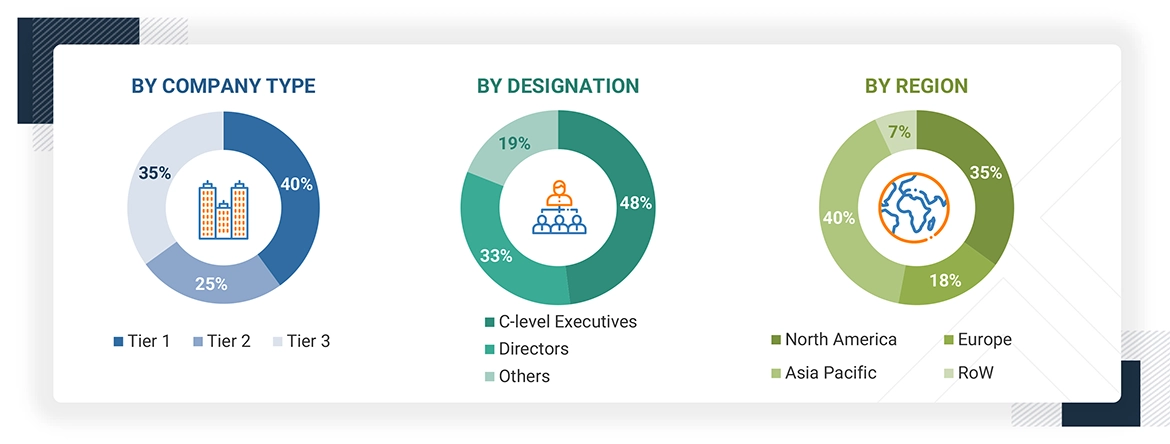
To know about the assumptions considered for the study, download the pdf brochure
Market Size Estimation
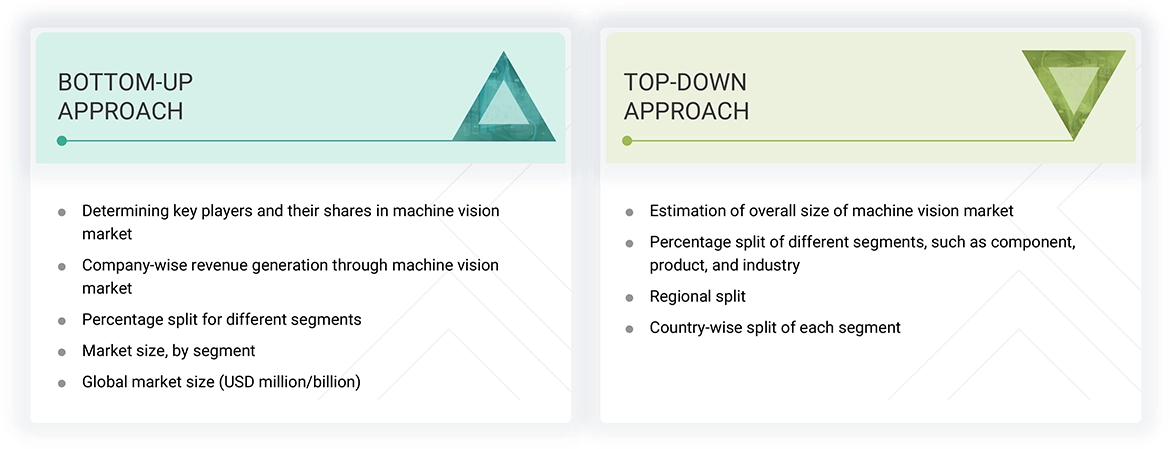
Both the top-down and bottom-up approaches have been used to estimate and validate the total size of the machine vision market. These methods have also been used extensively to estimate the size of various subsegments in the market. The following research methodology has been used to estimate the market size:
- Major players in the market have been identified through extensive secondary research.
- The industry’s value chain and market size (in terms of value) have been determined through primary and secondary research processes.
- All percentage shares, splits, and breakdowns have been determined using secondary sources and verified through primary sources.
Machine Vision Market : Top-Down and Bottom-Up Approach
Data Triangulation
After arriving at the overall size of the machine vision market from the market size estimation process explained above, the total market has been split into several segments and subsegments. Data triangulation and market breakdown procedures have been employed, wherever applicable, to complete the overall market engineering process and arrive at the exact statistics for all segments and subsegments of the market. The data has been triangulated by studying various factors and trends from both the demand and supply sides. Along with this, the market size has been validated using both the top-down and bottom-up approaches.
Market Definition
Machine vision systems use a combination of hardware and software to provide operational guidance to devices in executing their functions. Visual inspections are automated, and product assembly equipment are precisely guided using sensors (cameras), processing hardware, and software algorithms. The system relies on digital sensors installed in cameras with specialized optics to acquire images. These images are then processed, analyzed, and measured by artificial intelligence (AI) technology embedded in the computer hardware for decision-making. AI allows machines to learn from experience, intercept new inputs, and perform human-like tasks. Machine learning and natural language processing (NLP), used to train computers, are also used in machine vision to perform specific tasks by processing large data captured by cameras. Machine vision systems offer fast response, a tailored approach, accurate information, and fewer redundancies—all essential to achieving higher organizational efficiency. Machine vision systems encompass all industrial and non-industrial applications.
Key Stakeholders
- Government bodies and policymakers
- Industry organizations, forums, alliances, and associations
- Raw material suppliers and distributors
- Research institutes and organizations
- Original equipment manufacturers (OEMs)
- Technology, service, and solution providers
- Intellectual property (IP) core and licensing providers
- Market research and consulting firms
Report Objectives
- To describe, segment, and forecast the overall machine vision market by application, vision type, deployment, component, system type, and industry, in terms of value
- To describe and forecast the market for four key regions: North America, Europe, Asia Pacific, and Rest of the World (RoW), along with their respective countries, in terms of value
- To provide an overview of the recent trends in the market
- To provide detailed information regarding the drivers, restraints, opportunities, and challenges influencing the growth of the market
- To analyze the supply chain, trends/disruptions impacting customer business, market/ecosystem map, pricing analysis, and regulatory landscape pertaining to the machine vision market
- To strategically analyze micromarkets with respect to individual growth trends, prospects, and contributions to the overall market size.
- To analyze opportunities in the market for stakeholders and provide a competitive landscape of the market
- To strategically profile the key players and comprehensively analyze their market positions in terms of their ranking and core competencies, along with detailing the competitive landscape for market leaders
- To analyze competitive developments, such as product launches, acquisitions, collaborations, agreements, and partnerships, in the machine vision market
- To provide ecosystem analysis, case study analysis, patent analysis, technology analysis, value chain analysis, trends/disruptions impacting customer business, impact of AI/Gen AI, key conferences and events, pricing analysis, Porter’s five forces analysis, and regulations pertaining to the market under study
- To provide a macroeconomic outlook based on all the regions in the region chapter
Available Customizations:
With the given market data, MarketsandMarkets offers customizations according to the company’s specific needs. The following customization options are available for the report:
Company Information:
- Detailed analysis and profiling of additional market players (up to 5)
Get the Full Machine Vision Market Report
Full forecast, segment splits, and company analysis for all Machine Vision Market.
- US Machine Vision Market
- Canada Machine Vision Market
- Mexico Machine Vision Market
- Germany Machine Vision Market
- UK Machine Vision Market
- France Machine Vision Market
- Italy Machine Vision Market
- Spain Machine Vision Market
- Netherlands Machine Vision Market
- Switzerland Machine Vision Market
- China Machine Vision Market
- Japan Machine Vision Market
- South Korea Machine Vision Market
- India Machine Vision Market
- Indonesia Machine Vision Market
- Singapore Machine Vision Market
- Nordics Machine Vision Market
- Rest Of Europe Machine Vision Market
- Rest Of Asia Pacific Machine Vision Market
- Bahrain Machine Vision Market
- Kuwait Machine Vision Market
Need a Tailored Report?
Customize this report to your needs
Get 10% FREE Customization
Customize This Report
