
Middle East Infrared Imaging Market (2025-2030)

The Middle East Infrared Imaging Market was valued at $19.2 Million in 2025 and projected to reach to $24 Million by 2030, representing a compound annual growth rate of 4.6%. The Middle East infrared imaging market is positioned for steady growth through 2030, supported by continued government investments in defense modernization and critical infrastructure development.


| Market Size in | USD 26.32 MN |
| Market Forecast in | |
| CAGR | |
| Forecast Period | |
| Units Considered | Value (USD MN) |
Middle East Infrared Imaging Market Trends and Insights
- This moderate expansion reflects Oman's strategic investments in defense, security infrastructure, and industrial applications across the Middle East region.
- Oman's adoption of thermal imaging technologies is driven by increasing demand in border surveillance, port security, and oil & gas sector monitoring. The infrared imaging sector in Oman benefits from the country's geographic position and economic diversification initiatives.
- Oman continues to modernize its security apparatus and industrial capabilities, creating sustained demand for advanced thermal sensing solutions.
- Between 2025 and 2030, Oman's market growth will be supported by infrastructure development projects and heightened focus on critical infrastructure protection across the sultanate..
Key Market Statistics
- CAGR (2025-2030) 4.6% CAGR
- Market Size, 2025 ~USD 19.2 Million
- Forecast, 2030 ~USD 24 Million
- Geography Middle East
Middle East Infrared Imaging Market Overview
Defense & Security Dominance :
The Middle East infrared imaging market is primarily driven by substantial defense and security investments across Gulf Cooperation Council (GCC) nations, with thermal imaging technologies critical for border surveillance, military applications, and counter-terrorism operations.
Oil & Gas Industrial Applications :
Infrared imaging adoption in the Middle East's oil and gas sector supports predictive maintenance, equipment monitoring, and safety protocols, leveraging thermal technology for enhanced operational efficiency in harsh desert environments.
Regional Growth at 4.6% CAGR :
The Middle East infrared imaging market is projected to grow from USD 19.2 million in 2025 to USD 24.0 million by 2030, demonstrating steady expansion driven by modernization initiatives and increased technology adoption across GCC economies.
Smart City & Infrastructure Development :
Emerging smart city projects across the Middle East, particularly in UAE and Saudi Arabia, are creating new demand for infrared imaging in building automation, energy management, and urban security infrastructure.
Middle East Infrared Imaging Market Dynamics
- GCC nations are increasingly prioritizing advanced surveillance and thermal monitoring technologies to enhance national security and operational efficiency across military, border control, and industrial sectors.
- The region's strategic focus on diversifying beyond oil-dependent economies is driving adoption of sophisticated imaging solutions in smart city initiatives and industrial automation. Key growth catalysts include rising geopolitical security concerns, expansion of oil and gas operations requiring advanced monitoring capabilities, and accelerating digital transformation initiatives.
- However, market growth remains moderate compared to global rates, reflecting the region's smaller overall market size and concentrated customer base.
- Strategic partnerships between regional governments and international technology providers are expected to accelerate technology transfer and localization efforts throughout the forecast period..
Market Ecosystem
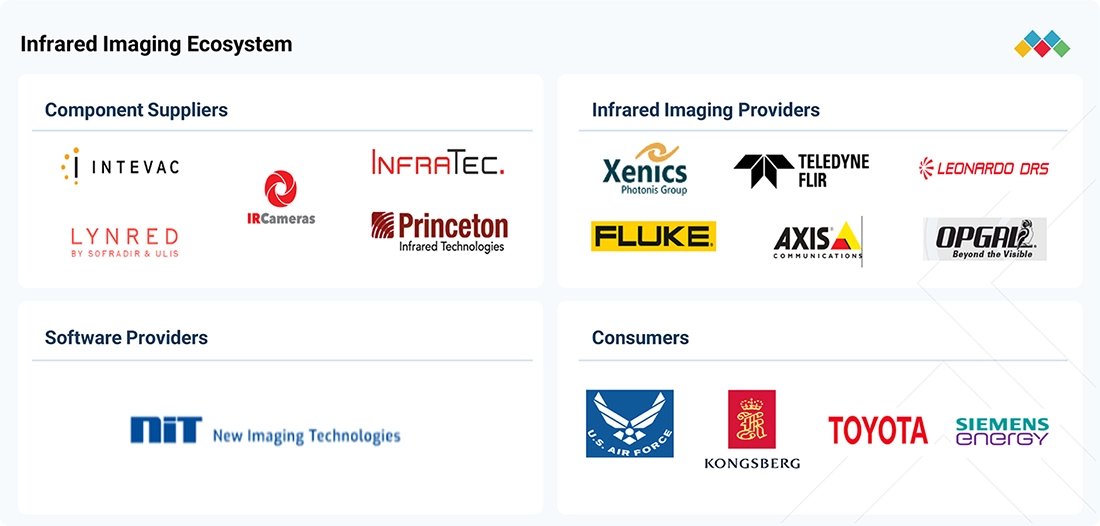
INFRARED IMAGING MARKET SIZE, SHARE & TRENDS: COMMERCIAL USE CASES ACROSS INDUSTRIES
| COMPANY | USE CASE DESCRIPTION | BENEFITS |
|---|---|---|
 |
Teledyne FLIR OEM launched the Boson SX8, an uncooled LWIR thermal camera module with 1280 × 1024 SXGA resolution and an 8 µm pixel pitch. The module is designed for defense and industrial applications, including unmanned systems, counter-UAS, perimeter security, and ISR. | Enables high-resolution thermal imaging in compact platforms | Supports defense and industrial integration | Improves detection performance | Optimizes size, weight, and power |
 |
Fluke provides infrared thermal cameras for preventive maintenance, electrical inspection, HVAC, mechanical equipment monitoring, and industrial troubleshooting. Its portfolio includes handheld, mounted, and high-resolution thermal cameras with advanced image analysis and connectivity capabilities. | Enables early fault detection | Reduces equipment downtime | Supports predictive maintenance | Improves inspection accuracy and operational efficiency |
 |
Leonardo DRS launched the Tenum 640 Orbit, an uncooled LWIR thermal camera module optimized for unmanned air, ground, and maritime platforms. The module is designed for high-volume OEM integration while maintaining compact size, weight, power, and cost characteristics. | Supports thermal imaging for unmanned platforms | Accelerates OEM integration | Enables reliable detection in demanding environments | Reduces SWaP-C requirements |
 |
Axis introduced the AXIS Q2802-E Bispectral Camera, combining a 640 × 480 thermal sensor with a 4K visual sensor. The camera uses thermal-visual image fusion and AI-based analytics for perimeter protection, critical infrastructure monitoring, and temperature monitoring. | Enhances detection and visual verification | Enables operation in darkness and challenging weather | Supports AI-based object detection | Improves critical infrastructure monitoring |
 |
LYNRED develops advanced cooled and uncooled infrared detectors and thermal imaging technologies for defense, aerospace, industrial, and commercial applications. Its infrared detector technologies support thermal imaging systems requiring high sensitivity and reliable performance across demanding operating environments. | Enables high-performance infrared detection | Supports defense and aerospace imaging | Improves thermal sensitivity | Enables integration into advanced imaging systems |
Logos and trademarks shown above are the property of their respective owners. Their use here is for informational and illustrative purposes only.
Related Ecosystem
Aviation
- Narrow Body Aircraft
- Wide Body Aircraft
- Military Helicopters
- Special Mission Aircraft
- Fighter Aircraft
- HONEYWELL INTERNATIONAL INC.
- COLLINS AEROSPACE
- Thales group
- Safran group
- HEICO Corporation
Data Centre And Networking
- Software-Defined Networking (SDN)
- Mid-Sized Data Centers
- Small Data Centers
- Remote Monitoring
- Smart Healthcare
- Cisco Systems, Inc.
- HUAWEI TECHNOLOGIES CO LTD
- Hewlett Packard Enterprise Company
- MITSUBISHI ELECTRIC INFORMATION SYSTEMS CORPORATION
- MITSUBISHI ELECTRIC INFORMATION NETWORK CORPORATION
Electronics System And Components
- Sensors
- Temperature Sensors
- Pressure Sensors
- Actuators
- Image Sensors
- Lenovo
- Samsung
- Texas Instruments Incorporated
- HONEYWELL INTERNATIONAL INC.
- Teledyne Technologies Incorporated
Key Takeaways
- Oman's infrared imaging market is valued at USD 19.2 million in 2025 and will reach USD 24.0 million by 2030.
- Oman is experiencing a 4.6% CAGR, driven by defense modernization and critical infrastructure security needs.
- Oman's strategic location and oil & gas sector expansion are key growth catalysts for thermal imaging adoption.
- Oman's market growth is supported by government initiatives in border surveillance and port security modernization.
Infrared Imaging Market Report Scope
| Report Metric | Details |
|---|---|
| Base Year | 2025 |
| Fastest Growing Segment | SWIR (Wavelength) |
| Forecast Period | 2025–2030 |
| Growth Rate | CAGR of 6.2% from 2025 to 2030 |
| Largest Segment | UNCOOLED (Technology) |
| Market Size Base Year (Billions) | ~USD 8.62 (2025) |
| Revenue Forecast (Billions) | ~USD 11.65 (2030) |
| Segments Covered | Type, Wavelength, Component, Technology, Application, Vertical |
Middle East Infrared Imaging Market Report Segmentation
6 segment dimensions are covered across the global market.
By Type
- Reflective
- Thermal
By Wavelength
- Lwir
- Mwir
- Nir
- Swir
By Component
- Cameras
- Modules
- Scopes
By Technology
- Cooled
- Uncooled
By Application
- Detection
- Monitoring & Inspection
- Security & Surveillance
By Vertical
- Industrial
- Non-Industrial
Target Audience
- Defense & Military Procurement Officials : Government defense ministries and military procurement departments across GCC nations require market intelligence on thermal imaging capabilities, vendor comparisons, and technology roadmaps to support modernization programs and border security initiatives.
- Oil & Gas Operations Managers : Industrial facility managers and operations teams in the Middle East's energy sector need detailed insights on infrared imaging applications for equipment monitoring, predictive maintenance, and safety compliance in demanding operational environments.
- Technology Solution Providers : International and regional infrared imaging manufacturers and system integrators require market sizing data, growth forecasts, and competitive positioning analysis to develop go-to-market strategies for Middle East expansion.
- Smart City Project Developers : Urban development authorities and smart city initiative leaders in the Middle East need comprehensive market data on thermal imaging integration in building automation, energy management, and urban security infrastructure.
- Investment & Business Development Teams : Corporate development, venture capital, and private equity professionals evaluating Middle East technology investments require detailed market analysis, growth drivers, and competitive dynamics to assess investment opportunities and exit potential.
Key Companies in the Middle East Infrared Imaging Market
| Company | HQ | Ownership | Strongest segments |
|---|---|---|---|
| JABIL | United States | Public Company | Regulated Industries (healthcare, medical devices, automotive, packaging),Intelligent Infrastructure (5G, wireless, cloud, networking, storage, industrial),Connected Living & Digital Commerce (connected devices, mobility, digital print and retail), |
| GENERAL DYNAMICS CORPORATION | United States | Public Company | Aerospace (Gulfstream and aviation services),Marine Systems (submarines and surface combatants),Combat Systems (land combat and munitions), |
| ROBERT BOSCH GMBH | India | Private Company | Mobility (powertrain, chassis, automotive electronics, aftermarket, steering),Industrial Technology (factory automation, drives, process and packaging),Energy and Building Technology (heating, heat pumps, boilers, security, building management), |
| LENOVO | China | Public Company | Small form factor and mini PCs as signage controllers,Embedded media players and thin clients,Tablets and smart devices for kiosks/PoS, |
| TENET HEALTHCARE CORPORATION | United States | Public Company | Hospital Operations and Services,Ambulatory Care (ASCs, surgical hospitals, outpatient centers), |
| TELEDYNE FLIR LLC | United States | Private Company | Industrial and OGI thermal imaging (incl. FLIR G-Series),Defense and government thermal/ISR systems,Commercial and public safety imaging devices, |
| FLUKE CORPORATION | United States | Private Company | Digital multimeters and basic electrical testers,Power analyzers and power quality meters,Thermal imagers and infrared cameras, |
| LEONARDO S.P.A. | Italy | Public Company | Helicopters and related services,Defense electronics, C2, radars, and avionics,Aircraft, aerostructures, and defense systems, |
| RTX | United States | Public Company | Collins Aerospace systems and services,Pratt & Whitney engines and MRO,Raytheon sensors, effectors, and mission systems, |
| L3HARRIS TECHNOLOGIES, INC. | United States | Public Company | Space & Mission Systems,Communications & Spectrum Dominance,Missile Solutions, |
| EXOSENS | France | Public Company | Amplification (image intensifier tubes and related components),Detection and Imaging systems (cameras, sensors, modules, cores, solutions),Radiation and gas detection (Geiger-Müller, gamma/neutron, methane detection), |
| BAE SYSTEMS | United Kingdom | Public Company | Air,Electronic Systems,Maritime, |
| INTEVAC, INC. | United States | Private Company | HDD thin-film processing systems,Adjacent thin-film markets (non-HDD small substrates),Services, upgrades, and spares, |
| ZHEJIANG DALI TECHNOLOGY CO., LTD. | China | Public Company | Hand-held thermal imagers and cameras,Online thermal and dual-spectrum cameras,Special equipment (firefighting, coal mining, acoustic imaging), |
JABIL
Jabil is a United States-based public company founded in 1966 that employs 135,000 people. The company operates as a global manufacturing and supply chain solutions provider.
GENERAL DYNAMICS CORPORATION
General Dynamics Corporation is a United States public company established in 1899 with 117,000 employees. The company is a major defense and aerospace contractor.
ROBERT BOSCH GMBH
Robert Bosch GmbH is a private company founded in 1886 with 412,774 employees operating in India. The company is a global supplier of technology and services.
LENOVO
Lenovo is a Chinese public company founded in 1984. The company is a global technology manufacturer and provider.
TENET HEALTHCARE CORPORATION
Tenet Healthcare Corporation is a United States public company founded in 1967 with 88,500 employees. The company operates as a major healthcare services provider.
TELEDYNE FLIR LLC
Teledyne FLIR LLC is a United States private company founded in 1978 with 4,179 employees. The company specializes in thermal imaging and infrared technology.
FLUKE CORPORATION
Fluke Corporation is a United States private company founded in 1948 with 2,525 employees. The company manufactures electronic test and measurement equipment.
LEONARDO S.P.A.
Leonardo S.p.A. is an Italian public company founded in 1948 with 65,455 employees. The company operates in the defense, aerospace, and security sectors.
RTX
RTX is a United States public company founded in 1934 with 180,000 employees. The company operates as a major aerospace and defense contractor.
L3HARRIS TECHNOLOGIES, INC.
L3Harris Technologies, Inc. is a United States public company founded in 1895 with 45,000 employees. The company provides advanced defense and commercial technologies.
EXOSENS
Exosens is a French public company founded in 1937 with 1,499 employees. The company specializes in imaging and detection technologies.
BAE SYSTEMS
BAE Systems is a United Kingdom public company founded in 1979 with 111,400 employees. The company is a major defense, aerospace, and security contractor.
INTEVAC, INC.
Intevac, Inc. is a United States private company founded in 2021 with 106 employees. The company operates in the technology and manufacturing sector.
ZHEJIANG DALI TECHNOLOGY CO., LTD.
Zhejiang Dali Technology Co., Ltd. is a Chinese public company founded in 1984 with 860 employees. The company operates in the technology sector.
Countries within Middle East - compare and drill down
| Country | 2025 size (native) |
|---|---|
| Bahrain | USD 43.9 Million |
| Kuwait | USD 34.5 Million |
| Oman | USD 88.5 Million |
| Qatar | USD 86.1 Million |
Country market size visualization
Reasons to Buy this Report
- Regional Market Segmentation : Gain detailed insights into country-specific market dynamics across Bahrain, Kuwait, Oman, and Qatar, enabling targeted market entry strategies and localized business development for Middle East operations.
- Defense & Security Opportunity Assessment : Understand the primary growth drivers in military modernization and border security investments across GCC nations, identifying high-value contract opportunities and government procurement trends.
- Industrial Application Insights : Access comprehensive analysis of infrared imaging adoption in the Middle East's oil and gas sector, including predictive maintenance applications and equipment monitoring requirements specific to regional operations.
- Competitive Landscape Intelligence : Identify key market players, technology providers, and partnership opportunities within the Middle East infrared imaging ecosystem, including local distributors and regional system integrators.
- Growth Forecast & Investment Planning : Leverage 5-year market projections (2025-2030) to inform capital allocation decisions, product development roadmaps, and expansion strategies tailored to Middle East market conditions and regulatory requirements.
Frequently asked questions
What is the current size of Oman's infrared imaging market?
Oman's infrared imaging market is estimated at USD 19.2 million in 2025.
What is the projected market size for Oman by 2030?
Oman's infrared imaging market is projected to reach USD 24.0 million by 2030.
What is the CAGR for Oman's infrared imaging market?
Oman's infrared imaging market is growing at a compound annual growth rate of 4.6% from 2025 to 2030.
What are the primary drivers of growth in Oman's infrared imaging market?
Oman's market growth is driven by defense modernization, border surveillance expansion, port security upgrades, and oil & gas sector monitoring requirements.
Which sectors in Oman are adopting infrared imaging technology?
Oman's key adopting sectors include defense and security, oil & gas operations, port and maritime security, and critical infrastructure protection.
RESEARCH METHODOLOGY
The study involved four major activities in estimating the current size of the infrared imaging market. Extensive secondary research was conducted to gather information on the market, adjacent industries, and the broader infrared sensing, thermal imaging, and electro-optics ecosystem. This was followed by primary research with industry stakeholders across the value chain, including infrared camera manufacturers, thermal sensor and detector suppliers, imaging module providers, system integrators, distributors, defense and aerospace companies, industrial users, and technology providers, to validate assumptions and market sizing. Both top-down and bottom-up approaches were used to estimate the overall market size. Market breakdowns and data triangulation techniques were then applied to derive the size of individual segments and subsegments. Secondary and primary sources were jointly used to support a comprehensive technical and commercial analysis of the infrared imaging market.
Secondary Research
Various secondary sources were referred to during the secondary research process to identify and collect information relevant to the infrared imaging market. These sources included annual reports, press releases, investor presentations of key companies, product catalogs, technical datasheets, white papers, technical journals, certified publications, patents, industry associations, company websites, trade directories, and government databases. Secondary research was conducted to obtain key insights into the market’s supply chain, value chain, competitive landscape, and segmentation across type, wavelength, component, technology, application, vertical, and region. It also helped analyze industry trends, adoption of thermal imaging, defense modernization, industrial automation, predictive maintenance, AI-enabled image analytics, and recent technological advancements in cooled and uncooled infrared detectors, SWIR, MWIR, and LWIR imaging systems. The collected data was further analyzed to estimate the overall market size and validate findings, which were subsequently refined through primary research with industry experts and key stakeholders.
Primary Research
Extensive primary research was conducted after gaining knowledge about the current scenario of the infrared imaging market through secondary research. Several primary interviews were conducted with experts from the demand and supply sides across four major regions: North America, Europe, Asia Pacific, and RoW. This primary data was collected through questionnaires, emails, and telephonic interviews.
Breakdown of Primary Interviews
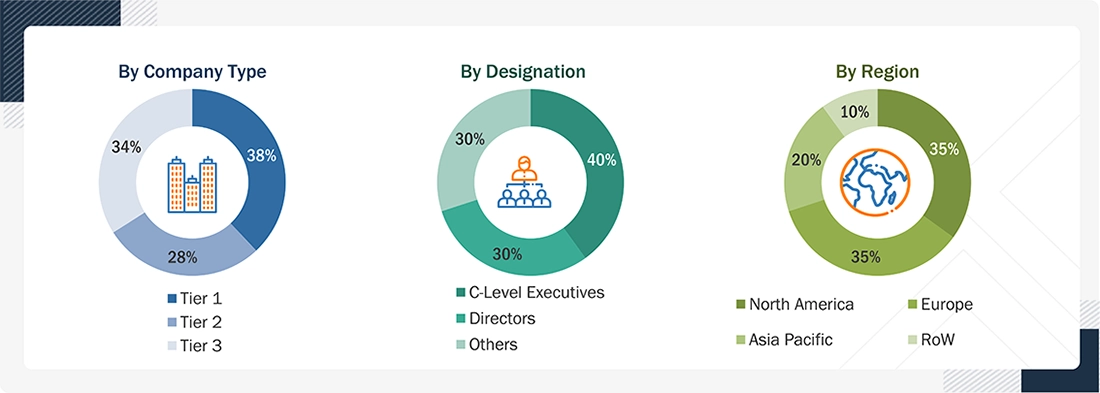
Note: The three tiers of the companies are defined based on their total revenue in 2025: Tier 1 - revenue greater than or equal to USD 1 billion; Tier 2 - revenue between USD 100 million and USD 1 billion; and Tier 3 revenue less than or equal to USD 100 million. Other designations include sales managers, marketing managers, and product managers.
To know about the assumptions considered for the study, download the pdf brochure
Market Size Estimation
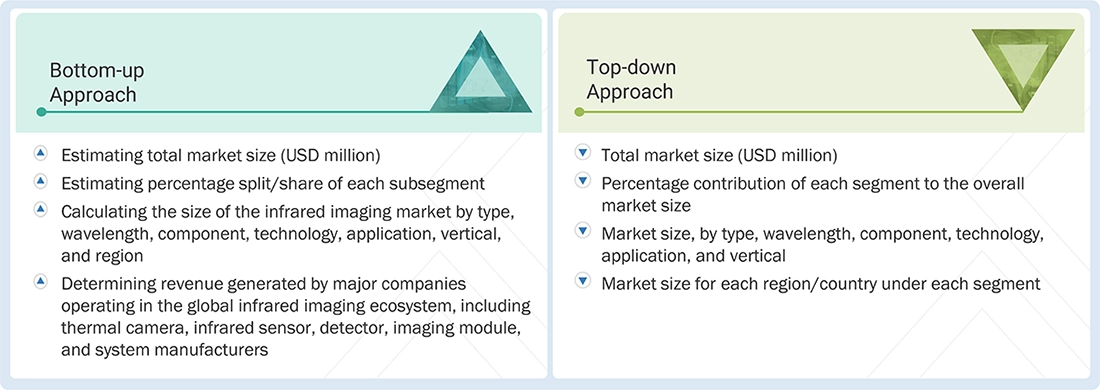
Both top-down and bottom-up approaches were used to estimate and validate the total size of the infrared imaging market. These methods have also been used extensively to estimate the size of various subsegments in the market. The following research methodology was used to estimate the market size:
- Major players in the infrared imaging industry and related markets were identified through extensive secondary research.
- The industry’s value chain and market size (in terms of value) were determined through primary and secondary research processes.
- All percentage shares, splits, and segment-level breakdowns were determined using secondary sources and verified through primary sources.
Infrared Imaging Market: Top-Down and Bottom-Up Approach
Data Triangulation
After arriving at the overall size of the infrared imaging market from the market size estimation process explained above, the total market was split into several segments and subsegments. Data triangulation and market breakdown procedures were employed, wherever applicable, to complete the overall market engineering process and arrive at the statistics for all segments and subsegments of the market. The data was triangulated by studying various factors and trends from both the demand and supply sides, including technology adoption, product offerings, application requirements, and regional developments. Along with this, the market size was validated using both top-down and bottom-up approaches.
Market Definition
Infrared imaging refers to the use of infrared radiation to capture images based on the thermal or spectral characteristics of objects, materials, and environments. Infrared imaging systems enable the detection and visualization of radiation beyond the visible spectrum and are used for thermal measurement, object detection, inspection, surveillance, and condition monitoring across a wide range of applications. These systems can operate under low-light or complete-darkness conditions and provide information that may not be visible through conventional optical imaging technologies. Infrared imaging solutions can incorporate cooled or uncooled detectors, infrared cameras, focal plane arrays, optics, sensors, and image-processing systems, depending on application requirements and operating conditions.
Infrared imaging plays a critical role across industries such as defense & aerospace, industrial manufacturing, automotive, security & surveillance, healthcare, energy & utilities, and commercial applications. These systems help improve situational awareness, enable predictive maintenance, identify equipment faults, support night vision, enhance security monitoring, and facilitate non-contact temperature and thermal inspection. Infrared imaging is commonly integrated into thermal cameras, unmanned systems, automotive vision systems, industrial inspection equipment, surveillance platforms, and scientific instruments. A typical infrared imaging system consists of an infrared detector, optical assembly, focal plane array, signal-processing electronics, imaging module, and software or analytics, with configurations varying based on wavelength, detector technology, resolution, sensitivity, application, and operating environment.
Key Stakeholders
- Infrared imaging manufacturers.
- Thermal imaging solution providers.
- Infrared detector component suppliers.
- Defense & aerospace companies
- Industrial manufacturers
- Technology providers
- Government and regulatory authorities
- Research institutions, laboratories, and R&D organizations
Report Objectives
- To define, describe, and forecast the infrared imaging market by type, wavelength, component, technology, application, vertical, and region, in terms of value
- To forecast the market size by region—North America, Europe, Asia Pacific, Middle East & Africa, and Latin America—in terms of value
- To provide qualitative information about the applications of infrared imaging, recent trends in thermal imaging technologies, and advancements in infrared sensors, detectors, cameras, and imaging systems across industries
- To provide detailed information regarding the major factors influencing market growth, namely, drivers (increasing use of infrared imaging products in security & surveillance applications, rising adoption of infrared cameras in quality control and inspection applications), restraints (stringent import and export regulations for selling infrared cameras in US, limitations associated with image resolution and sensitivity of infrared cameras), opportunities (emerging applications of ir imaging technology in automotive sector, newer application areas of SWIR cameras), and challenges (high cost associated with infrared cameras, and designing highly accurate IR imaging products).
- To estimate the market size in terms of value for infrared imaging by wavelength, including NIR, SWIR, MWIR, and LWIR
- To estimate the market size by technology, including cooled and uncooled infrared imaging technologies.
- To strategically analyze micro markets with respect to individual growth trends, prospects, and contributions to the total market
- To study the complete infrared imaging value chain participants, including infrared detector suppliers, sensor and component manufacturers, camera and imaging module manufacturers, optics providers, system integrators, distributors, and end users.
- To analyze opportunities in the market for stakeholders by identifying high-growth applications such as defense & aerospace, industrial inspection, automotive, security & surveillance, healthcare, energy & utilities, semiconductor inspection, building diagnostics, and autonomous systems
- To strategically profile key players and comprehensively analyze their core competencies, along with detailing the competitive landscape for market leaders
- To analyze competitive developments such as product launches, partnerships, acquisitions, collaborations, expansions, and technological developments in the infrared imaging market
- To benchmark market players using company evaluation frameworks based on various parameters within business strategies, product portfolios, geographic presence, and technological capabilities
- To provide a macroeconomic outlook for all regions covered in this report, considering defense spending, industrial automation, semiconductor manufacturing, automotive technology, smart infrastructure, and digitalization initiatives
- To provide information on ecosystem analysis, case study analysis, technology trends, emerging applications, interconnected markets, and cross-sector opportunities, along with the impact of evolving sensor technologies, AI-based image analytics, autonomous systems, and digitalization trends on the infrared imaging market
Available customizations:
With the given market data, MarketsandMarkets offers customizations according to the company’s specific needs. The following customization options are available for the report:
Company Information
-
Detailed analysis and profiling of additional market players (up to 5)
Get the Full Infrared Imaging Market Report
Full forecast, segment splits, and company analysis for all Infrared Imaging Market.
- US Infrared Imaging Market
- Canada Infrared Imaging Market
- Mexico Infrared Imaging Market
- Germany Infrared Imaging Market
- UK Infrared Imaging Market
- France Infrared Imaging Market
- Italy Infrared Imaging Market
- China Infrared Imaging Market
- Japan Infrared Imaging Market
- India Infrared Imaging Market
- Rest Of Europe Infrared Imaging Market
- Rest Of Asia Pacific Infrared Imaging Market
- Bahrain Infrared Imaging Market
- Kuwait Infrared Imaging Market
- Oman Infrared Imaging Market
- Qatar Infrared Imaging Market
Need a Tailored Report?
Customize this report to your needs
Get 10% FREE Customization
Customize This Report
