
North America IoT Node and Gateway Market (2024-2029)

The North America IoT Node and Gateway Market was valued at $140300 Million in 2024 and projected to reach to $190000 Million by 2029, representing a compound annual growth rate of 6.2%. North America's IoT Node and Gateway Market is positioned for sustained growth through 2029, supported by accelerating digital transformation across manufacturing, healthcare, and smart infrastructure sectors.


| Market Size in | USD 26.32 MN |
| Market Forecast in | |
| CAGR | |
| Forecast Period | |
| Units Considered | Value (USD MN) |
North America IoT Node and Gateway Market Trends and Insights
- North America maintains a dominant position in the global IoT ecosystem, driven by advanced infrastructure, high technology adoption rates, and significant investments in smart city and industrial IoT initiatives.
- The region's mature semiconductor industry and established connectivity standards position North America as a critical hub for IoT innovation and deployment. Growth in North America's IoT Node and Gateway Market is fueled by increasing demand for edge computing solutions, enterprise IoT adoption, and the proliferation of connected devices across manufacturing, healthcare, and smart infrastructure sectors.
- North America's regulatory environment and emphasis on data security further accelerate the deployment of secure IoT gateways and nodes.
- Between 2024 and 2029, North America is expected to capture significant market share as enterprises modernize legacy systems and integrate IoT capabilities into their digital transformation strategies..
Key Market Statistics
- CAGR (2024-2029) 6.2% CAGR
- Market Size, 2024 ~USD 140300 Million
- Forecast, 2029 ~USD 190000 Million
- Geography North America
North America IoT Node and Gateway Market Overview
Market Valuation & Growth :
North America's IoT Node and Gateway Market reached $140.3 billion in 2024, with projected growth to $190 billion by 2029, representing a steady 6.2% CAGR driven by enterprise digital transformation initiatives.
Regional Leadership Position :
North America commands a dominant share of the global IoT ecosystem, outpacing the 7.3% global CAGR due to mature infrastructure, high technology adoption rates, and concentrated investments in smart city and industrial IoT deployments.
Smart City & Industrial IoT Expansion :
Significant capital allocation toward smart city infrastructure and Industry 4.0 initiatives across the US and Canada is accelerating demand for advanced IoT nodes and gateways in manufacturing, utilities, and urban development sectors.
Advanced Infrastructure Advantage :
North America's robust 5G rollout, edge computing capabilities, and established IoT ecosystems provide competitive advantages for deploying next-generation connected devices and gateway solutions across enterprise and consumer segments.
North America IoT Node and Gateway Market Dynamics
- The region's technological maturity and significant R&D investments create favorable conditions for innovation in edge computing and 5G-enabled IoT solutions.
- Enterprise adoption of Industrial IoT and smart city projects will remain primary growth catalysts, with increasing focus on cybersecurity and interoperability standards. The market's 6.2% CAGR reflects North America's transition toward more sophisticated IoT architectures and integrated gateway solutions.
- Government initiatives supporting smart infrastructure, combined with private sector investments in automation and real-time data analytics, will drive sustained demand.
- Competition among semiconductor manufacturers and solution providers will intensify, fostering technological advancement and creating opportunities for specialized IoT node and gateway vendors targeting vertical-specific applications..
Market Ecosystem
Related Ecosystem
Internet Of Things And M2M
- Sensors
- Cellular Network
- Digital Signal Processor (DSP)
- Global Positioning System (GPS)
- Image Sensors
- MITSUI ELECTRONICS INC
- MICROSOFT CORPORATION
- INTEL CORPORATION
- Amazon.com, Inc.
- Cisco Systems, Inc.
Smart Home
- Sensors
- Pressure Sensors
- Temperature Sensors
- Actuators
- Face Recognition
- HONEYWELL INTERNATIONAL INC.
- SCHNEIDER ELECTRIC SE
- Siemens ag
- Samsung
- Godrej Industries Limited
Application Security
- Cloud Security
- Security Analytics
- Network Testing
- Security Testing
- Web Application Security
- REDINGTON
- International Business Machines Corporation
- MICROSOFT CORPORATION
- Cisco Systems, Inc.
- PALO ALTO NETWORKS, INC
Key Takeaways
- North America's IoT Node and Gateway Market is valued at $140.3 billion in 2024 and will reach $190 billion by 2029, growing at a 6.2% CAGR.
- North America leads in IoT adoption due to advanced infrastructure, high technology penetration, and strong enterprise investment in digital transformation.
- Edge computing and industrial IoT applications are primary growth drivers in North America, particularly in manufacturing and smart infrastructure sectors.
- North America's focus on data security and regulatory compliance creates demand for secure, enterprise-grade IoT gateways and nodes through 2029.
IoT Node and Gateway Market Report Scope
| Report Metric | Details |
|---|---|
| Base Year | 2024 |
| Fastest Growing Segment | SMART PILL DISPENSERS (Device Type) |
| Forecast Period | 2024-2029 |
| Growth Rate | CAGR of 7.3% from 2024 to 2029 |
| Largest Segment | CONSUMER (End-Use Application) |
| Market Size Base Year (Billions) | ~USD 425.15 (2024) |
| Revenue Forecast (Billions) | ~USD 604.7 (2029) |
| Segments Covered | Hardware, Type, End-Use Application, Industrial Application, Consumer Application, Connectivity Technology, Wired Connectivity Technology, Wireless Connectivity Technology, Industrial And Consumer End-Use Application, Device Type, Processor Type, Sensor Type |
North America IoT Node and Gateway Market Report Segmentation
12 segment dimensions are covered across the global market.
By Hardware
- Connectivity Ics
- Logic Devices
- Memory Devices
- Processors
- Sensors
By Type
- Accelerometer (3-Axis)
- Ambient Light Sensor
- Ap
- Blood Glucose Sensor
- Blood Oxygen Sensor
- Camera Module
- Carbon Monoxide Sensor
- Chemical Sensor
- Dsp
- Ecg Sensor
- Flow Sensor
- Gateways
- Heart Rate Sensor
- Humidity Sensor
- Image Sensor
- Imu (6-Axis, 9-Axis)
- IoT Nodes
- Level Sensor
- Mcu
- Motion & Position Sensor
- Mpu
- Off-Chip Memory
- On-Chip Memory
- Other Sensors
- Pressure Sensor
- Temperature Sensor
By End-Use Application
- Consumer
- Industrial
- Wearable Devices
By Industrial Application
- Aerospace & Defense
- Agriculture
- Automotive & Transportation
- Bfsi
- Building Automation
- Healthcare
- Industrial
- Manufacturing
- Oil & Gas
- Retail
By Consumer Application
- Consumer Electronics
- Wearable Devices
By Connectivity Technology
- Wired
- Wireless
By Wired Connectivity Technology
- Ethernet/Ip
- Foundation Fieldbus
- Modbus
- Profinet
By Wireless Connectivity Technology
- Ant+
- Bluetooth
- Bluetooth Smart/Ble
- Bluetooth/Wlan
- Cellular Network
- Gps/Gnss Module
- Isa100
- Nfc
- Whart
- Wi-Fi
- Wirelesshart
- Zigbee
By Industrial And Consumer End-Use Application
- Aerospace & Defense
- Agriculture
- Automotive & Transportation
- Bfsi
- Building Automation
- Consumer Electronics
- Healthcare
- Industrial
- Manufacturing
- Oil & Gas
- Retail
- Wearable Devices
By Device Type
- Activity Monitors
- Automated External Defibrillators
- Blood Glucose Meters
- Blood Pressure Monitors
- Body-Worn Cameras
- Chemical Sensors
- Connected Cars
- Contactless Checkout/Pos
- Continuous Glucose Monitors
- Daylight Sensors
- Digital Signage
- Drones
- E-Tolls
- Fall Detectors
- Fitness & Heart Rate Monitors
- Flow Sensors
- Gateways
- Humidity Sensors
- Image Sensor
- Image Sensors
- In-Car Infotainment
- Intelligent Vending Machines
- IoT Nodes
- Ip Cameras
- Level Sensors
- Motion & Position Sensors
- Motion &Position Sensors
- Mpos
- Multiparameter Monitors
- Occupancy Sensors
- Pressure Sensors
- Programmable Syringe Pumps
- Pulse Oximeters
- Smart Baggage Tags
- Smart Beacons
- Smart Coffee Makers
- Smart Cookers
- Smart Cooktops
- Smart Deep Freezers
- Smart Dishwashers
- Smart Dryers
- Smart Glasses
- Smart Kettles
- Smart Kiosks/Interactive Kiosk
- Smart Kiosks/Interactive Kiosks
- Smart Lights
- Smart Locks
- Smart Meters
- Smart Mirrors
- Smart Ovens
- Smart Pill Dispensers
- Smart Refrigerator
- Smart Refrigerators
- Smart Shopping Carts
- Smart Tags
- Smart Thermostats
- Smart Tvs
- Smart Washing Machines
- Smartwatches
- Smoke Detectors
- Temperature Sensors
- Traffic Management
- Wearable Injectors
- Wireless Beacons
By Processor Type
- Ap
- Mcu
- Mpu
By Sensor Type
- Chemical Sensors
- Climate Sensors
- Flow Sensors
- Gateways
- Humidity Sensors
- Image Sensors
- Level Sensors
- Motion & Position Sensors
- Pressure Sensors
- Soil Moisture Sensors
- Temperature Sensors
Target Audience
- IoT Hardware Manufacturers : Semiconductor and device manufacturers need North America-specific market data to optimize product portfolios, forecast regional demand, and align manufacturing capacity with the region's 6.2% growth trajectory.
- Enterprise Technology Leaders : CIOs and digital transformation executives require detailed North American IoT market insights to evaluate gateway solutions, plan smart infrastructure investments, and benchmark adoption rates against industry peers.
- System Integrators & Solution Providers : IoT solution providers need regional market segmentation and vertical-specific growth data to identify high-value customer segments, develop targeted offerings, and expand service delivery across North America.
- Investment & Strategy Teams : Private equity, venture capital, and corporate strategy teams require North America IoT market forecasts and competitive intelligence to evaluate acquisition targets, assess investment returns, and guide portfolio companies.
- Government & Infrastructure Planners : Public sector agencies and smart city planners need market data on IoT node and gateway adoption to inform infrastructure investments, procurement strategies, and technology standards for North American smart city initiatives.
Countries within North America - compare and drill down
| Country | 2025 size (native) |
|---|
Country market size visualization
Reasons to Buy this Report
- Regional Market Sizing & Forecasts : Access precise valuation data for North America's IoT Node and Gateway Market with detailed 2024-2029 projections, enabling accurate budget allocation and revenue forecasting for regional expansion strategies.
- Competitive Landscape Intelligence : Understand North America-specific competitive dynamics, market consolidation trends, and key player positioning to identify partnership opportunities and competitive threats in the region's IoT ecosystem.
- Vertical Market Segmentation : Gain insights into North America's high-growth IoT segments including smart cities, industrial automation, healthcare IoT, and utilities, with tailored growth drivers and adoption patterns specific to regional verticals.
- Technology & Infrastructure Trends : Analyze North America's 5G deployment, edge computing adoption, and IoT security standards to align product development and go-to-market strategies with regional technology priorities and regulatory requirements.
- Investment & Growth Opportunity Mapping : Identify high-potential North American markets, emerging use cases, and investment hotspots to prioritize resource allocation and capture growth opportunities in the region's rapidly evolving IoT landscape.
Frequently asked questions
What is the current size of North America's IoT Node and Gateway Market?
North America's IoT Node and Gateway Market is valued at $140.3 billion in 2024 and is expected to grow to $190 billion by 2029.
What is the projected growth rate for North America's IoT market?
North America's IoT Node and Gateway Market is projected to grow at a compound annual growth rate (CAGR) of 6.2% from 2024 to 2029.
What are the main drivers of growth in North America's IoT market?
Key growth drivers in North America include increasing enterprise IoT adoption, edge computing demand, smart city initiatives, industrial automation, and heightened focus on data security and regulatory compliance.
Which industries are leading IoT adoption in North America?
Manufacturing, healthcare, smart infrastructure, utilities, and retail are among the leading sectors driving IoT Node and Gateway adoption across North America.
How does North America's IoT market compare to other regions?
North America maintains a dominant position in the global IoT ecosystem due to its advanced infrastructure, mature semiconductor industry, high technology adoption rates, and significant enterprise investment in IoT solutions.
RESEARCH METHODOLOGY
The research process for this technical, market-oriented, and commercial study of the IoT node and gateway market included the systematic gathering, recording, and analysis of data about customers and companies operating in the market. It involved the extensive use of secondary sources, directories, and databases (Factiva, Oanda, and OneSource) to identify and collect relevant information. In-depth interviews were conducted with various primary respondents, including experts from core and related industries and preferred manufacturers, to obtain and verify critical qualitative and quantitative information as well as to assess the growth prospects of the market. Key players in the IoT node and gateway market were identified through secondary research, and their market rankings were determined through primary and secondary research. This included studying annual reports of top players and interviewing key industry experts, such as CEOs, directors, and marketing executives.
Secondary Research
In the secondary research process, various secondary sources were used to identify and collect information for this study. These include annual reports, press releases, and investor presentations of companies, whitepapers, certified publications, and articles from recognized associations and government publishing sources. Research reports from a few consortiums and councils were also consulted to structure qualitative content.
Secondary research has been mainly used to obtain important information about the industry’s value chain, the market’s monetary chain, the overall pool of key players, market classification and segmentation according to industry trends to the bottom-most level, regional markets, and key developments from both market- and technology-oriented perspectives.
Primary Research
Extensive primary research was accomplished after understanding and analyzing the IoT node and gateway market scenario through secondary research. Several primary interviews were conducted with key opinion leaders from both demand- and supply-side vendors across four major regions—North America, Europe, Asia Pacific, and RoW. Approximately 30% of the primary interviews were conducted with the demand side, and 70% with the supply side. Primary data was collected through questionnaires, emails, and telephonic interviews. Various departments within organizations, such as sales, operations, and administration, were contacted to provide a holistic viewpoint in the report.
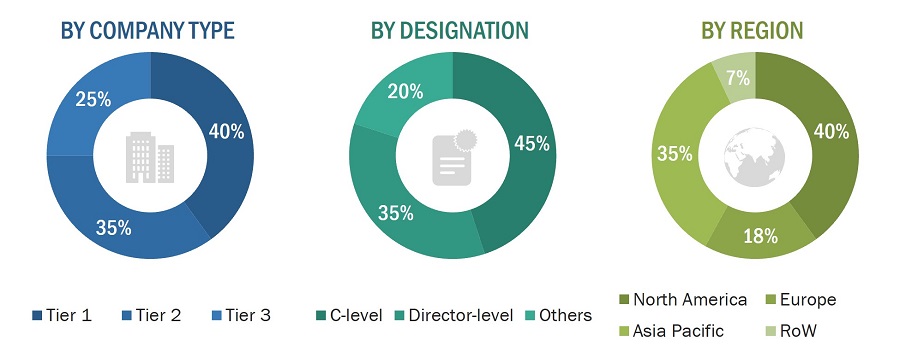
To know about the assumptions considered for the study, download the pdf brochure
Market Size Estimation
Multiple approaches were adopted to estimate and forecast the size of the IoT node and gateway market. The first approach involves estimation of the market size through summation of the revenues generated by companies through the sales of IoT node and gateway devices.
In this approach, all applications of IoT node and gateway market, such as industrial and consumer, have been considered. Different device types/products offered by various players were identified and their sales volume and average selling prices were estimated to derive the market numbers. This data was verified through primary research.
IoT Node and Gateway Market: Bottom-Up Approach
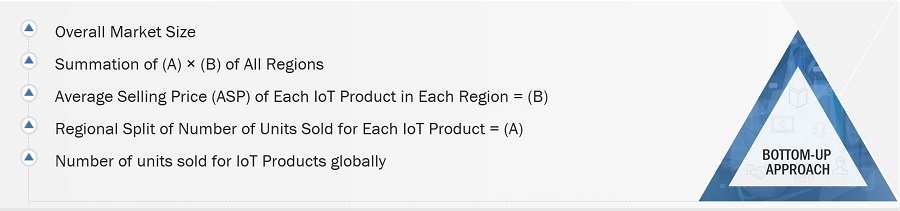
The bottom-up procedure was employed to arrive at the overall size of the IoT node and gateway market from revenues of the key players and their share in the market. The overall market size was calculated on the basis of the revenues of the key companies identified in the market.
IoT Node and Gateway Market: Top-Down Approach
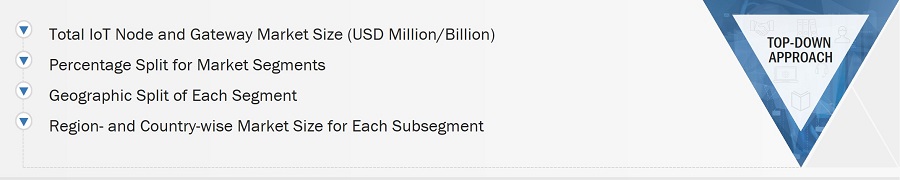
In the top-down approach, the overall size of the IoT node and gateway market was used to estimate the size of the individual markets (mentioned in the market segmentation) through percentage splits obtained from secondary and primary research. To calculate the size of the specific market segments, the size of the most appropriate parent market was used to implement the top-down approach. The bottom-up approach was also implemented for the data extracted from the secondary research to validate the size of various segments of the IoT node and gateway market.
The share of each company in the market was estimated to verify the revenue shares used earlier in the bottom-up approach. With the data triangulation procedure and the validation of data through primaries, sizes of the parent market and each individual market were determined and confirmed. The data triangulation procedure used for this study has been explained in the next section.
Data Triangulation
After arriving at the overall market size from the market size estimation process explained above, the total market was split into several segments and subsegments. Data triangulation and market breakdown procedures were employed, wherever applicable, to complete the overall market engineering process and arrive at the exact statistics for all segments and subsegments. The data was triangulated by studying various factors and trends from both demand and supply sides. Along with this, the market size was validated using both top-down and bottom-up approaches.
Market Definition
In the Internet of Things (IoT), a node refers to a device equipped with sensors, actuators, and processing capabilities, enabling it to collect, transmit, and receive data within a network. These nodes serve as endpoints for data generation and are typically deployed in various environments for monitoring and control purposes. On the other hand, a gateway acts as a bridge between IoT devices and external networks, facilitating communication, data aggregation, and protocol translation. Gateways play a crucial role in connecting IoT nodes to the internet or other networks, enabling centralized management, data analysis, and integration with cloud services or backend systems. IoT nodes and gateways form the backbone of interconnected systems, enabling the creation of smart environments, efficient data exchange, and intelligent decision-making.
Key Stakeholders
- Raw material and manufacturing equipment suppliers
- Semiconductor wafer vendors
- Fabless players
- Foundry players
- Original equipment manufacturers (OEMs)
- Original design manufacturers (ODM) and OEM technology solution providers
- Distributors and retailers
- Research organizations
- Technology standard organizations, forums, alliances, and associations
- Technology investors
- Operating system (OS) vendors
- Content providers
- Software providers
Report Objectives
- To define, describe, segment, and forecast the IoT node and gateway market size, in terms of value and volume, based on end-use application and hardware
- To forecast the market size, in terms of value, across North America, Europe, Asia Pacific, and the Rest of the World (RoW)
- To present detailed information regarding the major factors influencing the growth of the market (drivers, restraints, opportunities, and challenges)
- To provide an ecosystem analysis, case study analysis, patent analysis, technology analysis, ASP analysis, Porter’s Five Forces analysis, and regulations pertaining to the market.
- To offer a comprehensive overview of the value chain of the IoT node and gateway market ecosystem
- To critically analyze micromarkets1 with respect to individual growth trends, prospects, and contributions to the total market
- To strategically profile the key players and comprehensively analyze their market shares and core competencies.
- To assess the opportunities in the market for stakeholders and describe the competitive landscape of the market
- To analyze competitive developments, such as collaborations, agreements, partnerships, product developments, and research and development (R&D), in the market
- To evaluate the impact of the recession on the IoT node and gateway market
Available Customizations
With the given market data, MarketsandMarkets offers customizations according to the company’s specific needs. The following customization options are available for the report:
Company Information
- Detailed analysis and profiling of additional market players (up to 7)
Get the Full IoT Node and Gateway Market Report
Full forecast, segment splits, and company analysis for all IoT Node and Gateway Market.
Need a Tailored Report?
Customize this report to your needs
Get 10% FREE Customization
Customize This Report
