
South Korea In Vitro Diagnostics Market (2025-2030)

The South Korea In Vitro Diagnostics Market was valued at $727.6 Million in 2025 and projected to reach to $1026.8 Million by 2030, representing a compound annual growth rate of 7.1%. South Korea's in vitro diagnostics market is positioned for sustained growth driven by an aging population, increasing chronic disease prevalence, and the country's commitment to advanced healthcare delivery.


| Market Size in | USD 26.32 MN |
| Market Forecast in | |
| CAGR | |
| Forecast Period | |
| Units Considered | Value (USD MN) |
South Korea In Vitro Diagnostics Market Trends and Insights
- This 7.1% compound annual growth rate reflects South Korea's advanced healthcare infrastructure, high diagnostic adoption rates, and increasing prevalence of chronic diseases.
- South Korea's strong emphasis on preventive healthcare and early disease detection continues to drive demand for innovative diagnostic solutions across clinical laboratories, hospitals, and point-of-care settings. The South Korean IVD market benefits from robust technological innovation, significant government healthcare investments, and a population with high health awareness.
- South Korea's aging demographic profile and rising incidence of lifestyle-related diseases are key catalysts for market expansion through 2030.
- Additionally, South Korea's competitive manufacturing base and export capabilities position the country as a regional hub for diagnostic product development and distribution within Asia Pacific..
Key Market Statistics
- CAGR (2025-2030) 7.1% CAGR
- Market Size, 2025 ~USD 727.6 Million
- Forecast, 2030 ~USD 1026.8 Million
- Country South Korea
South Korea In Vitro Diagnostics Market Overview
Market Valuation & Growth :
South Korea's in vitro diagnostics market is valued at USD 727.6 million in 2025, with a projected CAGR of 7.1% through 2030, reaching USD 1,026.8 million. This growth trajectory reflects the country's robust healthcare spending and technological advancement.
Advanced Healthcare Infrastructure :
South Korea boasts one of Asia's most sophisticated healthcare systems with high diagnostic adoption rates. The country's emphasis on early disease detection and preventive medicine drives consistent demand for advanced IVD solutions and testing capabilities.
Chronic Disease Prevalence :
Rising incidence of chronic diseases including diabetes, cardiovascular conditions, and cancer in South Korea's aging population significantly increases the need for diagnostic testing. This demographic shift creates sustained market expansion opportunities for IVD manufacturers.
Preventive Healthcare Focus :
South Korea's strong cultural emphasis on preventive healthcare and regular health screenings supports high utilization of diagnostic tests. Government health initiatives and insurance coverage for preventive diagnostics further accelerate market penetration and accessibility.
South Korea In Vitro Diagnostics Market Dynamics
- The 7.1% CAGR reflects strong demand for molecular diagnostics, immunoassays, and point-of-care testing solutions across hospitals, diagnostic laboratories, and clinical settings. Key growth catalysts include technological innovation in diagnostic platforms, expanding healthcare insurance coverage, and rising consumer awareness of preventive health screening.
- South Korea's competitive healthcare market and emphasis on quality diagnostics create opportunities for both established players and innovative diagnostic solution providers to capture market share through advanced testing capabilities and improved patient outcomes..
Market Ecosystem
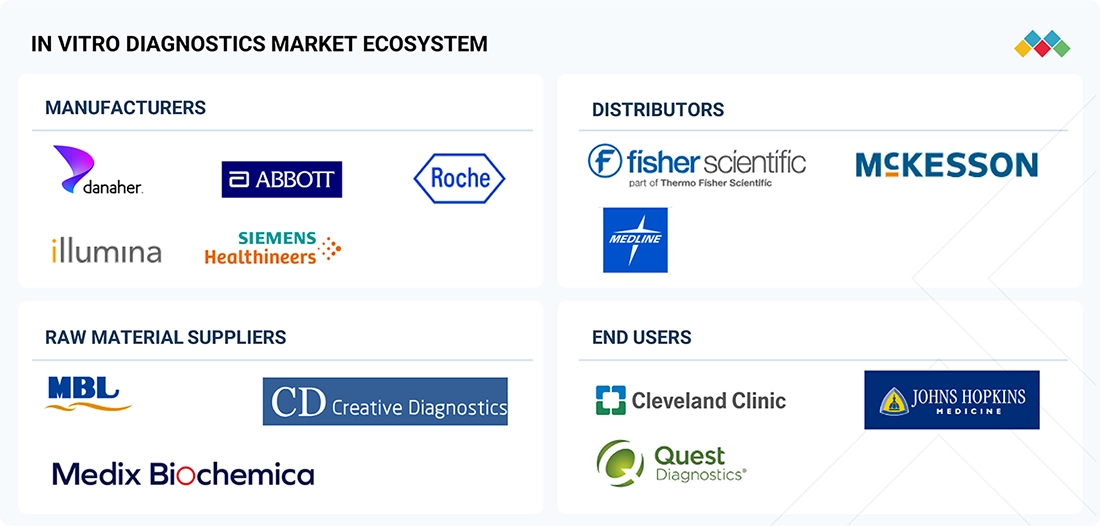
IN VITRO DIAGNOSTICS MARKET: GROWTH, SIZE, SHARE, AND TRENDS: COMMERCIAL USE CASES ACROSS INDUSTRIES
| COMPANY | USE CASE DESCRIPTION | BENEFITS |
|---|---|---|
 |
Use of cobas 4800 and cobas 5800/6800/8800 molecular systems for high-throughput viral load testing in centralized clinical laboratories. | High analytical accuracy, automated high-volume workflows, reduced turnaround time, and strong regulatory compliance supporting large-scale infectious disease testing. |
 |
Deployment of Alinity m analyzers for automated molecular detection of HIV, HBV, and HCV in medium- to high-throughput diagnostic settings. | Faster sample-to-result time, minimal manual intervention, consistent assay performance, and enhanced workflow efficiency in infectious disease diagnostics. |
 |
Utilization of GeneXpert systems for rapid, cartridge-based molecular testing in decentralized and point-of-care environments. | Quick results with minimal hands-on time, broad test menu across infectious diseases, high sensitivity, and strong suitability for low-resource or near-patient settings. |
 |
Use of the Atellica CI Analyzer for integrated clinical chemistry and immunoassay testing in hospital laboratories. | Improved operational efficiency, faster turnaround times, streamlined sample management, and flexible scalability to support medium-throughput labs. |
 |
Application of the NextSeq 550Dx instrument for high-throughput next-generation sequencing (NGS) in oncology and genetic testing. | High depth of sequencing, broad genomic coverage, faster analysis for complex mutations, and improved diagnostic precision in personalized medicine workflows. |
Logos and trademarks shown above are the property of their respective owners. Their use here is for informational and illustrative purposes only.
Related Ecosystem
In Vitro Diagnostics
- Polymerase Chain Reaction (PCR)
- Enzyme-Linked Immunosorbent Assay (ELISA)
- Dna Microarrays
- Assay Kits
- Microarrays
- ROCHE HOLDINGS AG
- Thermo Fisher Scientific Inc.
- Danaher Corporation
- Abbott Laboratories
- Biomerieux s.a.
Medical Devices
- Polymerase Chain Reaction (PCR)
- Magnetic Resonance Imaging (MRI)
- Disposable Autoinjectors
- Pulse Oximeters
- Blood Pressure Monitors
- Medtronic plc
- Stryker Corporation
- Abbott Laboratories
- Becton, Dickinson and Company
- JOHNSON & JOHNSON
Key Takeaways
- South Korea's IVD market is valued at USD 727.6 million in 2025 and will reach USD 1,026.8 million by 2030, growing at a 7.1% CAGR.
- South Korea's advanced healthcare system and high diagnostic penetration drive consistent demand for in vitro diagnostic products and services.
- South Korea's aging population and rising chronic disease burden are primary growth catalysts for the IVD market through 2030.
- South Korea serves as a regional manufacturing and innovation hub, strengthening its competitive position in the Asia Pacific IVD landscape.
In Vitro Diagnostics Market Report Scope
| Report Metric | Details |
|---|---|
| Base Year | 2025 |
| Fastest Growing Segment | MOLECULAR DIAGNOSTICS (Technology) |
| Forecast Period | 2025–2030 |
| Growth Rate | CAGR of 7.6% from 2025 to 2030 |
| Largest Segment | REAGENTS & KITS (Product & Service) |
| Market Size Base Year (Billions) | ~USD 109.29 (2025) |
| Revenue Forecast (Billions) | ~USD 157.63 (2030) |
| Segments Covered | Product & Service, Technology, Type, Specimen, Test Type, Application, End User |
South Korea In Vitro Diagnostics Market Report Segmentation
7 segment dimensions are covered across the global market.
By Product & Service
- Data Management Software & Services
- Data Management Software And Services
- Instruments
- Reagents & Kits
By Technology
- Blood Gas Analyzers
- Chromatography & Mass Spectrometry
- Clinical Chemistry
- Coagulation & Hemostasis
- Glucose Monitoring
- Hematology
- Immunoassays
- Microbiology
- Molecular Diagnostics
- Urinalysis
By Type
- Basic Metabolic Panels
- Chemiluminescence Immunoassays
- Dna Microarrays
- Dna Sequencing & Next-Generation Sequencing (Ngs)
- Electrolyte Panels
- Enzyme-Linked Immunosorbent Assays (Elisa)
- Enzyme-Linked Immunospot Assays (Elispot)
- Immunofluorescence Assays
- In Situ Hybridization (Ish)
- Isothermal Nucleic Acid Amplification Technology (Inaat)
- Large Reference Laboratories
- Lipid Profiles
- Liver Panels
- Other Immunoassay Technologies
- Other Molecular Diagnostic Technologies
- Polymerase Chain Reaction (Pcr)
- Rapid Tests
- Renal Profiles
- Small & Medium-Sized Laboratories
- Specialty Chemical Tests
- Thyroid Function Profiles
- Western Blotting
By Specimen
- Blood, Serum, And Plasma Specimens
- Other Specimens
- Saliva Specimens
- Urine Specimens
By Test Type
- Laboratory Test
- Laboratory Tests
- Point-Of-Care Tests
By Application
- Allergy Diagnostics
- Autoimmune Diseases
- Blood Group Typing
- Blood Screening
- Bone & Mineral Disorders
- Cardiology
- Coagulation Testing
- Drug Monitoring & Testing
- Endocrinology
- Genetic Testing
- Infectious Diseases
- Oncology
- Other Applications
By End User
- Academic Institutes
- Blood Banks
- Clinical Laboratories
- Home Care Settings
- Hospitals & Clinics
- Other End Users
- Pharmaceutical & Biotechnology Companies
Target Audience
- IVD Manufacturers & Diagnostics Companies : Manufacturers need South Korea-specific market data to assess market opportunity, plan product launches, and develop competitive strategies. Understanding local market dynamics, growth rates, and customer segments is critical for successful market penetration and revenue growth.
- Healthcare Investors & Private Equity : Investors require detailed market analysis to evaluate investment opportunities in South Korea's growing diagnostic sector. Market sizing, growth projections, and competitive landscape data inform investment decisions and portfolio allocation in the healthcare diagnostics space.
- Hospital & Laboratory Administrators : Healthcare facility leaders need market insights to optimize diagnostic service offerings, evaluate equipment investments, and benchmark performance against market trends. Understanding market growth and emerging technologies helps improve operational efficiency and patient care quality.
- Regulatory & Policy Makers : Government agencies and healthcare policymakers use market data to develop informed healthcare policies, reimbursement strategies, and regulatory frameworks. Market intelligence supports evidence-based decision-making for healthcare system improvements and diagnostic accessibility.
- Consultants & Business Strategists : Strategy consultants advising healthcare clients require comprehensive South Korea market data to develop business plans, competitive strategies, and market recommendations. Detailed market insights enable credible client advisory and strategic planning in the diagnostic sector.
Key Companies in the South Korea In Vitro Diagnostics Market
| Company | HQ | Ownership | Strongest segments |
|---|---|---|---|
| CEPHEID INC. | United States | Private Company | Kits / Assays (Xpert test cartridges),Instruments (GeneXpert, SmartCycler),Services & Other (service contracts, collaborations), |
| AT&S | Austria | Public Company | Kits (including cartridges and consumables manufacturing systems),Instruments (analyzers and device manufacturing systems),Software & digital factory solutions for IVD plants, |
| IMMUCOR, INC. | United States | Private Company | Transfusion serology reagents (manual and Capture),Automated serology instruments (NEO, Echo, Capture Workstation),Transplant & molecular assays (HEA/HPA typing, Array Imaging System, BASIS), |
| UNILABS | Switzerland | Private Company | Kits (consumed in internal labs and managed services),Instruments (installed base within owned and in-house labs),IVD Service Revenue (testing, reporting, and clinical trial support), |
| EIKEN CHEMICAL CO., LTD. | Japan | Public Company | Kits & Reagents (microbiology, FIT, immunology, serology, urinalysis, clinical chemistry),Instruments & Automated Analyzers, |
| DANAHER | United States | Public Company | Kits & Consumables,Instruments,Software & Services, |
| ABBOTT | United States | Public Company | Kits & Reagents,Instruments (Core Lab & Hematology),Glucose Monitoring Systems, |
| SIEMENS HEALTHINEERS AG | Germany | Public Company | Kits & Reagents,Instruments (Core Lab Analyzers and Hematology Systems),Point-of-Care and Glucose Monitoring, |
| THERMO FISHER SCIENTIFIC INC. | United States | Public Company | Kits & Reagents,Instruments & Analyzers,Services & Others (IVD-related), |
| ILLUMINA, INC. | United States | Public Company | Sequencing instruments,Sequencing consumables (reagents, flow cells),Library preparation and targeted/whole-genome kits, |
| HOLOGIC, INC. | United States | Private Company | Molecular infectious disease and women’s health assays (Aptima portfolio),Cytology and cervical cancer screening (ThinPrep and related solutions),Other diagnostic assays and instruments (including viral load, SARS-CoV-2, and fetal fibronectin), |
| BIO-RAD LABORATORIES, INC. | United States | Public Company | Kits & Reagents (including QC),Instruments & Systems,Informatics & Software / Services, |
| BIOMÉRIEUX | France | Public Company | Kits & Reagents (including panels, media, CLIA, PCR, AST strips),Instruments & Systems (BACT/ALERT, BIOFIRE platforms, VITEK, VIDAS, CHEMUNEX, TEMPO),Software, Services & Lab Consultancy, |
| SYSMEX CORPORATION | Japan | Public Company | Hematology instruments,Hematology reagents and consumables,Coagulation and hemostasis, |
| REVVITY | United States | Public Company | Kits & Reagents,Instruments & Analyzers,Software, Subscriptions & Services, |
| BECTON, DICKINSON AND COMPANY | United States | Public Company | Kits & Reagents (including microbiology media, TB, infectious disease assays),Instruments & Lab Automation (microbiology, blood culture, identification/susceptibility, flow cytometry),Specimen & Blood Collection Systems, |
| AGILENT TECHNOLOGIES, INC. | United States | Public Company | Instruments (analyzers, LC/MS, pathology platforms),Kits, reagents, and consumables,Services, software, and informatics (CrossLab, OpenLab), |
| QIAGEN | Netherlands | Public Company | Kits & Consumables (sample technologies, immune response, oncology, infectious disease assays),Instruments (nucleic acid purification, PCR, digital PCR, integrated sample-to-insight systems),Bioinformatics & SaaS (NGS analysis, interpretation, forensic genealogy services), |
| DIASORIN S.P.A. | Italy | Public Company | Immunoassay Kits (LIAISON menu across infectious disease, endocrinology, oncology),Immunoassay Instruments (LIAISON XL, LIAISON XS),Molecular Diagnostics Kits (Simplexa, LIAISON PLEX assays, xMAP-based IVD), |
CEPHEID INC.
Cepheid Inc. is a private U.S. company founded in 1996 with 1,700 employees. The company develops molecular diagnostics and point-of-care testing systems.
AT&S
AT&S is a publicly traded Austrian company founded in 1978 with 7,000 employees. The company manufactures printed circuit boards and electronics components.
IMMUCOR, INC.
Immucor, Inc. is a private U.S. company established in 1982 with 1,125 employees. The company develops immunohematology and transfusion diagnostics products.
UNILABS
Unilabs is a private Swiss company established in 1987 with 1,897 employees. The company provides clinical laboratory and diagnostic testing services.
EIKEN CHEMICAL CO., LTD.
Eiken Chemical Co., Ltd. is a publicly traded Japanese company founded in 1939 with 696 employees. The company manufactures diagnostic reagents and chemical products.
DANAHER
Danaher is a publicly traded U.S. company founded in 1969 with 59,000 employees. The company operates a diversified portfolio of businesses in diagnostics, life sciences, and environmental solutions.
ABBOTT
Abbott is a publicly traded U.S. company founded in 1888 with 115,000 employees. The company develops and manufactures pharmaceuticals, diagnostics, medical devices, and nutritional products.
SIEMENS HEALTHINEERS AG
Siemens Healthineers AG is a publicly traded German company founded in 1896 with 72,369 employees. The company provides medical imaging, laboratory diagnostics, and healthcare IT solutions.
THERMO FISHER SCIENTIFIC INC.
Thermo Fisher Scientific Inc. is a publicly traded U.S. company founded in 1956 with 125,000 employees. The company supplies life sciences, analytical instruments, reagents, and laboratory services globally.
ILLUMINA, INC.
Illumina, Inc. is a publicly traded U.S. company founded in 1998 with 8,625 employees. The company develops and manufactures DNA sequencing and genetic analysis systems.
HOLOGIC, INC.
Hologic, Inc. is a private U.S. company founded in 1985 with 7,070 employees. The company develops medical devices and diagnostics for women's health and oncology.
BIO-RAD LABORATORIES, INC.
Bio-Rad Laboratories, Inc. is a publicly traded U.S. company founded in 1952 with 7,450 employees. The company manufactures clinical diagnostics, life science research products, and quality control systems.
BIOMÉRIEUX
bioMérieux is a publicly traded French company founded in 1963 with 14,894 employees. The company develops in vitro diagnostics and microbiology testing solutions.
SYSMEX CORPORATION
Sysmex Corporation is a publicly traded Japanese company founded in 1968 with 10,861 employees. The company manufactures hematology, hemostasis, and clinical chemistry diagnostic systems.
REVVITY
Revvity is a publicly traded U.S. company founded in 1937 with 11,000 employees. The company provides analytical instruments, software, and services for life sciences and diagnostics.
BECTON, DICKINSON AND COMPANY
Becton, Dickinson and Company is a publicly traded U.S. company founded in 1897 with 72,000 employees. The company manufactures medical devices, diagnostics, and laboratory equipment.
AGILENT TECHNOLOGIES, INC.
Agilent Technologies, Inc. is a publicly traded U.S. company founded in 1999 with 18,000 employees. The company develops analytical instruments, software, and services for life sciences and diagnostics.
QIAGEN
QIAGEN is a publicly traded Dutch company founded in 1984 with 5,500 employees. The company develops molecular diagnostics, sample preparation, and life sciences research products.
DIASORIN S.P.A.
DiaSorin S.p.A. is a publicly traded Italian company founded in 1968 with 3,242 employees. The company manufactures immunodiagnostic and molecular diagnostic systems.
Reasons to Buy this Report
- Market Size & Growth Validation : Obtain precise market valuation data for South Korea's IVD sector with verified CAGR projections through 2030. Validate investment decisions and business expansion strategies with credible market sizing and growth forecasts specific to the Korean market.
- Competitive Landscape Intelligence : Understand South Korea's unique competitive dynamics, regulatory environment, and market structure. Identify key players, market consolidation trends, and opportunities for differentiation in this advanced healthcare market with high diagnostic adoption rates.
- Strategic Market Entry Planning : Develop informed market entry or expansion strategies for South Korea with detailed insights into healthcare infrastructure, reimbursement policies, and customer preferences. Reduce market entry risks through comprehensive understanding of local market conditions and growth drivers.
- Investment & Partnership Opportunities : Identify high-potential investment targets, partnership opportunities, and acquisition candidates within South Korea's growing IVD sector. Leverage market data to evaluate business viability and growth potential in this technologically advanced healthcare market.
- Product Development & Localization : Guide product development and localization strategies tailored to South Korea's healthcare needs, regulatory requirements, and customer preferences. Align R&D investments with market demand for specific diagnostic solutions and emerging healthcare trends in Korea.
Frequently asked questions
What is the current size of South Korea's in vitro diagnostics market?
South Korea's in vitro diagnostics market is valued at USD 727.6 million in 2025 and is expected to grow to USD 1,026.8 million by 2030.
What is the projected growth rate for South Korea's IVD market?
South Korea's IVD market is projected to grow at a compound annual growth rate (CAGR) of 7.1% from 2025 to 2030.
What factors are driving growth in South Korea's IVD market?
Key growth drivers in South Korea include an aging population, rising prevalence of chronic diseases, advanced healthcare infrastructure, strong government healthcare investments, and high diagnostic adoption rates.
How does South Korea's IVD market compare to other Asia Pacific countries?
South Korea maintains a competitive position in Asia Pacific due to its advanced healthcare system, technological innovation capabilities, and established manufacturing base for diagnostic products.
What diagnostic segments are most prominent in South Korea?
South Korea's IVD market encompasses clinical chemistry, immunoassays, molecular diagnostics, hematology, and point-of-care testing, with strong adoption across hospitals, clinical laboratories, and diagnostic centers.
RESEARCH METHODOLOGY
This study involved the extensive use of primary and secondary sources. A comprehensive study was conducted using secondary research methods to gather data about the market, its parent market, and its peer markets. The next stage involved conducting primary research to confirm these conclusions and assumptions and sizing with industry experts throughout the value chain. A combination of top-down and bottom-up methods was used to assess the overall market size. The market sizes of segments and subsegments were then estimated using data triangulation techniques and market breakdown.
Secondary Research
The secondary research process involves the widespread use of secondary sources, directories, databases (such as Bloomberg Businessweek, Factiva, and D&B Hoovers), white papers, annual reports, investor presentations, SEC filings of companies and publications from government sources [such as National Institutes of Health (NIH), US FDA, US Census Bureau, World Health Organization (WHO), International Trade Administration (ITA), American Association for Clinical Chemistry (AACC), American Diabetes Association (ADA), Association for Molecular Pathology (AMP) and Centers for Medicare and Medicaid Services (CMS) were referred to identify and collect information for the global in vitro diagnostics market study. It was also used to obtain important information about the key players and market classification & segmentation according to industry trends to the bottom-most level and key developments related to market and technology perspectives. A database of the key industry leaders was also prepared using secondary research.
Primary Research
In the primary research process, various sources from the supply and demand sides were interviewed to obtain qualitative and quantitative information for this report. The primary sources from the supply side include industry experts such as CEOs, vice presidents, marketing and sales directors, technology & innovation directors, and related key executives from various key companies and organizations in the in vitro diagnostics market. The primary sources from the demand side include hospitals & clinics, clinical laboratories, blood banks, pharmaceutical and biotechnology companies, and academic institutes. Primary research was conducted to validate the market segmentation, identify key players, and gather insights on key industry trends & key market dynamics.
A breakdown of the primary respondents is provided below:
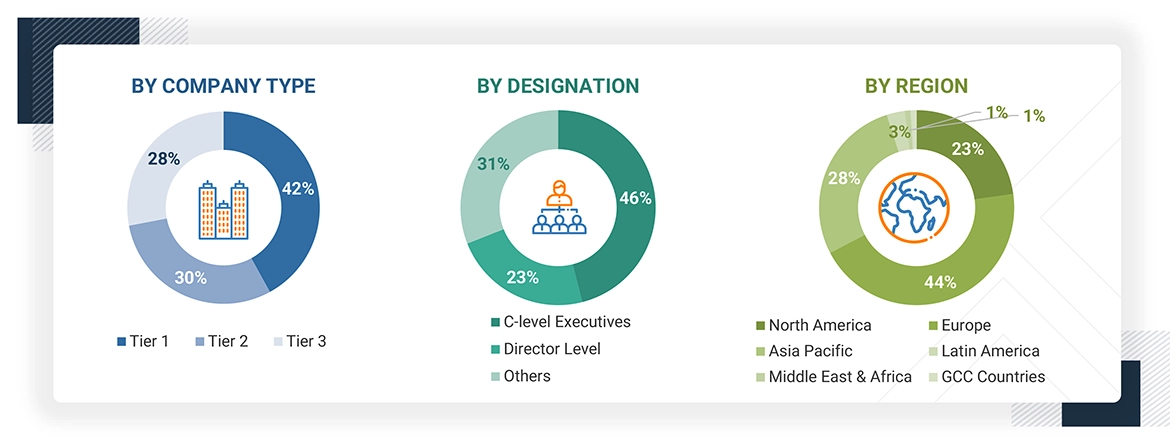
Note 1: C-level primaries include CEOs, CFOs, COOs, and VPs.
Note 2: Other designations include sales managers, marketing managers, business development managers, product managers, distributors, and suppliers.
Note 3: Tiers are defined based on a company’s total revenue. As of 2023, Tier 1= >USD 10 billion, Tier 2 = USD 1 billion to USD 10 billion, and Tier 3 = < USD 1 billion.
To know about the assumptions considered for the study, download the pdf brochure
Market Size Estimation
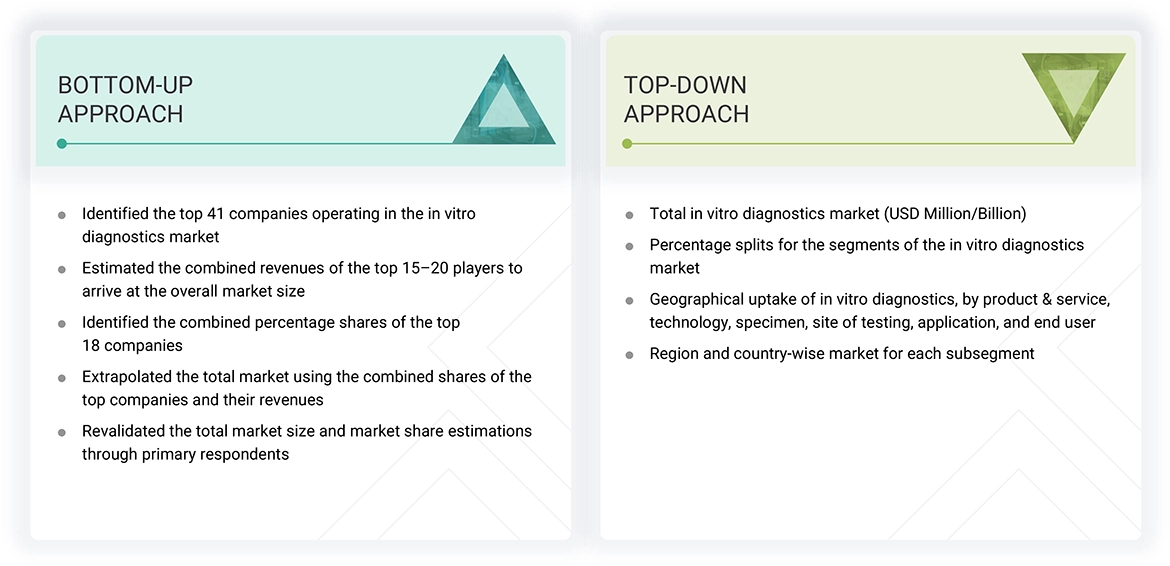
For the global market value, annual revenues were calculated based on the revenue mapping of major product manufacturers and OEMs active in the global in vitro diagnostics market. All the major product manufacturers were identified at the global and/or country/regional level. Revenue mapping for the respective business segments/subsegments was done for the major players. The global in vitro diagnostics market was split into various segments and sub-segments based on:
- List of major players operating in the products market at the regional and/or country level.
- Product mapping of various in vitro diagnostics manufacturers at the regional and/or country level.
- Mapping of annual revenue generated by listed major players from in vitro diagnostics (or the nearest reported business unit/product category).
- Extrapolation of the revenue mapping of the listed major players to derive the global market value of the respective segments/subsegments.
- Summation of the market value of all segments/subsegments to arrive at the global in vitro diagnostics market.
The above-mentioned data was consolidated and added with detailed inputs and analysis from MarketsandMarkets and presented in this report.
Market Size Estimation (Bottom-up Approach & Top-down Approach)
Data Triangulation
After arriving at the overall size of the global in vitro diagnostics market through the above-mentioned methodology, this market was split into several segments and subsegments. Where applicable, the data triangulation and market breakdown procedures were employed to complete the overall market engineering process and arrive at the exact market value data for the key segments and subsegments. Examining several macro variables and regional trends from demand- and supply-side players helped triangulate the extrapolated market data.
Market Definition
IVD tests are non-invasive tests performed to diagnose, monitor, screen, and assess diseases and health conditions. The term "in vitro," which refers to "in glass," signifies that test tubes or petri dishes are typically used in these tests. These tests are performed artificially on biological samples (blood, urine, and tissues). IVD has a broad scope ranging from sophisticated technologies performed in clinical laboratories to simple and easy-to-use rapid testing kits.
IVD is used to assess a person's health. This technique is used in precision medicine to determine the suitable course of treatment for particular patients and diagnose and prevent diseases and other medical disorders.
Stakeholders
- Transfection products manufacturing companies
- Pharmaceutical & Biopharmaceutical Companies
- Chemical Companies
- Biopharmaceutical Companies
- Contract Research Organizations (CROs)
- Contract Development and Manufacturing Organizations (CDMOs)
- Research Institutes and Universities
- Venture Capitalists & Investors
- Government Associations
Report Objectives
- To define, describe, and forecast the in vitro diagnostics (IVD) market based on product & service, technology, specimen, site of testing, application, end user, and region.
- To provide detailed information regarding the major factors influencing the market growth (such as drivers, restraints, opportunities, and industry-specific challenges).
- To assess the in vitro diagnostics market with respect to Porter’s Five Forces, regulatory landscape, the value chain, the supply chain, ecosystem analysis, patent protection, pricing assessment, key stakeholders, and buying criteria.
- To strategically analyze micromarkets with respect to individual growth trends, prospects, and contributions to the overall market.
- To analyze the opportunities in the IVD market for stakeholders and provide details of the competitive landscape for market leaders.
- To forecast the size of the IVD market in six primary regions (along with countries)—North America, Europe, the Asia Pacific, Latin America, the Middle East & Africa, and the GCC Countries.
- To profile the key players operating in the IVD market and comprehensively analyze their core competencies and market shares.
- To track and analyze competitive developments such as partnerships, agreements, collaborations, acquisitions, expansions, product/technology developments, and product approvals.
- To benchmark players within the IVD market using the Company Evaluation Quadrant framework, which analyzes market players on various parameters within categories of business strategies, market share, and product offerings.
Get the Full In Vitro Diagnostics Market Report
Full forecast, segment splits, and company analysis for all In Vitro Diagnostics Market.
- Canada In Vitro Diagnostics Market
- US In Vitro Diagnostics Market
- Germany In Vitro Diagnostics Market
- France In Vitro Diagnostics Market
- UK In Vitro Diagnostics Market
- Italy In Vitro Diagnostics Market
- Spain In Vitro Diagnostics Market
- Russia In Vitro Diagnostics Market
- Switzerland In Vitro Diagnostics Market
- Japan In Vitro Diagnostics Market
- China In Vitro Diagnostics Market
- India In Vitro Diagnostics Market
- Australia In Vitro Diagnostics Market
- Singapore In Vitro Diagnostics Market
- Brazil In Vitro Diagnostics Market
- Mexico In Vitro Diagnostics Market
- Saudi Arabia In Vitro Diagnostics Market
- UAE In Vitro Diagnostics Market
Need a Tailored Report?
Customize this report to your needs
Get 10% FREE Customization
Customize This Report
