
South Africa Kombucha Market (2024-2029)

The South Africa Kombucha Market was valued at $18.47 Million in 2024 and projected to reach to $29.77 Million by 2029, representing a compound annual growth rate of 10.0%. South Africa's kombucha market is poised for sustained growth as consumer awareness of functional beverages and health benefits continues to rise.


| Market Size in | USD 26.32 MN |
| Market Forecast in | |
| CAGR | |
| Forecast Period | |
| Units Considered | Value (USD MN) |
South Africa Kombucha Market Trends and Insights
- This represents a compound annual growth rate (CAGR) of 10.0%, reflecting growing consumer interest in functional beverages and health-conscious alternatives across South Africa.
- The market expansion in South Africa is driven by increasing awareness of gut health benefits, rising disposable incomes, and a shift toward premium wellness products among urban consumers. The kombucha sector in South Africa is characterized by a mix of local artisanal producers and international brands entering the market.
- South Africa's beverage industry is increasingly recognizing kombucha as a high-potential category within the functional drinks segment.
- Between 2024 and 2029, South Africa is expected to see enhanced distribution channels, including retail expansion and e-commerce penetration, supporting market accessibility.
- Consumer preferences in South Africa are evolving toward natural, fermented, and probiotic-rich beverages, positioning kombucha as a key growth opportunity in the country's health and wellness sector..
Key Market Statistics
- CAGR (2024-2029) 10.0% CAGR
- Market Size, 2024 ~USD 18.47 Million
- Forecast, 2029 ~USD 29.77 Million
- Country South Africa
South Africa Kombucha Market Overview
Market Valuation :
South Africa's kombucha market is valued at USD 18.47 million in 2024, with strong growth trajectory positioning it as a key emerging market in the African beverage sector.
Growth Rate :
The South African kombucha market is expanding at a CAGR of 10.0% from 2024 to 2029, outpacing many traditional beverage categories and reflecting shifting consumer preferences toward functional drinks.
Market Forecast :
By 2029, South Africa's kombucha market is projected to reach USD 29.77 million, representing a 61.3% increase over the five-year forecast period as health-conscious consumption accelerates.
Consumer Trends :
Growing awareness of functional beverages and wellness-driven purchasing behavior among South African consumers is driving market expansion, particularly in urban centers and among younger demographics.
South Africa Kombucha Market Dynamics
- The market's 10% CAGR reflects increasing adoption among health-conscious consumers seeking alternatives to sugary soft drinks and conventional beverages.
- Urban centers and affluent consumer segments are leading adoption, with growing distribution through retail channels and specialty health stores. The forecast period through 2029 presents significant opportunities for market entrants and established players to capture growing demand.
- Rising disposable incomes, expanding retail infrastructure, and increasing availability of locally-produced kombucha brands are expected to accelerate market penetration.
- However, competition from other functional beverages and price sensitivity among broader consumer segments may moderate growth rates compared to global markets..
Market Ecosystem
Related Ecosystem
Consumer Fandb
- Bakery Products
- Animal-Based Sealants
- Dairy Products
- Actuators
- Azo Pigments
- AZELIS HOLDINGS SA
- VENTURA FOODS, LLC
- Amway
- UNILEVER PLC
- Nestle s.a
Key Takeaways
- South Africa's kombucha market is valued at USD 18.47 million in 2024 and will grow to USD 29.77 million by 2029, representing a 10.0% CAGR.
- South Africa's market growth is driven by increasing consumer awareness of gut health, wellness trends, and demand for functional beverages among health-conscious demographics.
- South Africa's kombucha sector features both local artisanal producers and international brands, creating a competitive landscape with diverse product offerings.
- Distribution expansion through retail channels and e-commerce platforms is expected to accelerate kombucha accessibility and market penetration across South Africa.
Kombucha Market Report Scope
| Report Metric | Details |
|---|---|
| Base Year | 2024 |
| Fastest Growing Segment | HARD (Product Type) |
| Forecast Period | 2024-2029 |
| Growth Rate | CAGR of 19.4% from 2024 to 2029 |
| Largest Segment | CONVENTIONAL (Product Type) |
| Market Size Base Year (Billions) | ~USD 2.43 (2024) |
| Revenue Forecast (Billions) | ~USD 5.9 (2029) |
| Segments Covered | Type, Nature, Product Type, Packaging Type, Distribution Channel, Application |
South Africa Kombucha Market Report Segmentation
6 segment dimensions are covered across the global market.
By Type
- Flavored
- Natural
- Other Yeast Derivatives*
- Yeast Autolysates
- Yeast Beta-Glucan
- Yeast Extracts
- -Apple
- -Berries
- -Citrus
- -Flowers
- -Herbs & Spices
- -Other Flavors
By Nature
- Inorganic
- Organic
By Product Type
- Conventional
- Hard
By Packaging Type
- Bottle
- Bottles
- Can
- Cans
By Distribution Channel
- Convenience Stores
- Online Retailers
- Other Distribution Channels
- Specialist Stores
- Supermarkets/Hypermarkets
By Application
- Alcoholic & Non-Alcoholic Beverages
- Dairy & Dairy Products
- Meat & Seafood
- Other Applications*
Target Audience
- Beverage Manufacturers : Kombucha producers and beverage companies need South Africa-specific market data to evaluate expansion opportunities, understand local production requirements, and develop products aligned with regional consumer preferences.
- Retail & Distribution Partners : Retailers, distributors, and wholesalers require detailed market insights to assess shelf space allocation, inventory planning, and partnership opportunities with kombucha brands in the growing South African market.
- Investment & Private Equity : Investors and PE firms evaluating opportunities in South Africa's functional beverage sector need comprehensive market data to assess growth potential, competitive dynamics, and return on investment projections.
- Marketing & Brand Strategists : Marketing professionals and brand managers need South Africa-specific consumer insights, competitive positioning data, and trend analysis to develop effective go-to-market strategies and brand differentiation approaches.
- Market Research & Consultants : Research firms and business consultants require detailed South African market data to support client advisory services, competitive analysis, and strategic recommendations for beverage industry stakeholders.
Reasons to Buy this Report
- Market Entry Strategy : Gain detailed insights into South Africa's kombucha market dynamics to develop targeted entry strategies, identify key distribution channels, and understand local consumer preferences specific to the South African market.
- Competitive Landscape Analysis : Understand the competitive positioning of local and international kombucha brands operating in South Africa, identify market gaps, and benchmark against regional competitors to inform product development and marketing strategies.
- Consumer Segmentation : Access detailed demographic and psychographic data on South African kombucha consumers, including purchasing behaviors, price sensitivity, and brand preferences to optimize targeting and messaging for this specific market.
- Growth Opportunity Assessment : Evaluate the 10% CAGR growth trajectory and USD 29.77M market forecast for South Africa to assess investment potential, identify high-growth segments, and prioritize resource allocation for market expansion initiatives.
- Regulatory & Distribution Insights : Obtain market-specific information on South African regulatory requirements, retail distribution networks, and supply chain considerations essential for successful market entry and operational planning.
Frequently asked questions
What is the current size of the kombucha market in South Africa?
South Africa's kombucha market was valued at USD 18.47 million in 2024 and is projected to reach USD 29.77 million by 2029.
What is the expected growth rate for kombucha in South Africa?
South Africa's kombucha market is expected to grow at a compound annual growth rate (CAGR) of 10.0% from 2024 to 2029.
What factors are driving kombucha market growth in South Africa?
Key drivers in South Africa include rising consumer awareness of gut health benefits, increasing disposable incomes, growing wellness trends, and demand for natural, probiotic-rich beverages among urban consumers.
Who are the main players in South Africa's kombucha market?
South Africa's kombucha market comprises local artisanal producers and international brands, creating a diverse competitive landscape with varied product offerings and price points.
How is distribution evolving in South Africa's kombucha market?
South Africa's kombucha distribution is expanding through traditional retail channels and e-commerce platforms, improving product accessibility and market penetration across the country.
RESEARCH METHODOLOGY
The study involved four major activities in estimating the current size of the kombucha market. Exhaustive secondary research was done to collect information on the market, peer market, and parent market. The next step was to validate these findings, assumptions, and sizing with industry experts across the value chain through primary research. Both top-down and bottom-up approaches were employed to estimate the complete market size. After that, market breakdown and data triangulation were used to estimate the market size of segments and subsegments.
Secondary Research
This research study involved the extensive use of secondary sources—directories and databases such as Bloomberg Businessweek and Factiva—to identify and collect information useful for a technical, market-oriented, and commercial study of the kombucha market.
In the secondary research process, various sources such as annual reports, press releases & investor presentations of companies, white papers, certified publications, articles from recognized authors, gold & silver standard websites, directories, and databases were referred to identify and collect information. This research study involved the extensive use of secondary sources—directories and databases such as Bloomberg Businessweek and Factiva—to identify and collect information useful for a technical, market-oriented, and commercial study of the kombucha market.
Secondary research was mainly used to obtain key information about the industry’s supply chain, the total pool of key players, and market classification and segmentation as per the industry trends to the bottom-most level, regional markets, and key developments from both market- and technology-oriented perspectives.
Primary Research
Extensive primary research was conducted after obtaining information regarding the kombucha market scenario through secondary research. Several primary interviews were conducted with market experts from both the demand and supply sides across major countries of North America, Europe, Asia Pacific, the Middle East & Africa, and South America. Primary data was collected through questionnaires, emails, and telephonic interviews. The primary sources from the supply side included various industry experts, such as Chief X Officers (CXOs), Vice Presidents (VPs), Directors from business development, marketing, research, and development teams, and related key executives from distributors and key opinion leaders. Primary interviews were conducted to gather insights such as market statistics, data on revenue collected from the products and services, market breakdowns, market size estimations, market forecasting, and data triangulation. Primary research also helped in understanding the various trends related to product type, type, by nature, packaging, by distribution channels and region.
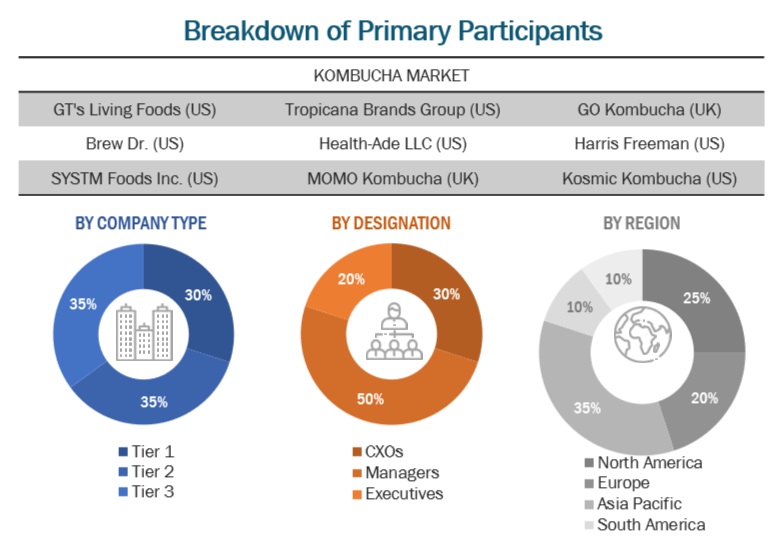
To know about the assumptions considered for the study, download the pdf brochure
Kombucha Market Size Estimation
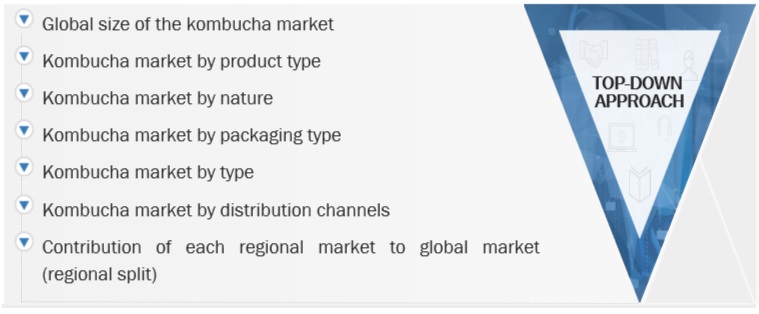
Both the top-down and bottom-up approaches were used to estimate and validate the total size of the kombucha market. These approaches were also used extensively to estimate the size of various dependent submarkets. The research methodology used to estimate the market size includes the following:
- Key players were identified through extensive secondary research.
- The industry’s value chain and market size were determined through primary and secondary research.
- All percentage share splits and breakdowns were determined using secondary sources and verified through primary sources.
- All the possible parameters that affect the markets covered in this research study were accounted for, viewed in extensive detail, verified through primary research, and analyzed to obtain the final quantitative and qualitative data.
- The following figure provides an illustrative representation of the complete market size estimation process implemented in this research study for an overall estimation of the kombucha market in a consolidated format.
The following sections (bottom-up & top-down) depict the overall market size estimation process employed for the purpose of this study.
Global Kombucha Market Bottom-Up Approach
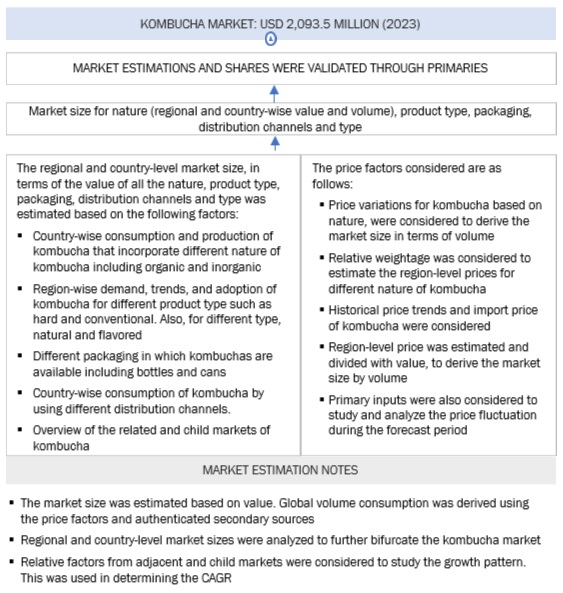
To know about the assumptions considered for the study, Request for Free Sample Report
Global Kombucha Market Top-Down Approach
Data Triangulation
After arriving at the overall market size from the estimation process explained above, the total market was split into several segments and subsegments. Data triangulation and market breakdown procedures were employed, wherever applicable, to estimate the overall kombucha market and arrive at the exact statistics for all segments and subsegments. The data was triangulated by studying various factors and trends from the demand and supply sides. Along with this, the market size was validated using both the top-down and bottom-up approaches.
Market Definition
Kombucha is an ancient tea-based beverage that is referred to as a healing tonic. It originated in China and has been known as the immortal health elixir for years. The main ingredients used in the manufacturing of kombucha are tea, sugar, water, and kombucha culture. Kombucha culture can include SCOBY, molds, enzymes, and other microbes; SCOBY is a Symbiotic Colony of Bacteria and Yeast. After the fermentation process, Kombucha becomes carbonated and contains vinegar, numerous beneficial acids, probiotics, amino acids, vitamins, and antioxidants. A variety of flavors can be added to add different tastes to the drink.
Key Stakeholders
- Government and Research Organizations
- Associations and Industrial Bodies
- Kombucha Manufacturers
- Kombucha Traders, Distributors, and Suppliers
- Beverage Manufacturers and Suppliers
- Live Science Laboratories and Institutes
- Government, Legislative, and Regulatory Bodies
- Consumers
Kombucha Market Report Objectives
Market Intelligence
- Determining and projecting the size of the kombucha market with respect to product type, type, nature, packaging, and region.
- Identifying the attractive opportunities in the market by determining the largest and fastest-growing segments
- Providing detailed information about the key factors influencing the market growth (drivers, restraints, opportunities, and industry-specific challenges)
- Providing the regulatory framework and market entry process related to the kombucha market
- Analyzing the micro markets with respect to individual growth trends, prospects, and their contribution to the total market
Competitive Intelligence
- Identifying and profiling the key players in the kombucha market
-
Providing a comparative analysis of market leaders based on the following:
- Product offerings
- Business strategies
- Strengths and weaknesses
- Key financials
- Understanding the competitive landscape and identifying the major growth strategies adopted by players across the country
- Providing insights on key product innovations and investments in the kombucha market
Available Customizations:
With the given market data, MarketsandMarkets offers customizations according to company-specific scientific needs.
The following customization options are available for the report:
Product Analysis
- Product Matrix, which gives a detailed comparison of the product portfolio of each company.
Geographic Analysis
With the given market data, MarketsandMarkets offers customizations according to company-specific scientific needs.
- Further breakdown of the Rest of Europe into Netherlands, Poland, and other EU & non-EU countries
- Further breakdown of the Rest of Asia Pacific into Indonesia, Vietnam, and Republic of Korea.
- Further breakdown of the Rest of South America into Colombia, Paraguay, Peru, and other South American countries
Company Information
- Detailed analyses and profiling of additional market players (up to five)
Get the Full Kombucha Market Report
Full forecast, segment splits, and company analysis for all Kombucha Market.
- US Kombucha Market
- Canada Kombucha Market
- Mexico Kombucha Market
- France Kombucha Market
- Germany Kombucha Market
- Italy Kombucha Market
- Spain Kombucha Market
- UK Kombucha Market
- China Kombucha Market
- Japan Kombucha Market
- India Kombucha Market
- Thailand Kombucha Market
- Brazil Kombucha Market
- Argentina Kombucha Market
- Nigeria Kombucha Market
- Kenya Kombucha Market
- Saudi Arabia Kombucha Market
- UAE Kombucha Market
- Qatar Kombucha Market
- Rest Of Europe Kombucha Market
- Rest Of Asia Pacific Kombucha Market
- Rest Of South America Kombucha Market
- Rest Of Africa Kombucha Market
- Rest Of Middle East Kombucha Market
Need a Tailored Report?
Customize this report to your needs
Get 10% FREE Customization
Customize This Report
