
US LED Packaging Market (2024-2029)

The US LED Packaging Market was valued at $2418.8 Million in 2024 and projected to reach to $2784.3 Million by 2029, representing a compound annual growth rate of 2.9%. The US LED Packaging Market is poised for steady growth through 2029, supported by continued adoption of energy-efficient lighting solutions and regulatory mandates favoring LED technology over traditional lighting.


| Market Size in | USD 26.32 MN |
| Market Forecast in | |
| CAGR | |
| Forecast Period | |
| Units Considered | Value (USD MN) |
US LED Packaging Market Trends and Insights
- The US market reflects steady demand driven by adoption of energy-efficient lighting solutions across residential, commercial, and industrial sectors.
- In 2024, the US represents a mature yet resilient segment within the global LED packaging ecosystem, supported by established manufacturing infrastructure and regulatory incentives for sustainable lighting technologies. Growth in the US LED Packaging Market through 2029 is underpinned by continued innovation in packaging materials, miniaturization trends, and integration with smart lighting systems.
- The US market benefits from strong consumer awareness of LED efficiency benefits and ongoing replacement cycles in existing lighting installations.
- By 2029, the US is expected to maintain its position as a significant regional market, with incremental gains driven by automotive LED applications, display technologies, and next-generation lighting architectures that demand advanced packaging solutions..
Key Market Statistics
- CAGR (2024-2029) 2.9% CAGR
- Market Size, 2024 ~USD 2418.8 Million
- Forecast, 2029 ~USD 2784.3 Million
- Country US
US LED Packaging Market Overview
Market Valuation :
The US LED Packaging Market is valued at $2,418.8 million in 2024, representing a mature and established segment within North American semiconductor manufacturing with consistent year-over-year growth.
Growth Trajectory :
Projected to reach $2,784.3 million by 2029 at a CAGR of 2.9%, the US market demonstrates steady expansion driven by sustained demand for energy-efficient lighting solutions across multiple end-use sectors.
Sector Adoption :
Strong adoption of LED packaging technologies in residential, commercial, and industrial lighting applications reflects the US market's shift toward sustainable and cost-effective lighting infrastructure.
Market Position :
The US represents a resilient and mature segment within the global LED packaging landscape, characterized by established supply chains, regulatory compliance, and advanced manufacturing capabilities.
US LED Packaging Market Dynamics
- The residential and commercial sectors remain primary growth drivers, with increasing investments in smart lighting and IoT-enabled solutions.
- Industrial applications are also expanding as manufacturers prioritize operational efficiency and sustainability goals. Market maturity in the US presents both challenges and opportunities.
- While growth rates remain moderate compared to emerging markets, the established infrastructure and high consumer awareness create a stable foundation for innovation.
- Key growth catalysts include advancements in packaging efficiency, integration with smart building systems, and expansion into specialized applications such as horticultural and automotive lighting..
Market Ecosystem
Related Ecosystem
Automotive Materials
- Light Commercial Vehicles (LCVs)
- Battery Electric Vehicle (BEV)
- Hybrid Electric Vehicle (HEV)
- Fuel Cell Electric Vehicle (FCEV)
- Agricultural Tractors
- AISIN CORPORATION
- GORKOVSKY AVTOMOBILNY ZAVOD
- Continental ag
- Basf se
- BOSCH LIMITED
Smart Lighting
- Fiber Laser
- Fluorescent Lighting
- Gas Lasers
- Sensors
- 3D Sensors
- Zumtobel group ag
- Nedap n.v.
- Acuity Brands, Inc.
- OSRAM Licht AG
- Philips
Key Takeaways
- The US LED Packaging Market is valued at $2,418.8 million in 2024 and will reach $2,784.3 million by 2029 at a 2.9% CAGR.
- The US market is driven by energy efficiency mandates, smart lighting adoption, and automotive LED integration across the forecast period.
- The US benefits from mature manufacturing capabilities and strong regulatory support for sustainable lighting technologies.
- By 2029, the US LED Packaging Market will see growth from miniaturization, advanced materials, and next-generation display applications.
LED Packaging Market Report Scope
| Report Metric | Details |
|---|---|
| Base Year | 2024 |
| Fastest Growing Segment | DEEP UV (Wavelength) |
| Forecast Period | 2024-2029 |
| Growth Rate | CAGR of 3.9% from 2024 to 2029 |
| Largest Segment | VISIBLE & INFRARED (Wavelength) |
| Market Size Base Year (Billions) | ~USD 16.02 (2024) |
| Revenue Forecast (Billions) | ~USD 19.4 (2029) |
| Segments Covered | Type, Package Type, Power Range, Wavelength, Application |
US LED Packaging Market Report Segmentation
5 segment dimensions are covered across the global market.
By Type
- Bonding
- Encapsulation & Packaging
- Exterior Lighting
- Interior Lighting
- Other Equipment
- Outdoor & Commercial Lighting
- Residential Lighting
- Testing
By Package Type
- Cob
- Csp
- Other Package Types
- Smd
By Power Range
- High-Power Led Packages
- Low- & Mid-Power Led Packages
- Low-& Mid-Power Led Packages
By Wavelength
- Deep Uv
- Visible & Infrared
By Application
- Automotive Lighting
- Backlighting
- Flash Lighting
- General Lighting
- Industrial Lighting
- Other Applications
Target Audience
- LED Packaging Manufacturers : Manufacturers need detailed US market data to optimize production capacity, identify regional demand hotspots, and develop competitive strategies within the $2.4B+ market segment.
- Lighting Solution Providers : Companies offering LED lighting solutions require market insights to understand customer adoption patterns, segment growth rates, and emerging opportunities in residential, commercial, and industrial sectors.
- Semiconductor & Electronics Investors : Investment firms and venture capitalists need accurate market valuations and growth forecasts to evaluate investment opportunities and assess the financial viability of LED packaging companies in the US.
- Supply Chain & Distribution Partners : Distributors and logistics providers require market sizing data to optimize inventory management, forecast demand, and identify growth opportunities across US regional markets.
- Strategic Business Planners : Corporate strategists and business development teams need comprehensive market analysis to support M&A decisions, market entry strategies, and long-term business planning in the US LED sector.
Reasons to Buy this Report
- Accurate Market Sizing : Obtain precise valuation data for the US LED Packaging Market with verified figures for 2024 ($2,418.8M) and 2029 forecasts ($2,784.3M), enabling accurate financial planning and investment decisions.
- Sector-Specific Insights : Understand demand patterns across US residential, commercial, and industrial segments with detailed analysis of adoption rates and growth drivers specific to each application area.
- Competitive Positioning : Benchmark your organization against market trends and identify growth opportunities within the mature US market, including emerging niches in smart lighting and specialized applications.
- Strategic Planning : Leverage 5-year forecast data and CAGR analysis to develop informed go-to-market strategies, resource allocation plans, and product development roadmaps tailored to US market dynamics.
- Risk Mitigation : Understand market maturity levels, regulatory landscape, and supply chain stability in the US to identify potential risks and opportunities for sustainable business growth through 2029.
Frequently asked questions
What is the current size of the US LED Packaging Market in 2024?
The US LED Packaging Market is valued at $2,418.8 million in 2024, representing a mature and established segment within the semiconductor and electronics industry.
What is the projected size of the US LED Packaging Market by 2029?
The US LED Packaging Market is projected to reach $2,784.3 million by 2029, growing at a CAGR of 2.9% from 2024 to 2029.
What are the primary growth drivers for the US LED Packaging Market?
Key growth drivers in the US include energy efficiency regulations, smart lighting system adoption, automotive LED applications, and ongoing replacement cycles in commercial and residential lighting installations.
How does the US LED Packaging Market compare to global trends?
The US market grows at 2.9% CAGR, slightly below the global average of 3.9%, reflecting the maturity of the US market relative to emerging regions with higher growth potential.
What packaging innovations are shaping the US LED market through 2029?
The US market is being shaped by miniaturization, advanced thermal management materials, integration with smart controls, and packaging solutions for high-brightness and automotive-grade LED applications.
RESEARCH METHODOLOGY
The research study involved 4 major activities in estimating the size of the LED packaging market. Exhaustive secondary research has been done to collect important information about the market and peer markets. The validation of these findings, assumptions, and sizing with the help of primary research with industry experts across the supply chain has been the next step. Both top-down and bottom-up approaches have been used to estimate the market size. Post which the market breakdown and data triangulation have been adopted to estimate the market sizes of segments and sub-segments.
Secondary Research
In the secondary research process, various secondary sources have been referred to for identifying and collecting information required for this study. The secondary sources include annual reports, press releases, and investor presentations of companies, white papers, and articles from recognized authors. Secondary research has been mainly done to obtain key information about the market’s value chain, the pool of key market players, market segmentation according to industry trends, regional outlook and developments from both market and technology perspectives.
Primary Research
In primary research, various primary sources from both supply and demand sides have been interviewed to obtain qualitative and quantitative insights required for this report. Primary sources from supply side include experts such as CEOs, vice presidents, marketing directors, manufacturers, technology and innovation directors, end users and related executives from multiple key companies and organizations operating in the LED packaging market ecosystem.
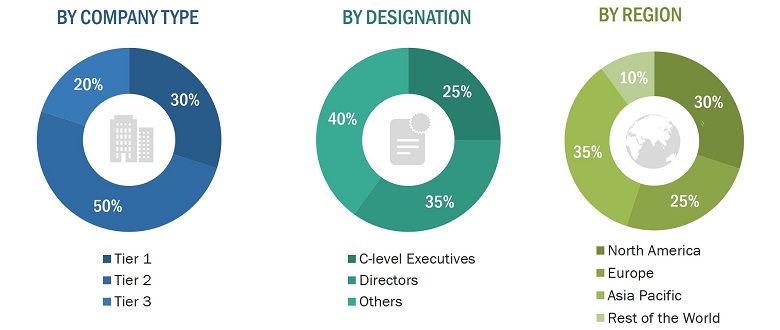
To know about the assumptions considered for the study, download the pdf brochure
Market Size Estimation
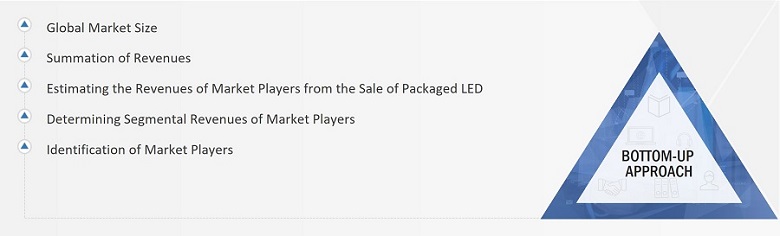
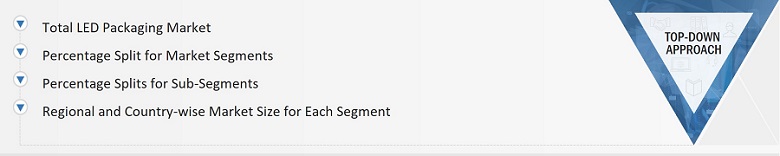
In the market engineering process, both top-down and bottom-up approaches have been used along with data triangulation methods to estimate and validate the size of the LED packaging market and other dependent submarkets. The research methodology used to estimate the market sizes includes the following:
- Identifying stakeholders in the LED packaging market that influence the entire market, along with participants across the value chain.
- Analyzing major manufacturers of LED packaging and studying their product portfolios
- Analyzing trends related to the adoption of LED packaging
- Tracking the recent and upcoming developments in the market that include investments, R&D activities, product launches, partnerships and agreements, as well as forecasting the market size based on these developments and other critical parameters
- Carrying out multiple discussions with key opinion leaders to identify the adoption trends of packaged LEDs
- Segmenting the overall market into various other market segments
- Validating the estimates at every level through discussions with key opinion leaders, such as chief executives (CXOs), directors, and operation managers, and finally with the domain experts at MarketsandMarkets
Market Size Estimation Methodology-Bottom-up Approach
Market Size Estimation Methodology-Top-down Approach
Data Triangulation
After arriving at the overall market size by the market size estimation process explained in the earlier section, the overall LED packaging market has been divided into several segments and subsegments. To complete the overall market engineering process and arrive at the exact statistics for all segments, the data triangulation and market breakdown procedures have been used, wherever applicable. The data has been triangulated by studying various factors and trends from both the demand and supply side perspectives. Along with data triangulation and market breakdown, the market has been validated by top-down and bottom-up approaches.
Market Definition
LED packages are defined as assemblies that house LED chip(s). Through packaging, LED chips and welded lead wires are protected from being in contact with the external environment. Also, packaging improves luminescence efficiency and ensures that diode chips function properly, and export visible light effectively. LED packages have empowered the lighting industry to overcome the challenges of high lumen maintenance and high-power consumption and helped in the extension of lifespan and reduction of carbon footprint. Various types of LED packages, including surface-mount device package (SMD), chip-on-board package (COB), chip-scale package (CSP), dual in-line package (DIP), and chip-on-flex (COF) LEDs, are available for various end-use applications. Package type refers to how LED semiconductor dies are integrated into LED technology-based devices used in different applications. Various applications of LED packages include general lighting, automotive lighting, backlighting, flash lighting, and industrial, among others.
Stakeholders
- Raw material suppliers
- Equipment manufacturers
- Material Suppliers
- Packaged LED manufacturer
- Semiconductor product designers and fabricators
- Regulatory bodies
- Semiconductor intellectual property vendors
- Assembly, testing, and packaging vendors
- Distributors and Resellers
- End Users
The main objectives of this study are as follows:
- To define, analyze and forecast the LED packaging market size, by package type, packaging component, power range, wavelength, application, and region, in terms of value.
- To define, analyze and forecast the LED packaging market size, by package type, in terms of volume
- To forecast the market size for various segments with respect to four main regions, namely, North America, Europe, Asia Pacific, and Rest of the World
- To provide detailed information regarding the major drivers, restraints, opportunities, and challenges influencing the growth of the LED packaging market
- To study the complete value chain and related industry segments for the LED packaging market
- To strategically analyze the micromarkets1 with respect to individual growth trends, prospects, and contributions to the total market
- To analyze the market ecosystem; trends/disruptions impacting customer’s business; technology analysis; pricing analysis; Porter’s five forces model; key stakeholders & buying criteria; case study analysis; trade analysis; patent analysis; key conferences & events, 2024–2025; and tariff and regulations related to the LED packaging market.
- To analyze opportunities in the market for various stakeholders by identifying the high-growth segments of the market.
- To strategically profile the key players and comprehensively analyze their market position in terms of ranking and core competencies2, along with detailing the competitive landscape for the market leaders.
- To analyze competitive developments such as product launches, partnerships, agreements, and research and development (R&D) activities carried out by players in the LED packaging market.
Customizations Options:
With the given market data, MarketsandMarkets offers customizations according to the company’s specific needs. The following customization options are available for the report:
Company Information
- Detailed analysis and profiling of additional market players (up to 5)
Geographic Information
- Detailed analysis of additional countries (up to 5)
Get the Full LED Packaging Market Report
Full forecast, segment splits, and company analysis for all LED Packaging Market.
- Japan LED Packaging Market
- Rest Of Asia Pacific LED Packaging Market
- South Korea LED Packaging Market
- Taiwan LED Packaging Market
- Canada LED Packaging Market
- Mexico LED Packaging Market
- France LED Packaging Market
- Germany LED Packaging Market
- Rest Of Europe LED Packaging Market
- UK LED Packaging Market
- China LED Packaging Market
Need a Tailored Report?
Customize this report to your needs
Get 10% FREE Customization
Customize This Report
