
Switzerland Machine Tools Market (2026-2031)

The Switzerland Machine Tools Market was valued at $1090 Million in 2026 and projected to reach to $1300 Million by 2031, representing a compound annual growth rate of 2.5%. Switzerland's machine tools market is positioned as a specialized, high-precision segment within Europe's broader industrial manufacturing landscape.


| Market Size in | USD 26.32 MN |
| Market Forecast in | |
| CAGR | |
| Forecast Period | |
| Units Considered | Value (USD MN) |
Switzerland Machine Tools Market Trends and Insights
- Switzerland maintains a specialized position within Europe's machine tools sector, driven by precision manufacturing demand and advanced automotive component production.
- The country's strong engineering heritage and focus on high-precision tooling support steady market expansion through the forecast period. During 2026-2031, Switzerland's machine tools market will benefit from continued investment in automation and Industry 4.0 technologies within the automotive and transportation sectors.
- Switzerland's reputation for quality and innovation positions it as a key hub for premium machine tool applications.
- Growth in Switzerland remains moderate compared to global benchmarks, reflecting the mature nature of the market and the country's emphasis on specialized, high-value manufacturing solutions rather than volume-driven expansion..
Key Market Statistics
- CAGR (2026-2031) 2.5% CAGR
- Market Size, 2026 ~USD 1090 Million
- Forecast, 2031 ~USD 1300 Million
- Country Switzerland
Switzerland Machine Tools Market Overview
Precision Manufacturing Hub :
Switzerland's machine tools market is anchored by world-class precision manufacturing capabilities, serving high-end automotive component production with strict quality standards and advanced technological requirements.
Moderate Growth Trajectory :
With a CAGR of 2.5% from 2026 to 2031, Switzerland's market growth is conservative compared to the global 4.3% rate, reflecting mature market dynamics and selective demand from specialized sectors.
Engineering Excellence Legacy :
Switzerland's strong engineering heritage and reputation for innovation drive sustained demand for advanced machine tools, particularly in automotive and precision component manufacturing segments.
Market Valuation Growth :
The Swiss market is projected to expand from USD 1,090 million in 2026 to USD 1,300 million by 2031, representing USD 210 million in absolute growth over the five-year forecast period.
Switzerland Machine Tools Market Dynamics
- The 2.5% CAGR reflects steady demand from automotive and transportation sectors that prioritize quality and technological sophistication over volume-driven growth.
- The country's established reputation for precision engineering and advanced manufacturing capabilities continues to attract investment in cutting-edge machine tool technologies. Looking ahead to 2031, Switzerland's market will benefit from ongoing automotive electrification, increased demand for lightweight component manufacturing, and sustained focus on automation and Industry 4.0 integration.
- However, growth will remain measured as the market matures, with opportunities concentrated in specialized applications requiring Swiss-level precision and engineering expertise rather than broad-based expansion..
Market Ecosystem
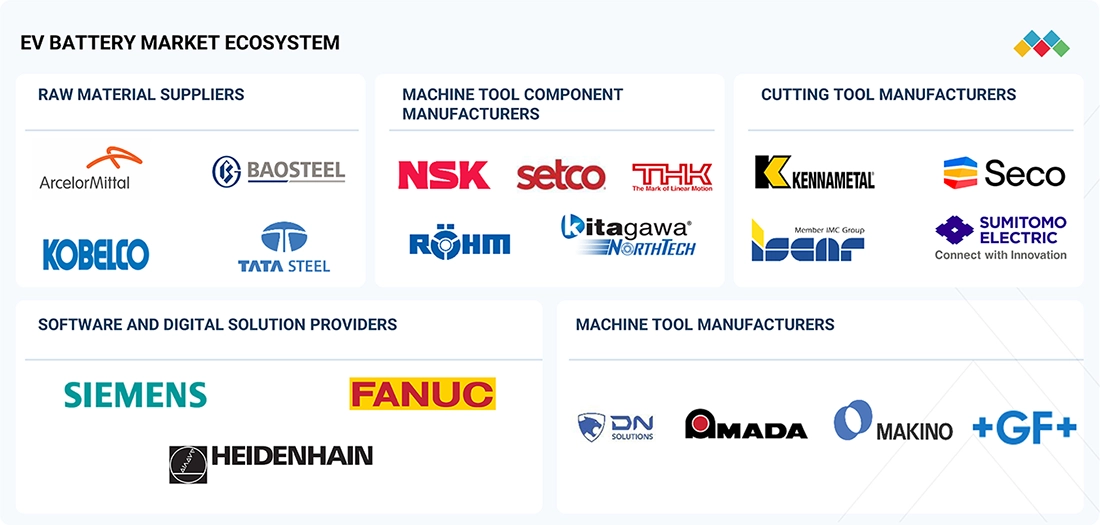
MACHINE TOOLS MARKET SIZE, SHARE & ANALYSIS: COMMERCIAL USE CASES ACROSS INDUSTRIES
| COMPANY | USE CASE DESCRIPTION | BENEFITS |
|---|---|---|
 |
Provides precision machining centers and EDM systems for aerospace, semiconductor, and medical manufacturing | Improves machining accuracy and production efficiency |
 |
Supplies grinding machines and machining centers for automotive and industrial manufacturing | Enhances production consistency and dimensional accuracy |
 |
Offers CNC turning, machining, and multitasking solutions for precision manufacturing | Increases machine utilization and manufacturing flexibility |
 |
Delivers turning centers, machining centers, and digital manufacturing solutions | Enables complex machining and supports smart manufacturing |
 |
Develops CNC machining centers and automation-ready production systems | Improves throughput and reduces operating costs |
Logos and trademarks shown above are the property of their respective owners. Their use here is for informational and illustrative purposes only.
Related Ecosystem
Automotive Advance Technologies
- Battery Electric Vehicle (BEV)
- Light Commercial Vehicles (LCVs)
- Fuel Cell Electric Vehicle (FCEV)
- Hybrid Electric Vehicle (HEV)
- Internal Combustion Engine (ICE)
- BOSCH LIMITED
- Continental ag
- Visteon Corporation
- DENSO Corporation
- ZF FRIEDRICHSHAFEN AG
On Highway Off Highway Vehicles
- Internal Combustion Engine (ICE)
- Agricultural Tractors
- Crawler Excavator
- Battery Electric Vehicle (BEV)
- Excavators
- Visteon Corporation
- Deere & Company
- AB VOLVO PENTA
- Honda Motor Co., Ltd.
- LIEBHERR-INTERNATIONAL AG
Equipment Machine And Tooling
- Wastewater Treatment
- Air Cooled Heat Exchangers
- Diaphragm Pumps
- Fiberglass
- HVAC System
- Alfa Laval Corporate AB
- Johnson Controls International plc
- Daikin Industries,Ltd.
- Veolia
- Carrier Global Corporation
Key Takeaways
- Switzerland's machine tools market is valued at USD 1,090 million in 2026 and will reach USD 1,300 million by 2031 at a 2.5% CAGR.
- Switzerland's market growth is driven by precision manufacturing demand and advanced automotive component production within the transportation sector.
- Switzerland's strong engineering heritage and focus on high-precision tooling differentiate it as a premium market segment within Europe.
- Moderate growth in Switzerland reflects a mature market prioritizing specialized, high-value solutions over volume expansion through 2031.
Machine Tools Market Report Scope
| Report Metric | Details |
|---|---|
| Base Year | 2026 |
| Fastest Growing Segment | SWISS-TYPE (Type) |
| Forecast Period | 2026-2031 |
| Growth Rate | CAGR of 4.3% from 2026 to 2031 |
| Largest Segment | CNC MACHINE TOOLS (Automation) |
| Market Size Base Year (Billions) | ~USD 82.64 (2026) |
| Revenue Forecast (Billions) | ~USD 102.01 (2031) |
| Segments Covered | Product Type, Axis Type, Type, Automation, Sales Channel, End-Use Industry |
Switzerland Machine Tools Market Report Segmentation
6 segment dimensions are covered across the global market.
By Product Type
- Drilling Machines
- Electrical Discharge Machines
- Grinding Machines
- Machining Centers
- Milling Machines
- Other Product Types
- Turning Machines
By Axis Type
- 4-Axis
- 5-Axis
By Type
- Multi-Spindle
- Other Turning Machines
- Swiss-Type
By Automation
- Cnc Machine Tools
- Conventional Machine Tools
By Sales Channel
- Dealers & Distributors
- Direct Sales
- Events & Exhibitions
By End-Use Industry
- Aerospace
- Automotive & Transportation
- Capital Goods
- Energy & Power
- Medical
- Other End-Use Industries
- Semiconductor
- Sheet Metal
Target Audience
- Machine Tool Manufacturers : Manufacturers need Switzerland-specific market data to develop precision-focused product lines, understand local competitive dynamics, and identify opportunities in the country's high-end automotive supply chain.
- Automotive Suppliers : Swiss and international automotive component suppliers require insights into machine tools demand trends to optimize manufacturing capabilities and investment in advanced production equipment.
- Investment & Private Equity Firms : Investors evaluating opportunities in Switzerland's industrial sector need accurate market valuations, growth forecasts, and sector dynamics to assess acquisition targets and portfolio companies.
- Market Entry Strategists : Companies planning market entry or expansion in Switzerland need localized intelligence on market size, growth rates, competitive landscape, and customer requirements specific to the country.
- Industry Consultants & Analysts : Consultants advising clients on manufacturing strategy, technology adoption, and market positioning require Switzerland-specific data to provide credible, localized recommendations and forecasts.
Reasons to Buy this Report
- Localized Market Intelligence : Gain Switzerland-specific insights into market dynamics, competitive positioning, and growth drivers that differ significantly from broader European or global machine tools trends.
- Precision Sector Expertise : Understand the unique demands of Switzerland's high-precision automotive and transportation manufacturing base, enabling targeted product development and market entry strategies.
- Accurate Valuation Data : Access verified market sizing (USD 1,090M in 2026, USD 1,300M in 2031) and Switzerland-specific CAGR (2.5%) for accurate financial forecasting and investment planning.
- Competitive Positioning : Benchmark your operations against Switzerland's specialized machine tools landscape and identify opportunities within the country's engineering-driven, quality-focused market segment.
- Strategic Decision Support : Make informed decisions on market entry, expansion, or partnership strategies in Switzerland with comprehensive data on growth trajectories and sector-specific opportunities through 2031.
Frequently asked questions
What is the current size of Switzerland's machine tools market?
Switzerland's machine tools market is valued at USD 1,090 million in 2026.
What is the projected market size for Switzerland by 2031?
Switzerland's machine tools market is forecast to reach USD 1,300 million by 2031.
What is the CAGR for Switzerland's machine tools market?
Switzerland's machine tools market is expected to grow at a compound annual growth rate of 2.5% from 2026 to 2031.
What drives growth in Switzerland's machine tools market?
Growth in Switzerland is driven by precision manufacturing demand, advanced automotive component production, and investment in automation and Industry 4.0 technologies.
How does Switzerland's market compare to global trends?
Switzerland's 2.5% CAGR is lower than the global 4.3% CAGR, reflecting a mature market focused on specialized, high-value manufacturing solutions rather than volume-driven expansion.
RESEARCH METHODOLOGY
The study involved four major activities in estimating the current size of the machine tools market. Exhaustive secondary research was done to collect information on the market, the peer market, and the child markets. The next step was to validate these findings and assumptions and size them with industry experts across value chains through primary research. The top-down and bottom-up approaches were employed to estimate the complete market size. Thereafter, market breakdown and data triangulation processes were used to estimate the market size of segments and subsegments.
Secondary Research
In the secondary research process, various secondary sources such as company annual report/presentations, press releases, investor presentations of companies, white papers, certified publications, and articles from recognized authors have been used to identify and collect information useful for an extensive commercial study of the global machine tools market.
Primary Research
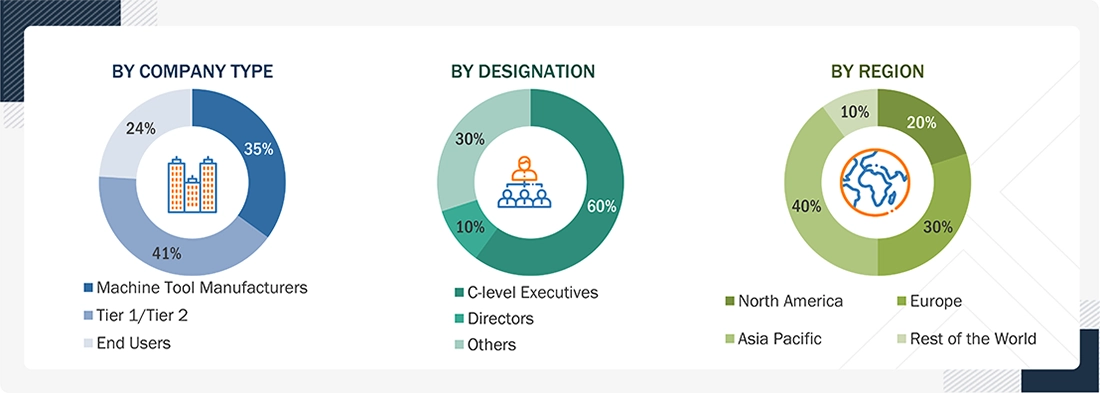
Extensive primary research was conducted after acquiring an understanding of the machine tools market scenarios through secondary research. Several primary interviews were conducted with market experts from both the demand (country-level government associations, trade associations, institutes, R&D centers, and machine tools manufacturers) and supply (machine tools manufacturers, machine tools component manufacturers, and raw material suppliers) sides across four major regions, namely, North America, Europe, Asia Pacific, and RoW. Approximately 24% and 76% of primary interviews were conducted from the demand and supply sides, respectively. Primary data was collected through questionnaires, emails, and telephonic interviews.
In the canvassing of primaries, various departments within organizations, such as sales, operations, and administration, were covered to provide a holistic viewpoint in the report. After interacting with industry experts, brief sessions were conducted with highly experienced independent consultants to reinforce the findings from primaries. This, along with in-house subject-matter experts’ opinions, led to the findings described in the remainder of this report.
To know about the assumptions considered for the study, download the pdf brochure
Market Size Estimation
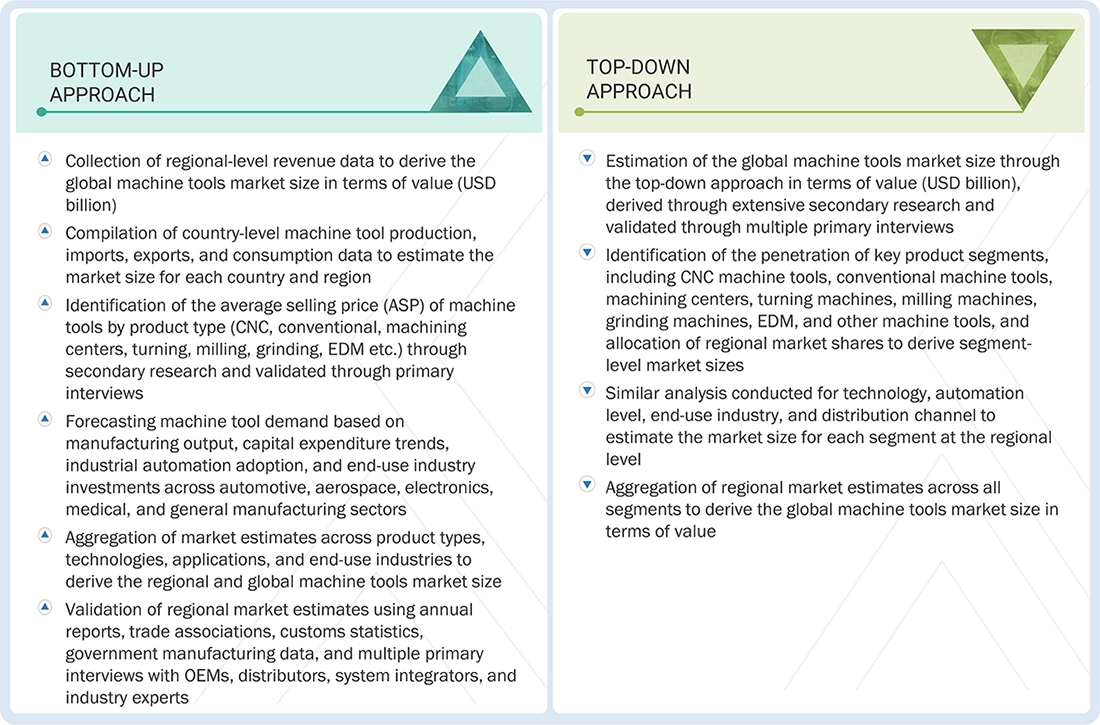
Both top-down and bottom-up approaches were used to estimate and validate the total size of the market. These methods were also used extensively to estimate the size of various subsegments in the market. The research methodology used to estimate the market size includes the following:
Machine Tools Market: Top-Down and Bottom-Up Approach
Data Triangulation
After arriving at the overall market size- using the market estimation processes as explained above- the market was split into several segments and subsegments. To complete the overall market engineering process and arrive at the exact statistics of each market segment and subsegment, data triangulation and market breakdown procedures were employed, wherever applicable. The data was triangulated by studying various factors and trends from both the demand and supply sides.
Market Definition
According to ISO standards, a “machine tool is a mechanical device, which is fixed and powered, typically used to process workpieces by selective removal/addition of material or mechanical deformation. Machine tools operation can be mechanical, controlled by humans or by computers”. There is a great variety of metalworking machine tools: milling machines, lathes, sheet metal forming machines, EDM machines and additive manufacturing machines are just some examples. Stainless steel, aluminum, titanium, and copper are some of the main metals processed by these machine tools. In addition, to manufacture components for key industries such as automotive, aerospace, energy and medical technology, machine tools enable the production of all the other machines, including themselves.
Key Stakeholders
- Automation consultants
- Companies developing and integrating industrial software
- Dealers and distributors of machine tools
- Government regulatory bodies, industry associations, and experts
- Integrators of automation systems
- Manufacturers of machine tools
- Manufacturers of machine tool components
- Research organizations and consulting companies
- Technology investors
- Technology standards organizations, forums, alliances, and associations
- Vendors of CNC machining software
Report Objectives
-
To define, segment, and forecast the size of the machine tools market in terms of value (USD billion) based on the following categories: product type, automation, end-use industry, sales channel, and region
- Product type {milling machines [by axis: 4-axis, 5-axis, others) and universal milling machines], drilling machines, turning machines (Swiss-type, multi-spindle, other turning machines), grinding machines, electrical discharge machines, machining centers, and other product types]
- Sales channel (events & exhibitions, dealers & distributors, and direct sales)
- Automation (CNC machine tools and conventional machine tools)
- End-use industry (automotive & transportation, aerospace, medical, semiconductor, sheet metal, energy & power, capital goods, and other end-use industries)
- Region [North America, Europe, Asia Pacific, and Rest of the World (RoW)]
- To evaluate the key market dynamics influencing the machine tools market, including strategic drivers, restraints, opportunities, challenges, and emerging technology trends shaping future industry growth
-
To study the following with respect to the market:
- Value Chain Analysis
- Ecosystem Analysis
- Technology Analysis
- Trade Analysis
- Case Study Analysis
- Investment and Funding Scenario
- Company Valuation and Financial Metrics
- Brand/Product Comparison
- Patent Analysis
- Regulatory Landscape
- Conferences and Events
- Global Manufacturing Investment Outlook
- Future Revenue Pools, 2026 Vs. 2033
- OEM Analysis
- EU India Trade Impact Analysis
- Iran-Israel Impact Analysis
- Future Roadmap of Multi-Axis CNC Adoption
- Machine Tools Software Market
- To strategically analyze segments with respect to individual growth trends, prospects, and contributions to the total market.
- To assess the competitive landscape by profiling leading global market participants based on their business overview, product portfolio, geographic presence, financial performance, and recent strategic developments such as product launches, partnerships, acquisitions, and capacity expansions.
- To map the competitive ecosystem by categorizing market participants into Stars, Emerging Leaders, Pervasive Players, and Participants using a robust evaluation framework based on the strength of their product portfolio, business strategy, innovation capability, and market presence.
Available customizations:
With the given market data, MarketsandMarkets offers customizations in line with company-specific needs.
- Further breakdown for the machine tools market, by product type, at the country level (for countries covered in the report)
- Further breakdown for the machine tools market, by end-use industry, at the country level (for countries covered in the report)
Company Profile
- Profiles of additional market players (Up to five)
Get the Full Machine Tools Market Report
Full forecast, segment splits, and company analysis for all Machine Tools Market.
- China Machine Tools Market
- Japan Machine Tools Market
- South Korea Machine Tools Market
- India Machine Tools Market
- Thailand Machine Tools Market
- Taiwan Machine Tools Market
- Vietnam Machine Tools Market
- Malaysia Machine Tools Market
- UK Machine Tools Market
- Germany Machine Tools Market
- France Machine Tools Market
- Italy Machine Tools Market
- Spain Machine Tools Market
- Turkey Machine Tools Market
- Canada Machine Tools Market
- Mexico Machine Tools Market
- US Machine Tools Market
- Russia Machine Tools Market
- Brazil Machine Tools Market
- Rest Of Asia Pacific Machine Tools Market
Need a Tailored Report?
Customize this report to your needs
Get 10% FREE Customization
Customize This Report
