
Japan Mass Flow Controller Market (2024-2029)

The Japan Mass Flow Controller Market was valued at $186.7 Million in 2024 and projected to reach to $260 Million by 2029, representing a compound annual growth rate of 6.8%. Japan's mass flow controller market is positioned for steady expansion driven by the country's dominant semiconductor manufacturing sector and continuous technological advancement.


| Market Size in | USD 26.32 MN |
| Market Forecast in | |
| CAGR | |
| Forecast Period | |
| Units Considered | Value (USD MN) |
Japan Mass Flow Controller Market Trends and Insights
- Japan's advanced semiconductor manufacturing ecosystem and precision engineering capabilities position the country as a critical hub for mass flow controller adoption.
- The market in Japan is driven by increasing demand from semiconductor fabrication plants, chemical processing industries, and research institutions that require precise gas flow measurement and control. Japan's established position in the semiconductor and electronics sectors continues to fuel investment in process automation and quality control technologies.
- Between 2024 and 2029, Japan's mass flow controller market will benefit from technological innovations, rising production volumes in chip manufacturing, and the expansion of specialty gas applications.
- Japan's commitment to maintaining competitive advantage in advanced manufacturing ensures sustained demand for high-performance mass flow control solutions across multiple industrial verticals..
Key Market Statistics
- CAGR (2024-2029) 6.8% CAGR
- Market Size, 2024 ~USD 186.7 Million
- Forecast, 2029 ~USD 260 Million
- Country Japan
Japan Mass Flow Controller Market Overview
Market Valuation :
Japan's mass flow controller market is valued at USD 186.7 million in 2024, with projected growth to USD 260.0 million by 2029, representing a steady CAGR of 6.8%.
Advanced Manufacturing Hub :
Japan's world-leading semiconductor fabrication facilities and precision engineering capabilities drive significant demand for high-accuracy mass flow controllers in chip production processes.
Technology Leadership :
Japanese manufacturers leverage cutting-edge automation and IoT integration in mass flow controller systems, setting industry standards for reliability and performance in Asia-Pacific markets.
Growth Drivers :
Expansion of semiconductor fabs, increasing adoption of advanced process nodes, and rising demand for specialty gases in electronics manufacturing fuel sustained market growth in Japan.
Japan Mass Flow Controller Market Dynamics
- The nation's commitment to maintaining semiconductor leadership, coupled with investments in next-generation fab facilities, ensures sustained demand for precision flow control solutions.
- Japan's aging population and labor constraints are accelerating automation adoption, further boosting mass flow controller integration across manufacturing processes.
- By 2029, the market is expected to reach USD 260.0 million, supported by both domestic consumption and export-driven manufacturing growth.
- Regional supply chain resilience initiatives and government support for advanced manufacturing will continue to strengthen Japan's position as a critical market for mass flow controller technologies..
Market Ecosystem
Related Ecosystem
Industrial Automation
- Sensors
- Image Sensors
- Manufacturing Execution System (MES)
- Actuators
- Flow Sensors
- Siemens ag
- ABB India Limited
- Emerson Electric Co.
- HONEYWELL INTERNATIONAL INC.
- SCHNEIDER ELECTRIC SE
Key Takeaways
- Japan's mass flow controller market reaches USD 186.7 million in 2024 and is forecast to expand to USD 260.0 million by 2029 at a 6.8% CAGR.
- Japan's semiconductor manufacturing dominance and precision engineering expertise drive sustained demand for advanced mass flow control technologies.
- Between 2024 and 2029, Japan will see increased adoption of mass flow controllers in chip fabrication, chemical processing, and specialty gas applications.
- Japan's focus on process automation and quality control in manufacturing ensures continued market growth and technology innovation through the forecast period.
Mass Flow Controller Market Report Scope
| Report Metric | Details |
|---|---|
| Base Year | 2024 |
| Fastest Growing Segment | CORIOLIS (Technology) |
| Forecast Period | 2024-2029 |
| Growth Rate | CAGR of 7.2% from 2024 to 2029 |
| Largest Segment | CHEMICAL CONTROL (Fab Facility Equipment) |
| Market Size Base Year (Billions) | ~USD 1.64 (2024) |
| Revenue Forecast (Billions) | ~USD 2.32 (2029) |
| Segments Covered | Display, Seal, Material, Media Type, Flow Rate, End-Use Industry, Technology, Connectivity, Fab Facility Equipment |
Japan Mass Flow Controller Market Report Segmentation
9 segment dimensions are covered across the global market.
By Display
- With Display
- Without Display
By Seal
- Elastomer
- Metal
By Material
- Alloys
- Other Materials
- Stainless Steel
By Media Type
- Gas
- Liquid
By Flow Rate
- High
- Low
- Medium
By End-Use Industry
- Chemical
- Chemicals
- Food & Beverages
- Metals & Mining
- Oil & Gas
- Other End-Use Industries
- Pharmaceuticals
- Semiconductors
- Water & Wastewater
- Water & Wastewater Treatment
By Technology
- Coriolis
- Differential Pressure
- Thermal
By Connectivity
- Analog
- Digital
By Fab Facility Equipment
- Automation
- Chemical Control
- Gas Control
- Other Fab Facility Equipment
JAPAN: MASS FLOW CONTROLLER MARKET, BY END-USE INDUSTRY, 2024–2029
| Segment | 2024 | 2025 | 2026 | 2027 | 2028 | 2029 | CAGR (%) |
|---|---|---|---|---|---|---|---|
| CHEMICALS | 12.1 | 12.9 | 13.7 | 14.7 | 15.9 | 17.3 | 7.4 |
| FOOD & BEVERAGES | 4 | 4.2 | 4.5 | 4.8 | 5.1 | 5.6 | 6.7 |
| METALS & MINING | 0.8 | 0.8 | 0.9 | 0.9 | 1 | 1.1 | 6.2 |
| OIL & GAS | 2.5 | 2.5 | 2.6 | 2.6 | 2.7 | 2.8 | 1.8 |
| OTHER END-USE INDUSTRIES | 2.4 | 2.6 | 2.7 | 2.9 | 3.1 | 3.3 | 6.3 |
| PHARMACEUTICALS | 12.2 | 13 | 14 | 15.1 | 16.4 | 18 | 8 |
| SEMICONDUCTORS | 150.5 | 158.5 | 167.9 | 179.2 | 192.7 | 209.2 | 6.8 |
| WATER & WASTEWATER TREATMENT | 2.1 | 2.2 | 2.3 | 2.5 | 2.6 | 2.8 | 6 |
| TOTAL | 186.7 | 196.7 | 208.5 | 222.5 | 239.5 | 260 | 6.8 |
Target Audience
- Semiconductor Equipment Manufacturers : Require Japan-specific market data to calibrate product development roadmaps, pricing strategies, and sales forecasts aligned with Japanese fab expansion and technology roadmaps.
- Mass Flow Controller Suppliers : Need detailed market intelligence on Japan's demand patterns, customer concentration, competitive positioning, and growth opportunities to optimize market entry and expansion strategies.
- Investment & Private Equity Firms : Seek comprehensive Japan market analysis to evaluate acquisition targets, assess portfolio company growth potential, and identify consolidation opportunities in the precision instrumentation sector.
- Electronics Manufacturing Services (EMS) Providers : Require insights into Japan's manufacturing trends, equipment specifications, and procurement patterns to enhance service offerings and maintain competitive advantage in precision production.
- Strategic Consultants & Business Analysts : Need Japan-focused market research to support client strategy development, competitive benchmarking, and market entry planning in the semiconductor and advanced manufacturing sectors.
Reasons to Buy this Report
- Market-Specific Sizing & Forecasts : Access precise valuation data for Japan's mass flow controller market with detailed 5-year forecasts, enabling accurate budgeting and investment planning specific to this critical Asian market.
- Competitive Landscape Intelligence : Understand Japan's unique competitive dynamics, local manufacturer strategies, and market consolidation trends to identify partnership and acquisition opportunities in this advanced manufacturing ecosystem.
- Semiconductor Fab Insights : Gain detailed analysis of Japan's semiconductor fabrication capacity expansion, process node transitions, and equipment procurement cycles driving mass flow controller demand.
- Regulatory & Supply Chain Context : Navigate Japan-specific regulations, export controls, and supply chain resilience initiatives impacting mass flow controller sourcing, manufacturing, and distribution strategies.
- Growth Opportunity Identification : Identify high-potential segments within Japan's market including advanced packaging, specialty gas applications, and emerging technology nodes for targeted business development.
Frequently asked questions
What is the current size of Japan's mass flow controller market in 2024?
Japan's mass flow controller market is valued at USD 186.7 million in 2024, reflecting strong demand from the semiconductor and electronics industries.
What is the projected market size for Japan's mass flow controller market by 2029?
Japan's mass flow controller market is forecast to reach USD 260.0 million by 2029, representing growth of approximately 39% over the five-year period.
What is the CAGR for Japan's mass flow controller market from 2024 to 2029?
Japan's mass flow controller market is expected to grow at a compound annual growth rate (CAGR) of 6.8% between 2024 and 2029.
Which industries drive demand for mass flow controllers in Japan?
Japan's mass flow controller demand is primarily driven by semiconductor fabrication, chemical processing, pharmaceutical manufacturing, and research and development sectors.
Why is Japan a significant market for mass flow controllers?
Japan's advanced semiconductor manufacturing infrastructure, precision engineering capabilities, and commitment to process automation make it a critical market for high-performance mass flow control solutions.
RESEARCH METHODOLOGY
The study involved four major activities in estimating the size of the mass flow controller market. Exhaustive secondary research has been carried out to collect information on the market, the peer markets, and the parent market. Both top-down and bottom-up approaches have been employed to estimate the total market size. Market breakdown and data triangulation methods have also been used to estimate the market for segments and subsegments.
Secondary Research
Revenues of companies offering mass flow controller have been obtained from the secondary data available through paid and unpaid sources. The revenues have also been derived by analyzing the product portfolio of key companies, and these companies have been rated according to the performance and quality of their products.
In the secondary research process, various sources have been referred to for identifying and collecting information for this study on the mass flow controller market. Secondary sources considered for this research study include government sources, corporate filings, and trade, business, and professional associations. Secondary data has been collected and analyzed to arrive at the overall market size, which has been further validated through primary research.
Secondary research has been mainly used to obtain key information about the supply chain of mass flow controller to identify key players based on their products and prevailing industry trends in the mass flow controller market by product specification, media type, material type, flow rate, technology, connectivity, end-user industry, and region. Secondary research also helped obtain market information- and technology-oriented key developments undertaken by market players to expand their presence and increase their market share.
Primary Research
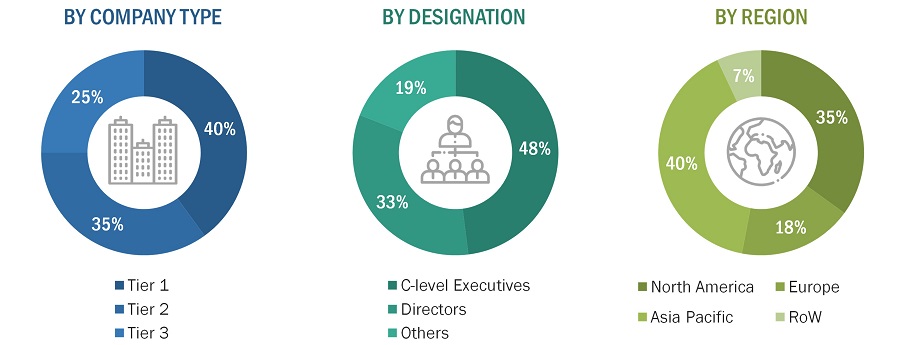
Extensive primary research has been conducted after understanding and analyzing the current scenario of the mass flow controller market through secondary research. Several primary interviews have been conducted with the key opinion leaders from the demand and supply sides across four main regions—North America, Europe, Asia Pacific, and the Rest of Europe. Approximately 25% of the primary interviews were conducted with the demand-side respondents, while approximately 75% were conducted with the supply-side respondents. The primary data has been collected through questionnaires, emails, and telephone interviews.
After interacting with industry experts, brief sessions were conducted with highly experienced independent consultants to reinforce the findings from our primary. This, along with the in-house subject matter experts’ opinions, has led us to the findings as described in the remainder of this report. The breakdown of primary respondents is as follows:
To know about the assumptions considered for the study, download the pdf brochure
Market Size Estimation
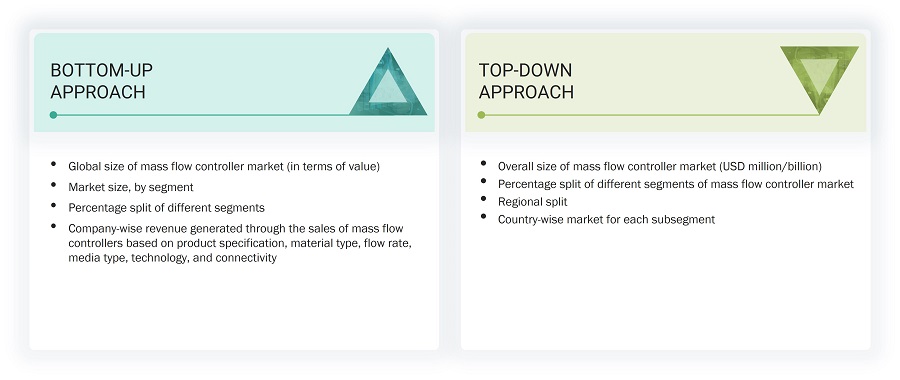
The bottom-up procedure has been employed to arrive at the overall size of the mass flow controller market.
- Initially, more than 35 companies offering mass flow controller were identified. Their offerings were mapped based on product specification, material type, media type, flow rate, and end–user industry.
- After understanding the different types of mass flow controllers offered by various manufacturers, based on the data gathered through primary and secondary sources, the market was categorized into different segments.
- To derive the global mass flow controller market, global server shipments of top players for each device type that were considered in the scope of the report were tracked.
- A suitable penetration rate was assigned for the shipment of each of these device types to derive the shipments of mass flow controller.
- Using the average selling price (ASP) at which a particular company offers its devices, we derived the mass flow controller market based on different device types. The ASP of each device was identified based on secondary sources and validated from primaries.
- For the projected market values of each of the device types, the Y-o-Y projections showed a steep growth initially until 2019. COVID-19 has not impacted market much and it is expected that market will grow positively during forecast period. The market is expected to witness a sharp ascent, thereafter, considering the demand for mass flow controller for different applications.
- For the CAGR, the market trend analysis was carried out by understanding the industry penetration rate and the demand and supply of mass flow controller in different applications.
- We also tracked the mass flow controller market through the data sanity method. The revenues of more than 25 key providers were analyzed through annual reports and press releases and summed to derive the overall market.
- For each company, a percentage is assigned to its overall revenue or, in a few cases, segmental revenue, to derive its revenue for the mass flow controller. This percentage for each company is assigned based on the company’s product portfolio and its range of mass flow controller offerings.
- Verifying and crosschecking the estimates at every level by discussing with key opinion leaders, including CXOs, directors, and operation managers, and then finally with the domain experts at MarketsandMarkets
- Studying various paid and unpaid sources of information, such as annual reports, press releases, white papers, and databases
The top-down approach has been used to estimate and validate the total size of the mass flow controller market.
- The global market size of maass flow controllers was estimated through the data sanity of 35 major companies.
- The growth of the mass flow controller market witnessed an upward slope trend during the studied period, as it is currently in the initial stage of the product cycle, with major players beginning to expand their business into various application areas of the market.
- Types of mass flow controllers, their features and properties, geographical presence, and key applications served by all players in the mass flow controller market were studied to estimate and arrive at the percentage split of the segments.
- Different types of mass flow controllers and their penetration for the end-user industries were also studied.
- The market split for mass flow controller by product specification, material type, media type, technology, connectivity, and end-user industry based on secondary research was estimated.
- The demand generated by companies operating in different application segments of the end-usee industry was analyzed.
- Multiple discussions with key opinion leaders across major companies involved in the development of mass flow controller and related components were conducted to validate the market split of technology, flow rate, and connectivity.
- The regional splits were estimated using secondary sources, based on factors such as the number of players in a specific country and region and the adoption and use cases of each implementation type with respect to applications in the region
Data Triangulation
After arriving at the overall market size-using the market size estimation processes as explained above-the market has been split into several segments and subsegments. To complete the entire market engineering process and arrive at the exact statistics of each market segment and subsegment, data triangulation and market breakdown procedures have been employed, wherever applicable. The data has been triangulated by studying various factors and trends from the demand and supply sides in the mass flow controller market.
Market Definition
A mass flow controller is a device that measures and controls the flow of liquids and gases. It is operated by electric signals and designed to monitor and calibrate media flow rate according to predetermined flow rates. It is implemented in various industries where accurate control and calibration of flow rates are required. The mass flow controller market is highly competitive, with more than 30 companies competing against each other to sustain their position in the market and increase their market share. The mass flow controller market is likely to witness significant growth in the coming years mainly owing to the growing demand for such controllers in the semiconductor industry and surging demand for intelligent flow meters in the chemical and water & wastewater industries.
Key Stakeholders
- End–users
- Government bodies, venture capitalists, and private equity firms
- Mass flow controller manufacturers
- Mass flow controller distributors
- Mass flow controller industry associations
- Professional service/solution providers
- Research institutions and organizations
- Standards organizations and regulatory authorities related to the mass flow controller market
- System integrators
- Technology consultants
Report Objectives
- To define, describe, segment, and forecast the mass flow controller market, by product specification, material type, media type, flow rate, technology, connectivity, and end-user industry, in terms of value
- To forecast the market for mass flow controllers, in terms of volume
- To describe and forecast the market for various segments, with respect to four main regions, namely, North America, Europe, Asia Pacific, and the Rest of the World (RoW), in terms of value
- To provide detailed information regarding drivers, restraints, opportunities, and challenges influencing the growth of the mass flow controller market
- To provide a detailed overview of the mass flow controller market’s supply chain, along with the ecosystem, technology trends, use cases, regulatory environment, and Porter’s five forces analysis for the market
- To analyze industry trends, pricing data, patents and innovations, and trade data (export and import data) related to the mass flow controllers.
- To strategically analyze the micromarkets1 with respect to individual growth trends, prospects, and contributions to the total market
- To strategically profile the key players and comprehensively analyze their market share and core competencies2
- To analyze opportunities for stakeholders and provide a detailed competitive landscape of the market
- To analyze competitive developments, such as product launches/developments, collaborations, partnerships, acquisitions, and research & development (R&D) activities, carried out by players in the mass flow controller market
- To profile key players in the mass flow controller market and comprehensively analyze their market ranking based on their revenue, market share, and core competencies2
Available customizations:
With the given market data, MarketsandMarkets offers customizations according to the specific requirements of companies. The following customization options are available for the report:
- Detailed analysis and profiling of additional market players based on various blocks of the supply chain
Get the Full Mass Flow Controller Market Report
Full forecast, segment splits, and company analysis for all Mass Flow Controller Market.
- US Mass Flow Controller Market
- Canada Mass Flow Controller Market
- Mexico Mass Flow Controller Market
- Germany Mass Flow Controller Market
- UK Mass Flow Controller Market
- France Mass Flow Controller Market
- China Mass Flow Controller Market
- India Mass Flow Controller Market
- Taiwan Mass Flow Controller Market
- South Korea Mass Flow Controller Market
- Rest Of Europe Mass Flow Controller Market
- Rest Of Asia Pacific Mass Flow Controller Market
- GCC Mass Flow Controller Market
Need a Tailored Report?
Customize this report to your needs
Get 10% FREE Customization
Customize This Report
