
India Microcrystalline Cellulose (MCC) Market (2025-2030)

The India Microcrystalline Cellulose (MCC) Market was valued at $96.9 Million in 2025 and projected to reach to $142.7 Million by 2030, representing a compound annual growth rate of 8.0%. India's Microcrystalline Cellulose market is poised for accelerated growth through 2030, driven by the pharmaceutical sector's expansion, increasing generic drug production, and rising demand from food and cosmetics manufacturers.


| Market Size in | USD 26.32 MN |
| Market Forecast in | |
| CAGR | |
| Forecast Period | |
| Units Considered | Value (USD MN) |
India Microcrystalline Cellulose (MCC) Market Trends and Insights
- India's MCC market is driven by rising demand from the pharmaceutical, food, and cosmetics industries, where MCC serves as a critical excipient and functional ingredient.
- India's position as a global pharmaceutical manufacturing hub and the expansion of domestic food processing capabilities are key catalysts for market expansion. India's MCC market growth is supported by increasing investments in manufacturing infrastructure and the adoption of advanced cellulose processing technologies.
- India's regulatory environment and cost-competitive production capabilities position the country as an attractive hub for both domestic consumption and export-oriented MCC production.
- The forecast period (2025-2030) will see India benefit from rising consumer demand for processed foods, dietary supplements, and pharmaceutical formulations across urban and semi-urban regions..
Key Market Statistics
- CAGR (2025-2030) 8.0% CAGR
- Market Size, 2025 ~USD 96.9 Million
- Forecast, 2030 ~USD 142.7 Million
- Country India
India Microcrystalline Cellulose (MCC) Market Overview
Market Size & Growth :
India's MCC market is valued at USD 96.9 million in 2025 and is projected to reach USD 142.7 million by 2030, growing at a robust CAGR of 8.0%, outpacing the global growth rate of 7.1%.
Pharmaceutical Sector Dominance :
The pharmaceutical industry remains the largest consumer of MCC in India, utilizing it as a critical excipient in tablet formulations, driven by India's position as the 'pharmacy of the world' and increasing domestic drug manufacturing.
Diversified End-Use Applications :
Beyond pharmaceuticals, India's MCC demand is expanding in food additives, cosmetics, and personal care products, reflecting growing consumer spending and the rise of domestic FMCG and cosmetics brands.
Manufacturing & Export Potential :
India's established chemical manufacturing base and cost-competitive production capabilities position it as a key MCC producer for both domestic consumption and export to emerging Asian markets.
India Microcrystalline Cellulose (MCC) Market Dynamics
- The country's regulatory support for domestic pharmaceutical manufacturing and the 'Make in India' initiative are expected to boost local MCC production capacity and reduce import dependency. Growing consumer awareness regarding product quality, coupled with India's emergence as a global manufacturing hub, will further strengthen market dynamics.
- Investment in R&D for specialized MCC grades and sustainable production methods will create new opportunities, while strategic partnerships between domestic manufacturers and international players will enhance market penetration across tier-2 and tier-3 cities..
Market Ecosystem
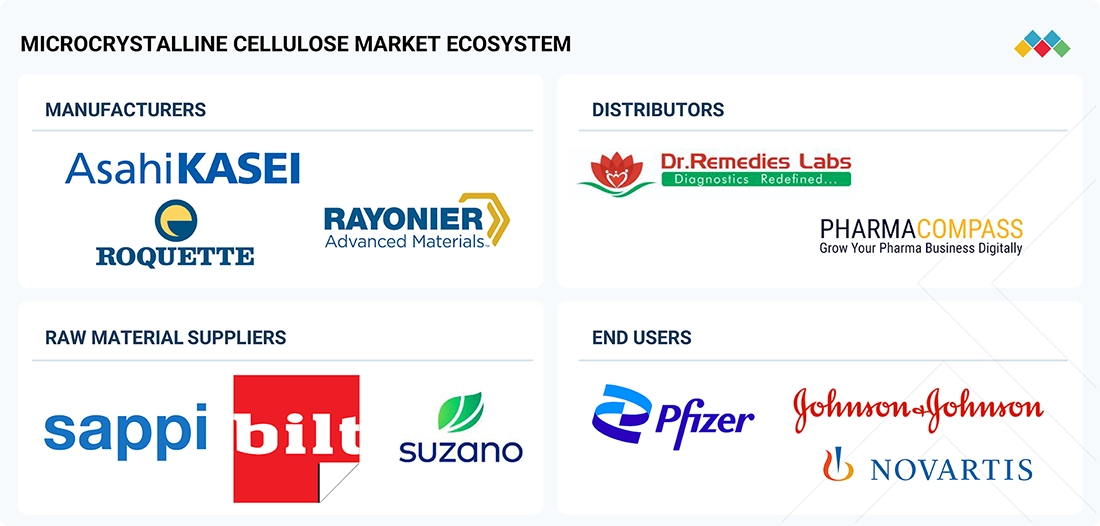
MICROCRYSTALLINE CELLULOSE (MCC) MARKET: COMMERCIAL USE CASES ACROSS INDUSTRIES
| COMPANY | USE CASE DESCRIPTION | BENEFITS |
|---|---|---|
 |
MCC used as a binder and filler in tablet formulations for enhanced tablet integrity. | Improves tablet hardness and uniformity, enables better compressibility, and ensures stability. |
 |
MCC added as a fat replacer and texturizer in dairy and processed food products | Enhances mouthfeel, supports calorie reduction, and improves product stability. |
 |
MCC used as a natural thickener in skincare creams and lotions. | Provides smooth texture, enhances spreadability, and supports clean-label cosmetic claims. |
 |
MCC applied in toothpaste as a binder and abrasive agent | Improves consistency, stabilizes formula, and enhances cleaning performance. |
 |
MCC used in laundry detergents and surface cleaners for flowability and moisture control. | Prevents clumping, improves shelf life, and enables uniform dispersion in powdered products. |
Logos and trademarks shown above are the property of their respective owners. Their use here is for informational and illustrative purposes only.
Related Ecosystem
Key Takeaways
- India's MCC market is valued at USD 96.9 million in 2025 and will reach USD 142.7 million by 2030, growing at 8.0% CAGR.
- India's pharmaceutical industry is the primary driver of MCC demand, leveraging the country's position as a global manufacturing hub.
- India's food and cosmetics sectors are emerging growth segments, supported by rising consumer spending and product innovation.
- India's cost-competitive production and favorable regulatory framework position it as a key regional supplier for MCC across Asia Pacific.
Microcrystalline Cellulose (MCC) Market Report Scope
| Report Metric | Details |
|---|---|
| Base Year | 2025 |
| Fastest Growing Segment | NON-WOOD-BASED (Source) |
| Forecast Period | 2025-2030 |
| Growth Rate | CAGR of 7.1% from 2025 to 2030 |
| Largest Segment | WOOD-BASED (Source) |
| Market Size Base Year (Billions) | ~USD 1.33 (2025) |
| Revenue Forecast (Billions) | ~USD 1.88 (2030) |
| Segments Covered | Source, Application |
India Microcrystalline Cellulose (MCC) Market Report Segmentation
2 segment dimensions are covered across the global market.
By Source
- Non-Wood-Based
- Wood-Based
By Application
- Cosmetics & Personal Care
- Food & Beverage
- Other Applications
- Pharmaceutical
INDIA: MICROCRYSTALLINE CELLULOSE MARKET, BY APPLICATION, 2025–2030
| Segment | 2025 | 2026 | 2027 | 2028 | 2029 | 2030 | CAGR (%) |
|---|---|---|---|---|---|---|---|
| COSMETICS & PERSONAL CARE | 9.6 | 10.5 | 11.4 | 12.4 | 13.6 | 14.8 | 8.9 |
| FOOD & BEVERAGE | 28.6 | 31 | 33.6 | 36.3 | 39.4 | 42.6 | 8.3 |
| OTHER APPLICATIONS | 8.5 | 9.2 | 10 | 10.8 | 11.7 | 12.7 | 8.5 |
| PHARMACEUTICAL | 50.2 | 54 | 58.2 | 62.6 | 67.4 | 72.5 | 7.6 |
| TOTAL | 96.9 | 104.7 | 113.1 | 122.2 | 132 | 142.7 | 8 |
Target Audience
- Pharmaceutical Manufacturers : Indian and multinational pharma companies need detailed MCC market data to optimize excipient sourcing, forecast ingredient costs, and plan capacity expansion aligned with India's growing tablet and capsule production.
- Chemical & Material Suppliers : MCC producers and cellulose suppliers require India-specific market intelligence to identify growth segments, assess demand from pharmaceutical and FMCG sectors, and develop localized product strategies.
- Food & Beverage Companies : Indian F&B manufacturers and food additive distributors need market insights to understand MCC adoption trends, regulatory compliance, and competitive positioning in the growing functional food and processed food segments.
- Cosmetics & Personal Care Brands : Domestic and international beauty and personal care companies operating in India require market data to evaluate MCC ingredient sourcing, understand consumer preferences, and plan product innovation strategies.
- Investment & Business Development Teams : Private equity firms, venture capitalists, and corporate development professionals need India market analysis to evaluate acquisition targets, assess investment returns, and identify growth opportunities in the chemical sector.
Reasons to Buy this Report
- India-Specific Market Sizing : Access precise market valuation for India (USD 96.9M in 2025) with country-level forecasts through 2030, enabling accurate budgeting and investment decisions tailored to the Indian market landscape.
- Pharmaceutical Sector Insights : Understand India's pharmaceutical industry dynamics, generic drug manufacturing trends, and regulatory environment to identify MCC demand drivers and competitive opportunities in the world's largest drug producer by volume.
- Emerging End-Use Opportunities : Discover growth potential in India's food, cosmetics, and personal care segments with detailed analysis of consumer trends, brand expansion, and market penetration strategies specific to Indian demographics.
- Competitive & Supply Chain Analysis : Gain insights into India's MCC manufacturing landscape, local producer capabilities, import-export dynamics, and cost competitiveness to benchmark against regional competitors and identify partnership opportunities.
- Strategic Market Entry Planning : Leverage India-focused data to develop market entry strategies, assess regulatory requirements, identify key distribution channels, and evaluate investment viability in this high-growth emerging market.
Frequently asked questions
What is the current market size of MCC in India?
India's MCC market is estimated at USD 96.9 million in 2025 and is expected to grow to USD 142.7 million by 2030.
What is the projected CAGR for India's MCC market?
India's MCC market is projected to grow at a compound annual growth rate (CAGR) of 8.0% from 2025 to 2030.
Which industries drive MCC demand in India?
India's pharmaceutical, food processing, and cosmetics industries are the primary drivers of MCC demand, with pharmaceuticals accounting for the largest share.
Why is India a key MCC production hub?
India's cost-competitive manufacturing, strong pharmaceutical sector, advanced processing capabilities, and favorable regulatory environment make it a strategic MCC production and export hub.
What factors will support India's MCC market growth through 2030?
Rising pharmaceutical production, expanding food processing, increasing consumer demand for supplements, and investments in manufacturing infrastructure will drive India's MCC market growth.
RESEARCH METHODOLOGY
The study involves two major activities in estimating the current market size for microcrystalline cellulose market. Exhaustive secondary research was done to collect information on the market, peer market, and parent market. The next step was to validate these findings, assumptions, and sizing with industry experts across the value chain through primary research. Both top-down and bottom-up approaches were employed to estimate the complete market size. After that, market breakdown and data triangulation were used to estimate the market size of segments and subsegments.
Secondary Research
Secondary sources referred to for this research study include financial statements of companies offering microcrystalline cellulose and information from various trade, business, and professional associations. Secondary research has been used to obtain critical information about the industry’s value chain, the total pool of key players, market classification, and segmentation according to industry trends to the bottom-most level and regional markets. The secondary data was collected and analyzed to arrive at the overall size of the microcrystalline cellulose market, which was validated by primary respondents.
Primary Research
Extensive primary research was conducted after obtaining information regarding the microcrystalline cellulose market scenario through secondary research. Several primary interviews were conducted with market experts from both the demand and supply sides across major countries of North America, Europe, Asia Pacific, the Middle East & Africa, and South America. Primary data was collected through questionnaires, emails, and telephonic interviews. The primary sources from the supply side included various industry experts, such as chief experience officers (CXOs), vice presidents (VPs), business development/marketing directors, product development/innovation teams, related key executives from the microcrystalline cellulose industry, system integrators, component providers, distributors, and key opinion leaders. Primary interviews were conducted to gather insights such as market statistics, data on revenue collected from the products and services, market breakdowns, market size estimations, market forecasting, and data triangulation. Primary research also helped in understanding the various trends related to product type, end-use industry, and region. Stakeholders from the demand side, such as CIOs, CTOs, CSOs, and installation teams of the customers/end users who are 3D printing services, were interviewed to understand the buyer’s perspective on the suppliers, products, component providers, and their current usage of microcrystalline cellulose and future outlook of their business which will affect the overall market.
Breakup of Primary Research:
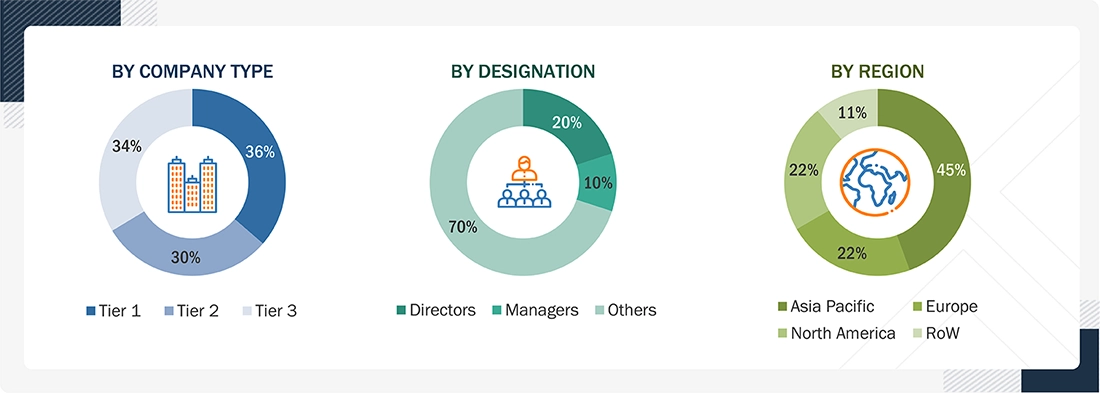
To know about the assumptions considered for the study, download the pdf brochure
Market Size Estimation
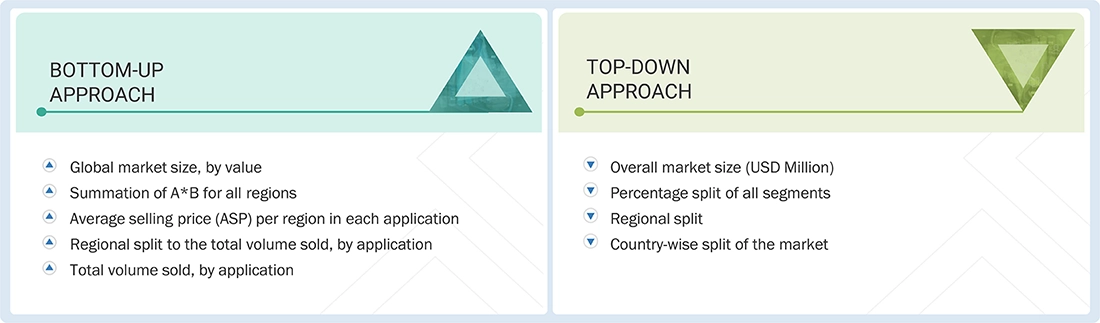
The research methodology used to estimate the size of the microcrystalline cellulose market includes the following details. The market size was undertaken from the demand side. The market was upsized based on the demand for microcrystalline cellulose in different applications at the regional level. Such procurements provide information on the demand aspects of the microcrystalline cellulose industry for each end-use industry. For each end-use industry, all possible segments of the microcrystalline cellulose market were integrated and mapped.
Data Triangulation
After arriving at the overall size from the market size estimation process explained above, the total market was split into several segments and subsegments. The data triangulation and market breakdown procedures explained below were implemented, wherever applicable, to complete the overall market engineering process and arrive at the exact statistics for various market segments and subsegments. The data was triangulated by studying various factors and trends from the demand and supply sides. Along with this, the market size was validated using both the top-down and bottom-up approaches.
Market Definition
Microcrystalline cellulose is a partially depolymerized alpha cellulose obtained from purified pulp, which is derived from wood or non-wood cellulose rich natural resource. It is a white, odorless, chemically inert, tasteless, free-flowing powder that is insoluble in water. As it is chemically inert and not absorbed in the human body, it is widely used in the pharmaceutical and food & beverage applications as a thickener, stabilizer, binder, dispersant, and bulking & anti-caking agent.
Microcrystalline cellulose has a high water-holding capacity, helping retain moisture in breads, cakes, cookies, sauces, and dressings, thus extending shelf life and improving product quality. It controls syneresis (water separation) in gels and reduces stickiness in candies and chocolates. Microcrystalline cellulose acts as an emulsion stabilizer in beverages preventing separation and ensuring consistent texture and appearance.
Microcrystalline cellulose is also widely used as an exfoliant and texturizer in cosmetics & personal care industry. Derived from plant cellulose, it appears as a fine powder. In skincare, it serves as a gentle physical exfoliant, helping to remove dead skin cells and promote smoother skin texture. Its small particle size makes it suitable for delicate areas. Microcrystalline cellulose is also utilized as a bulking agent and stabilizer in cosmetic formulations, contributing to product texture and consistency.
Stakeholders
- microcrystalline Cellulose Manufacturers
- microcrystalline cellulose Distributors and Suppliers
- Universities, Governments, and Research Organizations
- Associations and Industrial Bodies
- R&D Institutes
- Environmental Support Agencies
- Investment Banks and Private Equity Firms
- Research and Consulting Firms
Report Objectives
- To define, describe, and forecast the microcrystalline cellulose market size in terms of volume and value
- To provide detailed information regarding the key factors, such as drivers, restraints, opportunities, and challenges influencing market growth
- To analyze and project the global microcrystalline cellulose market by source, application, and region.
- To forecast the market size concerning five main regions (along with country-level data), namely, North America, Europe, Asia Pacific, the Middle East & Africa, and South America, and analyze the significant region-specific trends
- To strategically analyze micro markets with respect to individual growth trends, prospects, and contributions of the submarkets to the overall market
- To analyze the market opportunities and the competitive landscape for stakeholders and market leaders
- To assess recent market developments and competitive strategies, such as agreements, contracts, acquisitions, and product developments/product launches, to draw the competitive landscape
- To strategically profile the key market players and comprehensively analyze their core competencies
Get the Full Microcrystalline Cellulose (MCC) Market Report
Full forecast, segment splits, and company analysis for all Microcrystalline Cellulose (MCC) Market.
- Germany Microcrystalline Cellulose (MCC) Market
- France Microcrystalline Cellulose (MCC) Market
- UK Microcrystalline Cellulose (MCC) Market
- Italy Microcrystalline Cellulose (MCC) Market
- Spain Microcrystalline Cellulose (MCC) Market
- China Microcrystalline Cellulose (MCC) Market
- Japan Microcrystalline Cellulose (MCC) Market
- South Korea Microcrystalline Cellulose (MCC) Market
- Brazil Microcrystalline Cellulose (MCC) Market
- Mexico Microcrystalline Cellulose (MCC) Market
- South Africa Microcrystalline Cellulose (MCC) Market
- Rest Of Europe Microcrystalline Cellulose (MCC) Market
- Rest Of Asia Pacific Microcrystalline Cellulose (MCC) Market
- Rest Of Latin America Microcrystalline Cellulose (MCC) Market
- GCC Countries Microcrystalline Cellulose (MCC) Market
- -Rest Of GCC Microcrystalline Cellulose (MCC) Market
- US Microcrystalline Cellulose (MCC) Market
- Canada Microcrystalline Cellulose (MCC) Market
Need a Tailored Report?
Customize this report to your needs
Get 10% FREE Customization
Customize This Report
