
France Microencapsulation Market (2024-2029)

The France Microencapsulation Market was valued at $561.8 Million in 2024 and projected to reach to $896.4 Million by 2029, representing a compound annual growth rate of 9.8%. France's microencapsulation market is positioned for substantial growth as the country strengthens its role as a European leader in food innovation and functional ingredients.


| Market Size in | USD 26.32 MN |
| Market Forecast in | |
| CAGR | |
| Forecast Period | |
| Units Considered | Value (USD MN) |
France Microencapsulation Market Trends and Insights
- France is positioned as a key market within Europe, driven by increasing demand for functional food ingredients, flavor protection, and extended shelf-life solutions.
- The French market is expected to expand significantly, reaching USD 896.4 million by 2029, reflecting a compound annual growth rate of 9.8%. The expansion of France's microencapsulation market is supported by rising consumer preference for fortified and health-oriented food products, coupled with technological advancements in encapsulation techniques.
- France's strong food processing and pharmaceutical sectors are leveraging microencapsulation to enhance product performance and meet regulatory standards.
- Between 2024 and 2029, France will continue to attract investment in innovative microencapsulation solutions, particularly for probiotics, vitamins, and flavor compounds. France's position as a major food and beverage hub in Europe underscores the strategic importance of microencapsulation technologies for local manufacturers.
- The country's emphasis on premium and functional food products creates sustained demand for advanced encapsulation methods, positioning France as a growth engine within the broader European microencapsulation landscape..
Key Market Statistics
- CAGR (2024-2029) 9.8% CAGR
- Market Size, 2024 ~USD 561.8 Million
- Forecast, 2029 ~USD 896.4 Million
- Country France
France Microencapsulation Market Overview
Market Valuation :
France's microencapsulation market in food & beverage is valued at USD 561.8 million in 2024, establishing the country as a significant European hub for encapsulation technologies and functional ingredient solutions.
Strong Growth Trajectory :
The French market is projected to grow at a CAGR of 9.8% through 2029, outpacing the global average of 9.4%, demonstrating France's accelerating adoption of microencapsulation innovations.
Forecast Expansion :
Market size is expected to reach USD 896.4 million by 2029, representing a 59.6% increase over five years, driven by rising consumer demand for premium functional foods and beverage solutions.
Key Growth Drivers :
France's market is propelled by increasing demand for flavor protection, extended shelf-life solutions, and functional food ingredients, reflecting evolving consumer preferences for quality and innovation in the food & beverage sector.
France Microencapsulation Market Dynamics
- The 9.8% CAGR reflects strong demand from French food manufacturers seeking advanced encapsulation solutions to enhance product performance, protect sensitive flavors, and extend shelf-life in competitive markets.
- Premium positioning and consumer preference for high-quality functional foods support this expansion. The forecast to USD 896.4 million by 2029 underscores France's commitment to food technology advancement and regulatory compliance with European standards.
- Investment in R&D, coupled with growing consumer awareness of functional benefits, will drive adoption across dairy, beverages, confectionery, and nutritional supplement segments.
- France's established food industry infrastructure and export capabilities position it as a key growth market within the European microencapsulation landscape..
Market Ecosystem
Related Ecosystem
Key Takeaways
- France's microencapsulation market is valued at USD 561.8 million in 2024 and projected to reach USD 896.4 million by 2029, growing at a 9.8% CAGR.
- France's strong food processing sector and consumer demand for functional foods are primary drivers of microencapsulation adoption.
- Microencapsulation technologies in France are increasingly applied to probiotics, vitamins, and flavor protection in food and beverage products.
- France's emphasis on premium and health-oriented products positions the country as a strategic growth market within the European microencapsulation landscape.
Microencapsulation Market Report Scope
| Report Metric | Details |
|---|---|
| Base Year | 2024 |
| Fastest Growing Segment | GAS (Core Material Form) |
| Forecast Period | 2024-2029 |
| Growth Rate | CAGR of 9.4% from 2024 to 2029 |
| Largest Segment | CORE (Core & Shell Material) |
| Market Size Base Year (Billions) | ~USD 15.36 (2024) |
| Revenue Forecast (Billions) | ~USD 24.07 (2029) |
| Segments Covered | Core Material, Subtypes, Core Material Form, Core & Shell Material, Shell Material, Technology, End-Use Industry |
France Microencapsulation Market Report Segmentation
7 segment dimensions are covered across the global market.
By Core Material
- Active Ingredients
- Agricultural Inputs
- Food & Beverage Ingredients
- Fragrances
- Other Core Materials
- Phase Change Materials
By Subtypes
- Additives
- Enzymes
- Essential Oils
- Prebiotics & Probiotics
- Vitamins & Minerals
By Core Material Form
- Gas
- Liquid
- Solid
By Core & Shell Material
- Core
- Shell
By Shell Material
- Carbohydrates
- Gums & Resins
- Lipids
- Polymers
- Proteins
By Technology
- Dripping Technologies
- Emulsion Technologies
- Other Technologies
- Spray Technologies
By End-Use Industry
- Agriculture
- Building & Construction
- Food & Beverage
- Household & Personal Care
- Other End-Use Industries
- Pharmaceuticals
- Textile
FRANCE: MICROENCAPSULATION MARKET, BY END-USE INDUSTRY, 2024–2029
| Segment | 2024 | 2025 | 2026 | 2027 | 2028 | 2029 | CAGR (%) |
|---|---|---|---|---|---|---|---|
| AGRICULTURE | 28.3 | 30.6 | 32.9 | 35.7 | 39.2 | 42.2 | 8.3 |
| BUILDING & CONSTRUCTION | 21 | 22.4 | 23.7 | 25.3 | 27.3 | 28.9 | 6.6 |
| FOOD & BEVERAGE | 58.9 | 65 | 71.2 | 78.8 | 88.3 | 96.9 | 10.5 |
| HOUSEHOLD & PERSONAL CARE | 64.3 | 70.1 | 75.9 | 83 | 91.9 | 99.7 | 9.2 |
| OTHER END-USE INDUSTRIES | 12.3 | 13.4 | 14.4 | 15.8 | 17.4 | 18.8 | 8.9 |
| PHARMACEUTICALS | 309.9 | 340.6 | 371.4 | 409.1 | 456.1 | 498.5 | 10 |
| TEXTILE | 67.2 | 74.3 | 81.5 | 90.3 | 101.3 | 111.4 | 10.7 |
| TOTAL | 561.8 | 616.5 | 671.1 | 738 | 821.5 | 896.4 | 9.8 |
Target Audience
- Food & Beverage Manufacturers : French F&B producers need market data to assess microencapsulation adoption opportunities, benchmark competitive positioning, and make informed decisions on ingredient sourcing and product innovation investments.
- Microencapsulation Technology Suppliers : Encapsulation solution providers require France-specific market intelligence to identify growth segments, understand customer demand patterns, and develop targeted sales strategies for the expanding French market.
- Ingredient & Additive Distributors : Distributors operating in France need detailed market forecasts and application insights to optimize inventory planning, identify emerging opportunities in functional ingredients, and strengthen supplier relationships.
- Investment & Private Equity Firms : Investors evaluating opportunities in the French food technology sector require comprehensive market sizing and growth projections to assess portfolio companies, identify acquisition targets, and evaluate market entry strategies.
- Market Research & Strategy Consultants : Consultants advising clients on French market expansion need authoritative, country-specific data to support strategic recommendations, competitive analysis, and go-to-market planning in the microencapsulation sector.
Reasons to Buy this Report
- Market-Specific Sizing & Forecasts : Access precise valuation data for France's microencapsulation market (USD 561.8M in 2024, USD 896.4M by 2029) with country-specific CAGR of 9.8%, enabling accurate business planning and investment decisions tailored to the French market.
- Competitive Positioning Intelligence : Understand France's market dynamics relative to global trends (9.4% global CAGR) and identify competitive advantages in the European food & beverage sector, supporting strategic market entry and expansion strategies.
- Segment & Application Insights : Gain detailed analysis of French demand drivers including flavor protection, shelf-life extension, and functional ingredient applications, enabling targeted product development and marketing strategies for French manufacturers and suppliers.
- Regulatory & Consumer Trend Analysis : Leverage France-specific insights on regulatory compliance, consumer preferences for premium functional foods, and innovation trends shaping the microencapsulation landscape in this key European market.
- Investment & Growth Opportunity Assessment : Evaluate France's 59.6% market growth potential through 2029 to identify high-ROI opportunities in manufacturing, distribution, and technology partnerships within the expanding French food innovation ecosystem.
Frequently asked questions
What is the current size of France's microencapsulation market?
France's microencapsulation market was valued at USD 561.8 million in 2024 and is expected to grow to USD 896.4 million by 2029.
What is the projected growth rate for microencapsulation in France?
France's microencapsulation market is projected to grow at a compound annual growth rate (CAGR) of 9.8% from 2024 to 2029.
Which applications drive microencapsulation demand in France?
In France, microencapsulation is primarily driven by applications in probiotics, vitamins, flavor protection, and functional food ingredients within the food and beverage sector.
Why is France a significant market for microencapsulation?
France's strong food processing industry, consumer preference for premium and functional foods, and advanced pharmaceutical sector make it a key market for microencapsulation technologies.
What factors are expected to support France's microencapsulation market growth through 2029?
Growth in France is supported by rising demand for fortified foods, technological advancements in encapsulation, regulatory compliance needs, and consumer focus on health and wellness products.
RESEARCH METHODOLOGY
The study involved two major approaches in estimating the current size of the microencapsulation market. Exhaustive secondary research was done to collect information on the market, peer, and parent markets. The next step was to validate these findings, assumptions, and sizing with industry experts across the value chain through primary research. Both top-down and bottom-up approaches were employed to estimate the complete market size. After that, market breakdown and data triangulation were used to estimate the market size of segments and subsegments.
Secondary Research
This research study involved the extensive use of secondary sources—directories and databases such as Bloomberg Businessweek and Factiva—to identify and collect information useful for a technical, market-oriented, and commercial study of the market.
In the secondary research process, various sources such as annual reports, press releases & investor presentations of companies, white papers, food journals, certified publications, articles from recognized authors, directories, and databases were referred to identify and collect information.
Secondary research was mainly used to obtain key information about the industry’s supply chain, the total pool of key players, and market classification and segmentation as per the industry trends to the bottom-most level, regional markets, and key developments from both market- and technology-oriented perspectives.
Primary Research
Extensive primary research was conducted after obtaining information regarding the microencapsulation market scenario through secondary research. Several primary interviews were conducted with market experts from both the demand and supply sides across major countries of North America, Europe, Asia Pacific, South America, and the Rest of the World. Primary data was collected through questionnaires, emails, and telephonic interviews. The primary sources from the supply side included various industry experts, such as Chief X Officers (CXOs), Vice Presidents (VPs), Directors from business development, marketing, research, and development teams, and related key executives from distributors and key opinion leaders. Primary interviews were conducted to gather insights such as market statistics, data on revenue collected from the products and services, market breakdowns, market size estimations, market forecasting, and data triangulation. Primary research also helped in understanding the various trends related to core material, core material form, shell material type, technology, end-user industry, functionality, and region. Stakeholders from the demand side, such as food and beverage manufacturers, pharmaceutical companies, nutraceutical companies, the agriculture sector, and cosmetic and personal care brands, were interviewed to understand the buyer’s perspective on the suppliers, products, and their current usage of feeding systems and the outlook of their business, which will affect the overall market.
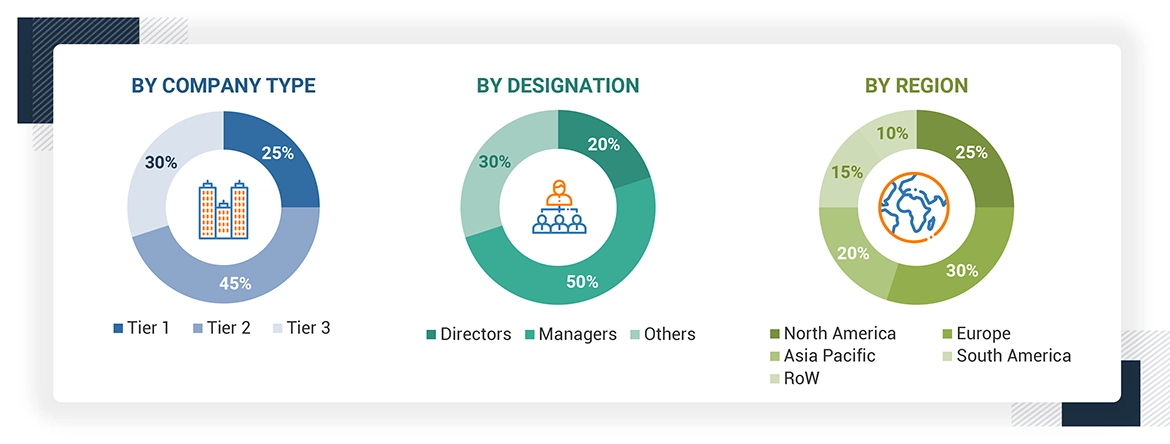
Note: The three tiers of the companies are defined based on their total revenues in 2022 or 2023, as per the availability of financial data: Tier 1: Revenue > USD 1 billion; Tier 2: USD 100 million = Revenue = USD 1 billion; Tier 3: Revenue < USD 100 million.
To know about the assumptions considered for the study, download the pdf brochure
|
COMPANY NAME |
DESIGNATION |
|
BASF (Germany) |
Product Development Manager |
|
FrieslandCampina (Netherlands) |
Senior R&D Scientist |
|
dsm-firmenich (Switzerland) |
Global Marketing Director |
|
GIVAUDAN (Switzerland) |
Head of Microencapsulation Technology |
|
International Flavors & Fragrances Inc. (US) |
Senior Research Scientist |
|
Sensient Technologies Corporation (US) |
Business Development Manager |
Market Size Estimation
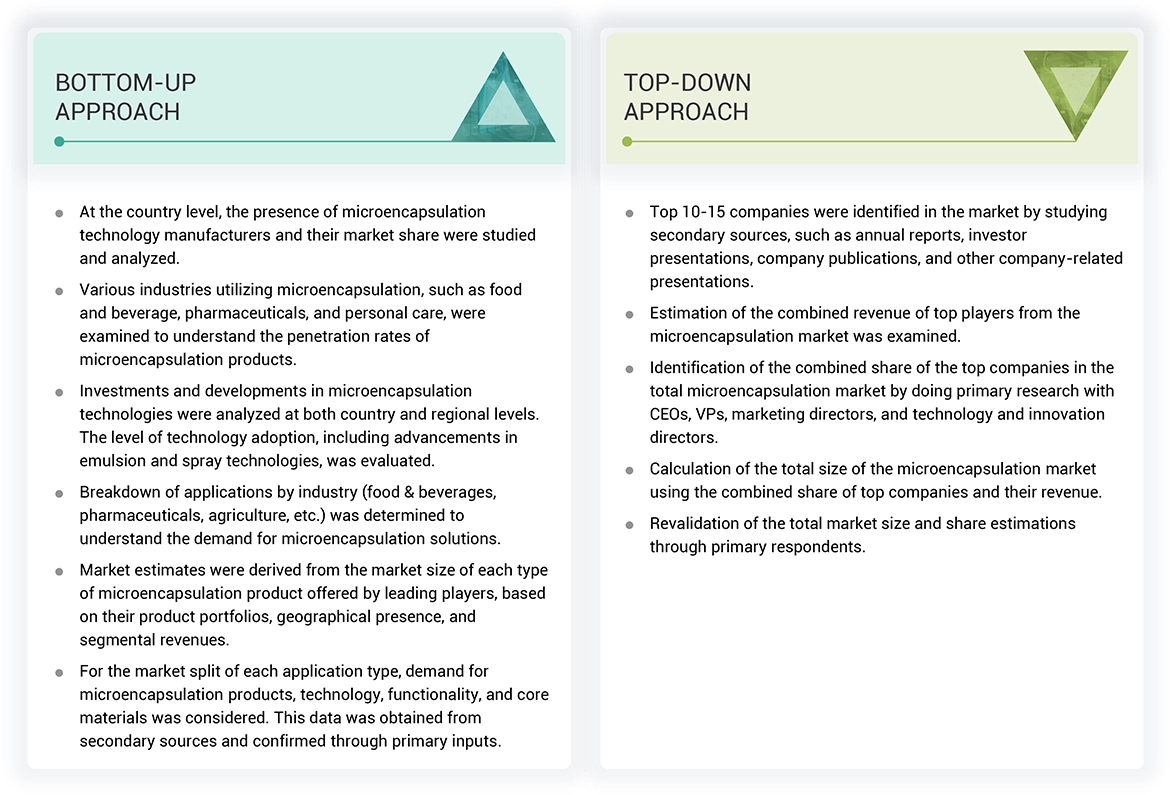
Both the top-down and bottom-up approaches were used to estimate and validate the total size of the microencapsulation market. These approaches were also used extensively to determine the size of various subsegments in the market. The research methodology used to estimate the market size includes the following details:
- The key players in the industry and the overall markets were identified through extensive secondary research.
- All shares, splits, and breakdowns were determined using secondary sources and verified through primary sources.
- All possible parameters that affect the market covered in this research study were accounted for, viewed in extensive detail, verified through primary research, and analyzed to obtain final quantitative and qualitative data.
- The research included the study of reports, reviews, and newsletters of top market players, along with extensive interviews for opinions from leaders, such as CEOs, directors, and marketing executives.
Microencapsulation Market : Top-Down and Bottom-Up Approach
Data Triangulation
After arriving at the overall market size from the estimation process explained above, the total market was split into several segments and subsegments. The data triangulation and market breakdown procedures were employed, wherever applicable, to estimate the overall microencapsulation market and arrive at the exact statistics for all segments and subsegments. The data was triangulated by studying various factors and trends from the demand and supply sides. The market size was also validated using both the top-down and bottom-up approaches.
Market Definition
Microencapsulation is the process of surrounding tiny particles or droplets with a coating to create microcapsules. These microcapsules can encapsulate various materials, including food ingredients, enzymes, cells, and pharmaceuticals. The encapsulated material is referred to as the core or internal phase, while the coating is known as the shell or membrane.
According to the article “A Review On Microspheres,” published by R. B. Saudagar and Kanchan T. Mandlik in the International Journal of Pharma and Bio Sciences, “Microencapsulation is a process in which tiny particles or droplets are surrounded by a coating to give small capsules. In a relatively simplistic form, a microcapsule is a small sphere with a uniform wall around it. The material inside the microcapsule is referred to as the core, internal phase, or fill, whereas the wall is sometimes called a shell, coating, or membrane. Most microcapsules have diameters between a few micrometers and a few millimeters.”
Stakeholders
-
Food and Beverage Manufacturers
- Fortified food producers
- Functional beverage companies
- Dietary supplement manufacturers
-
Pharmaceutical Companies
- Generic drug manufacturers
- Specialty pharmaceutical firms
-
Cosmetic and Personal Care Brands
- Skincare and hair care product manufacturers
- Cosmetic companies
-
Nutraceutical Companies
- Health supplement brands
- Functional food producers
-
Agricultural Sector
- Fertilizer and pesticide manufacturers
- Seed treatment companies
-
Regulatory bodies and institutions:
- U.S. Food and Drug Administration (FDA)
- European Food Safety Authority (EFSA)
- Health Canada
- Food Safety and Standards Authority of India (FSSAI)
- World Health Organization (WHO)
- Codex Alimentarius Commission
- European Medicines Agency (EMA)
- National Institutes of Health (NIH)
- Institute of Food Technologists (IFT)
- American Chemical Society (ACS)
-
Distributors and Wholesalers
- Ingredient and equipment distributors
-
Research and Development Institutions
- Academic research organizations
- Private research labs
Report Objectives
- To determine and project the size of the microencapsulation market with respect to the core material, core material form, shell material, end-use industry, technology, functionality, and regions in terms of value over five years, ranging from 2024 to 2029.
- To identify the attractive opportunities in the market by determining the largest and fastest-growing segments across regions
- To provide detailed information about the key factors influencing market growth (drivers, restraints, opportunities, and challenges)
- To analyze the opportunities in the market for stakeholders and provide details of the competitive landscape for market leaders.
- To analyze the micro-markets with respect to individual growth trends, prospects, and their contribution to the total market.
- To identify and profile the key players in the microencapsulation market.
- To understand the competitive landscape and identify the major growth strategies adopted by players across the key regions.
Available Customizations
With the given market data, MarketsandMarkets offers customizations according to company-specific scientific needs.
The following customization options are available for the report:
Product Analysis
- Product Matrix, which gives a detailed comparison of the product portfolio of each company.
Geographic Analysis
With the given market data, MarketsandMarkets offers customizations according to company-specific scientific needs.
- Further breakdown of the Rest of Europe microencapsulation market into key countries.
- Further breakdown of the Rest of Asia Pacific microencapsulation market into key countries.
- Further breakdown of the Rest of South America microencapsulation market into key countries.
Company Information
- Detailed analyses and profiling of additional market players (up to five)
Get the Full Microencapsulation Market Report
Full forecast, segment splits, and company analysis for all Microencapsulation Market.
- US Microencapsulation Market
- Canada Microencapsulation Market
- Mexico Microencapsulation Market
- Germany Microencapsulation Market
- UK Microencapsulation Market
- Italy Microencapsulation Market
- Spain Microencapsulation Market
- China Microencapsulation Market
- Japan Microencapsulation Market
- India Microencapsulation Market
- Brazil Microencapsulation Market
- Argentina Microencapsulation Market
- Rest Of Europe Microencapsulation Market
- Rest Of Asia Pacific Microencapsulation Market
- Rest Of South America Microencapsulation Market
Need a Tailored Report?
Customize this report to your needs
Get 10% FREE Customization
Customize This Report
