
US Military Cloud Computing Market (2026-2031)

The US Military Cloud Computing Market was valued at $8552.2 Million in 2026 and projected to reach to $21727.9 Million by 2031, representing a compound annual growth rate of 20.5%. The US military cloud computing market is poised for sustained growth through 2031, driven by the Department of Defense's commitment to digital modernization and cloud-first strategies.


| Market Size in | USD 26.32 MN |
| Market Forecast in | |
| CAGR | |
| Forecast Period | |
| Units Considered | Value (USD MN) |
US Military Cloud Computing Market Trends and Insights
- The US defense sector's accelerating digital transformation and modernization initiatives are driving significant investment in cloud infrastructure to enhance operational efficiency, data management, and cybersecurity capabilities.
- The US military's shift toward cloud-native architectures reflects broader strategic priorities in maintaining technological superiority and enabling real-time intelligence sharing across distributed defense networks. Driving this growth, the US faces increasing pressure to modernize legacy systems while managing complex multi-cloud environments across military branches.
- The US Department of Defense's commitment to cloud adoption, coupled with rising cybersecurity threats and the need for scalable computing resources, positions cloud computing as critical infrastructure.
- Between 2026 and 2031, the US market will benefit from increased defense budgets, accelerated digital warfare capabilities, and enhanced collaboration platforms that leverage cloud technologies to support joint operations and intelligence analysis..
Key Market Statistics
- CAGR (2026-2031) 20.5% CAGR
- Market Size, 2026 ~USD 8552.2 Million
- Forecast, 2031 ~USD 21727.9 Million
- Country US
US Military Cloud Computing Market Overview
Market Valuation Growth :
The US military cloud computing market is valued at $8,552.2 million in 2026 and is projected to expand to $21,727.9 million by 2031, representing a robust 20.5% CAGR over the forecast period.
Digital Transformation Momentum :
US defense sector modernization initiatives are accelerating cloud adoption to enhance operational efficiency, streamline data management, and strengthen cybersecurity posture across military installations and command centers.
Strategic Infrastructure Investment :
Increased federal defense budgets and DoD cloud modernization programs are driving substantial investments in secure, scalable cloud infrastructure to support mission-critical operations and real-time intelligence capabilities.
Cybersecurity & Compliance Focus :
US military cloud solutions prioritize advanced security protocols, compliance with NIST standards, and data sovereignty requirements, positioning the market as a critical component of national defense infrastructure.
US Military Cloud Computing Market Dynamics
- Increasing demand for secure, scalable infrastructure to support advanced analytics, artificial intelligence, and real-time command capabilities will fuel market expansion.
- The integration of cloud technologies across military branches for enhanced interoperability and operational readiness represents a significant growth catalyst. Government spending on defense cloud initiatives, coupled with private sector innovation in secure cloud solutions, will create substantial opportunities for market participants.
- Regulatory compliance requirements and cybersecurity mandates will continue to shape product development and service offerings, ensuring the US military cloud market remains a priority investment area for defense modernization through the forecast period..
Market Ecosystem
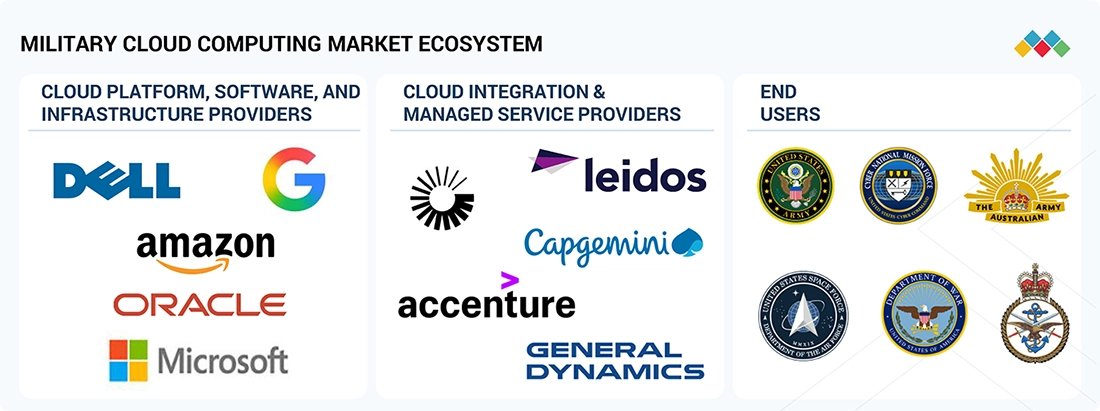
MILITARY CLOUD COMPUTING MARKET: COMMERCIAL USE CASES ACROSS INDUSTRIES
| COMPANY | USE CASE DESCRIPTION | BENEFITS |
|---|---|---|
 |
AWS was selected under the US DoD JWCC contract to provide cloud services across security domains and classification levels, from headquarters to tactical edge locations | It supports mission applications, ISR data, command systems, and secure workload hosting | Supports approved cloud access | Covers classified and unclassified workloads | Helps mission teams use cloud capacity across fixed and tactical locations |
 |
Google Public Sector used a Google Distributed Cloud air-gapped appliance in the US Air Force Mobility Guardian 2025 exercise for tactical edge cloud use in disconnected or low-bandwidth conditions | It supported local processing, secure collaboration, and AI-related field tasks | Supports cloud use in field conditions | Allows local processing when connectivity is limited | Helps with situational awareness, translation, OCR, and maintenance support |
 |
Dell EMC Tactical Microsoft Azure Stack provides Azure-consistent cloud capability for remote and rugged environments with limited connectivity | It supports tactical edge cloud use, local data processing, and hybrid connection back to Azure Government | Supports tactical edge cloud use | Enables local processing in low-connectivity areas | Helps defense users run hybrid cloud workloads closer to deployed units |
Logos and trademarks shown above are the property of their respective owners. Their use here is for informational and illustrative purposes only.
Related Ecosystem
Defence Platforms And Systems
- Sensors
- Unmanned Ground Vehicles (UGV)
- Fighter Aircraft
- Special Mission Aircraft
- Antennas
- Thales group
- BAE Systems plc
- LOCKHEED MARTIN CORPORATION
- Northrop Grumman Corporation
- L3Harris Technologies, Inc.
Electronic Warfare
- Antennas
- Automated Test Equipment
- Military Helicopters
- Signal Generators
- Special Mission Aircraft
- Thales group
- Northrop Grumman Corporation
- L3Harris Technologies, Inc.
- BAE Systems plc
- LOCKHEED MARTIN CORPORATION
Cloud Computing
- Software as A Service (SaaS)
- Natural Language Processing (NLP)
- Platform as A Service (PaaS)
- Machine Learning
- Supply Chain Management
- International Business Machines Corporation
- MICROSOFT CORPORATION
- Oracle Corporation
- Amazon.com, Inc.
Key Takeaways
- The US military cloud computing market will grow from $8.55B in 2026 to $21.73B by 2031, representing a 20.5% CAGR.
- The US Department of Defense's modernization strategy and digital transformation initiatives are primary catalysts for cloud adoption across military branches.
- The US market is driven by cybersecurity imperatives, real-time data processing needs, and the requirement for scalable infrastructure supporting joint operations.
- The US defense sector's investment in cloud technologies will enable enhanced intelligence sharing, operational efficiency, and competitive advantage in modern warfare.
Military Cloud Computing Market Report Scope
| Report Metric | Details |
|---|---|
| Base Year | 2026 |
| Fastest Growing Segment | INFRASTRUCTURE AS A SERVICE (Cloud Service Model) |
| Forecast Period | 2026–2031 |
| Growth Rate | CAGR of 19.9% from 2026 to 2031 |
| Largest Segment | PUBLIC CLOUD (Deployment) |
| Market Size Base Year (Billions) | ~USD 13.85 (2026) |
| Revenue Forecast (Billions) | ~USD 34.32 (2031) |
| Segments Covered | Offering, End User, Cloud Service Model, Deployment, Deployment Type, Service Model, Application |
US Military Cloud Computing Market Report Segmentation
7 segment dimensions are covered across the global market.
By Offering
- Cloud Cost Management And Governance, Finops
- Cloud Integration And Engineering Services
- Cloud Migration And Modernization Services
- Cloud Security, Compliance, And Authorization Services
- Cloud Service Models
- Managed Cloud Operations
By End User
- Air
- Air Force
- Army
- Land
- Naval
- Navy
- Other Defense Agencies
- Space
By Cloud Service Model
- Infrastructure As A Service
- Platform As A Service
- Software As A Service
By Deployment
- Hybrid Cloud
- Private Cloud
- Public Cloud
- Tactical Edge Cloud
By Deployment Type
- Hybrid Cloud
- Private Cloud
- Public Cloud
By Service Model
- Infrastructure-As-A-Service (IaaS)
- Platform-As-A-Service (PaaS)
- Software-As-A-Service (SaaS)
By Application
- Command, Control, And Mission Applications
- Isr Data Processing And Analytics
- Logistics, Maintenance, And Readiness Management
- Training, Simulation, And Digital Engineering
US: MILITARY CLOUD COMPUTING MARKET, BY END USER, 2026–2031
| Segment | 2026 | 2027 | 2028 | 2029 | 2030 | 2031 | CAGR (%) |
|---|---|---|---|---|---|---|---|
| AIR | 1825.6 | 2248.2 | 2771.4 | 3419.7 | 4223.9 | 5222.4 | 23.4 |
| LAND | 1803.5 | 2142.8 | 2543.3 | 3015.2 | 3570.7 | 4223.9 | 18.6 |
| NAVAL | 1270.2 | 1519.5 | 1815.7 | 2167.4 | 2584.3 | 3078.1 | 19.4 |
| OTHER DEFENSE AGENCIES | 2920.5 | 3496.7 | 4182.1 | 4996.5 | 5962.9 | 7108.3 | 19.5 |
| SPACE | 732.5 | 902 | 1111.9 | 1372 | 1694.7 | 2095.3 | 23.4 |
| TOTAL | 8552.2 | 10309.2 | 12424.5 | 14970.9 | 18036.6 | 21727.9 | 20.5 |
Target Audience
- Defense Contractors & Integrators : Need detailed US military cloud market data to develop competitive solutions, bid on DoD contracts, and align service offerings with government modernization priorities and procurement cycles.
- Cloud Technology Vendors : Require US-specific market intelligence to identify growth opportunities in the defense sector, understand compliance requirements, and develop secure cloud platforms tailored to military operational needs.
- Government & Military Procurement Officers : Utilize market insights to evaluate vendor capabilities, benchmark pricing, and make informed decisions on cloud infrastructure investments that support mission-critical defense operations and digital transformation.
- Investment & Private Equity Firms : Need comprehensive US market analysis to identify acquisition targets, assess growth potential in the defense technology sector, and evaluate investment opportunities in military cloud computing companies.
- Cybersecurity & Defense Consultants : Require current US market data to advise clients on cloud adoption strategies, security best practices, and compliance frameworks specific to military operations and federal defense requirements.
Reasons to Buy this Report
- Precise US Market Sizing : Access validated market valuations specific to the US military cloud computing sector, with detailed 2026-2031 forecasts enabling accurate budget allocation and investment planning for defense-focused organizations.
- DoD Strategy Alignment : Understand how US Department of Defense modernization priorities and cloud-first policies are reshaping the market landscape, helping stakeholders align product development with government procurement requirements.
- Competitive Intelligence : Identify market dynamics, growth drivers, and emerging opportunities specific to the US defense sector, enabling informed competitive positioning and strategic partnership decisions in this high-growth segment.
- Regulatory & Compliance Insights : Gain clarity on NIST standards, data sovereignty requirements, and security compliance mandates that govern US military cloud solutions, ensuring product offerings meet stringent government specifications.
- Investment Decision Support : Leverage comprehensive US market analysis to support capital allocation decisions, M&A strategies, and go-to-market planning for defense contractors, technology vendors, and investment firms targeting the military sector.
Frequently asked questions
What is the projected size of the US military cloud computing market by 2031?
The US military cloud computing market is projected to reach $21,727.9 million by 2031, growing from $8,552.2 million in 2026 at a CAGR of 20.5%.
What are the primary drivers of growth in the US military cloud computing market?
The US market is driven by the Department of Defense's digital transformation initiatives, modernization of legacy systems, cybersecurity requirements, and the need for scalable computing resources supporting joint military operations.
How does the US military cloud computing market compare to global trends?
The US market grows at 20.5% CAGR, slightly outpacing the global average of 19.9%, reflecting the US defense sector's strategic prioritization of cloud adoption and technological superiority.
What role does cybersecurity play in the US military cloud computing market?
Cybersecurity is a critical driver in the US market, as the military requires secure, resilient cloud infrastructure to protect sensitive defense data and maintain operational continuity against evolving threats.
Which US military branches are most actively adopting cloud computing?
The US Army, Navy, Air Force, and Department of Defense agencies are all actively adopting cloud technologies to enhance interoperability, data sharing, and operational capabilities across joint command structures.
RESEARCH METHODOLOGY
The study involved four major activities to estimate the current size of the military cloud computing market. Exhaustive secondary research was conducted to gather information on the military cloud computing market, its adjacent markets, and its parent market. The next step was to validate these findings, assumptions, and sizing with industry experts across the value chain through primary research. Demand-side analysis was conducted to estimate the overall market size. Thereafter, data triangulation procedures were employed to estimate the sizes of various segments and subsegments within the military cloud computing market.
Secondary Research
During the secondary research process, various sources were consulted to identify and collect information for this study. The secondary sources included government sources, such as SIPRI; corporate filings, including annual reports, press releases, and investor presentations; white papers, journals, and certified publications; and articles from recognized authors, directories, and databases.
Primary Research
Extensive primary research was conducted after acquiring information on the military cloud computing market through secondary research. Several primary interviews were conducted with market experts from the demand and supply sides across major countries of North America, Europe, Asia Pacific, and the Rest of the World (RoW). Primary data was collected through questionnaires, emails, and telephonic interviews.
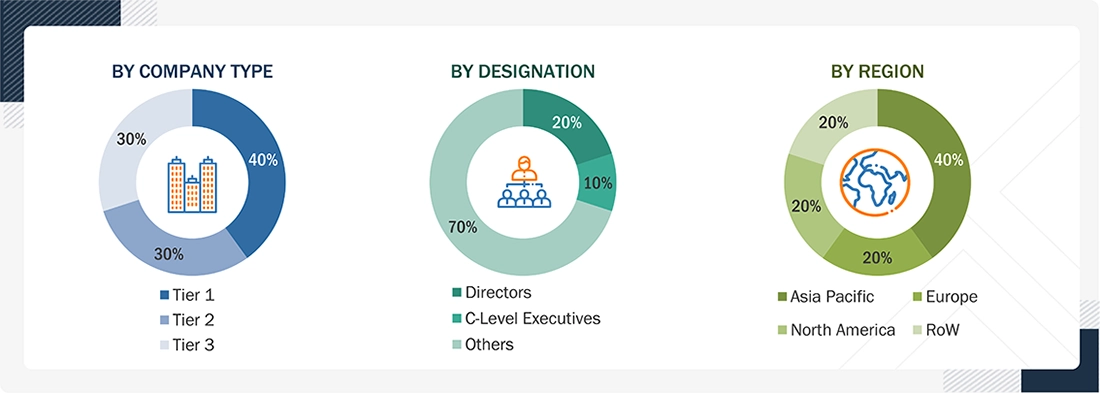
To know about the assumptions considered for the study, download the pdf brochure
Market Size Estimation
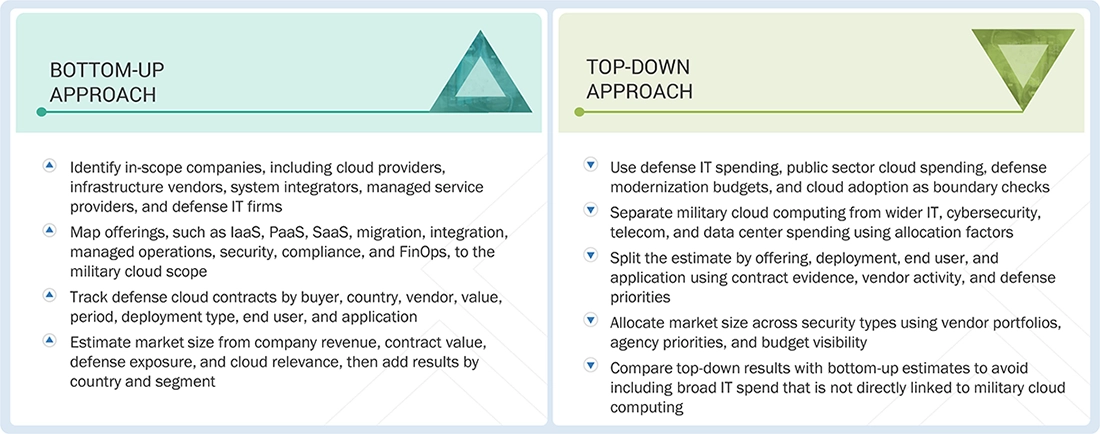
Top-down and bottom-up approaches were used to estimate and validate the size of the military cloud computing market. The bottom-up approach was used as the main method, while the top-down approach was used as a reasonableness check.
The research methodology used to estimate the market size included the following details:
- Key companies in the military cloud computing market were identified through secondary research. These included cloud providers, infrastructure vendors, system integrators, managed service providers, defense IT firms, SaaS providers and tactical edge cloud providers. Their military cloud revenue was estimated using company revenue, business segment revenue, contract awards, defense exposure, product fit, and geographic presence.
- Market shares, splits, and breakdowns were determined using public sources, company filings, contract databases, defense procurement records, and vendor disclosures. The market was split by offering, deployment, end user, application, country, and region, based on visible contracts and company-level revenue allocation.
- Top-down checks were used to test whether the final estimates were reasonable against broader defense IT spending, public sector cloud spending, defense digital modernization budgets, and cloud adoption levels. The final data was reviewed to avoid including general IT, telecom, cybersecurity, or data center spending that was not directly linked to military cloud computing.
Military Cloud Computing Market : Top-Down and Bottom-Up Approach
Data Triangulation
After determining the overall market size, the total market was classified into several segments and subsegments. The data triangulation and market breakdown procedures explained below were implemented, wherever applicable, to complete the overall market engineering process and arrive at the estimated market numbers for the market segments and subsegments. The data was triangulated by examining various factors and trends on both the demand and supply sides. Additionally, the market size was validated using top-down and bottom-up approaches.
Market Definition
Military cloud computing includes cloud infrastructure, platforms, software, migration, integration, managed operations, cloud security, compliance, and cost management used by defense organizations. Cloud storage is part of the market, but the market also covers wider cloud services and support, not storage alone.
Key Stakeholders
- Cloud Platform Providers
- Cloud Infrastructure and Software Providers
- Cloud Integration and Managed Services Providers
- Defense End Users
- Government and Defense Procurement Bodies
- Cybersecurity, Compliance, and Authorization Bodies
- Defense Primes and Mission System Integrators
- Tactical Edge and Communications Providers
Report Objectives
- To define, describe, and forecast the military cloud computing market based on offering, application, end user, deployment, and region in terms of value
- To forecast the size of various segments of the market across North America, Europe, Asia Pacific and RoW, in terms of value
- To identify and analyze the drivers, restraints, opportunities, and challenges influencing the growth of the market
- To identify industry trends, market trends, and technology trends currently prevailing in the military cloud computing market
- To provide an overview of the regulatory landscape with respect to military cloud computing across regions
- To analyze micromarkets with respect to individual growth trends, prospects, and their contribution to the overall market
- To analyze opportunities in the market for stakeholders by identifying key market trends
- To profile key market players and comprehensively analyze their market share and core competencies
- To evaluate the degree of competition in the market by analyzing recent developments, such as contracts, agreements, and acquisitions adopted by leading market players
- To identify detailed financial positions, key products, and unique selling points of leading companies in the market
- To provide a detailed competitive landscape of the market, along with market share analysis and revenue analysis of key players
Available customizations:
MarketsandMarkets offers the following customizations for this market report:
- Additional country-level analysis of the military cloud computing market
- Profiling of other market players (Up to 5)
Product Analysis
- Product matrix, which provides a detailed comparison of the product portfolios of each company in the military cloud computing market
Get the Full Military Cloud Computing Market Report
Full forecast, segment splits, and company analysis for all Military Cloud Computing Market.
- Canada Military Cloud Computing Market
- UK Military Cloud Computing Market
- France Military Cloud Computing Market
- Germany Military Cloud Computing Market
- Italy Military Cloud Computing Market
- Spain Military Cloud Computing Market
- India Military Cloud Computing Market
- Japan Military Cloud Computing Market
- South Korea Military Cloud Computing Market
- Australia Military Cloud Computing Market
- Rest Of Europe Military Cloud Computing Market
- Rest Of Asia Pacific Military Cloud Computing Market
Need a Tailored Report?
Customize this report to your needs
Get 10% FREE Customization
Customize This Report
