
Japan Military Platforms Market (2025-2030)

The Japan Military Platforms Market was valued at $58957 Million in 2025 and projected to reach to $59601 Million by 2030, representing a compound annual growth rate of 0.2%. Japan's military platforms market is entering a period of sustained stability with minimal expansion through 2030.


| Market Size in | USD 26.32 MN |
| Market Forecast in | |
| CAGR | |
| Forecast Period | |
| Units Considered | Value (USD MN) |
Japan Military Platforms Market Trends and Insights
- This minimal expansion indicates Japan's mature and stable defense procurement environment, where existing platform modernization and maintenance dominate spending patterns rather than new platform acquisitions.
- Japan's strategic focus on regional security and alliance partnerships with advanced economies shapes the trajectory of its military platforms sector. The subdued growth in Japan's military platforms market contrasts with broader Asia-Pacific expansion, driven by Japan's established defense industrial base and constrained budget allocations relative to GDP.
- Between 2025 and 2030, Japan will prioritize upgrades to existing naval, air, and ground platforms to maintain technological parity amid evolving regional threats.
- Japan's emphasis on indigenous defense capabilities and selective foreign partnerships will continue to define procurement strategies throughout the forecast period..
Key Market Statistics
- CAGR (2025-2030) 0.2% CAGR
- Market Size, 2025 ~USD 58957 Million
- Forecast, 2030 ~USD 59601 Million
- Country Japan
Japan Military Platforms Market Overview
Mature Defense Market :
Japan's military platforms market is valued at $58,957 million in 2025, characterized by a stable and mature procurement environment focused on platform modernization rather than new acquisitions.
Minimal Growth Trajectory :
With a CAGR of 0.2% through 2030, Japan's market reflects conservative defense spending patterns, reaching $59,601 million by forecast end, indicating budget constraints and strategic consolidation.
Maintenance-Driven Spending :
Japan's defense budget prioritizes existing platform maintenance and incremental upgrades over large-scale new platform development, reflecting aging fleet modernization needs.
Contrast with Global Growth :
While Japan's market grows at 0.2% CAGR, the global military platforms market expands at 10.2%, highlighting Japan's unique position as a slower-growth, stability-focused defense economy.
Japan Military Platforms Market Dynamics
- The 0.2% CAGR reflects a mature defense procurement landscape where budget allocations remain constrained by fiscal pressures and demographic challenges.
- Spending will continue to concentrate on lifecycle management, system upgrades, and incremental capability enhancements of existing platforms rather than transformative new acquisitions. Looking ahead, Japan's defense modernization will be shaped by regional security dynamics and aging platform inventories.
- While growth remains subdued compared to global trends, strategic investments in cyber-integrated systems and autonomous capabilities may emerge as niche growth areas.
- The market will remain characterized by long-term sustainment contracts and selective platform replacements rather than expansionary procurement cycles..
Market Ecosystem
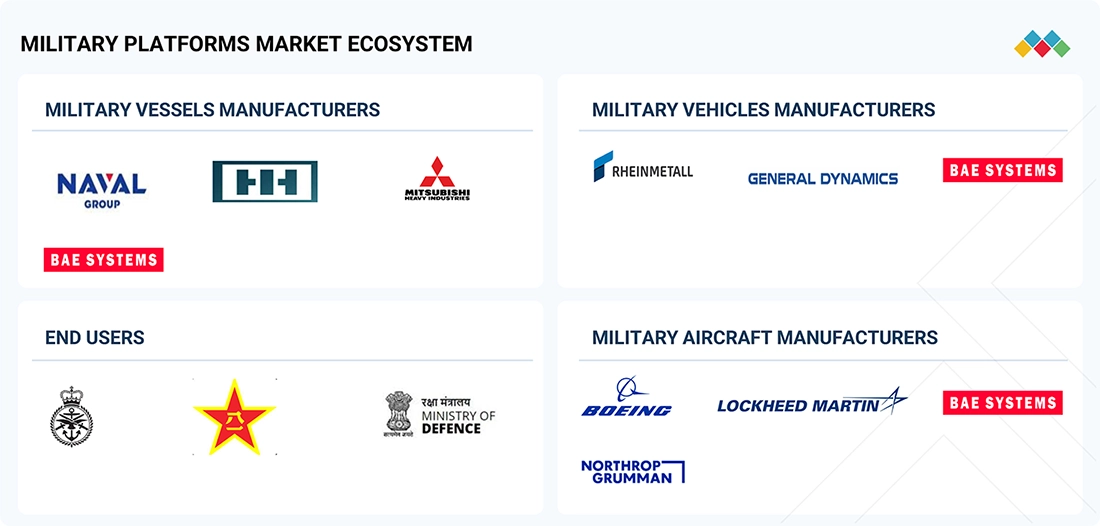
MILITARY PLATFORMS MARKET: COMMERCIAL USE CASES ACROSS INDUSTRIES
| COMPANY | USE CASE DESCRIPTION | BENEFITS |
|---|---|---|
 |
Develops and upgrades military vehicles, naval vessels, and combat aircraft for multi-domain combat, mobility, and force protection missions | Improves operational readiness, survivability, and mission effectiveness across land, sea, and air operations |
 |
Designs advanced combat aircraft, missile systems, and integrated defense platforms for air dominance and strategic deterrence roles | Enhances situational awareness, precision engagement, and interoperability in complex threat environments |
 |
Builds and maintains aircraft carriers, destroyers, and amphibious ships for naval power projection and maritime security | Strengthens naval presence, fleet availability, and long-term maritime operational capability |
 |
Develops military aircraft, rotorcraft, and support platforms for transport, surveillance, and multi-role operations | Improves air mobility, mission flexibility, and force sustainment across global deployments |
Logos and trademarks shown above are the property of their respective owners. Their use here is for informational and illustrative purposes only.
Related Ecosystem
Aviation
- Narrow Body Aircraft
- Wide Body Aircraft
- Military Helicopters
- Special Mission Aircraft
- Fighter Aircraft
- HONEYWELL INTERNATIONAL INC.
- COLLINS AEROSPACE
- Thales group
- Safran group
- HEICO Corporation
Defence Platforms And Systems
- Sensors
- Unmanned Ground Vehicles (UGV)
- Fighter Aircraft
- Special Mission Aircraft
- Antennas
- Thales group
- BAE Systems plc
- LOCKHEED MARTIN CORPORATION
- Northrop Grumman Corporation
- L3Harris Technologies, Inc.
Marine
- Tankers
- Fuel Cell
- HVAC System
- Navigation Systems
- Sensors
- Wartsila
- Kongsberg Gruppen ASA
- L3Harris Technologies, Inc.
- ABB India Limited
- Northrop Grumman Corporation
Key Takeaways
- Japan's military platforms market will grow at only 0.2% CAGR from 2025 to 2030, indicating market maturity and stable, incremental spending.
- Japan's defense procurement strategy prioritizes modernization and maintenance of existing platforms over new acquisitions during the forecast period.
- Japan's market size of $58,957 million in 2025 reflects a well-established defense industrial base with limited room for expansion.
- Japan's regional security concerns and alliance partnerships will drive selective platform upgrades rather than transformative market growth through 2030.
Military Platforms Market Report Scope
| Report Metric | Details |
|---|---|
| Base Year | 2025 |
| Fastest Growing Segment | PATROL VESSELS (Military Vessel) |
| Forecast Period | 2025–2030 |
| Growth Rate | CAGR of 10.2% from 2025 to 2030 |
| Largest Segment | LEGACY (Technology) |
| Market Size Base Year (Billions) | ~USD 38.63 (2025) |
| Revenue Forecast (Billions) | ~USD 62.79 (2030) |
| Segments Covered | Platform Type, Military Aircraft, Military Vessel, Military Vehicle, Customer, Technology |
Japan Military Platforms Market Report Segmentation
6 segment dimensions are covered across the global market.
By Platform Type
- Military Aircraft
- Military Vehicles
- Military Vessels
By Military Aircraft
- Fighter Aircraft
- Helicopters
- Special Mission Aircraft
- Transport Aircraft
By Military Vessel
- Aircraft Carriers
- Corvettes
- Destroyers
- Frigates
- Mine Warfare
- Patrol Vessels
- Submarines
By Military Vehicle
- Armored Personnel Carriers (Apcs)
- Armored Supply Trucks
- Infantry Fighting Vehicles (Ifvs)
- Main Battle Tanks (Mbts)
- Mine Resistant Ambush Protected (Mrap)
By Customer
- Air Force
- Army
- Naval
- Navy
By Technology
- Legacy
- Next Generation
Target Audience
- Defense Contractors & OEMs : Manufacturers and system integrators need Japan-specific market data to identify sustainment contract opportunities, platform upgrade requirements, and long-term modernization partnerships in this stable but low-growth market.
- Government & Military Procurement : Japanese Ministry of Defense and Self-Defense Force planners require market intelligence to benchmark spending trends, validate budget forecasts, and optimize platform lifecycle management strategies.
- Investment & Private Equity Firms : Investors evaluating aerospace & defense portfolios need Japan market analysis to assess growth potential, identify consolidation targets, and understand regional defense spending sustainability.
- Supply Chain & Component Suppliers : Subsystem and component manufacturers require Japan-specific demand forecasts to plan production capacity, inventory levels, and supplier relationships aligned with maintenance-driven procurement cycles.
- Strategic Consultants & Analysts : Management consultants and research firms need comprehensive Japan market data to support client advisory work on defense strategy, market positioning, and regional competitive analysis.
Key Companies in the Japan Military Platforms Market
| Company | HQ | Ownership | Strongest segments |
|---|---|---|---|
| BAE SYSTEMS | United Kingdom | Public Company | Air (combat air systems, Eurofighter, future combat air),Electronic Systems (EW, avionics, sensors, space electronics),Maritime (submarines, shipbuilding, naval support), |
| LOCKHEED MARTIN | United States | Public Company | Aeronautics (combat and air mobility aircraft, UAVs),Missiles and Fire Control,Rotary and Mission Systems, |
| BOEING | United States | Public Company | Commercial Airplanes,Defense, Space & Security,Global Services, |
| RHEINMETALL AG | Germany | Public Company | Vehicle Systems,Weapon and Ammunition,Electronic Solutions, |
| GENERAL DYNAMICS CORPORATION | United States | Public Company | Aerospace (Gulfstream & services),Marine Systems (submarines, surface combatants, commercial ships),Combat Systems (land combat vehicles, weapons, munitions), |
| TEXTRON INC. | United States | Public Company | Textron Aviation (business and military fixed-wing),Bell (military and commercial rotorcraft),Textron Systems (unmanned, weapons, marine, armored), |
| SAAB AB | Sweden | Public Company | Aeronautics (manned and unmanned aircraft, aviation technology),Dynamics (combat weapons, missiles, training and simulation, signature management),Surveillance (radar, EW, combat systems, C4I), |
| LEONARDO S.P.A. | Italy | Public Company | Helicopters and related services,Defense electronics, avionics, and security systems,Aircraft, trainers, and aerostructures, |
| MITSUBISHI HEAVY INDUSTRIES, LTD. | Japan | Public Company | Thermal Power Generation (gas turbine combined cycle, steam power),Nuclear Power & Fuel Cycle Services,Wind Power & Renewable Solutions, |
| FINCANTIERI S.P.A. | Italy | Public Company | Shipbuilding (cruise, naval, ferries, specialized vessels),Offshore and Specialized Vessels (including offshore wind, drilling, cable-laying),Underwater (submarines, unmanned, acoustic and effectors), |
| HD HYUNDAI HEAVY INDUSTRIES CO., LTD. | South Korea | Public Company | General merchant ships (container, tanker, ro-pax/ro-ro, bulk, car carriers),Gas and petrochemical carriers (LNG, LPG, LEG, petrochemical product carriers),Naval and medium-size combatant ships, |
| HANWHA OCEAN CO., LTD. | South Korea | Public Company | Commercial shipbuilding (tankers, container, bulk, LNG/LPG, FSRU),Offshore EPC (FLNG, fixed platforms, FPSO/FPU/FSO, drilling rigs),Defense systems and naval platforms, |
| RTX | United States | Public Company | Collins Aerospace (avionics, interiors, connected solutions, defense systems, aftermarket),Pratt & Whitney (commercial and military engines, APUs, MRO),Raytheon (sensors, mission systems, software, satellite control), |
BAE SYSTEMS
BAE Systems is a United Kingdom-based public company founded in 1979, employing 111,400 people. It operates as a major defense and aerospace contractor serving global markets.
LOCKHEED MARTIN
Lockheed Martin is a United States public company founded in 1912 with 123,000 employees. It is a leading global security and aerospace company providing advanced technology solutions.
BOEING
Boeing is a United States public company founded in 1916 with 182,000 employees. It is a leading aerospace and defense manufacturer producing commercial aircraft, defense systems, and space exploration products.
RHEINMETALL AG
Rheinmetall AG is a Germany-based public company founded in 1889 with 28,815 employees. It operates as a major defense and automotive supplier serving international markets.
GENERAL DYNAMICS CORPORATION
General Dynamics Corporation is a United States public company founded in 1899 with 117,000 employees. It is a leading defense contractor providing aerospace, combat systems, and technology solutions.
TEXTRON INC.
Textron Inc. is a United States public company founded in 1923 with 34,000 employees. It operates multi-industry businesses including aerospace, defense, and specialized vehicles.
SAAB AB
Saab AB is a Sweden-based public company founded in 1937 with 28,667 employees. It is a major defense and aerospace contractor providing advanced technology and security solutions.
LEONARDO S.P.A.
Leonardo S.p.A. is an Italy-based public company founded in 1948 with 65,455 employees. It operates as a global defense, security, and aerospace company serving international markets.
MITSUBISHI HEAVY INDUSTRIES, LTD.
Mitsubishi Heavy Industries, Ltd. is a Japan-based public company founded in 1884 with 78,793 employees. It operates across defense, aerospace, and industrial manufacturing sectors.
FINCANTIERI S.P.A.
Fincantieri S.p.A. is an Italy-based public company founded in 1959 with 24,193 employees. It is a leading shipbuilder specializing in naval and commercial vessel construction.
HD HYUNDAI HEAVY INDUSTRIES CO., LTD.
HD Hyundai Heavy Industries Co., Ltd. is a South Korea-based public company founded in 1972 with 12,297 employees. It operates in shipbuilding, offshore engineering, and industrial manufacturing.
HANWHA OCEAN CO., LTD.
Hanwha Ocean Co., Ltd. is a South Korea-based public company founded in 1952 with 9,460 employees. It specializes in naval shipbuilding and defense systems manufacturing.
RTX
RTX is a United States public company founded in 1934 with 180,000 employees. It is a leading aerospace and defense company providing advanced technology and systems integration solutions.
Reasons to Buy this Report
- Accurate Market Sizing : Obtain precise valuation data for Japan's military platforms market ($58,957M in 2025) with verified forecasts through 2030, enabling accurate budget allocation and investment planning.
- Competitive Intelligence : Understand Japan's unique low-growth market dynamics (0.2% CAGR) versus global expansion (10.2%), identifying differentiated opportunities in maintenance, upgrades, and niche modernization segments.
- Strategic Procurement Insights : Analyze Japan's maintenance-focused spending patterns and platform lifecycle priorities to align product offerings with actual procurement trends and budget constraints.
- Regional Market Context : Benchmark Japan's defense market performance against global trends and regional peers, supporting market entry strategies and partnership development in Asia-Pacific.
- Long-Term Planning : Leverage 5-year forecast data to develop sustained engagement strategies for Japan's stable, contract-based defense market focused on sustainment and incremental upgrades.
Frequently asked questions
What is the current size of Japan's military platforms market?
Japan's military platforms market is estimated at $58,957 million in 2025.
What is the projected market size for Japan by 2030?
Japan's military platforms market is forecast to reach $59,601 million by 2030.
What is the CAGR for Japan's military platforms market?
Japan's military platforms market is expected to grow at a compound annual growth rate of 0.2% between 2025 and 2030.
Why is Japan's military platforms market growth so modest?
Japan's minimal growth reflects a mature defense sector focused on platform modernization and maintenance rather than new acquisitions, combined with constrained budget allocations.
What drives Japan's military platforms spending?
Japan's spending is driven by regional security concerns, alliance partnerships with advanced economies, and the need to upgrade existing naval, air, and ground platforms.
RESEARCH METHODOLOGY
This study followed a structured four-step approach to estimate the current size of the global military platforms market. The process includes extensive secondary research to build a clear understanding of the military platforms landscape, including land, naval, and air platforms, as well as the broader defense environment in which they operate. At this stage, information was gathered on platform types, procurement patterns, deployment trends, and ongoing modernization efforts across major regions. This helped establish an initial view of the market and identify key growth drivers and constraints.
The preliminary findings and market estimates were then validated through primary research. Interviews were conducted with a range of industry participants, including platform manufacturers, subsystem suppliers, defense system integrators, and military end users. These discussions helped confirm assumptions, refine market boundaries, and ensure that the estimates reflected real-world procurement and deployment trends. To improve accuracy, both top-down and bottom-up approaches were used, and the results were cross-checked through data triangulation before finalizing the overall market size and segment-level estimates.
Secondary Research
During the secondary research phase, information was collected from a wide range of reliable public and proprietary sources. These included government defense budgets, procurement and inventory disclosures, official military publications, and reports from defense ministries. Company-level information was sourced from annual reports, corporate filings, press releases, and investor presentations of military platform manufacturers and system integrators. Additional insights were drawn from defense and aerospace journals, research papers, policy reports, and industry databases covering military vehicles, vessels, and aircraft. Together, these sources provided a solid and consistent foundation for the market analysis.
Primary Research
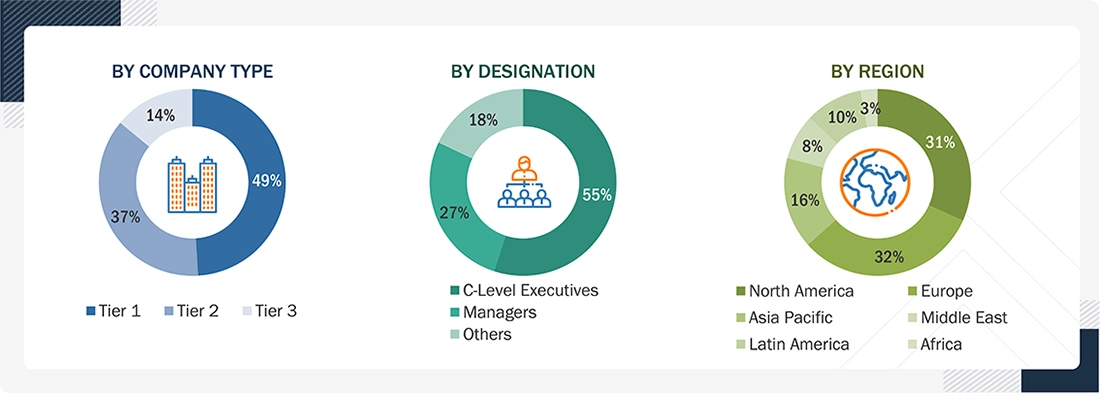
Extensive primary research was conducted to validate the data gathered through secondary sources and to refine market segmentation for the military platforms market. Interviews were carried out with industry experts representing both the demand and supply sides across key regions, including North America, Europe, Asia Pacific, the Middle East, Latin America, and Africa. Participants included military platform manufacturers, subsystem and component suppliers, defense system integrators, procurement officials, and representatives from armed forces and government agencies.
Primary insights were collected through structured questionnaires, email exchanges, and telephonic discussions. These interactions provided first-hand perspectives on platform procurement priorities, modernization timelines, regional demand patterns, and evolving operational requirements across land, naval, and air domains. The inputs from primary research were used to validate assumptions, adjust market estimates where required, and ensure that the final analysis accurately reflects real-world military procurement and deployment trends.
Market Size Estimation
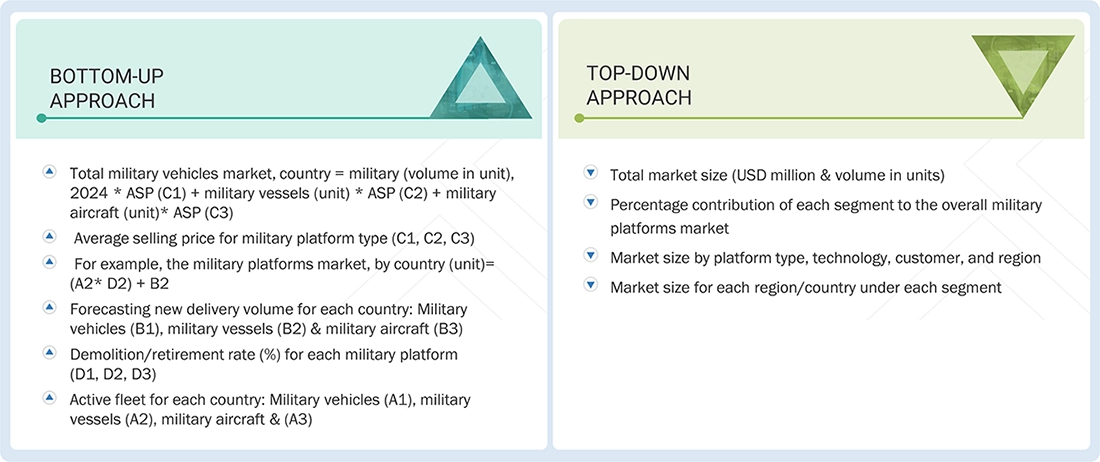
The top-down and bottom-up approaches were employed to estimate and validate the size of the global military platforms market. The research methodology used to determine market size included the following steps and considerations:
- Key players in the military platforms market were identified through secondary research, and their market shares were determined through a combination of primary and secondary research. This included a study of the annual and financial reports of the top market players, as well as extensive interviews with leaders, including directors, engineers, marketing executives, and other key stakeholders of leading companies operating in the market.
- All shares, splits, and breakdowns were determined using secondary sources and verified through primary sources.
- All possible parameters that affect the markets covered in this research study were accounted for, viewed in extensive detail, verified through primary research, and analyzed to obtain the final quantitative and qualitative data on the military platforms market. This data was consolidated, enhanced with detailed inputs, analyzed by MarketsandMarkets, and presented in this report.
Military Platforms Market : Top-Down and Bottom-Up Approach
Data Triangulation
After determining the overall market size, the total market was divided into several segments and subsegments. The data triangulation and market breakdown procedures explained below were implemented, wherever applicable, to complete the overall market engineering process and arrive at the estimated market numbers for the market segments and subsegments. The data was triangulated by studying various factors and trends from the demand and supply sides. Additionally, the market size was validated using top-down and bottom-up approaches.
Market Definition
The military platforms market encompasses developing and deploying key assets, including military aircraft, naval vessels, and land vehicles that provide strategic and tactical capabilities to armed forces. These platforms support combat, reconnaissance, logistics, and surveillance defense operations. The military platforms market is driven by advanced technologies, enabling enhanced operational efficiency and multi-domain interoperability.
Key Stakeholders
- Defense Ministries
- Armed Forces (Army, Navy, Air Force)
- Prime Contractors (e.g., Lockheed Martin, Boeing)
- Tier-1 and Tier-2 Suppliers
- Military Research Labs
- National Defense Authorization Agencies
- Defense and Security Consultants
- International Defense Regulatory Organizations
Report Objectives
- To define, describe, and forecast the military platforms market based on type, technology, customer, and region
- To forecast the size of different segments of the market with respect to North America, Europe, Asia Pacific, the Middle East, Africa, and Latin America
- To identify and analyze the drivers, restraints, opportunities, and challenges influencing the growth of the market
- To identify industry trends, market trends, and technology trends currently prevailing in the market
- To analyze micro markets with respect to individual growth trends, prospects, and their contribution to the overall market
- To analyze the degree of competition in the market by analyzing recent developments adopted by leading market players
- To provide a detailed competitive landscape of the market, along with a ranking analysis of key players, and an analysis of startup companies in the market
- To strategically profile the key market players and comprehensively analyze their core competencies
- To provide a detailed competitive landscape of the military platforms market, along with a market share analysis and revenue analysis of key players
Available customizations:
MarketsandMarkets offers the following customizations for this market report:
- Additional country-level analysis of the military platforms market
- Profiling of other market players (up to 5)
Product Analysis
- Product matrix, which provides a detailed comparison of the product portfolio of each company in the military platforms market
Get the Full Military Platforms Market Report
Full forecast, segment splits, and company analysis for all Military Platforms Market.
- Canada Military Platforms Market
- US Military Platforms Market
- UK Military Platforms Market
- Germany Military Platforms Market
- France Military Platforms Market
- Italy Military Platforms Market
- Australia Military Platforms Market
- India Military Platforms Market
- South Korea Military Platforms Market
- Brazil Military Platforms Market
- Mexico Military Platforms Market
- UAE Military Platforms Market
- Saudi Arabia Military Platforms Market
- Israel Military Platforms Market
- Turkey Military Platforms Market
Need a Tailored Report?
Customize this report to your needs
Get 10% FREE Customization
Customize This Report
