
Canada Self-driving Cars Market (2024-2029)

The Canada Self-driving Cars Market was valued at $1351 Million in 2024 and projected to reach to $1234 Million by 2029, representing a compound annual growth rate of -4.3%. Canada's self-driving cars market faces a challenging period through 2029, with projected contraction from $1,351 million USD to $1,234 million USD.


| Market Size in | USD 26.32 MN |
| Market Forecast in | |
| CAGR | |
| Forecast Period | |
| Units Considered | Value (USD MN) |
Canada Self-driving Cars Market Trends and Insights
- This downturn in Canada reflects broader challenges in autonomous vehicle adoption, including regulatory uncertainty, high development costs, and slower-than-anticipated consumer acceptance across the country.
- Canada's automotive sector, traditionally a key player in North America, faces headwinds as investment priorities shift and technology maturation timelines extend beyond initial forecasts. The decline in Canada's self-driving cars market through 2029 underscores the gap between early industry optimism and real-world deployment realities.
- Canada's regulatory environment, while progressive, has not yet catalyzed the commercial-scale rollouts seen in select U.S.
- markets, constraining market growth.
- Despite technological advances, Canada's market contraction suggests that autonomous vehicle commercialization in the country will proceed more cautiously than previously anticipated, with stakeholders reassessing timelines and investment strategies..
Key Market Statistics
- CAGR (2024-2029) -4.3%
- Market Size, 2024 ~USD 1351 Million
- Forecast, 2029 ~USD 1234 Million
- Country Canada
Canada Self-driving Cars Market Overview
Market Contraction :
Canada's self-driving cars market is declining at -4.3% CAGR, contrasting sharply with the global growth rate of 6.8%, indicating unique headwinds in the Canadian autonomous vehicle sector.
Regulatory Uncertainty :
Canadian provinces maintain fragmented autonomous vehicle regulations, creating barriers to deployment and investment. Federal-provincial coordination gaps slow market development compared to more unified jurisdictions.
High Development Costs :
Elevated R&D expenses and infrastructure requirements for autonomous vehicle testing in Canada's diverse climate conditions strain market participants, limiting commercial viability and investor confidence.
Slower Adoption Rates :
Canadian consumers and fleet operators show cautious adoption patterns for self-driving technology, driven by safety concerns, limited real-world deployment examples, and preference for proven alternatives.
Canada Self-driving Cars Market Dynamics
- This decline reflects regulatory fragmentation across provinces, substantial capital requirements for autonomous vehicle development, and consumer hesitancy regarding safety and reliability.
- Key barriers include weather-related testing challenges, limited infrastructure investment, and competitive pressure from global players. Recovery prospects depend on federal regulatory harmonization, increased government support for autonomous vehicle corridors, and successful pilot programs demonstrating commercial viability.
- Strategic partnerships between Canadian tech firms and international OEMs may accelerate market stabilization.
- Long-term growth hinges on resolving liability frameworks, insurance models, and establishing clear deployment pathways for autonomous fleets in urban and logistics sectors..
Market Ecosystem
Related Ecosystem
Key Takeaways
- Canada's self-driving cars market is contracting at -4.3% CAGR from 2024 to 2029, declining from $1,351M to $1,234M.
- Regulatory uncertainty and slower consumer adoption in Canada are primary drivers of market decline compared to global growth.
- Canada's autonomous vehicle deployment lags behind select U.S. markets, limiting commercial-scale opportunities.
- Market participants in Canada are reassessing investment timelines and strategies amid extended technology maturation cycles.
Self-driving Cars Market Report Scope
| Report Metric | Details |
|---|---|
| Base Year | 2024 |
| Fastest Growing Segment | L5 (Level Of Autonomy) |
| Forecast Period | 2024-2029 |
| Growth Rate | CAGR of 6.8% from 2024 to 2029 |
| Largest Segment | PERSONAL MOBILITY (Mobility Type) |
| Segments Covered | Level Of Autonomy, Component, Mobility Type, Vehicle Class |
Canada Self-driving Cars Market Report Segmentation
4 segment dimensions are covered across the global market.
By Level Of Autonomy
- L1
- L2
- L3
- L4
- L5
By Component
- Camera
- Lidar
- Radar
- Ultrasonic Sensor
By Mobility Type
- Personal Mobility
- Shared Mobility
By Vehicle Class
- A&B
- C&D
- E&F
Target Audience
- Automotive OEMs : Evaluate Canada's autonomous vehicle market potential, regulatory requirements, and localization strategies to determine R&D investment levels and go-to-market timing for self-driving platforms.
- Technology & Software Companies : Assess partnership opportunities with Canadian automotive players, identify regulatory compliance needs, and understand market demand for autonomous driving software and AI solutions in Canada.
- Investment & Private Equity Firms : Conduct due diligence on Canadian autonomous vehicle startups and market opportunities, understanding growth constraints and recovery catalysts to optimize portfolio allocation decisions.
- Government & Policy Makers : Leverage market data to inform autonomous vehicle policy development, infrastructure investment priorities, and regulatory frameworks that can stimulate Canadian market growth and competitiveness.
- Fleet Operators & Logistics Companies : Evaluate autonomous vehicle adoption feasibility for Canadian operations, understanding deployment timelines, regulatory pathways, and cost-benefit analysis for fleet modernization initiatives.
Reasons to Buy this Report
- Identify Market Gaps : Understand why Canada's market is contracting while global markets grow, revealing specific investment opportunities and underserved segments within the Canadian autonomous vehicle ecosystem.
- Regulatory Intelligence : Access detailed analysis of provincial and federal regulatory frameworks affecting autonomous vehicle deployment, enabling compliant market entry strategies and policy advocacy positioning.
- Competitive Landscape Mapping : Analyze key players, partnerships, and competitive dynamics specific to Canada's market, identifying partnership opportunities and competitive threats in the autonomous vehicle sector.
- Investment Decision Support : Make informed capital allocation decisions with comprehensive market sizing, growth projections, and risk assessments tailored to Canada's unique autonomous vehicle market conditions.
- Strategic Planning Data : Develop market entry, expansion, or pivot strategies grounded in Canada-specific data on consumer adoption, infrastructure readiness, and technology deployment timelines.
Frequently asked questions
Why is Canada's self-driving cars market declining?
Canada's market contraction is driven by regulatory uncertainty, high development costs, slower consumer adoption, and delayed commercial deployment timelines compared to early industry forecasts.
What is the market size of self-driving cars in Canada in 2024?
Canada's self-driving cars market is valued at $1,351 million USD in 2024, based on verified market data.
What will Canada's self-driving cars market be worth in 2029?
Canada's self-driving cars market is projected to reach $1,234 million USD by 2029, representing a decline from 2024 levels.
How does Canada's market performance compare to North America?
Canada's negative -4.3% CAGR contrasts with broader North American trends, indicating that Canada is underperforming relative to regional growth dynamics.
What factors are affecting autonomous vehicle adoption in Canada?
Key factors include regulatory gaps, infrastructure limitations, consumer hesitancy, high technology costs, and the absence of large-scale commercial deployment pilots in Canada.
RESEARCH METHODOLOGY
The research uses extensive secondary sources, such as company annual reports/presentations, industry association publications, magazine articles, directories, technical handbooks, World Economic Outlook, trade websites, technical articles, and databases, to identify and collect information on the self-driving car market. Primary sources, such as experts from related industries, OEMs, and suppliers, have been interviewed to obtain and verify critical information and assess the growth prospects and market estimations.
Secondary Research
Secondary sources for this research study include corporate filings, such as annual reports, investor presentations, and financial statements; trade, business, and professional associations; whitepapers and self-driving car and ADAS-related journals; certified publications; articles by recognized authors; directories; and databases. Secondary data has been collected and analyzed to determine the overall market size, further validated by primary research.
Primary Research
After understanding the self-driving cars market scenario through secondary research, extensive primary research has been conducted. Primary interviews have been conducted with market experts from both demand and supply sides across North America, Europe, and Asia Pacific. Approximately 35% of interviews have been conducted from the demand side, while 65% of primary interviews have been conducted from the supply side. The primary data has been collected through questionnaires, emails, and telephone interviews.
In the canvassing of primaries, various departments within organizations, such as sales and operations, have been covered to provide a holistic viewpoint in this report. Primary sources from the supply side include various industry experts, such as CXOs, vice presidents, directors from business development, marketing, product development/innovation teams, and related key executives from various key companies. Various system integrators, industry associations, independent consultants/industry veterans, and key opinion leaders have also been interviewed.
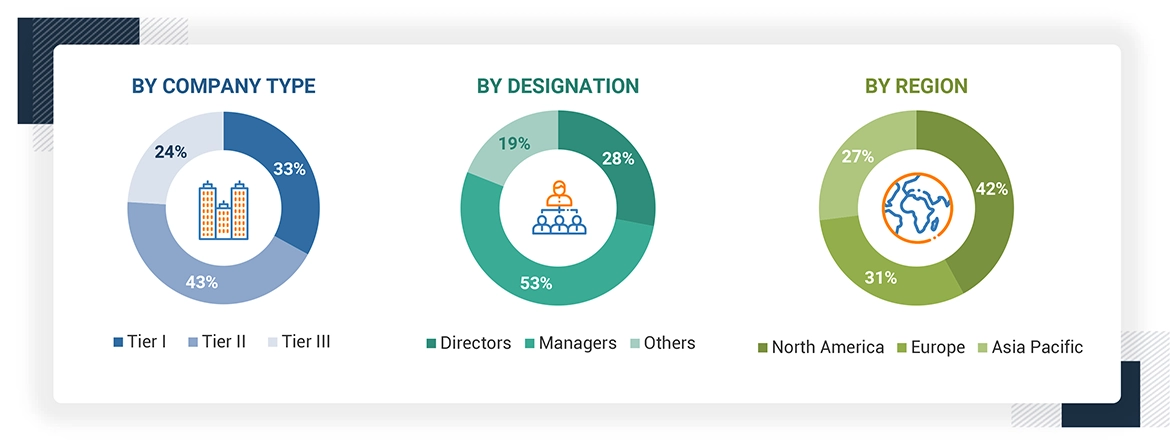
Note: Others include sales, managers, and product managers.
Company tiers are based on the value chain; the company's revenue is not considered.
To know about the assumptions considered for the study, download the pdf brochure
Market Size Estimation
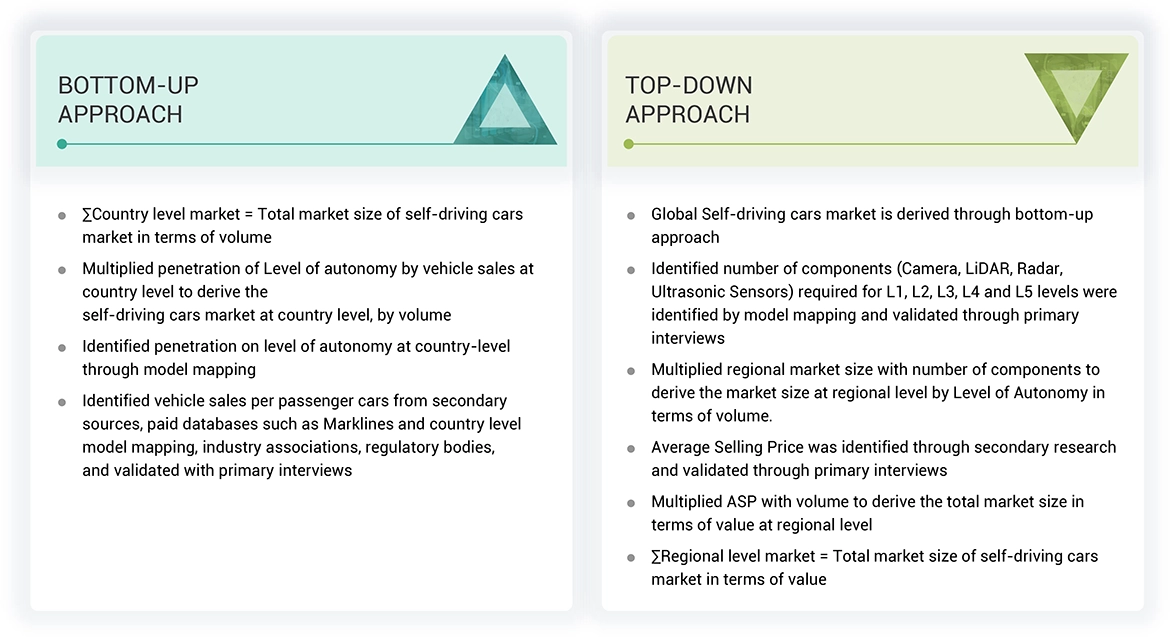
Both top-down and bottom-up approaches were used to estimate and validate the total size of the self-driving car market. These methods were also used extensively to estimate the size of various subsegments in the market. The research methodology used to estimate the market size includes the following:
Self-driving Cars Market : Top-Down and Bottom-Up Approach
Data Triangulation
After arriving at the overall market size of the global market through the methodology mentioned above, this market was split into several segments and subsegments. The data triangulation and market breakdown procedures were employed to complete the overall market engineering process and arrive at the exact market value data for the key segments and sub-segments, wherever applicable. The extrapolated market data was triangulated by studying various macro indicators and regional trends from both the demand and supply-side participants.
Market Definition
Self-driving cars are technologies capable of performing dynamic driving tasks, with or without human supervision. The California DMV defines autonomous mode as when the technology manages driving operations independently. At the same time, SAE Level 5 autonomy represents vehicles capable of moving under all conditions without human intervention, even with a user in the driver's seat.
Stakeholders
- ADAS Integrators
- ADAS Solution Suppliers
- Associations, Forums, and Alliances related to Autonomous Vehicles
- Automotive Component Manufacturers
- Automotive Industry Associations, Government Authorities, and Research Organizations
- Automotive OEMs
- Automotive Sensor Manufacturers
- Automotive SoC and ECU Manufacturers
- Automotive Software and Platform Providers
- Autonomous Driving Platform Providers
- Autonomous Vehicle Manufacturers
- Country-specific Automotive Associations
- European Automobile Manufacturers Association (ACEA)
- Government and Research Organizations
- National Highway Traffic Safety Administration (NHTSA)
- Transport Authorities
- Vehicle Safety Regulatory Bodies
Report Objectives
- To analyze and forecast the self-driving cars market in terms of volume (thousand units) and value (USD million) from 2024 to 2035
-
To segment the market by Level of Autonomy, Component Type, Mobility Type, Vehicle Class, and region
- To segment and forecast the market by Level of Autonomy (Semi-autonomous (L1, L2, and L3), and Autonomous (L4 and L5))
- To segment and forecast the market by Component Type (Camera, LiDAR, Radar, Ultrasonic Sensors, Infrared Sensors, and Others)
- To segment and forecast the market by Mobility Type (Personal Mobility and Shared Mobility)
- To segment and forecast the market by Vehicle Class (A&B, C&D, and E&F)
- To forecast the market by region [North America, Europe, and Asia Pacific]
- To identify and analyze key drivers, challenges, restraints, and opportunities influencing the market growth
- To strategically analyze the market for individual growth trends, prospects, and contributions to the total market
-
To study the following with respect to the market
- Pricing Analysis
- Investment and Funding Scenario
- Value Chain Analysis
- Ecosystem Analysis
- Technology Analysis
- Trade Analysis
- Case Study Analysis
- Patent Analysis
- Regulatory Landscape
- Key Stakeholders and Buying Criteria
- Key Conferences and Events
- To strategically profile the key players and comprehensively analyze their market share and core competencies
- To analyze the impact of AI on the market
- To track and analyze competitive developments such as deals, product launches/developments, expansions, and other activities undertaken by the key industry participants
Available Customizations
With the given market data, MarketsandMarkets offers customizations in accordance with the company's specific needs.
- Additional Company Profiles (Up to 5)
- Global Self-driving cars market, By Level of Autonomy, at Country Level
- Global Self-driving cars market, By EV Type, at Country Level
Get the Full Self-driving Cars Market Report
Full forecast, segment splits, and company analysis for all Self-driving Cars Market.
- China Self-driving Cars Market
- India Self-driving Cars Market
- Japan Self-driving Cars Market
- South Korea Self-driving Cars Market
- Germany Self-driving Cars Market
- France Self-driving Cars Market
- Italy Self-driving Cars Market
- UK Self-driving Cars Market
- Spain Self-driving Cars Market
- US Self-driving Cars Market
Need a Tailored Report?
Customize this report to your needs
Get 10% FREE Customization
Customize This Report
