
North America Neuromorphic Computing Market (2024-2029)

The North America Neuromorphic Computing Market was valued at $10 Million in 2024 and projected to reach to $439.6 Million by 2029, representing a compound annual growth rate of 87.8%. North America is positioned as the global epicenter for neuromorphic computing innovation, leveraging its robust semiconductor ecosystem, world-class research institutions, and substantial venture capital availability.


| Market Size in | USD 26.32 MN |
| Market Forecast in | |
| CAGR | |
| Forecast Period | |
| Units Considered | Value (USD MN) |
North America Neuromorphic Computing Market Trends and Insights
- This remarkable expansion reflects North America's leadership in semiconductor innovation and artificial intelligence development, driven by substantial investments from technology giants and government initiatives.
- North America's position as a hub for research institutions and venture capital funding accelerates the commercialization of neuromorphic technologies across edge computing, autonomous systems, and AI applications. The 87.8% compound annual growth rate (CAGR) underscores North America's dominance in neuromorphic chip design and deployment.
- North America's ecosystem benefits from early adoption by enterprises seeking energy-efficient computing solutions and reduced latency in real-time applications.
- By 2029, North America is expected to capture significant market share as neuromorphic processors transition from research laboratories into mainstream commercial deployment across healthcare, automotive, and industrial sectors..
Key Market Statistics
- CAGR (2024-2029) 87.8% CAGR
- Market Size, 2024 ~USD 10 Million
- Forecast, 2029 ~USD 439.6 Million
- Geography North America
North America Neuromorphic Computing Market Overview
Explosive CAGR Growth :
North America's neuromorphic computing market is expanding at 87.8% CAGR from 2024-2029, significantly outpacing traditional semiconductor segments and reflecting the region's AI innovation momentum.
Market Size Expansion :
The market is projected to grow from $10.0 million in 2024 to $439.6 million by 2029, representing a 43.96x increase driven by enterprise adoption and edge AI deployment across North America.
Tech Giant Investments :
Major technology corporations and semiconductor leaders in North America are heavily investing in neuromorphic chip development, establishing R&D centers and accelerating commercialization timelines.
Government Support & Initiatives :
U.S. and Canadian government funding programs, including AI research grants and semiconductor manufacturing incentives, are catalyzing neuromorphic computing development and attracting venture capital investment.
North America Neuromorphic Computing Market Dynamics
- The region's 87.8% CAGR reflects accelerating adoption across enterprise AI, autonomous systems, and edge computing applications.
- Major technology hubs in Silicon Valley, Boston, and Toronto are driving breakthrough innovations in neuromorphic chip architectures and AI algorithms.
- Government initiatives supporting semiconductor manufacturing and AI research are further strengthening North America's competitive advantage.
- By 2029, the region is expected to capture significant market share as neuromorphic solutions transition from research prototypes to mainstream commercial deployment across industries including automotive, healthcare, and financial services..
Market Ecosystem
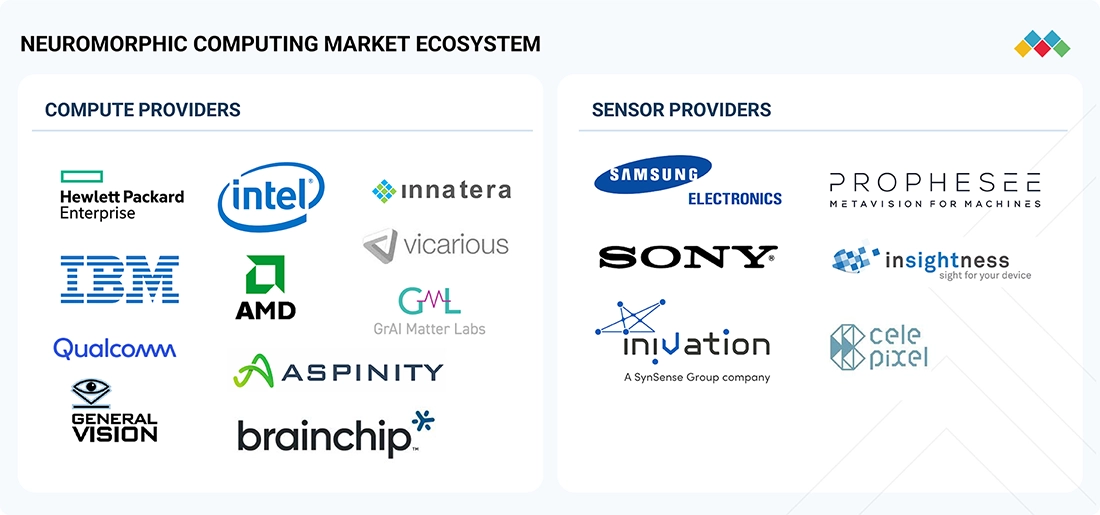
NEUROMORPHIC COMPUTING MARKET SIZE, SHARE & GROWTH: COMMERCIAL USE CASES ACROSS INDUSTRIES
| COMPANY | USE CASE DESCRIPTION | BENEFITS |
|---|---|---|
 |
Neuromorphic chips used for real-time gesture recognition, autonomous robotics navigation, and sparse sensor data processing. | Ultra-low power processing, millisecond-level inference, improved edge AI performance. |
 |
Deploys neuromorphic systems for pattern recognition and large-scale neural simulations in research labs. | Massive parallelism, reduced computational load, highly energy-efficient training/inference. |
 |
Event-based neuromorphic vision sensors integrated into industrial inspection cameras. | High-speed motion tracking, reduced latency, lower data rates than traditional camera sensors. |
 |
Neuromorphic processors embedded in wearables and AR devices. | Always-on sensing with microwatt-level power consumption and instant response. |
Logos and trademarks shown above are the property of their respective owners. Their use here is for informational and illustrative purposes only.
Related Ecosystem
Defence Platforms And Systems
- Sensors
- Unmanned Ground Vehicles (UGV)
- Fighter Aircraft
- Special Mission Aircraft
- Antennas
- BAE Systems plc
- Thales group
- LOCKHEED MARTIN CORPORATION
- Northrop Grumman Corporation
- L3Harris Technologies, Inc.
Analytics
- Natural Language Processing (NLP)
- Machine Learning
- Supply Chain Management
- Predictive Analytics
- Image Sensors
- International Business Machines Corporation
- MICROSOFT CORPORATION
- Oracle Corporation
- SAP SE
Electronics System And Components
- Sensors
- Temperature Sensors
- Pressure Sensors
- Actuators
- Image Sensors
- Lenovo
- Samsung
- Texas Instruments Incorporated
- HONEYWELL INTERNATIONAL INC.
- Teledyne Technologies Incorporated
Key Takeaways
- North America's neuromorphic computing market will grow from $10.0M (2024) to $439.6M (2029), representing an 87.8% CAGR.
- North America leads global neuromorphic innovation through concentrated R&D investments and semiconductor manufacturing expertise.
- North America's early enterprise adoption of neuromorphic chips for edge AI and autonomous systems drives market acceleration.
- North America's venture capital ecosystem and government support position the region as the primary neuromorphic technology commercialization hub through 2029.
Neuromorphic Computing Market Report Scope
| Report Metric | Details |
|---|---|
| Base Year | 2024 |
| Fastest Growing Segment | CLOUD (Deployment) |
| Forecast Period | 2024–2029 |
| Growth Rate | CAGR of 89.7% from 2024 to 2029 |
| Largest Segment | EDGE (Deployment) |
| Market Size Base Year (Billions) | ~USD 0.03 (2024) |
| Revenue Forecast (Billions) | ~USD 1.3252 (2029) |
| Segments Covered | Offering, Deployment, Application |
North America Neuromorphic Computing Market Report Segmentation
3 segment dimensions are covered across the global market.
By Offering
- Memory
- Processor
- Sensor
- Software
By Deployment
- Cloud
- Edge
By Application
- Image And Video Processing
- Natural Language Processing (Nlp)
- Other Applications
- Sensor Fusion
Target Audience
- Semiconductor Manufacturers : Chipmakers need North America market intelligence to guide product development roadmaps, identify customer segments, and benchmark competitive positioning in the rapidly growing neuromorphic sector.
- Technology Investors & VCs : Investment firms require detailed North America market data to evaluate neuromorphic startups, assess market timing, and identify high-growth investment opportunities in the region.
- Enterprise Technology Leaders : CIOs and technology executives need North America-specific insights to evaluate neuromorphic solutions for edge AI, autonomous systems, and real-time processing applications.
- Government & Policy Makers : U.S. and Canadian government agencies require market intelligence to inform semiconductor policy, funding allocation, and strategic initiatives supporting neuromorphic computing development.
- Research & Academic Institutions : Universities and research centers need North America market data to align neuromorphic research programs with commercial opportunities and secure industry partnerships and funding.
Key Companies in the North America Neuromorphic Computing Market
| Company | HQ | Ownership | Strongest segments |
|---|---|---|---|
| NVIDIA CORPORATION | United States | Public Company | Data Center Accelerated Computing & AI Platforms,Networking Platforms,Gaming GPUs (GeForce), |
| UNITED MICROELECTRONICS CORP | Taiwan | Public Company | Communications ICs (wireless, networking, connectivity),Consumer electronics ICs,Computing and storage-related ICs, |
| INTEL CORPORATION | United States | Public Company | Client Computing Group (CCG),Data Center and AI (DCAI),Intel Foundry, |
| IBM | United States | Public Company | Software (Hybrid Cloud and AI Platforms),Consulting (Strategy, Technology, Intelligent Operations),Infrastructure (Servers, Storage, Lifecycle Services), |
| SAMSUNG ELECTRONICS CO., LTD. | South Korea | Public Company | Smartphones, tablets, wearables, and accessories,Consumer electronics (TVs, audio, and appliances),Semiconductors (memory, foundry, system LSI), |
| SONY CORPORATION | Japan | Public Company | Game & Network Services,Music,Pictures, |
| BRAINCHIP, INC. | Australia | Public Company | Akida IP and Akida GenAI IP (licensing and NRE),Akida SoCs and hardware platforms (AKD1000 SoC, PCIe, M.2, Edge AI Box, FPGA Platform),Software and cloud tools (MetaTF, Akida Cloud, Akida GenAI FPGA tooling), |
| MEDIATEK INC. | Taiwan | Public Company | Mobile SoCs (smartphones and tablets),Consumer multimedia ICs (TV, STB, smart home),Connectivity and computer peripheral ICs, |
| NXP SEMICONDUCTORS | Netherlands | Public Company | Microcontrollers (MCUs),Application & Communication Processors,Wireless Connectivity (NFC, UWB, BLE, Wi-Fi, Zigbee, Thread), |
| ADVANCED MICRO DEVICES, INC. | United States | Public Company | Data Center (EPYC, Instinct, data center GPUs and infrastructure),Client (Ryzen, Ryzen AI, Athlon, PRO),Gaming (Radeon, semi-custom SoCs for consoles), |
| OMNIVISION | United States | Private Company | Mobile (smartphones, tablets, notebooks, webcams),Automotive imaging,Security and surveillance, |
NVIDIA CORPORATION
NVIDIA Corporation is a United States-based public company founded in 1993 with 42,000 employees. The company designs and manufactures graphics processing units and system-on-chip units.
UNITED MICROELECTRONICS CORP
United Microelectronics Corp is a Taiwan-based public company founded in 1980 with 20,000 employees. The company is a semiconductor foundry providing chip manufacturing services.
INTEL CORPORATION
Intel Corporation is a United States-based public company founded in 1968 with 85,100 employees. The company designs and manufactures microprocessors and semiconductor products for computing and data center applications.
IBM
IBM is a United States-based public company founded in 1911 with 264,300 employees. The company provides information technology services, software, and hardware solutions for enterprise clients globally.
SAMSUNG ELECTRONICS CO., LTD.
Samsung Electronics Co., Ltd. is a South Korea-based public company founded in 1969 with 128,735 employees. The company manufactures consumer electronics, semiconductors, and display panels.
SONY CORPORATION
Sony Corporation is a Japan-based public company founded in 1946 with 94,900 employees. The company manufactures and sells consumer electronics, entertainment products, and gaming systems.
BRAINCHIP, INC.
BrainChip, Inc. is an Australia-based public company with 71 employees. The company develops neuromorphic computing technology and artificial intelligence solutions.
MEDIATEK INC.
MediaTek Inc. is a Taiwan-based public company founded in 1997 with 17,449 employees. The company designs semiconductors and system-on-chip solutions for mobile and multimedia devices.
NXP SEMICONDUCTORS
NXP Semiconductors is a Netherlands-based public company founded in 2006 with 32,169 employees. The company designs and manufactures semiconductors for automotive, industrial, and mobile applications.
ADVANCED MICRO DEVICES, INC.
Advanced Micro Devices, Inc. is a United States-based public company founded in 1969 with 31,000 employees. The company designs and manufactures microprocessors and graphics processing units.
OMNIVISION
OmniVision is a United States-based private company founded in 1995 with 2,176 employees. The company designs and manufactures image sensors and imaging solutions.
Countries within North America - compare and drill down
| Country | 2025 size (native) |
|---|
Country market size visualization
Reasons to Buy this Report
- Regional Market Sizing & Forecasts : Obtain precise market valuations and growth projections specific to North America, enabling accurate budget allocation and investment decisions for neuromorphic computing initiatives.
- Competitive Landscape Analysis : Identify leading semiconductor companies, startups, and research institutions in North America driving neuromorphic innovation, including their product portfolios and market positioning.
- Investment & Funding Trends : Understand venture capital flows, government grants, and corporate R&D spending patterns across North America to identify emerging opportunities and partnership potential.
- Application & Vertical Insights : Discover which North American industries are adopting neuromorphic solutions fastest, including automotive, healthcare, finance, and defense sectors with specific use case data.
- Strategic Market Entry Planning : Leverage North America-specific regulatory insights, talent availability, manufacturing capabilities, and customer preferences to develop effective market entry and expansion strategies.
Frequently asked questions
What is the projected market size for neuromorphic computing in North America by 2029?
North America's neuromorphic computing market is projected to reach $439.6 million by 2029, growing from $10.0 million in 2024.
What is the CAGR for North America's neuromorphic computing market?
North America's neuromorphic computing market is expected to grow at a compound annual growth rate (CAGR) of 87.8% between 2024 and 2029.
Which industries in North America are driving neuromorphic computing adoption?
North America's primary adoption sectors include autonomous vehicles, edge AI applications, healthcare diagnostics, industrial IoT, and real-time data processing systems.
Why is North America leading the neuromorphic computing market?
North America leads due to its concentration of semiconductor expertise, substantial venture capital funding, advanced research institutions, and early enterprise adoption of AI technologies.
What factors will accelerate neuromorphic computing growth in North America through 2029?
Key growth factors include increasing demand for energy-efficient AI processing, government R&D initiatives, enterprise investments in edge computing, and the transition from prototype to commercial-scale production.
RESEARCH METHODOLOGY
The research process for this technical, market-oriented, and commercial study of the neuromorphic computing market included the systematic gathering, recording, and analysis of data about companies operating in the market. It involved the extensive use of secondary sources, directories, and databases (Factiva, Oanda, and OneSource) to identify and collect relevant information. In-depth interviews were conducted with various primary respondents, including experts from core and related industries and preferred manufacturers, to obtain and verify critical qualitative and quantitative information as well as to assess the growth prospects of the market. Key players in the neuromorphic computing market were identified through secondary research, and their market rankings were determined through primary and secondary research. This included studying annual reports of top players and interviewing key industry experts, such as CEOs, directors, and marketing executives.
Secondary Research
In the secondary research process, various secondary sources were used to identify and collect information for this study. These include annual reports, press releases, and investor presentations of companies, whitepapers, certified publications, and articles from recognized associations and government publishing sources. Research reports from a few consortiums and councils were also consulted to structure qualitative content. Secondary sources included corporate filings (such as annual reports, investor presentations, and financial statements); trade, business, and professional associations; white papers; Journals and certified publications; articles by recognized authors; gold-standard and silver-standard websites; directories; and databases. Data was also collected from secondary sources, such as the International Trade Centre (ITC) (Switzerland), and the International Monetary Fund (IMF).
List of key secondary sources
|
Source |
Web Link |
|
IEEE |
|
|
U.S. Department of Energy |
|
|
Open Neuromorphic |
|
|
IOPscience |
|
|
NIST |
|
|
Data Science Association |
|
|
Sandia National Laboratories |
|
|
National Library of Medicine |
|
|
Los Alamos National Laboratory |
Primary Research
Extensive primary research was accomplished after understanding and analyzing the neuromorphic computing market scenario through secondary research. Several primary interviews were conducted with key opinion leaders from both demand- and supply-side vendors across four major regions—North America, Europe, Asia Pacific, and RoW. Approximately 30% of the primary interviews were conducted with the demand side, and 70% with the supply side. Primary data was collected through questionnaires, emails, and telephonic interviews. Various departments within organizations, such as sales, operations, and administration, were contacted to provide a holistic viewpoint in the report.
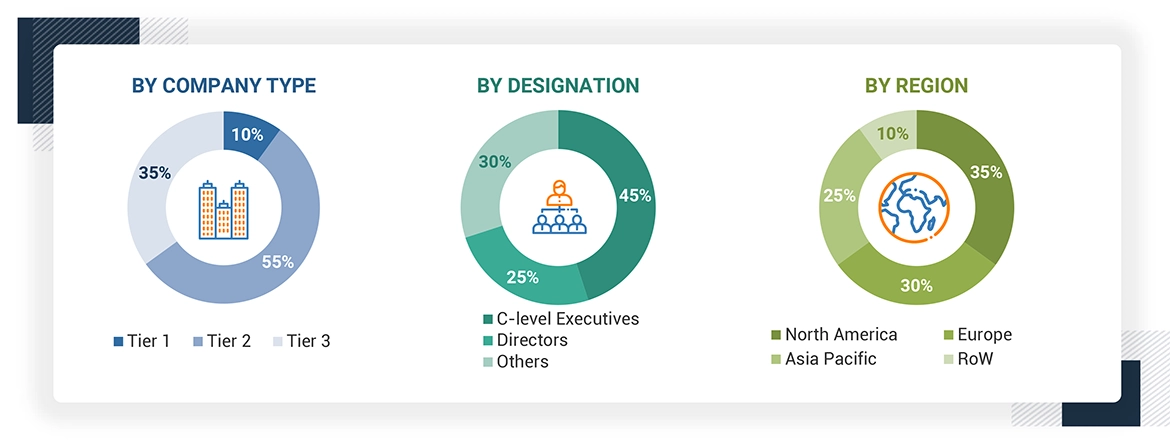
Note: Other designations include technology heads, media analysts, sales managers, marketing managers, and product managers.
The three tiers of the companies are based on their total revenues as of 2023 ? Tier 1: >USD 1 billion, Tier 2: USD 500 million–1 billion, and Tier 3: USD 500 million.
About the assumptions considered for the study, To know download the pdf brochure
Market Size Estimation
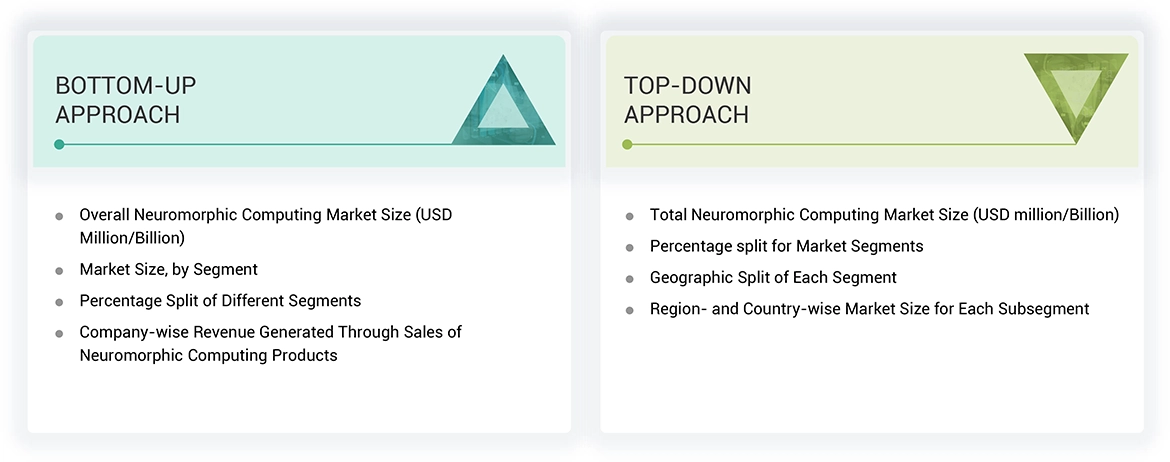
In the complete market engineering process, both top-down and bottom-up approaches were used, along with several data triangulation methods, to estimate and forecast the size of the market and its segments and subsegments listed in the report. Extensive qualitative and quantitative analyses were carried out on the complete market engineering process to list the key information/insights pertaining to neuromorphic computing market.
The key players in the market were identified through secondary research, and their rankings in the respective regions determined through primary and secondary research. This entire procedure involved the study of the annual and financial reports of top players, and interviews with industry experts such as chief executive officers, vice presidents, directors, and marketing executives for quantitative and qualitative key insights. All percentage shares, splits, and breakdowns were determined using secondary sources and verified through primary sources. All parameters that affect the markets covered in this research study were accounted for, viewed in extensive detail, verified through primary research, and analyzed to obtain the final quantitative and qualitative data. This data was consolidated, supplemented with detailed inputs and analysis from MarketsandMarkets, and presented in this report.
Bottom-Up Approach
- Identifying various verticals of neuromorphic computing
- Analyzing the penetration of each type of neuromorphic computing technology through secondary and primary research
- Analyzing the penetration of neuromorphic computing for different applications and verticals through secondary and primary research
- Conducting multiple discussion sessions with key opinion leaders to understand the detailed working of neuromorphic computing and their implementation in multiple applications; this helped analyze the break-up of the scope of work carried out by each major company
- Verifying and cross-checking the estimates at every level with key opinion leaders, including CEOs, directors, operation managers, and finally with MarketsandMarkets domain experts
- Studying various paid and unpaid sources of information, such as annual reports, press releases, white papers, and databases
Top-Down Approach
- Focusing initially on the top-line investments and expenditures being made in the ecosystem of the neuromorphic computing market; further, splitting the key market areas based on offering, deployment, application, vertical, and region, and listing the key developments
- Identifying all leading players and applications in the neuromorphic computing market based on region through secondary research and thoroughly verifying them through a brief discussion with industry experts
- Analyzing revenues, product mix, geographic presence, and key applications served by all identified players to estimate and arrive at percentage splits for all key segments
- Discussing splits with the industry experts to validate the information and identify key growth pockets across all key segments
- Breaking down the total market based on verified splits and key growth pockets across all segments
Neuromorphic Computing Market : Top-Down and Bottom-Up Approach
Data Triangulation
After arriving at the overall market size from the market size estimation process explained above, the total market was split into several segments and subsegments. Data triangulation and market breakdown procedures were employed, wherever applicable, to complete the overall market engineering process and arrive at the exact statistics for all segments and subsegments. The data was triangulated by studying various factors and trends from both demand and supply sides. Along with this, the market size was validated using both top-down and bottom-up approaches.
Market Definition
Neuromorphic computing is a cutting-edge approach to designing computing systems that mimic the structure and functioning of the human brain's neural networks. It involves the development of hardware and software that replicate the way neurons communicate and process information, using specialized architectures like spiking neural networks (SNNs). Neuromorphic systems are highly energy-efficient, capable of real-time learning, and can process complex sensory data, such as images and sounds, with minimal power consumption. This technology is used in applications ranging from AI and robotics to healthcare, autonomous vehicles, and edge computing. These are used across various industries like consumer electronics, aerospace & defense, automotive, industrial, medical, IT & telecommunication, others.
Key Stakeholders
- Neuromorphic computing device manufacturers
- Research organizations and universities
- Original equipment manufacturers (OEMs)
- Technology standard organizations, forums, alliances, and associations
- Analysts and strategic business planners
- Government bodies, venture capitalists, and private equity firms
- Existing and prospective end users
- Venture capitalists, private equity firms, and startup companies
- Distributors and traders
Report Objectives
- To define, describe, segment, and forecast the neuromorphic computing market size, in terms of value, based on offering, deployment, application, vertical, and region
- To forecast the market size, in terms of value, across North America, Europe, Asia Pacific, and the Rest of the World (RoW)
- To present detailed information regarding the major factors influencing the growth of the market (drivers, restraints, opportunities, and challenges)
- To provide an ecosystem analysis, case study analysis, patent analysis, technology analysis, ASP analysis, Porter’s Five Forces analysis, investment and funding scenario, and regulations pertaining to the market.
- To offer a comprehensive overview of the value chain of the neuromorphic computing market ecosystem
- To critically analyze micromarkets1 with respect to individual growth trends, prospects, and contributions to the total market
- To strategically profile the key players and comprehensively analyze their market shares and core competencies
- To assess the opportunities in the market for stakeholders and describe the competitive landscape of the market
- To analyze competitive developments in the market, such as collaborations, agreements, partnerships, product developments, and research and development (R&D)
Available Customizations
With the given market data, MarketsandMarkets offers customizations according to the company’s specific needs. The following customization options are available for the report:
Company Information
- Detailed analysis and profiling of additional market players (up to 7)
Get the Full Neuromorphic Computing Market Report
Full forecast, segment splits, and company analysis for all Neuromorphic Computing Market.
Need a Tailored Report?
Customize this report to your needs
Get 10% FREE Customization
Customize This Report
