
Canada North America Healthcare IT Market (2026-2031)

The Canada North America Healthcare IT Market was valued at $588.8 Million in 2026 and projected to reach to $709.1 Million by 2031, representing a compound annual growth rate of 4.9%. Canada's healthcare IT market is experiencing steady growth driven by provincial government initiatives to modernize healthcare infrastructure and improve patient outcomes through digital solutions.


| Market Size in | USD 26.32 MN |
| Market Forecast in | |
| CAGR | |
| Forecast Period | |
| Units Considered | Value (USD MN) |
Canada North America Healthcare IT Market Trends and Insights
- This steady growth reflects Canada's ongoing digital transformation in healthcare delivery, driven by investments in electronic health records, telemedicine platforms, and interoperable health information systems across provincial and federal healthcare networks.
- Canada's aging population and increasing demand for efficient healthcare administration are key factors supporting market expansion through 2031. The Canadian healthcare IT landscape is characterized by a mix of public sector modernization initiatives and private healthcare technology adoption.
- Canada's healthcare providers are increasingly prioritizing cybersecurity, data analytics, and cloud-based solutions to improve patient outcomes and operational efficiency.
- The market growth from 2026 to 2031 reflects Canada's commitment to leveraging technology to address healthcare workforce shortages and enhance care coordination across its decentralized provincial health systems..
Key Market Statistics
- CAGR (2026-2031) 4.9% CAGR
- Market Size, 2026 ~USD 588.8 Million
- Forecast, 2031 ~USD 709.1 Million
- Country Canada
Canada North America Healthcare IT Market Overview
Market Size & Growth :
Canada's healthcare IT market is valued at $588.8 million in 2026 and is projected to reach $709.1 million by 2031, representing a steady CAGR of 4.9% over the forecast period.
Provincial Digital Transformation :
Canadian provinces are accelerating healthcare digitalization through coordinated investments in electronic health records (EHRs), creating opportunities for interoperable solutions across regional health authorities.
Telemedicine Expansion :
Post-pandemic adoption of telemedicine platforms continues to drive demand for remote care technologies, with provincial health systems integrating virtual care into standard service delivery models.
Interoperability Focus :
Canada's emphasis on health information system interoperability across provinces is creating demand for integration platforms and data exchange solutions to improve care coordination.
Canada North America Healthcare IT Market Dynamics
- The 4.9% CAGR reflects sustained investment in electronic health records, telemedicine capabilities, and integrated health information systems across Canada's publicly funded healthcare system.
- Provincial health authorities are prioritizing interoperability to enable seamless data sharing and care coordination. Looking ahead to 2031, Canada's healthcare IT market will benefit from aging population demographics, increasing chronic disease management needs, and continued government funding for digital health initiatives.
- The market growth will be supported by regulatory frameworks promoting health data standards and privacy compliance, alongside healthcare provider demand for solutions that enhance operational efficiency and patient engagement in a resource-constrained environment..
Market Ecosystem
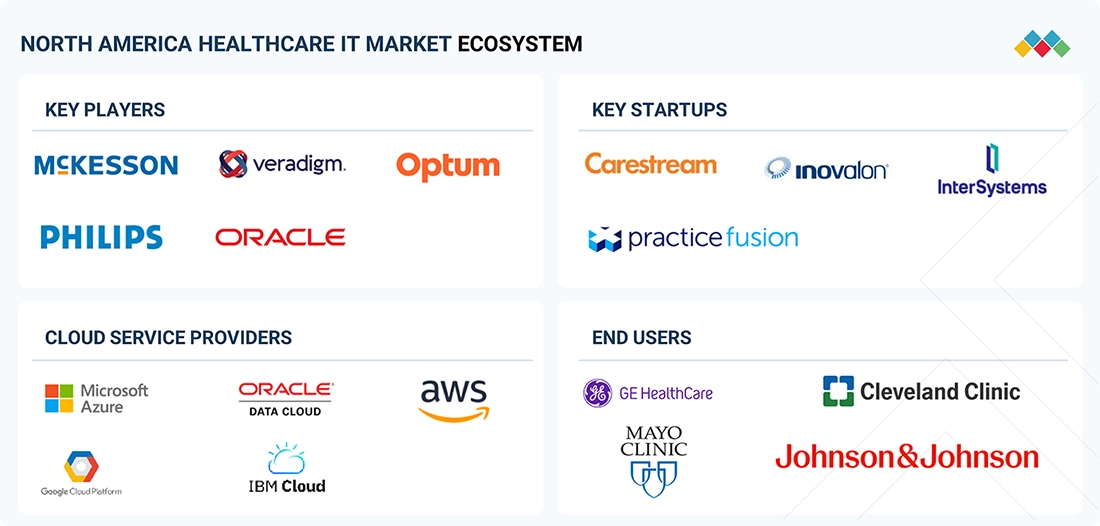
NORTH AMERICA HEALTHCARE IT MARKET: COMMERCIAL USE CASES ACROSS INDUSTRIES
| COMPANY | USE CASE DESCRIPTION | BENEFITS |
|---|---|---|
 |
Population health analytics solutions enabling payers and providers to leverage claims, EHR, and patient risk data for care optimization and value-based decision-making | Lower healthcare costs, improved care coordination, enhanced population risk management, stronger patient outcomes |
 |
Digital transformation services for healthcare providers focused on EHR integration, workflow automation, interoperability, and operational modernization | Streamlined clinical and administrative workflows, reduced operational errors, improved patient engagement and experience |
 |
Cloud-enabled radiology and imaging workflow platforms supporting PACS, AI-driven reporting, and enterprise imaging management across hospitals and diagnostic centers | Faster diagnostic turnaround, increased radiologist productivity, optimized imaging workflows and resource utilization |
 |
Healthcare IT infrastructure modernization through cloud, edge computing, cybersecurity, and secure data storage solutions for clinical environments | Scalable infrastructure, secure and seamless data access, lower IT complexity and maintenance costs |
 |
AI-powered imaging and clinical decision support solutions integrated into diagnostic modalities and radiology workflows to improve precision and efficiency | Enhanced diagnostic accuracy, reduced reporting turnaround time, improved clinician productivity and workflow efficiency |
Logos and trademarks shown above are the property of their respective owners. Their use here is for informational and illustrative purposes only.
Related Ecosystem
Key Takeaways
- Canada's healthcare IT market will grow from $588.8M (2026) to $709.1M (2031) at a 4.9% CAGR.
- Canada's provincial healthcare systems are driving demand for interoperable EHR and health information exchange solutions.
- Canada's aging demographic and healthcare workforce challenges are accelerating adoption of digital health and telemedicine technologies.
- Canada's focus on data security and privacy compliance is shaping investment priorities in healthcare IT infrastructure.
North America Healthcare IT Market Report Scope
| Report Metric | Details |
|---|---|
| Base Year | 2026 |
| Fastest Growing Segment | HEALTHCARE PROVIDERS (End User) |
| Forecast Period | 2026–2031 |
| Growth Rate | CAGR of 14.3% from 2026 to 2031 |
| Largest Segment | HEALTHCARE PROVIDERS (End User) |
| Market Size Base Year (Billions) | ~USD 271.19 (2026) |
| Revenue Forecast (Billions) | ~USD 529.06 (2031) |
| Segments Covered | Type, End User, Component, Solution & Service |
Canada North America Healthcare IT Market Report Segmentation
4 segment dimensions are covered across the global market.
By Type
- Ambulatory Care Centers
- Back-End Rcm Solutions
- Barcode Medication Administration Systems
- Billing & Accounts Management Services
- Business Process Management Services
- Cadiovascular Information Systems
- Claims Management Services
- Claims Management Solutions
- Clinical Analytics Solutions
- Clinical Decision Support Systems
- Computerized Physician Order Entry
- Customer Relationship Management Solutions
- Diagnostic & Imaging Centers
- Ehr
- Electronic Medication Administration Records
- Eprescribing Solutions
- Financial Analytics Solutions
- Fraud Analytics
- Fraud Analytics Services
- Front-End Rcm Solutions
- Hcit Integration Systems
- Healthcare Analytics
- Healthcare Asset Management Solutions
- Healthcare Information Exchanges
- Healthcare Interoperability Solutions
- Healthcare Quality Management Solutions
- Home Care Agencies & Nursing Homes
- Hospitals
- Infection Surveillance Solutions
- Inventory Management Solutions
- It Infrastructure Management Services
- Laboratory Information Management Services
- Laboratory Information Systems
- Medical Document Management Solutions
- Medical Documents Management Services
- Medical Image Analysis Systems
- Medication Assurance Systems
- Medication Inventory Management Systems
- Medication Management Solutions
- Mid-Rcm Solutions
- Mobile Health Applications
- Oncology Information Systems
- Operational & Administrative Analytics Solutions
- Operational Hcit Outsourcing Services
- Other Operational Hcit Outsourcing Services
- Other Payer Hcit Outsourcing Services
- Other Provider Hcit Outsourcing Services
- Other Specialty Information Management Systems
- Pacs & Vna
- Patient Registry Software
- Payer Hcit Outsourcing Services
- Pharmacies
- Pharmacy Audit & Analysis
- Pharmacy Information Systems
- Population Health Management
- Population Health Management Solutions
- Practice Management Systems
- Private Payers
- Procurement Management Solutions
- Provider Hcit Outsourcing Services
- Provider Network Management Services
- Provider Network Management Solutions
- Public Payers
- Radiation Dose Management Systems
- Radiology Information Systems
- Revenue Cycle Management Services
- Revenue Cycle Management Solutions
- Specialty Information System
- Supply Chain Management Services
- Supply Chain Management Solutions
- Telehealth Solutions
- Workforce Management Solutions
By End User
- Healthcare Payers
- Healthcare Providers
- Life Science Industry
- Life Sciences Industry
By Component
- Hardware
- Services
- Software
By Solution & Service
- Hcit Outsourcing Services
- Healthcare Payer Solutions
- Healthcare Provider Solutions
CANADA: HEALTHCARE IT MARKET, BY END USER, 2024–2031
| Segment | 2024 | 2025 | 2026 | 2027 | 2028 | 2029 | 2031 | CAGR (%) |
|---|---|---|---|---|---|---|---|---|
| HEALTHCARE PAYERS | 2948.5 | 3252 | 3589.8 | 3966.8 | 4388.7 | 4859 | 5971.6 | 10.7 |
| HEALTHCARE PROVIDERS | 8594.9 | 9671.7 | 10892.9 | 12281.1 | 13863 | 15659.6 | 20034.3 | 13 |
| LIFE SCIENCES INDUSTRY | 381.8 | 415.6 | 451.3 | 488.9 | 528.2 | 568.7 | 651.4 | 7.6 |
| TOTAL | 11925.3 | 13339.3 | 14934 | 16736.8 | 18779.8 | 21087.2 | 26657.4 | 12.3 |
Target Audience
- Healthcare IT Vendors : Software and technology providers seeking to expand market share in Canada need detailed insights into provincial procurement processes, competitive positioning, and customer requirements for EHR and interoperability solutions.
- Healthcare Providers & Systems : Canadian hospitals, clinics, and health authorities require market intelligence on available solutions, vendor capabilities, and implementation best practices to optimize digital health investments.
- Government & Policy Makers : Federal and provincial health officials use market data to inform healthcare IT funding decisions, digital health strategy development, and regulatory frameworks supporting system interoperability.
- Investment & Private Equity Firms : Investors evaluating opportunities in Canada's healthcare IT sector need market sizing, growth projections, and competitive analysis to assess acquisition targets and portfolio companies.
- Consultants & System Integrators : IT consulting firms and implementation partners require comprehensive market insights to advise healthcare clients on technology selection, vendor evaluation, and digital transformation roadmaps.
Key Companies in the Canada North America Healthcare IT Market
| Company | HQ | Ownership | Strongest segments |
|---|---|---|---|
| WNS GLOBAL SERVICES | India | ||
| ZENSAR TECHNOLOGIES LTD | India | ||
| CYIENT | India | ||
| COGNIZANT | United States | ||
| GE HEALTHCARE | United States | ||
| ORACLE | United States | ||
| WIPRO | India |
WNS GLOBAL SERVICES
WNS Global Services is an India-based business process management and IT services company that provides outsourced services to healthcare, financial services, and other industries.
ZENSAR TECHNOLOGIES LTD
Zensar Technologies Ltd is an India-based IT services and consulting company offering digital transformation, cloud, and enterprise solutions to clients across multiple sectors including healthcare.
CYIENT
Cyient is an India-based engineering and technology services company specializing in digital, cloud, and infrastructure solutions for healthcare, aerospace, and other industries.
COGNIZANT
Cognizant is a United States-based IT services and consulting company offering digital transformation, cloud, and business process services to healthcare and other industries.
GE HEALTHCARE
GE Healthcare is a United States-based healthcare technology company providing medical imaging equipment, monitoring systems, diagnostics, and digital health solutions.
ORACLE
Oracle is a United States-based software company that develops database, cloud computing, and enterprise application solutions used in healthcare and other industries.
WIPRO
Wipro is an India-based IT services and consulting company offering digital transformation, cloud, and business process outsourcing services to healthcare and other sectors.
Reasons to Buy this Report
- Provincial Market Segmentation : Understand market dynamics across Canada's 10 provinces and 3 territories with region-specific insights into healthcare IT adoption rates, funding mechanisms, and regulatory requirements.
- Competitive Landscape Analysis : Identify key players in Canada's healthcare IT ecosystem, including domestic vendors, international competitors, and emerging startups competing for provincial contracts and healthcare provider partnerships.
- Investment & Funding Trends : Access detailed analysis of government healthcare IT budgets, public-private partnerships, and venture capital activity driving innovation in Canadian digital health solutions.
- Regulatory & Compliance Framework : Navigate Canada's healthcare privacy laws (PIPEDA), provincial health information protection acts, and federal digital health standards essential for market entry and product development.
- Growth Opportunity Identification : Pinpoint high-growth segments including remote patient monitoring, integrated care platforms, and health data analytics solutions with strongest adoption potential across Canadian healthcare systems.
Frequently asked questions
What is the current size of Canada's healthcare IT market?
Canada's healthcare IT market is valued at $588.8 million in 2026 and is expected to reach $709.1 million by 2031.
What is the growth rate of Canada's healthcare IT market?
Canada's healthcare IT market is growing at a compound annual growth rate (CAGR) of 4.9% from 2026 to 2031.
What are the main drivers of growth in Canada's healthcare IT market?
Key drivers include Canada's aging population, healthcare workforce shortages, provincial EHR modernization initiatives, telemedicine expansion, and increased focus on interoperable health information systems.
Which healthcare IT solutions are most in demand in Canada?
Canada's healthcare providers are prioritizing electronic health records, telemedicine platforms, cloud-based solutions, health information exchange systems, and cybersecurity infrastructure.
How does Canada's healthcare IT market compare to other North American countries?
Canada's 4.9% CAGR reflects a more moderate growth trajectory compared to the broader North America region, driven by Canada's unique provincial healthcare structure and regulatory environment.
RESEARCH METHODOLOGY
The study involved five major activities to estimate the current size of the North America healthcare IT market. Exhaustive secondary research was conducted to gather information on the market and its subsegments. The next step was to validate these findings, assumptions, and sizing with industry experts across the value chain through primary research. Both top-down and bottom-up approaches were employed to estimate the complete market size. Thereafter, market breakdown and data triangulation procedures were used to estimate the market size of the segments and subsegments.
Secondary Research
This research study used secondary sources, directories, and databases such as Dun & Bradstreet, Bloomberg Business, and Factiva; white papers, annual reports, and companies’ house documents; investor presentations; and companies' SEC filings. The market for medical simulation solutions is assessed using secondary data from both paid and free sources. This involves analyzing the product portfolios of major industry players and evaluating them based on performance and quality. Various resources were utilized in the secondary research process to gather information for this study. The sources include annual reports, press releases, investor presentations, white papers, academic journals, certified publications, articles by recognized authors, directories, and databases. The secondary research process involved consulting various sources to identify and collect information for the study. These sources included annual reports, press releases, investor presentations of medical simulation vendors, forums, certified publications, and white papers. Secondary research was used to obtain critical information on the industry’s value chain, the total pool of key players, and market classification and segmentation from market- and technology-oriented perspectives.
Primary Research
In the primary research process, various supply and demand sources were interviewed to obtain qualitative and quantitative information for this report. Primary sources are primarily industry experts from core and related industries, as well as preferred suppliers, manufacturers, distributors, technology developers, researchers, and organizations across all segments of this industry’s value chain. In-depth interviews were conducted with various primary respondents, including key industry participants, subject-matter experts (SMEs), C-level executives of key market players, and industry consultants, among other experts, to obtain and verify critical qualitative and quantitative information and assess prospects.
Primary research was conducted to identify segmentation types, industry trends, key players, and key market dynamics, including drivers, restraints, opportunities, and challenges, as well as the strategies adopted by key players.
After completing the market engineering process, which includes calculations for market statistics, market breakdown, size estimations, forecasting, and data triangulation, extensive primary research was conducted. This research aimed to gather information and verify the critical numbers obtained during the market analysis. Additionally, primary research was conducted to identify market segmentation types, analyze industry trends, evaluate the competitive landscape of medical simulation solutions offered by various players, and understand key market dynamics, including drivers, restraints, opportunities, challenges, and strategies employed by key market participants.
Throughout the complete market engineering process, the top-down and bottom-up approaches, along with several data triangulation methods, were extensively used to estimate and forecast the overall market segments and subsegments listed in this report. Extensive qualitative and quantitative analysis was performed on the complete market engineering process to list the key information/insights throughout the report.
Breakdown of Primary Respondents:
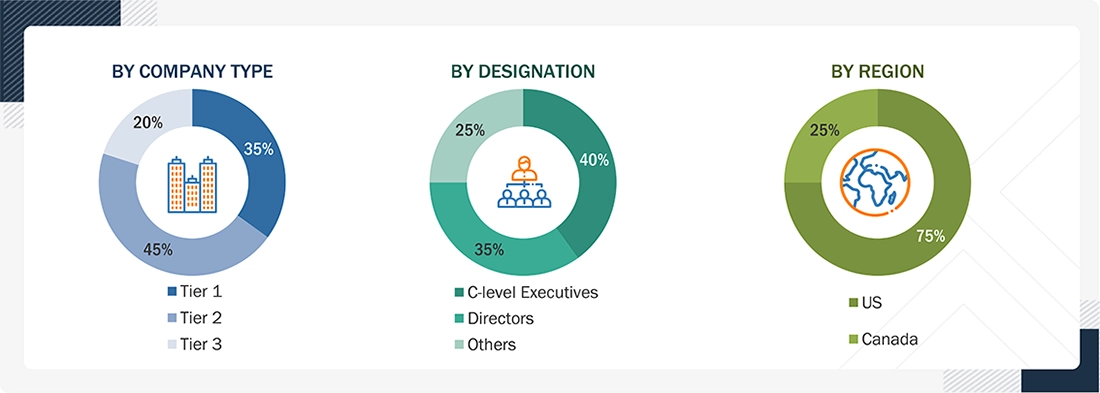
Note: Other designations include sales, marketing, and product managers.
Tiers are defined based on a company’s total revenue as of 2024: Tier 1 = >USD 1 billion, Tier 2 = USD 500 million to USD 1 billion, and Tier 3 = <USD 500 million.
To know about the assumptions considered for the study, download the pdf brochure
Market Size Estimation
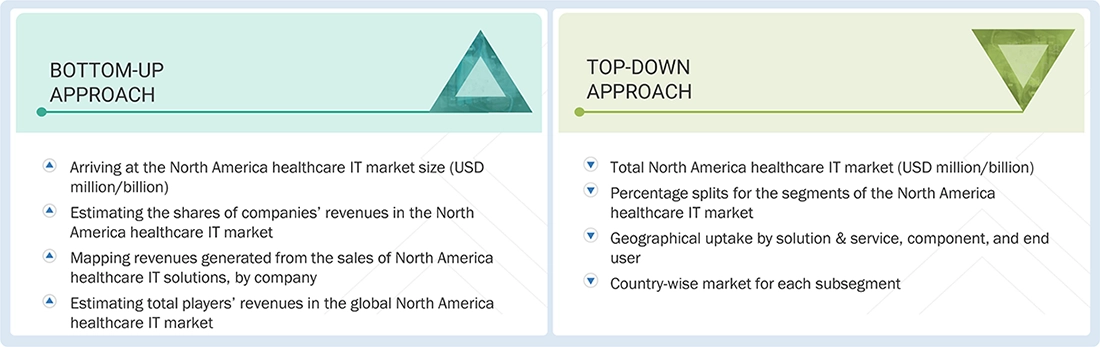
The market size estimates and forecasts provided in this study are derived through a mix of the bottom-up approach (revenue share analysis of leading players) and the top-down approach (assessment of utilization/adoption/penetration trends by solution & service, component, end user, and country).
North America Healthcare IT Market : Top-Down and Bottom-Up Approach
Data Triangulation
After determining the overall market size, the estimation process divided the market into several segments and subsegments. To complete the overall market engineering process and arrive at the exact statistics of each market segment and subsegment, the data triangulation and market breakdown procedures were employed, wherever applicable. The data was triangulated by studying various factors and trends from both the demand and supply sides in the North America healthcare IT market.
Market Definition
Healthcare information technology (HCIT) refers to the use of digital technologies, software platforms, IT infrastructure, and related services to manage, store, exchange, and analyze healthcare information across the healthcare ecosystem. It includes solutions used by healthcare providers, payers, and other stakeholders to support clinical, administrative, operational, and financial workflows. HCIT enables the digitization and integration of healthcare processes to improve patient care, operational efficiency, data accessibility, care coordination, and healthcare decision-making.
Key Stakeholders
- Healthcare IT solution providers
- Healthcare IT vendors
- Healthcare IT service providers
- Healthcare payers
- Laboratory information system (LIS) vendors
- Radiology information system (RIS), PACS, and VNA vendors
- Pharmacy information system & medication management vendors
- Healthcare consulting & IT service providers
- Medical device & connected health companies
- Academic medical centers & research institutions
- Contract research organizations (CROs)
- Cloud & data infrastructure providers
- Cybersecurity solution providers
- Healthcare interoperability & health information exchange vendors
- Telehealth & remote patient monitoring providers
- Population health management solution providers
- Academic research institutes
- Government institutes
- Market research and consulting firms
- Venture capitalists and investors
Report Objectives
- To define, describe, and forecast the North America healthcare IT market by solution & service, component, end user, and country
- To provide detailed information regarding the major factors, such as drivers, restraints, opportunities, and challenges, influencing the growth of the market
- To analyze micromarkets with respect to individual growth trends, prospects, and contributions to the overall North America healthcare IT market
- To assess the North America healthcare IT market with regard to Porter’s five forces, regulatory landscape, value chain, ecosystem map, patent protection, impact of 2025 US tariff, AI/Gen AI on the market under study, and key stakeholders’ buying criteria
- To analyze opportunities in the market for stakeholders and provide details of the competitive landscape for market leaders
- To forecast the size of the North America healthcare IT market with respect to two main countries, namely, the US and Canada
- To profile the key players in the North America healthcare IT market and comprehensively analyze their core competencies and market shares
- To track and analyze competitive developments such as agreements, partnerships, acquisitions, expansions, product launches and enhancements, and R&D activities in the North America healthcare IT market
Available customizations:
With the given market data, MarketsandMarkets offers customizations according to your company’s specific needs. The following customization options are available for the report:
Company Information
-
Detailed analysis and profiling of additional market players (up to 5)
Get the Full North America Healthcare IT Market Report
Full forecast, segment splits, and company analysis for all North America Healthcare IT Market.
Need a Tailored Report?
Customize this report to your needs
Get 10% FREE Customization
Customize This Report
