
UK Optical Transceiver Market (2024-2029)

The UK Optical Transceiver Market was valued at $981.6 Million in 2024 and projected to reach to $1834.8 Million by 2029, representing a compound annual growth rate of 13.3%. The optical transceiver market is experiencing accelerated growth driven by escalating demand for high-speed data transmission, cloud computing expansion, and 5G network deployment.


| Market Size in | USD 26.32 MN |
| Market Forecast in | |
| CAGR | |
| Forecast Period | |
| Units Considered | Value (USD MN) |
UK Optical Transceiver Market Trends and Insights
- The UK market is driven by increasing demand for high-speed data transmission infrastructure, cloud computing expansion, and 5G network deployment across the country.
- UK telecommunications operators and data center providers are investing heavily in optical networking solutions to support bandwidth-intensive applications and improve network efficiency. The UK's position as a leading European technology hub accelerates adoption of advanced optical transceiver technologies.
- UK enterprises are modernizing their network infrastructure to meet growing data traffic demands, with particular emphasis on data center interconnectivity and long-haul transmission capabilities.
- Between 2024 and 2029, the UK market will benefit from government digital transformation initiatives and private sector investments in next-generation network infrastructure..
Key Market Statistics
- CAGR (2024-2029) 13.3% CAGR
- Market Size, 2024 ~USD 981.6 Million
- Forecast, 2029 ~USD 1834.8 Million
- Country UK
UK Optical Transceiver Market Overview
Strong Market Growth :
The optical transceiver market is projected to grow from $13.57 billion in 2024 to $25 billion by 2037, representing a robust 13% CAGR over the forecast period.
Europe Leads Regional Growth :
Europe emerges as the fastest-growing region with a 14.4% CAGR, driven by increasing data center investments and 5G infrastructure deployment across the continent.
Diverse Market Segmentation :
The market spans multiple segments including form factor, wavelength, data rate, fiber type, connector types, and applications, offering varied opportunities across different use cases.
Global Market Expansion :
Growth is distributed across North America, Europe, Asia Pacific, and Rest of World regions, indicating widespread demand for optical transceiver solutions globally.
UK Optical Transceiver Market Dynamics
- Key drivers include the proliferation of data centers, increasing internet traffic, and the need for efficient bandwidth management across telecommunications infrastructure.
- The market's 13% CAGR reflects sustained investment in optical networking technologies. Looking ahead, technological advancements in transceiver design, miniaturization of form factors, and enhanced data rate capabilities will further propel market expansion.
- The shift toward higher wavelength solutions and improved connector standards will create new opportunities.
- Regional variations, particularly Europe's accelerated growth at 14.4% CAGR, suggest emerging markets and infrastructure modernization initiatives will continue to fuel demand through 2037..
Market Ecosystem
Related Ecosystem
Semiconductor Materials And Components
- Sensors
- Gallium Nitride (GaN)
- Digital Signal Processor (DSP)
- Natural Language Processing (NLP)
- Silicon Carbide
- Texas Instruments Incorporated
- Samsung
- APPLIED MATERIALS, INC.
- Stmicroelectronics
- Lenovo
Cns Systems
- C-Band
- Ka-Band
- Antennas
- Unmanned Ground Vehicles (UGV)
- Rotary Wing Aircraft
- L3Harris Technologies, Inc.
- Thales group
- HONEYWELL INTERNATIONAL INC.
- Northrop Grumman Corporation
- LOCKHEED MARTIN CORPORATION
Communication And Connectivity Technology
- Sensors
- Smart Card & Readers
- Cellular Network
- Femtocell
- Image Sensors
- Cisco Systems, Inc.
- HUAWEI TECHNOLOGIES CO LTD
- Lenovo
- CommScope Holding Company, Inc.
- Texas Instruments Incorporated
Key Takeaways
- The UK optical transceiver market is valued at $981.6 million in 2024 and will nearly double to $1,834.8 million by 2029.
- The UK market is growing at a 13.3% CAGR, driven by 5G deployment, cloud infrastructure expansion, and data center modernization.
- UK telecommunications and data center operators are primary growth drivers, investing in high-speed optical networking solutions.
- The UK's digital transformation initiatives and technology sector strength position it as a key European market for optical transceiver adoption.
Optical Transceiver Market Report Scope
| Report Metric | Details |
|---|---|
| Base Year | 2024 |
| Fastest Growing Segment | 41 GBPS TO 100 GBPS (Data Rate) |
| Forecast Period | 2024-2029 |
| Growth Rate | CAGR of 13% from 2024 to 2029 |
| Largest Segment | LC (Connector) |
| Market Size Base Year (Billions) | ~USD 13.57 (2024) |
| Revenue Forecast (Billions) | ~USD 25 (2029) |
| Segments Covered | Form Factor, Wavelength, Data Rate, Fiber Type, Connector, Application, Distance, Protocol |
UK Optical Transceiver Market Report Segmentation
8 segment dimensions are covered across the global market.
By Form Factor
- Cfp, Cfp2, Cfp4, And Cfp8
- Cxp
- Qsfp, Qsfp+, Qsfp-Dd, Qsfp28, And Qsfp56
- Sff And Sfp
- Sfp+ And Sfp28
- Xfp
By Wavelength
- 1310 Nm Band
- 1550 Nm Band
- 850 Nm Band
- Other Wavelengths
By Data Rate
- 10 Gbps To 40 Gbps
- 41 Gbps To 100 Gbps
- Less Than 10 Gbps
- More Than 100 Gbps
By Fiber Type
- Multimode Fiber
- Single Mode Fiber
- Single-Mode Fiber
By Connector
- Lc
- Mpo
- Rj-45
- Sc
By Application
- Data Center
- Data Centers
- Enterprise
- Enterprises
- Telecommunication
By Distance
- 1 To 10 Km
- 11 To 100 Km
- Less Than 1 Km
- More Than 100 Km
By Protocol
- Cwdm/Dwdm
- Ethernet
- Fiber Channel
- Fiber Channels
- Fttx
- Other Protocols
Target Audience
- Equipment Manufacturers : Semiconductor and optical equipment manufacturers need market insights to guide R&D investments, product roadmaps, and manufacturing capacity planning in response to growing demand.
- Telecom Service Providers : Telecommunications companies require market analysis to inform infrastructure investments, technology selection, and network upgrade strategies aligned with market evolution.
- Data Center Operators : Data center providers need comprehensive market data to evaluate transceiver technologies, optimize network architecture, and plan capital expenditures for connectivity solutions.
- Investment & Financial Analysts : Investors and financial professionals require detailed market forecasts and segmentation data to assess investment opportunities, valuations, and growth potential in the optical networking sector.
- Technology Consultants : Consulting firms and technology advisors need market intelligence to provide clients with informed recommendations on optical transceiver adoption and technology deployment strategies.
Reasons to Buy this Report
- Comprehensive Market Sizing : Detailed quantification of market value from 2024 baseline through 2037 forecast, enabling accurate financial planning and investment decisions based on verified growth projections.
- Segmentation Analysis : In-depth breakdown across six key segments including form factor, wavelength, data rate, fiber type, connector, and application, identifying high-growth opportunities within specific market niches.
- Regional Performance Insights : Geographic analysis covering North America, Europe, Asia Pacific, and Rest of World with Europe highlighted as fastest-growing region, supporting targeted market entry and expansion strategies.
- Competitive Intelligence : Market intelligence to understand industry dynamics, identify emerging trends, benchmark against competitors, and anticipate technological shifts in optical transceiver solutions.
- Strategic Decision Support : Actionable insights for product development, market positioning, partnership opportunities, and resource allocation aligned with market growth trajectories and regional demand patterns.
Frequently asked questions
What is the current size of the UK optical transceiver market?
The UK optical transceiver market was valued at $981.6 million in 2024 and is expected to reach $1,834.8 million by 2029.
What is the growth rate of the UK optical transceiver market?
The UK optical transceiver market is growing at a compound annual growth rate (CAGR) of 13.3% from 2024 to 2029.
What are the main drivers of growth in the UK optical transceiver market?
Key drivers include 5G network deployment, cloud computing expansion, data center modernization, and increased demand for high-speed data transmission infrastructure across the UK.
Which sectors are driving demand for optical transceivers in the UK?
The UK telecommunications sector, data center operators, and enterprise IT infrastructure providers are the primary drivers of optical transceiver demand.
How much will the UK optical transceiver market grow by 2029?
The UK optical transceiver market is projected to grow from $981.6 million in 2024 to $1,834.8 million in 2029, representing an 87% increase over the five-year period.
RESEARCH METHODOLOGY
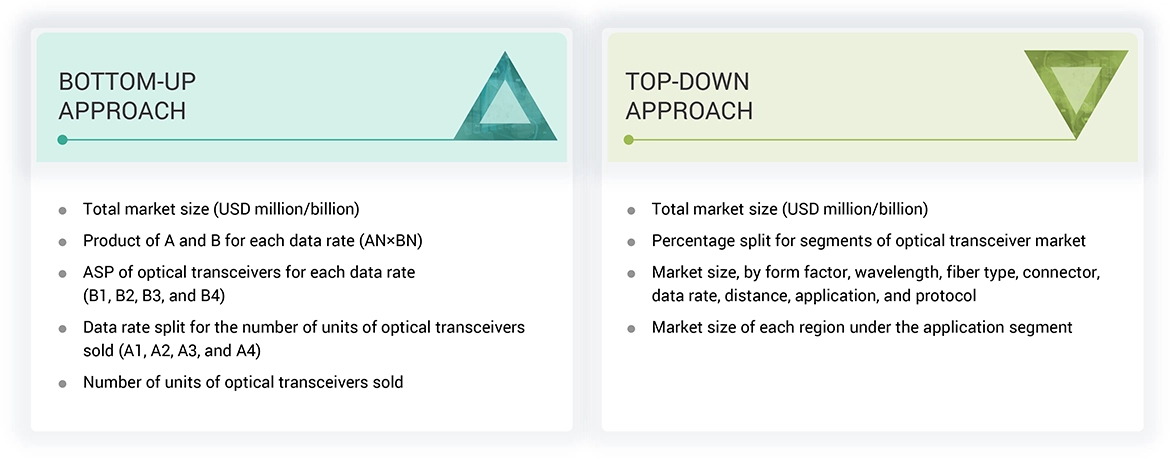
The study involved four major activities in estimating the size of the optical transceiver market. Exhaustive secondary research has been done to collect information on the market, peer market, and parent market. Validation of these findings, assumptions, and sizing with industry experts across the value chain through primary research has been the next step. Both top-down and bottom-up approaches have been employed to estimate the global market size. After that, market breakdown and data triangulation have been used to estimate the market sizes of segments and subsegments.
Secondary Research
Various secondary sources were used to identify and collect relevant information. These include corporate filings such as annual reports, press releases, investor presentations, and financial statements; trade, business, and professional associations; white papers, journals, and articles from recognized authors; certified publications related to optical transceiver; directories; and databases.
Secondary research was conducted to obtain key information about the supply chain of the industry, the monetary chain of the market, the total pool of key players, the segmentation of the market according to industry trends to the bottommost level, geographic markets, and key developments from the market-oriented perspective. Secondary data was collected and analyzed to arrive at the overall market size, which was further validated through primary research.
Primary Research
In the primary research process, various primary sources, from both supply and demand sides, were interviewed to obtain qualitative and quantitative information for this report. Primary sources from the supply side included experts such as chief executive officers (CEOs), vice presidents, marketing directors, technology and innovation directors, SMEs, consultants, and related key executives from the major companies and organizations operating in the optical transceiver market.
After the complete market engineering process (which includes market statistics calculations, market breakdown, market size estimations, market forecasting, and data triangulation), extensive primary research was conducted to gather information and verify and validate the critical market numbers.
Several primary interviews were conducted with experts from both the demand and supply sides across four major regions—North America, Europe, Asia Pacific, and RoW. Approximately 25% of the primary interviews were conducted with demand respondents and 75% with supply respondents. This primary data was collected through questionnaires, emails, and telephonic interviews.
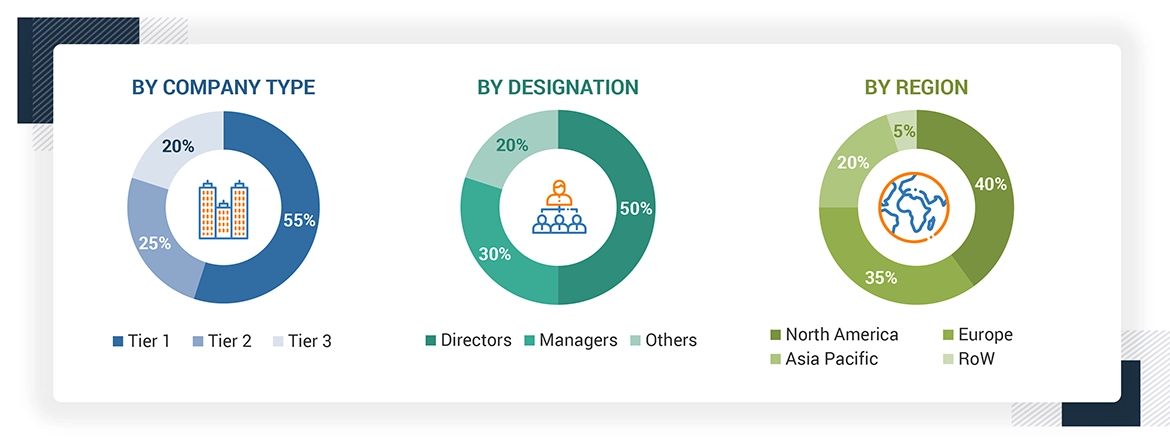
Note: “Others” includes sales, marketing, and product managers.
ROW includes the GCC, Rest of Middle East and Africa, and South America
About the assumptions considered for the study, To know download the pdf brochure
Market Size Estimation
Both top-down and bottom-up approaches have been used to estimate and validate the total size of the optical transceiver market. These methods have also been extensively used to estimate the sizes of various market subsegments. The research methodology used to estimate the market sizes includes the following:
Data Triangulation
After arriving at the overall market size from the estimation process explained above, the total market was split into several segments and subsegments. To complete the overall market engineering process and arrive at the exact statistics for all the segments and subsegments, data triangulation and market breakdown procedures were employed, wherever applicable. The data was triangulated by studying various factors and trends from both the demand and supply sides. The market has also been validated using both top-down and bottom-up approaches.
Market Definition
An optical transceiver is a device that uses fiber optical technology to send and receive data. This device comprises a transmitter and a receiver, which are combined and share common circuitry or a single housing. The transceiver is an important part of a fiber-optic network. It converts electrical signals to light signals to transmit data through an optical cable and vice versa. Manufacturers need to obtain ISO 9001 certifications to ensure that their optical transceivers are good quality.
Stakeholders
- Original equipment manufacturers (OEMs)
- Providers of technology solutions
- Research institutes
- Market research & consulting firms
- Forums, alliances, and associations related to optical transceivers
- Technology investors
- Governments & financial institutions
- Analysts & strategic business planners
- Existing end users and prospective ones
Research Objectives
- To describe and forecast the optical transceiver market, in terms of value, based on form factor, data rate, wavelength, fiber type, connector, distance, protocol, and application
- To describe and forecast the optical transceiver market, in terms of volume, based on data rate
- To describe and forecast the optical transceiver market size, in terms of value, with respect to four main regions: North America, Europe, Asia Pacific, and the Rest of the World (RoW)
- To provide detailed information regarding the drivers, restraints, opportunities, and challenges influencing the growth of the optical transceiver market
- To provide a detailed overview of the supply chain of the optical transceiver ecosystem
- To strategically analyze the micromarkets with respect to individual growth trends, prospects, and contributions to the overall market
- To analyze the opportunities in the market for various stakeholders by identifying the high-growth segments of the market
- To benchmark the market players using the proprietary company evaluation matrix framework, which analyzes market players on various parameters within the broad categories of market ranking/share and product portfolio
- To strategically profile the key players and comprehensively analyze their market positions in terms of ranking and core competencies, along with a detailed competitive landscape of the market
- To analyze competitive developments, such as acquisitions, product launches, partnerships, expansions, and collaborations, undertaken in the optical transceiver market
Get the Full Optical Transceiver Market Report
Full forecast, segment splits, and company analysis for all Optical Transceiver Market.
- US Optical Transceiver Market
- Canada Optical Transceiver Market
- Mexico Optical Transceiver Market
- Germany Optical Transceiver Market
- France Optical Transceiver Market
- Rest Of Europe Optical Transceiver Market
- China Optical Transceiver Market
- Japan Optical Transceiver Market
- South Korea Optical Transceiver Market
- Rest Of Asia Pacific Optical Transceiver Market
Need a Tailored Report?
Customize this report to your needs
Get 10% FREE Customization
Customize This Report
