
South America Outdoor Power Equipment Market (2024-2029)

The South America Outdoor Power Equipment Market was valued at $701.5 Million in 2024 and projected to reach to $902.2 Million by 2029, representing a compound annual growth rate of 5.2%. South America's outdoor power equipment market is positioned for sustained expansion through 2029, driven by demographic shifts and lifestyle changes favoring outdoor living investments.


| Market Size in | USD 26.32 MN |
| Market Forecast in | |
| CAGR | |
| Forecast Period | |
| Units Considered | Value (USD MN) |
South America Outdoor Power Equipment Market Trends and Insights
- South America's market is driven by increasing demand for landscaping and garden maintenance equipment across residential and commercial sectors.
- The region's growing middle class and rising investment in outdoor living spaces are key factors propelling South America's market expansion during the forecast period. South America's outdoor power equipment sector benefits from favorable climatic conditions that support year-round outdoor activities and maintenance.
- The market in South America is characterized by a mix of established manufacturers and emerging local players competing to capture growing consumer demand.
- South America's 5.2% compound annual growth rate significantly outpaces the global average, reflecting strong regional momentum and untapped market potential through 2029..
Key Market Statistics
- CAGR (2024-2029) 5.2% CAGR
- Market Size, 2024 ~USD 701.5 Million
- Forecast, 2029 ~USD 902.2 Million
- Country South America
South America Outdoor Power Equipment Market Overview
Market Valuation :
South America's outdoor power equipment market reached USD 701.5 million in 2024, with strong momentum expected to drive growth to USD 902.2 million by 2029.
Regional Growth Trajectory :
The South American market is outpacing global trends with a 5.2% CAGR, significantly exceeding the global average of 3.3%, indicating accelerating regional demand.
Residential & Commercial Expansion :
Rising middle-class populations across South America are investing heavily in outdoor living spaces, driving demand for landscaping and garden maintenance equipment in both residential and commercial sectors.
Economic Drivers :
Increasing disposable incomes and urbanization in South American countries are fueling consumer spending on outdoor power equipment, creating sustained market opportunities.
South America Outdoor Power Equipment Market Dynamics
- The region's growing middle class is increasingly prioritizing residential landscaping and garden maintenance, creating robust demand across both consumer and commercial segments.
- Infrastructure development and urbanization trends further support market penetration in emerging South American economies. Key growth catalysts include rising disposable incomes, expanding real estate development, and increased adoption of mechanized outdoor maintenance solutions.
- The 5.2% CAGR reflects South America's competitive advantage relative to global markets, suggesting strong regional economic fundamentals and consumer confidence.
- Strategic market entry and localized product offerings will be critical for capturing growth opportunities in this dynamic region..
Market Ecosystem
Related Ecosystem
Electronics System And Components
- Sensors
- Temperature Sensors
- Pressure Sensors
- Actuators
- Image Sensors
- Lenovo
- Samsung
- Texas Instruments Incorporated
- HONEYWELL INTERNATIONAL INC.
- Teledyne Technologies Incorporated
On Highway Off Highway Vehicles
- Internal Combustion Engine (ICE)
- Agricultural Tractors
- Crawler Excavator
- Battery Electric Vehicle (BEV)
- Excavators
- Visteon Corporation
- Deere & Company
- AB VOLVO PENTA
- Honda Motor Co., Ltd.
- Komatsu Ltd.
Electrical System And Components
- Natural Language Processing (NLP)
- Sensors
- Machine Learning
- Temperature Sensors
- Actuators
- ABB India Limited
- Siemens ag
- SCHNEIDER ELECTRIC SE
- Eaton Corporation plc
- Lenovo
Key Takeaways
- South America's outdoor power equipment market will grow from $701.5M (2024) to $902.2M (2029) at a 5.2% CAGR, outpacing global growth.
- South America's favorable climate and expanding middle class are driving sustained demand for landscaping and garden maintenance equipment.
- South America presents significant growth opportunities compared to mature markets, with emerging local manufacturers gaining market share.
- South America's market dynamics are shaped by increasing residential and commercial investment in outdoor living spaces and property maintenance.
Outdoor Power Equipment Market Report Scope
| Report Metric | Details |
|---|---|
| Base Year | 2024 |
| Fastest Growing Segment | DRILLING & FASTENING TOOLS (Tool Type) |
| Forecast Period | 2024-2029 |
| Growth Rate | CAGR of 3.3% from 2024 to 2029 |
| Largest Segment | FUEL-BASED (Power Source) |
| Market Size Base Year (Billions) | ~USD 31.03 (2024) |
| Revenue Forecast (Billions) | ~USD 36.5 (2029) |
| Segments Covered | Equipment Type, Type, Application, Power Source, Tool Type, Mode Of Operation |
South America Outdoor Power Equipment Market Report Segmentation
6 segment dimensions are covered across the global market.
By Equipment Type
- Blowers
- Lawn Mowers
- Saws
- Snow Throwers
- Tillers & Cultivators
- Trimmers & Edgers
By Type
- Corded
- Cordless
- Garden & Lawn Tractors
- Non-Riding
- Rear Engine Mowers
- Riding
- Robotic Lawn Mowers
- Walk-Behind Lawn Mowers
- Zero-Turn Radius Mowers (Ztrs)
By Application
- Commercial
- Residential/Diy
By Power Source
- Electric
- Fuel-Based
By Tool Type
- Demolition Tools
- Drilling & Fastening Tools
- Material Removal Tools
- Routing Tools
- Sawing & Cutting Tools
By Mode Of Operation
- Electric
- Pneumatic
Target Audience
- Equipment Manufacturers : Manufacturers need South America-specific market data to assess regional demand, identify growth segments, and develop localized product strategies for landscaping and garden equipment.
- Distribution & Retail Partners : Distributors require detailed market sizing and growth forecasts to optimize inventory planning, channel expansion, and sales strategies across South American territories.
- Private Equity & Investors : Investment firms need regional market intelligence to evaluate acquisition targets, assess portfolio company growth potential, and identify emerging opportunities in South America's outdoor equipment sector.
- Market Entry Strategists : Companies planning South American expansion require country-level insights on market dynamics, competitive landscape, and consumer behavior to minimize entry risks and maximize ROI.
- Business Development Executives : BD professionals need comprehensive South American market data to support partnership negotiations, joint venture evaluations, and strategic alliance decisions in the outdoor power equipment space.
Reasons to Buy this Report
- Regional Market Sizing : Obtain precise valuation data for South America's outdoor power equipment market with verified 2024 baseline (USD 701.5M) and 2029 forecasts, enabling accurate regional business planning.
- Competitive Growth Intelligence : Understand South America's 5.2% CAGR outperformance versus global 3.3%, identifying why the region presents superior growth opportunities compared to mature markets.
- Sector-Specific Demand Drivers : Access detailed analysis of residential and commercial landscaping trends, middle-class expansion, and outdoor living investment patterns specific to South American markets.
- Strategic Market Entry : Leverage country-level insights to develop targeted go-to-market strategies, product localization approaches, and distribution channel optimization for South American expansion.
- Investment Decision Support : Make informed capital allocation decisions with comprehensive South American market data, growth trajectory analysis, and economic fundamentals supporting long-term regional viability.
Frequently asked questions
What is the current market size of outdoor power equipment in South America?
South America's outdoor power equipment market was valued at USD 701.5 million in 2024.
What is the projected market size for South America by 2029?
South America's outdoor power equipment market is forecast to reach USD 902.2 million by 2029.
What is the CAGR for South America's outdoor power equipment market?
South America's market is expected to grow at a compound annual growth rate of 5.2% from 2024 to 2029.
What factors are driving growth in South America's outdoor power equipment market?
South America's growth is driven by rising middle-class incomes, increased investment in outdoor living spaces, favorable climate conditions, and growing demand for landscaping and garden maintenance equipment.
How does South America's market growth compare to global trends?
South America's 5.2% CAGR significantly exceeds the global average of 3.3%, indicating stronger regional market momentum and expansion potential.
RESEARCH METHODOLOGY
The study involved four major activities in estimating the current size of the outdoor power equipment market. Exhaustive secondary research has been done to collect information on the market, peer market, and parent market. To validate these findings, assumptions, and sizing with industry experts across the value chain through primary research has been the next step. Finally, both top-down and bottom-up approaches have been employed to estimate the complete market size. After that, market breakdown and data triangulation methods have been used to estimate the market size of segments and subsegments.
Secondary Research
In the secondary research process, various secondary sources have been referred to identify and collect information relevant to this study. The secondary sources include annual reports, press releases, and investor presentations of companies; white papers, certified publications, and articles from recognized authors; directories; and databases. Secondary research has been mainly conducted to obtain key information about the industry’s supply chain, value chain of the market, total pool of key players, market classification and segmentation according to industry trends, geographic markets, and key developments from both market- and technology-oriented perspectives.
Primary Research
In the primary research process, various primary sources from both supply and demand sides have been interviewed to obtain the qualitative and quantitative information relevant to this report. Primary sources from the supply side include experts such as CEOs, VPs, marketing directors, technology and innovation directors, application developers, application users, and related executives from various key companies and organizations operating in the outdoor power equipment ecosystem. Following is the breakdown of primary respondents:
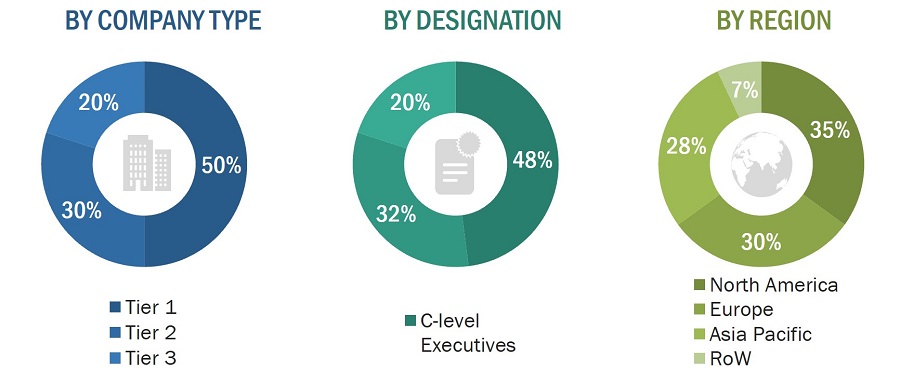
To know about the assumptions considered for the study, download the pdf brochure
Market Size Estimation
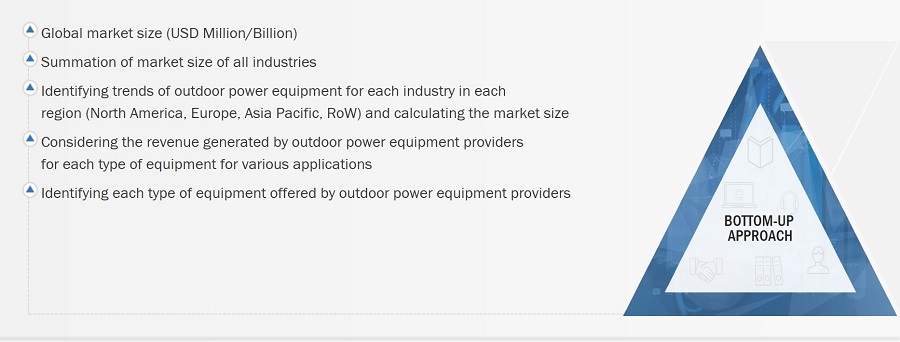
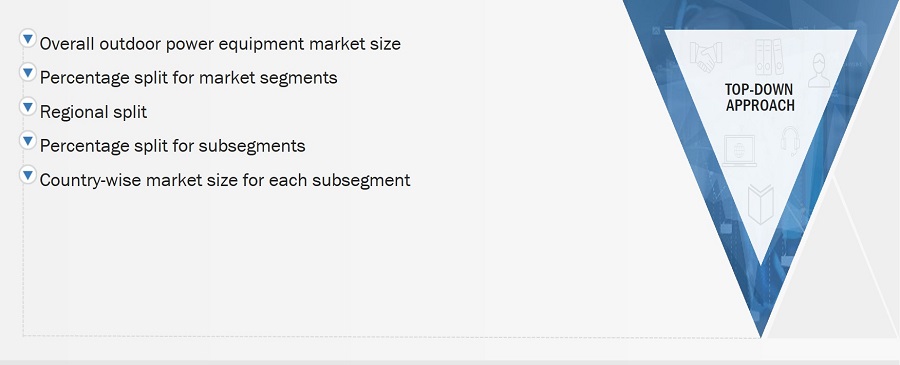
Both the top-down and bottom-up approaches have been used to estimate and validate the size of the overall outdoor power equipment market and the market based on segments. The research methodology used to estimate the market size has been given below:
- Major players operating in the outdoor power equipment market have been identified and considered for the report through extensive secondary research.
- The supply chain and market size of the outdoor power equipment market, both in terms of value and units, have been estimated/determined through secondary and primary research processes.
- All estimations and calculations, including percentage share, revenue mix, splits, and breakdowns have been determined through use of secondary sources which are further verified through primary sources.
Global outdoor power equipment market Size: Bottom-Up Approach
Global Outdoor Power Equipment Market Size: Top-Down Approach
Market Definition
Outdoor power equipment allows the alteration, building, maintenance, and improvement of green spaces in residential, as well as public and commercial spaces. Such equipment is used for a variety of applications, including home refurbishment, backyard beautification, do-it-yourself (DIY) projects. Professional landscaping, and turf care. Various types of outdoor power equipment, including lawnmowers, and trimmers & edgers, are used for basic yard and garden maintenance. Other equipment such as saws and tillers & cultivators are used in forestry, and agricultural applications.
Key Stakeholders
- Outdoor power equipment manufacturers
- Associations and industrial bodies
- Government bodies, such as regulatory authorities and policymakers
- Financial institutions and investment communities
- Market research and consulting firms
- Raw material suppliers and distributors
- Research institutes and organizations
- Outdoor power equipment traders and suppliers
- End-user industries
Data Triangulation
After arriving at the overall market size from the market size estimation process explained above, the total market has been split into several segments and subsegments. To complete the overall market engineering process and arrive at the exact statistics for all segments and subsegments, the data triangulation and market breakdown procedures have been employed, wherever applicable. The data has been triangulated by studying various factors and trends from both the demand and supply sides of the outdoor power equipment market.
Report Objectives:
- To define, describe, and forecast the global outdoor power equipment market, in terms of value, based on equipment type, application, power source, and region
- To describe and forecast the market size, in terms of value, across four main regions: North America, Europe, Asia Pacific, and the Rest of the World (RoW)
- To provide detailed information regarding the drivers, restraints, opportunities, and challenges influencing market growth
- To provide a detailed overview of the process flow of the outdoor power equipment market
- To analyze opportunities for stakeholders in the outdoor power equipment market by identifying the high-growth segments
- To strategically analyze micromarkets1 with respect to individual growth trends, prospects, and contributions to the overall market
- To strategically profile the key players and comprehensively analyze their market positions in terms of their ranking and core competencies
- To analyze the major growth strategies adopted by key market players, such as contracts, agreements, acquisitions, product launches, expansions, and partnerships
Available Customizations:
Based on the given market data, MarketsandMarkets offers customizations in the reports according to the client’s specific requirements. The available customization options are as follows:
Product Analysis
- Product matrix that gives a detailed comparison of the product portfolio of each company
Company Information
- Detailed analysis and profiling of 25 key players
Get the Full Outdoor Power Equipment Market Report
Full forecast, segment splits, and company analysis for all Outdoor Power Equipment Market.
- US Outdoor Power Equipment Market
- Canada Outdoor Power Equipment Market
- Mexico Outdoor Power Equipment Market
- Germany Outdoor Power Equipment Market
- UK Outdoor Power Equipment Market
- France Outdoor Power Equipment Market
- Rest Of Europe Outdoor Power Equipment Market
- China Outdoor Power Equipment Market
- Japan Outdoor Power Equipment Market
- South Korea Outdoor Power Equipment Market
- India Outdoor Power Equipment Market
- Rest Of Asia Pacific Outdoor Power Equipment Market
- GCC Countries Outdoor Power Equipment Market
Need a Tailored Report?
Customize this report to your needs
Get 10% FREE Customization
Customize This Report
