
Poland Pharmaceutical Contract Manufacturing Market (2025-2030)

The Poland Pharmaceutical Contract Manufacturing Market was valued at $890 Million in 2025 and projected to reach to $1050 Million by 2030, representing a compound annual growth rate of 3.3%. Poland's pharmaceutical contract manufacturing market is positioned for steady growth as European pharmaceutical companies increasingly seek cost-effective manufacturing solutions without compromising regulatory compliance.


| Market Size in | USD 26.32 MN |
| Market Forecast in | |
| CAGR | |
| Forecast Period | |
| Units Considered | Value (USD MN) |
Poland Pharmaceutical Contract Manufacturing Market Trends and Insights
- Poland has emerged as a strategic hub for contract manufacturing services in Central Europe, driven by competitive labor costs, regulatory compliance, and proximity to Western European markets.
- The market in Poland reflects steady expansion as pharmaceutical companies increasingly outsource manufacturing operations to optimize production efficiency and reduce operational costs. The growth trajectory for Poland's market through 2030 is supported by rising demand for specialized manufacturing capabilities, including biologics and complex formulations.
- Poland's pharmaceutical contract manufacturing sector benefits from established infrastructure, skilled workforce, and alignment with European Union regulatory standards.
- Between 2025 and 2030, Poland is expected to capture growing market share as multinational pharmaceutical firms expand their outsourcing partnerships in the region, positioning the country as a reliable manufacturing destination within Europe's broader pharmaceutical supply chain..
Key Market Statistics
- CAGR (2025-2030) 3.3% CAGR
- Market Size, 2025 ~USD 890 Million
- Forecast, 2030 ~USD 1050 Million
- Country Poland
Poland Pharmaceutical Contract Manufacturing Market Overview
Central European Hub Status :
Poland has established itself as a strategic contract manufacturing center in Central Europe, leveraging its geographic proximity to Western European markets and competitive operational advantages to attract pharmaceutical manufacturers seeking regional production capabilities.
Cost Competitiveness :
Poland's pharmaceutical contract manufacturing sector benefits from significantly lower labor costs compared to Western Europe, enabling manufacturers to optimize production expenses while maintaining high regulatory standards and quality assurance protocols.
Regulatory Excellence :
Polish contract manufacturers maintain full compliance with EU pharmaceutical regulations and GMP standards, providing clients with assured quality and regulatory certainty for products destined for European and international markets.
Moderate Growth Trajectory :
With a CAGR of 3.3% from 2025 to 2030, Poland's market is projected to grow from USD 890 million to USD 1,050 million, reflecting steady expansion driven by increasing outsourcing demand and regional manufacturing consolidation.
Poland Pharmaceutical Contract Manufacturing Market Dynamics
- The country's strategic location, skilled workforce, and established infrastructure continue to attract both multinational pharmaceutical firms and specialized contract manufacturers seeking to establish or expand Central European operations.
- The 3.3% CAGR reflects Poland's maturation as a reliable manufacturing destination, with growth driven by rising outsourcing trends and nearshoring strategies from Western European pharmaceutical companies.
- Investment in advanced manufacturing technologies and capacity expansion by existing players will further strengthen Poland's competitive position within the broader European contract manufacturing landscape..
Market Ecosystem
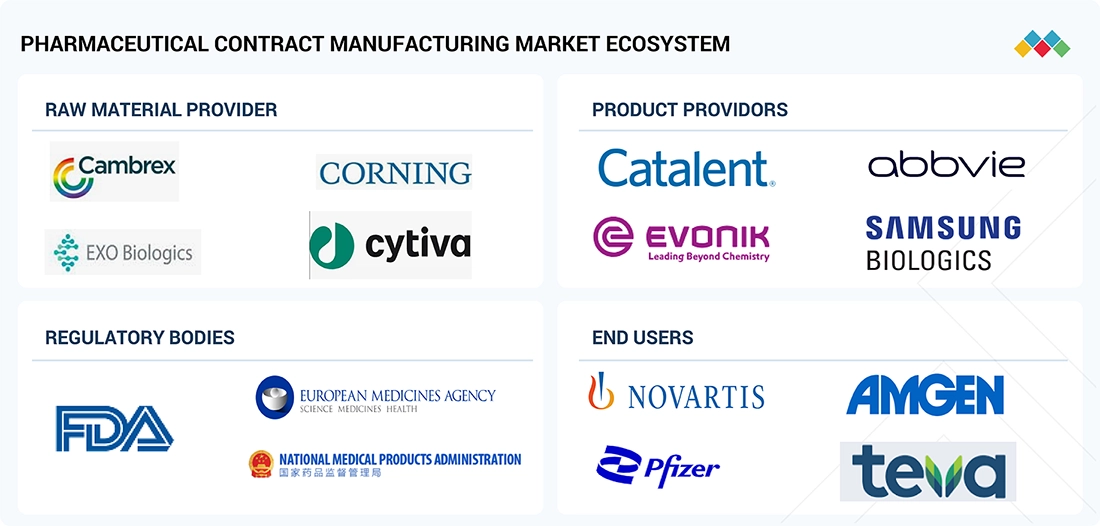
pharmaceutical-contract-manufacturing-market: COMMERCIAL USE CASES ACROSS INDUSTRIES
| COMPANY | USE CASE DESCRIPTION | BENEFITS |
|---|---|---|
 |
AstraZeneca partners with WuXi Biologics for commercial-scale manufacturing of monoclonal antibodies and biologics to meet global demand for oncology and respiratory therapies. | Secures large-volume, multi-site commercial supply and ensures rapid global distribution in high-demand market |
 |
Eli Lilly uses Cipla’s India-based CDMO facilities for commercial manufacturing of insulin formulations to supply emerging markets at scale. | Expands manufacturing capacity in cost-efficient regions and strengthens supply reliability for chronic disease therapies. |
 |
Teva relies on Recipharm for commercial production of inhalation and respiratory medicines, using Recipharm’s specialized device-plus-drug manufacturing expertise | Access to advanced inhalation device technology and faster commercial rollout for complex combination products |
Logos and trademarks shown above are the property of their respective owners. Their use here is for informational and illustrative purposes only.
Related Ecosystem
Medical Devices
- Polymerase Chain Reaction (PCR)
- Magnetic Resonance Imaging (MRI)
- Disposable Autoinjectors
- Pulse Oximeters
- Blood Pressure Monitors
- Medtronic plc
- Abbott Laboratories
- Stryker Corporation
- Becton, Dickinson and Company
- JOHNSON & JOHNSON
Pharmaceuticals
- Bioreactors
- Analytical Testing
- Bioanalytical Testing Services
- Cell Counters
- Data Management Services
- Thermo Fisher Scientific Inc.
- SANOFI
- Merck KGaA
- NOVARTIS
- Pfizer Inc.
Key Takeaways
- Poland's pharmaceutical contract manufacturing market is valued at USD 890.0 million in 2025 and is forecast to reach USD 1,050.0 million by 2030.
- Poland is experiencing a 3.3% CAGR, reflecting steady but moderate growth driven by outsourcing demand and EU regulatory alignment.
- Poland's competitive advantages include lower manufacturing costs, skilled labor, and strategic location within Central Europe.
- Between 2025 and 2030, Poland is positioned to attract increased investment from multinational pharmaceutical companies seeking reliable contract manufacturing partners.
Pharmaceutical Contract Manufacturing Market Report Scope
| Report Metric | Details |
|---|---|
| Base Year | 2025 |
| Fastest Growing Segment | DRUG DEVELOPMENT SERVICES (Service) |
| Forecast Period | 2025-2030 |
| Growth Rate | CAGR of 8.2% from 2025 to 2030 |
| Largest Segment | PHARMACEUTICAL MANUFACTURING SERVICES (Service) |
| Market Size Base Year (Billions) | ~USD 210.35 (2025) |
| Revenue Forecast (Billions) | ~USD 311.95 (2030) |
| Segments Covered | Service, Type, Molecule, End User |
Poland Pharmaceutical Contract Manufacturing Market Report Segmentation
4 segment dimensions are covered across the global market.
By Service
- Biologics Manufacturing Services
- Drug Development Services
- Fill-Finish Services
- Other Services
- Packaging & Labeling Services
- Packaging & Labelling Services
- Pharmaceutical Manufacturing Services
By Type
- Adc
- Antibody Drug Conjugates
- Biologics Api Manufacturing Services
- Biologics Fdf Manufacturing Services
- Capsule Manufacturing Services
- Cell & Gene Therapies
- Cgt
- High-Potency Small Molecule
- High-Potency Small Molecules
- Mabs
- Monoclonal Antibodies
- Oligonucleotide & Synthetic Peptides
- Oligonucleotides & Synthetic Peptides
- Oral Liquid Manufacturing Services
- Other Fdf Manufacturing Services
- Other Large Molecules
- Other Small Molecules
- Parenteral Manufacturing Services
- Pharmaceutical Api Manufacturing Services
- Pharmaceutical Fdf Manufacturing Services
- Radiopharmaceutical Molecules
- Semi-Solid Manufacturing Services
- Tablet Manufacturing Services
- Therapeutic Peptides & Proteins
- Vaccines
By Molecule
- Large Molecules
- Small Molecules
By End User
- Big Pharmaceutical Companies
- Generic Pharmaceutical Companies
- Other End Users
- Small & Medium-Sized Pharmaceutical Companies
Target Audience
- Pharmaceutical Manufacturers : Multinational and regional pharmaceutical companies seeking cost-effective contract manufacturing solutions in Europe need Poland-specific market data to evaluate outsourcing opportunities and identify qualified CDMO partners in this strategic region.
- Contract Development & Manufacturing Organizations (CDMOs) : Existing and prospective CDMOs require detailed Poland market intelligence to assess growth potential, competitive landscape, capacity utilization trends, and investment opportunities for facility expansion or new market entry.
- Private Equity & Investment Firms : Investment groups evaluating pharmaceutical manufacturing assets in Central Europe need Poland-specific market sizing, growth forecasts, and competitive dynamics to identify acquisition targets and assess portfolio company performance.
- Regulatory & Compliance Consultants : Consultants advising pharmaceutical clients on manufacturing strategy and regulatory compliance require Poland market data to recommend optimal production locations and validate nearshoring strategies within the EU framework.
- Supply Chain & Procurement Professionals : Pharmaceutical supply chain managers need Poland market insights to optimize sourcing strategies, evaluate contract manufacturer capabilities, and make informed decisions about regional production consolidation and vendor selection.
Reasons to Buy this Report
- Market Size & Growth Data : Access precise valuation of Poland's pharmaceutical contract manufacturing market at USD 890 million (2025) with detailed forecasts through 2030, enabling accurate investment planning and competitive benchmarking specific to this Central European market.
- Regional Competitive Intelligence : Understand Poland's positioning relative to global markets (8.2% global CAGR vs. 3.3% Poland CAGR) and identify opportunities for market entry, expansion, or partnership within Central Europe's pharmaceutical manufacturing ecosystem.
- Strategic Location Insights : Leverage detailed analysis of Poland's geographic and economic advantages as a nearshoring destination for Western European pharmaceutical manufacturers, including cost structures, regulatory frameworks, and supply chain proximity benefits.
- Investment & Expansion Planning : Make informed decisions regarding facility establishment, capacity investment, or acquisition targets in Poland's contract manufacturing sector with comprehensive market data and growth projections through 2030.
- Regulatory & Compliance Framework : Gain insights into Poland's EU-compliant manufacturing standards, GMP certifications, and regulatory environment that ensure product quality and market access for pharmaceutical manufacturers and contract service providers.
Frequently asked questions
What is the current size of Poland's pharmaceutical contract manufacturing market?
Poland's pharmaceutical contract manufacturing market is valued at USD 890.0 million in 2025, with projections to reach USD 1,050.0 million by 2030.
What is the expected growth rate for Poland's pharmaceutical contract manufacturing market?
Poland's pharmaceutical contract manufacturing market is expected to grow at a CAGR of 3.3% from 2025 to 2030.
What factors are driving growth in Poland's pharmaceutical contract manufacturing sector?
Growth in Poland is driven by competitive labor costs, EU regulatory compliance, proximity to Western European markets, and increasing pharmaceutical outsourcing demand.
Why is Poland an attractive location for pharmaceutical contract manufacturing?
Poland offers established infrastructure, a skilled workforce, cost competitiveness, EU regulatory alignment, and strategic positioning within Central Europe's pharmaceutical supply chain.
What is the forecast market size for Poland's pharmaceutical contract manufacturing by 2030?
Poland's pharmaceutical contract manufacturing market is forecast to reach USD 1,050.0 million by 2030, representing an increase of USD 160.0 million from 2025.
RESEARCH METHODOLOGY
This research study extensively used secondary sources, directories, and databases to identify and collect valuable information to analyze the global pharmaceutical contract manufacturing market. In-depth interviews were conducted with various primary respondents, including key industry participants, subject-matter experts, C-level executives of key market players, and industry consultants, to obtain and verify critical qualitative and quantitative information and assess the growth prospects of the market. The global market size estimated through secondary research was then triangulated with inputs from primary research to arrive at the final market size.
Secondary Research
Secondary research was used mainly to identify and collect information for the extensive, technical, market-oriented, and commercial study of the pharmaceutical contract manufacturing market. The secondary sources used for this study include Indian Pharmaceutical Association (IPA), Pharmaceutical Research and Manufacturers of America (PhRMA), European Federation of Pharmaceutical Industries and Associations (EFPIA), Central Drugs Standard Control Organization (CDSCO), Indian Brand Equity Foundation (IBEF), European Medicines Agency (EMA), Pharma & Biopharma Outsourcing Association (PBOA), Generics and Biosimilars Initiative (GaBI), Pharma Times, Parenteral Drug Association (PDA), Indian Drug Manufacturers’ Association (IDMA), American Association of Pharmaceutical Scientists (AAPS), Global Cancer Observatory, American Chemical Society, National Center for Biotechnology Information, Eurostat, Food and Drug Administration (FDA), Biotechnology and Biological Sciences Research Council (BBSRC), Pharmaceutical Research and Manufacturers of America (PhRMA), World Journal of Pharmaceutical Sciences, research journals; corporate filings such as annual reports, SEC filings, investor presentations, and financial statements; press releases; trade, business, professional associations and among others. These sources were also used to obtain key information about major players, market classification, and segmentation according to industry trends, regional/country-level markets, market developments, and technology perspectives.
Primary Research
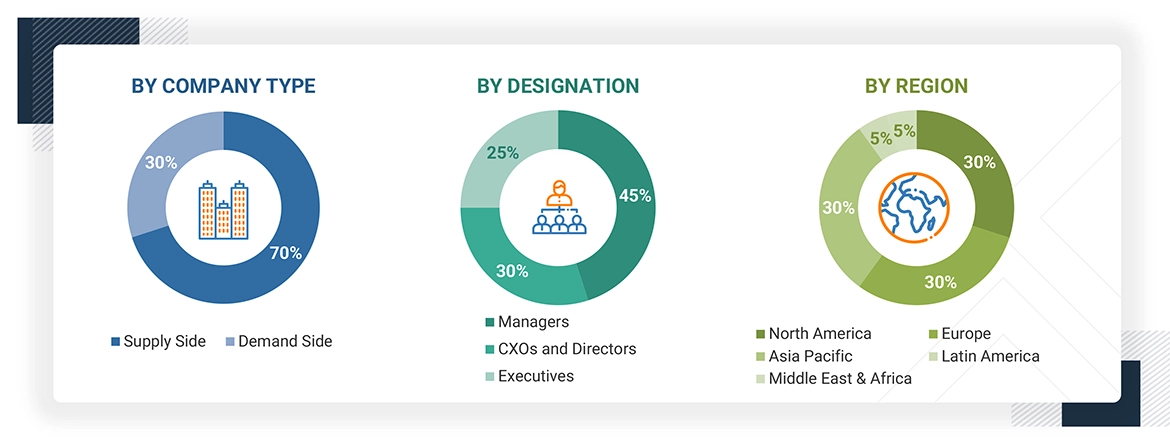
Following an initial assessment of the global pharmaceutical contract manufacturing market landscape through secondary research, comprehensive primary research was undertaken. This involved conducting in-depth interviews with market experts from the demand side, including stakeholders from pharmaceutical and biotechnology firms, CROs, CMOs, and academic and research institutions. Additionally, interviews were held with key supply-side participants, such as C-suite and senior executives, product managers, and marketing and sales leaders from prominent manufacturers, distributors, and channel partners. The research covered six major geographical regions: North America, Europe, Asia Pacific, Latin America, the Middle East, and Africa. Approximately 70% of the primary interviews were conducted with supply-side participants, while 30% involved demand-side experts. Data collection methods included structured questionnaires, email correspondence, online surveys, personal interviews, and telephonic discussions to understand the market dynamics comprehensively.
The following is a breakdown of the primary respondents:
To know about the assumptions considered for the study, download the pdf brochure
Market Size Estimation
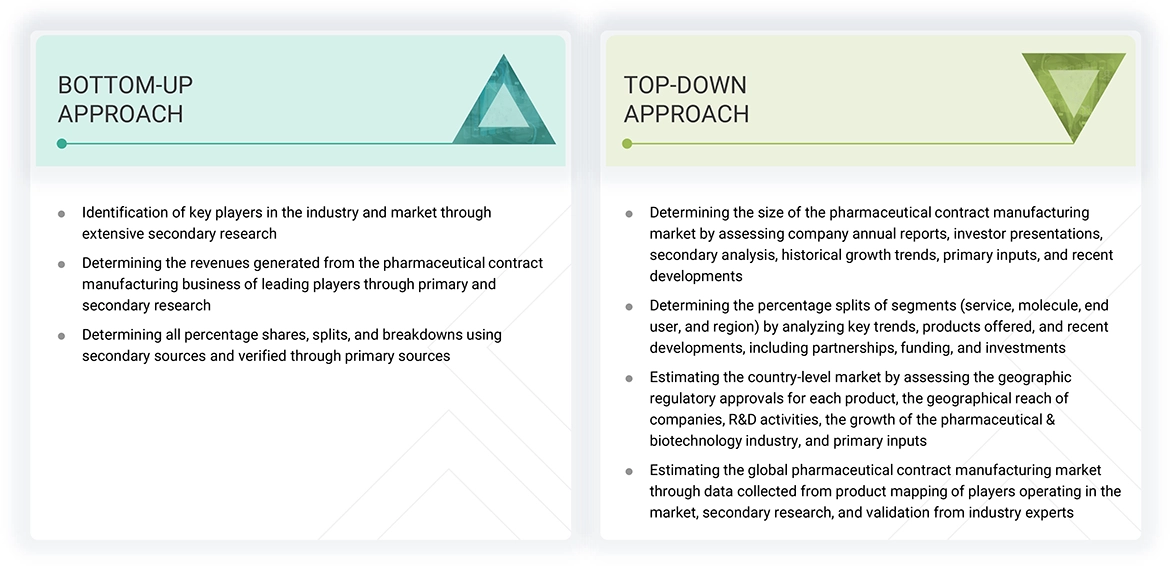
Both bottom-up and top-down approaches were used to estimate and validate the total size of the pharmaceutical contract manufacturing market. These methods were also used extensively to estimate the size of various subsegments in the market. The research methodology used to estimate the market size includes the following:
- A list of the major global players operating in the pharmaceutical contract manufacturing market was generated.
- The revenues generated from their pharmaceutical contract manufacturing product have been determined through annual reports and secondary sources (including paid databases)
- The products were mapped according to the segments of the market. Percentage shares and splits were determined based on the revenue contributed to each segment. This was verified using secondary sources and by industry experts.
- All assumptions, approaches, and individual shares/revenue estimates were validated through interviews with experts.
Global Pharmaceutical Contract Manufacturing Market: Bottom-up and Top-down Approach
Data Triangulation
After arriving at the market size from the estimation process explained above, the total market was divided into several segments and subsegments. To complete the overall market engineering process and arrive at the exact statistics for all segments and subsegments, data triangulation and market breakdown procedures were employed, wherever applicable. The data was triangulated by studying various factors and trends from both the demand and supply sides.
Market Definition
Pharmaceutical contract manufacturing organizations (CMOs) provide contract-based, comprehensive services, such as drug development and manufacturing. CMOs offer manufacturing services for active pharmaceutical ingredients (APIs) and finished dosage formulations (FDFs). Different aspects of contract manufacturing, such as drug development & manufacturing, formulation development, and commercial pharmaceutical & biopharmaceutical manufacturing, have been considered in this report.
Stakeholders
- Contract Development & Manufacturing Organizations
- Biotechnology and Pharmaceutical Companies
- Academic and Research Institutions
- Corporate Entities
- Venture Capitalists
- Regulatory Agencies
- Industry Associations and Government Agencies
- Pharmaceutical Distributors and Suppliers
- Contract Research Organizations
Report Objectives
- To define, describe, and forecast the global pharmaceutical contract manufacturing market based on the service, molecule, end user, and region
- To provide detailed information regarding the major factors influencing market growth (such as drivers, restraints, opportunities, and challenges)
- To strategically analyze micromarkets1 with respect to individual growth trends, prospects, and contributions to the overall pharmaceutical contract manufacturing market
- To analyze opportunities in the market for stakeholders and provide details of the competitive landscape for market leaders
- To forecast the size of the market segments with respect to six main regions: North America, Europe, the Asia Pacific, Latin America, the Middle East, and Africa
- To profile the key players in the pharmaceutical contract manufacturing market and comprehensively analyze their service portfolios, market positions, and core competencies
- To track and analyze competitive developments in the pharmaceutical contract manufacturing market, such as acquisitions, product launches, expansions, agreements, partnerships, and collaborations
- To benchmark players within the pharmaceutical contract manufacturing market using the ‘Company Evaluation Matrix' framework, which analyzes market players based on various parameters within the broad categories of business strategy and product strategy
Get the Full Pharmaceutical Contract Manufacturing Market Report
Full forecast, segment splits, and company analysis for all Pharmaceutical Contract Manufacturing Market.
- Rest Of Latin America Pharmaceutical Contract Manufacturing Market
- Kingdom Of Saudi Arabia (Ksa) Pharmaceutical Contract Manufacturing Market
- Rest Of GCC Countries Pharmaceutical Contract Manufacturing Market
- US Pharmaceutical Contract Manufacturing Market
- Canada Pharmaceutical Contract Manufacturing Market
- Germany Pharmaceutical Contract Manufacturing Market
- UK Pharmaceutical Contract Manufacturing Market
- France Pharmaceutical Contract Manufacturing Market
- Italy Pharmaceutical Contract Manufacturing Market
- Switzerland Pharmaceutical Contract Manufacturing Market
- Spain Pharmaceutical Contract Manufacturing Market
- China Pharmaceutical Contract Manufacturing Market
- Japan Pharmaceutical Contract Manufacturing Market
- South Korea Pharmaceutical Contract Manufacturing Market
- India Pharmaceutical Contract Manufacturing Market
- Australia Pharmaceutical Contract Manufacturing Market
- Brazil Pharmaceutical Contract Manufacturing Market
- Mexico Pharmaceutical Contract Manufacturing Market
- UAE Pharmaceutical Contract Manufacturing Market
- Rest Of Europe Pharmaceutical Contract Manufacturing Market
- Rest Of Asia Pacific Pharmaceutical Contract Manufacturing Market
Need a Tailored Report?
Customize this report to your needs
Get 10% FREE Customization
Customize This Report
