
Japan Plant-based Protein Market (2025-2030)

The Japan Plant-based Protein Market was valued at $1777.1 Million in 2025 and projected to reach to $2852 Million by 2030, representing a compound annual growth rate of CAGR 9.9%. Japan's plant-based protein market is positioned for substantial growth through 2030, driven by evolving consumer preferences toward healthier and more sustainable food choices.


| Market Size in | USD 26.32 MN |
| Market Forecast in | |
| CAGR | |
| Forecast Period | |
| Units Considered | Value (USD MN) |
Japan Plant-based Protein Market Trends and Insights
- Japan's market expansion is driven by increasing health consciousness among consumers, rising adoption of flexitarian and vegetarian diets, and growing demand for sustainable protein alternatives.
- The Japanese market benefits from strong innovation in plant-based product development and established distribution networks across retail and foodservice channels. By 2030, Japan is expected to solidify its position as a key growth market within Asia Pacific for plant-based proteins.
- Japan's aging population and focus on preventive health, combined with environmental sustainability concerns, are accelerating the shift toward plant-based alternatives.
- Japan's market growth outpaces the global average of 7.9% CAGR, reflecting unique regional consumer preferences and regulatory support for alternative protein innovation..
Key Market Statistics
- CAGR (2025-2030) CAGR 9.9%
- Market Size, 2025 ~USD 1777.1 Million
- Forecast, 2030 ~USD 2852 Million
- Country Japan
Japan Plant-based Protein Market Overview
Market Valuation Growth :
Japan's plant-based protein market is valued at USD 1,777.1 million in 2025 and is projected to reach USD 2,852.0 million by 2030, demonstrating strong market expansion potential.
Accelerated Growth Rate :
Japan's market is growing at a CAGR of 9.9%, significantly outpacing the global average of 7.9%, indicating stronger regional adoption and market momentum.
Health & Sustainability Drivers :
Rising health consciousness among Japanese consumers, combined with growing demand for sustainable protein alternatives, is fueling market expansion across urban and suburban regions.
Dietary Shift Adoption :
Increasing adoption of flexitarian and vegetarian diets among Japanese consumers is creating sustained demand for innovative plant-based protein products and solutions.
Japan Plant-based Protein Market Dynamics
- The market's 9.9% CAGR reflects strong regional momentum as Japanese consumers increasingly embrace flexitarian and vegetarian lifestyles.
- Health consciousness, environmental awareness, and product innovation are key catalysts reshaping the protein landscape.
- Manufacturers are responding with diverse offerings tailored to Japanese taste preferences and nutritional requirements.
- The market is expected to attract significant investment from both domestic and international players seeking to capitalize on this high-growth opportunity in Asia's developed economy..
Market Ecosystem
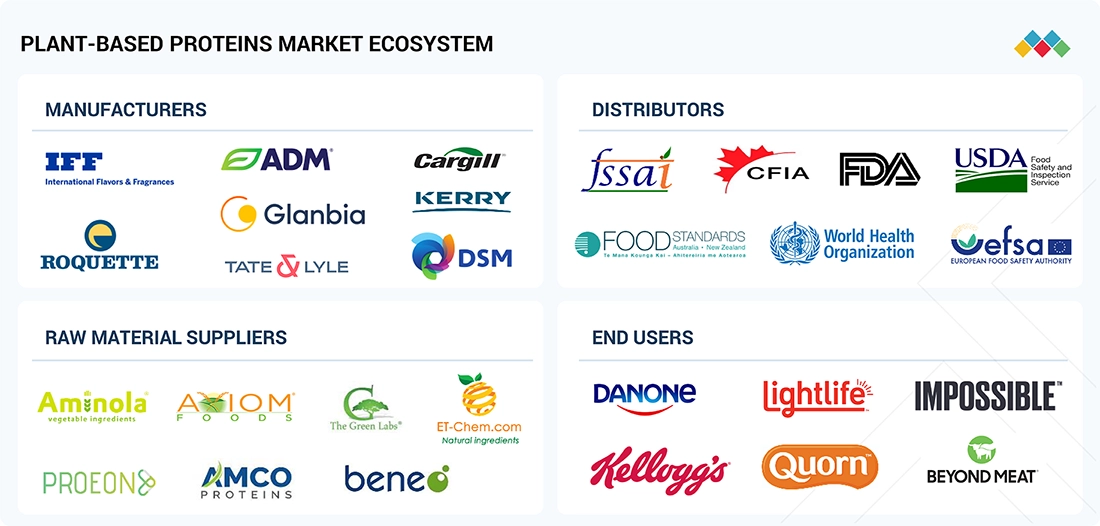
Plant-based Protein Market: COMMERCIAL USE CASES ACROSS INDUSTRIES
| COMPANY | USE CASE DESCRIPTION | BENEFITS |
|---|---|---|
 |
In June 2025, Roquette expanded its NUTRALYS plant protein portfolio with the launch of two new textured protein solutions: NUTRALYS T WHEAT 600L (textured wheat protein) and NUTRALYS T PEA 700XC (textured pea protein). | These innovations mark Roquette’s entry into textured wheat and strengthen its position in the plant-based space. |
 |
In November 2024, Burcon partnered with Puratos to develop innovative canola protein applications for the bakery and patisserie sectors. | The collaboration aims to deliver healthier, sustainable, and cost-effective alternatives to traditional ingredients such as eggs. |
Logos and trademarks shown above are the property of their respective owners. Their use here is for informational and illustrative purposes only.
Related Ecosystem
Plant Based Alternatives Ingredients
- Dairy Products
- Bakery Products
- Diaphragm Pumps
- Enzymatic Hydrolysis
- Microorganism
- AZELIS HOLDINGS SA
- Archer-Daniels-Midland Company
- Amway
- CARGILL, INCORPORATED
- INTERNATIONAL FLAVORS & FRAGRANCES INC.
Key Takeaways
- Japan's plant-based protein market will grow from USD 1,777.1M (2025) to USD 2,852.0M (2030) at a 9.9% CAGR, outpacing global growth.
- Japan's health-conscious consumers and aging demographic are primary drivers of plant-based protein adoption and market expansion.
- Japan's strong innovation ecosystem and established retail infrastructure position the country as a regional leader in plant-based alternatives.
- Japan's sustainability focus and regulatory environment support continued market growth through 2030 and beyond.
Plant-based Protein Market Report Scope
| Report Metric | Details |
|---|---|
| Base Year | 2025 |
| Fastest Growing Segment | FABA BEANS (Source) |
| Forecast Period | 2025-2030 |
| Growth Rate | CAGR of 7.9% from 2025 to 2030 |
| Largest Segment | DRY (Form) |
| Market Size Base Year (Billions) | ~USD 23.91 (2025) |
| Revenue Forecast (Billions) | ~USD 34.97 (2030) |
| Segments Covered | Application, Nature, Form, Source, Type, Food & Beverage Application |
Japan Plant-based Protein Market Report Segmentation
6 segment dimensions are covered across the global market.
By Application
- Bakery Products
- Convenience Foods
- Dairy Alternatives
- Feed
- Food & Beverages
- Meat Alternatives
- Other Food Applications
- Performance Nutrition
By Nature
- Conventional
- Organic
By Form
- Dry
- Liquid
- Wet
By Source
- Canola, Rice, Oats, & Potatoes
- Canola, Rice, Oats, And Potatoes
- Faba Beans
- Other Sources
- Pea
- Peas
- Soy
- Wheat
By Type
- Concentrates
- Isolates
- Milled Protein Flours
- Starch-Rich Protein Flours
- Textured
By Food & Beverage Application
- Bakery Products
- Convenience Foods
- Dairy Alternatives
- Meat Alternatives
- Other Food & Beverage Applications
- Performance Nutrition
Target Audience
- Food & Beverage Manufacturers : Need Japan-specific market data to develop plant-based protein product lines, optimize formulations for local preferences, and plan market entry or expansion strategies in this high-growth segment.
- Investment & Private Equity Firms : Require detailed market sizing and growth projections for Japan to evaluate investment opportunities, assess portfolio companies' regional performance, and identify acquisition targets in the plant-based sector.
- Retail & Distribution Companies : Need insights into Japan's market dynamics, consumer demand trends, and growth forecasts to optimize product assortment, shelf space allocation, and supply chain strategies.
- Market Research & Consulting Firms : Utilize Japan-specific data and analysis to support client engagements, validate market hypotheses, and provide competitive intelligence for strategic consulting projects.
- Government & Policy Organizations : Require market intelligence on Japan's plant-based protein sector to inform agricultural policies, sustainability initiatives, and economic development strategies supporting the food industry.
Reasons to Buy this Report
- Market Size & Growth Validation : Access precise valuation data for Japan's plant-based protein market (USD 1,777.1M in 2025) with verified 9.9% CAGR projections through 2030 to support investment and expansion decisions.
- Competitive Positioning Intelligence : Understand Japan-specific market dynamics, consumer behavior patterns, and competitive landscape to identify gaps and opportunities for product development and market entry strategies.
- Regional Growth Benchmarking : Compare Japan's 9.9% CAGR against the global 7.9% benchmark to assess regional outperformance and prioritize resource allocation across international markets.
- Consumer Trend Analysis : Gain insights into Japanese consumer drivers including health consciousness, flexitarian adoption, and sustainability preferences to tailor marketing and product strategies effectively.
- Strategic Forecast Planning : Leverage 2030 market projections (USD 2,852M) to develop long-term business strategies, supply chain planning, and investment roadmaps specific to Japan's high-growth market segment.
Frequently asked questions
What is the current size of Japan's plant-based protein market?
Japan's plant-based protein market is valued at USD 1,777.1 million in 2025 and is projected to reach USD 2,852.0 million by 2030.
What is the growth rate of Japan's plant-based protein market?
Japan's plant-based protein market is growing at a compound annual growth rate (CAGR) of 9.9% from 2025 to 2030, which exceeds the global average of 7.9%.
What factors are driving growth in Japan's plant-based protein market?
Key drivers in Japan include increasing health consciousness, rising adoption of flexitarian and vegetarian diets, environmental sustainability concerns, and an aging population focused on preventive health.
How does Japan's market growth compare to global trends?
Japan's 9.9% CAGR outpaces the global plant-based protein market CAGR of 7.9%, reflecting strong regional demand and unique consumer preferences in Japan.
What is the forecast for Japan's plant-based protein market by 2030?
Japan's plant-based protein market is forecast to reach USD 2,852.0 million by 2030, representing a 60.5% increase from the 2025 baseline of USD 1,777.1 million.
RESEARCH METHODOLOGY
The study involved two major approaches in estimating the current size of the plant-based protein market. Exhaustive secondary research collected information on the market, source, type, application, nature, and form segments. The next step was to validate these findings, assumptions, and sizing with industry experts across the value chain through primary research. Both top-down and bottom-up approaches were employed to estimate the complete market size. Data triangulation was used to estimate the market size of segments and subsegments.
Secondary Research
This research study involved extensive secondary sources—directories and databases such as Bloomberg Businessweek and Factiva—to identify and collect valuable information for a technical, market-oriented, and commercial market study. In the secondary research process, sources such as annual reports, press releases & investor presentations of companies, white papers, food journals, certified publications, articles from recognized authors, directories, and databases were referred to identify and collect information. Secondary research was mainly used to obtain key information about the industry’s supply chain, the pool of key players, and market classification and segmentation as per the industry trends to the bottom-most level, regional markets, and key developments from market- and technology-oriented perspectives.
Primary Research
Extensive primary research was conducted after obtaining information regarding the plant-based protein market scenario through secondary research. Several primary interviews were conducted with market experts from the demand and supply sides across major countries of North America, Europe, Asia Pacific, South America, and the Rest of the World. Primary data was collected through questionnaires, emails, and telephonic interviews. The primary sources from the supply side included various industry experts, such as chief officers (CXOs), vice presidents (VPs), directors from business development, marketing, research, and development teams, and related key executives from distributors and key opinion leaders.
Primary interviews were conducted to gather insights such as market statistics, data on revenue collected from the products and services, market breakdowns, market size estimations, market forecasting, and data triangulation. Primary research also helped understand the source, type, application, nature, form, and region trend. Stakeholders from the demand side, such as plant-based food manufacturers and feed & pet-food manufacturers, were interviewed to understand the buyers’ perspective on the suppliers, products, and their business outlook, which will affect the overall market.
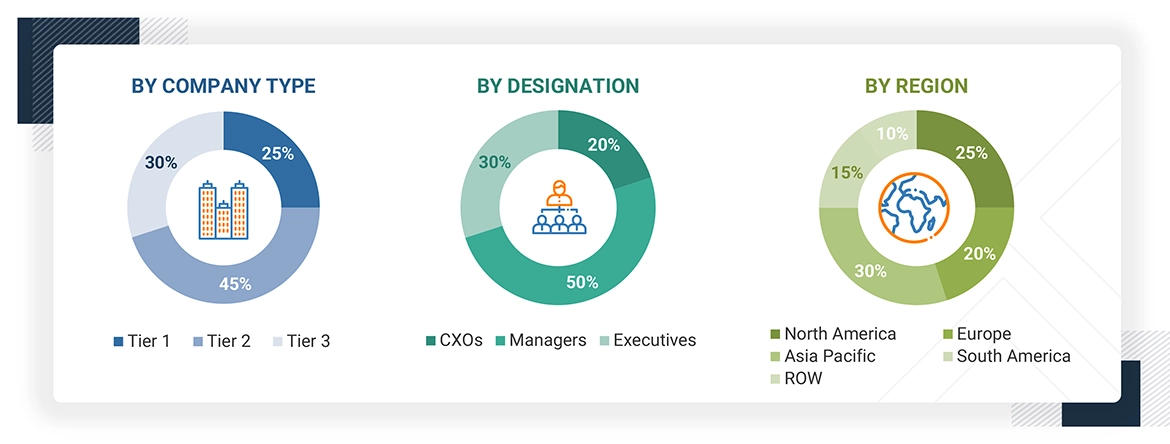
Note: The three tiers of the companies are defined based on their total revenues in 2023 or 2024,
as per the availability of financial data: Tier 1: Revenue > USD 1 billion; Tier 2: USD 100
million = revenue = USD 1 billion; Tier 3: Revenue < USD 100 million
To know about the assumptions considered for the study, download the pdf brochure
|
COMPANY NAME |
DESIGNATION |
|
ADM (US) |
Product Development Manager |
|
Wilmar International Ltd (Singapore) |
Senior R&D Scientist |
|
Roquette Frères (France) |
Marketing Director |
|
Kerry Group PLC (Ireland) |
Sales Head |
|
International Flavors & Fragrances Inc. (US) |
Senior Research Executive |
|
Tate & Lyle (UK) |
Business Development Manager |
Market Size Estimation
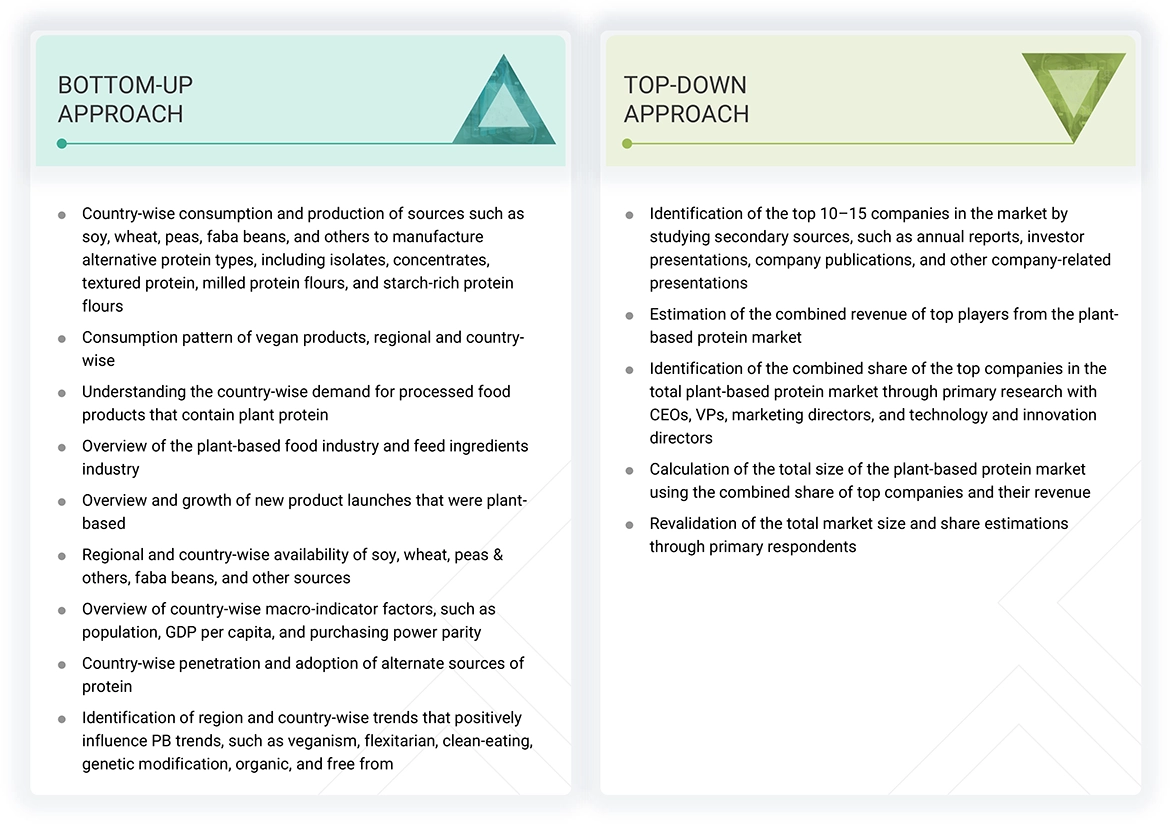
The top-down and bottom-up approaches were used to estimate and validate the total size of the plant-based protein market. These approaches were also used extensively to determine the size of various subsegments in the market. The research methodology used to estimate the market size includes the following details:
- The key players in the industry and the overall markets were identified through extensive secondary research.
- All shares, splits, and breakdowns were determined using secondary sources and verified through primary sources.
- All possible parameters that affect the market covered in this research study were accounted for, viewed in extensive detail, verified through primary research, and analyzed to obtain final quantitative and qualitative data.
- The research included the study of reports, reviews, and newsletters of top market players, along with extensive interviews for opinions from leaders, such as CEOs, directors, and marketing executives.
Plant-based Protein Market : Top-Down and Bottom-Up Approach
Data Triangulation
After determining the overall market size from the estimation process explained above, the total market was split into several segments and subsegments. The data triangulation procedure was employed, wherever applicable, to estimate the overall plant-based protein market and arrive at the exact statistics for all segments and subsegments. The data was triangulated by studying various factors and trends from the demand and supply sides. The market size was also validated using both the top-down and bottom-up approaches.
Market Definition
Plant-based protein is derived from plant-based sources, such as pulses, grains, and seeds. Plant-based protein sources include soy, wheat, peas, faba beans, canola, rice, and potatoes. Proteins are polymers of amino acids used in various applications for their nutritional and functional properties. Their potential to increase the nutritional level in a healthy diet makes them one of the key ingredients in the food and feed industries.
Milled protein flours are plant protein products with enhanced protein content (20–80%) and reduced starch levels (10–40%), produced through conventional milling combined with protein concentration techniques to achieve specific functional and nutritional profiles.
Starch-rich protein flours are plant-based flour products characterized by moderate protein content (15–35%) with substantial starch retention (35–55%), produced through mild processing techniques that preserve the natural macronutrient balance of the source material.
Stakeholders
- Raw material suppliers of plant-based protein
- Intermediate stakeholders, including distributors, retailers, associations, regulatory bodies, and others
- Manufacturers and traders of plant-based protein ingredients, such as soy, wheat, peas, canola, oats, rice, and potatoes
- Manufacturers and traders of food products, including dairy alternatives, meat alternatives, bakery products, nutritional products, convenience foods, and other food applications
- Manufacturers and traders of non-food applications, such as feed and pet food
- Government organizations, institutes, and research organizations
-
Associations and Industry Bodies:
- Food and Agriculture Organization (FAO)
- United States Department of Agriculture (USDA)
- U.S. Food and Drug Administration (FDA)
- European Food Safety Authority (EFSA)
- European Association of Specialty Feed Ingredients and their Mixtures (FEFANA)
- Organization for Economic Co-operation and Development (OECD)
- Plant-based Food Associations (PBFA)
- United Soybean Board (USB)
- European Plant-based Foods Association (ENSA)
- European Vegetable Protein Association (EUVEPRO)
- Food Standards Australia New Zealand (FSANZ)
Report Objectives
- To determine and project the size of the plant-based protein market based on source, type, application, nature, form, function (qualitative), and region over five years, ranging from 2025 to 2030
- To identify the attractive opportunities in the market by determining the largest and fastest-growing segments across regions
- To provide detailed information about the key factors influencing market growth (drivers, restraints, opportunities, and challenges)
- To analyze the opportunities in the market for stakeholders and provide details of the competitive landscape for market leaders
- To analyze the micromarkets concerning individual growth trends, prospects, and their contribution to the total market
- To identify and profile the key players in the plant-based protein market
- To understand the competitive landscape and identify the major growth strategies adopted by players across the key regions
Available Customizations
With the given market data, MarketsandMarkets offers customizations according to company-specific scientific needs.
The following customization options are available for the report:
Product Analysis
- Product matrix, which gives a detailed comparison of the product portfolio of each company.
Geographic Analysis as per Feasibility
With the given market data, MarketsandMarkets offers customizations according to company-specific scientific needs.
- Further breakdown of the Rest of European plant-based protein market into key countries
- Further breakdown of the Rest of Asia Pacific plant-based protein market into key countries
- Further breakdown of the Rest of South American plant-based protein market into key countries
Company Information
- Detailed analyses and profiling of additional market players (up to five)
Get the Full Plant-based Protein Market Report
Full forecast, segment splits, and company analysis for all Plant-based Protein Market.
- US Plant-based Protein Market
- Canada Plant-based Protein Market
- Mexico Plant-based Protein Market
- Germany Plant-based Protein Market
- UK Plant-based Protein Market
- France Plant-based Protein Market
- Italy Plant-based Protein Market
- Spain Plant-based Protein Market
- Netherlands Plant-based Protein Market
- China Plant-based Protein Market
- India Plant-based Protein Market
- Brazil Plant-based Protein Market
- Argentina Plant-based Protein Market
- Rest Of Europe Plant-based Protein Market
- Rest Of Apac Plant-based Protein Market
- Rest Of South America Plant-based Protein Market
Need a Tailored Report?
Customize this report to your needs
Get 10% FREE Customization
Customize This Report
