
Europe Plant Growth Regulators Market (2024-2029)

The Europe Plant Growth Regulators Market was valued at $997.8 Million in 2024 and projected to reach to $1361 Million by 2029, representing a compound annual growth rate of 6.4%. Europe's Plant Growth Regulators Market is poised for steady expansion through 2029, driven by the region's commitment to sustainable intensification and precision agriculture.


| Market Size in | USD 26.32 MN |
| Market Forecast in | |
| CAGR | |
| Forecast Period | |
| Units Considered | Value (USD MN) |
Europe Plant Growth Regulators Market Trends and Insights
- Europe maintains a mature yet dynamic agricultural sector where plant growth regulators play an increasingly critical role in optimizing crop yields and quality across diverse climatic zones.
- The region's stringent regulatory environment and emphasis on sustainable farming practices are shaping the adoption of advanced growth regulation technologies throughout the forecast period. In Europe, the demand for plant growth regulators is driven by the need to enhance productivity while adhering to strict environmental and food safety standards.
- European farmers are increasingly adopting these solutions to manage crop stress, improve uniformity, and reduce resource consumption.
- The market's growth from 2024 to 2029 reflects Europe's commitment to precision agriculture and the rising integration of biotechnology-based growth regulators.
- Europe's competitive landscape features both established multinational players and innovative regional suppliers catering to the continent's diverse agricultural requirements..
Key Market Statistics
- CAGR (2024-2029) 6.4% CAGR
- Market Size, 2024 ~USD 997.8 Million
- Forecast, 2029 ~USD 1361 Million
- Geography Europe
Europe Plant Growth Regulators Market Overview
Market Valuation & Growth :
Europe's Plant Growth Regulators Market reached USD 997.8 million in 2024 and is forecast to grow to USD 1,361.0 million by 2029, with a steady CAGR of 6.4%, reflecting sustained demand across the region's agricultural sector.
France Leads European Market :
France dominates the European market with USD 302.4 million in market size, followed by Germany at USD 279.6 million, demonstrating strong adoption of plant growth regulators in Western Europe's advanced agricultural systems.
Diverse Agricultural Applications :
Europe's mature agricultural sector leverages plant growth regulators across diverse climatic zones and crop types, from cereals and horticulture to viticulture, optimizing yields and quality in both conventional and precision farming practices.
Regulatory & Sustainability Focus :
European regulations emphasizing sustainable agriculture and reduced chemical inputs drive innovation in plant growth regulator formulations, positioning the region as a leader in eco-friendly crop management solutions.
Europe Plant Growth Regulators Market Dynamics
- The mature agricultural sector continues to adopt advanced crop management technologies to enhance productivity while meeting stringent environmental regulations.
- Key growth drivers include increasing pressure to maximize yields on limited arable land, rising adoption of integrated crop management practices, and growing investment in agricultural innovation across Western and Eastern European nations. The market will benefit from ongoing research into novel plant growth regulator formulations that align with EU sustainability directives and organic farming standards.
- Regional disparities present opportunities, with Eastern European countries showing accelerating adoption rates.
- Strategic partnerships between agrochemical manufacturers and agricultural cooperatives, combined with digital farming integration, will further propel market growth through the forecast period..
Market Ecosystem
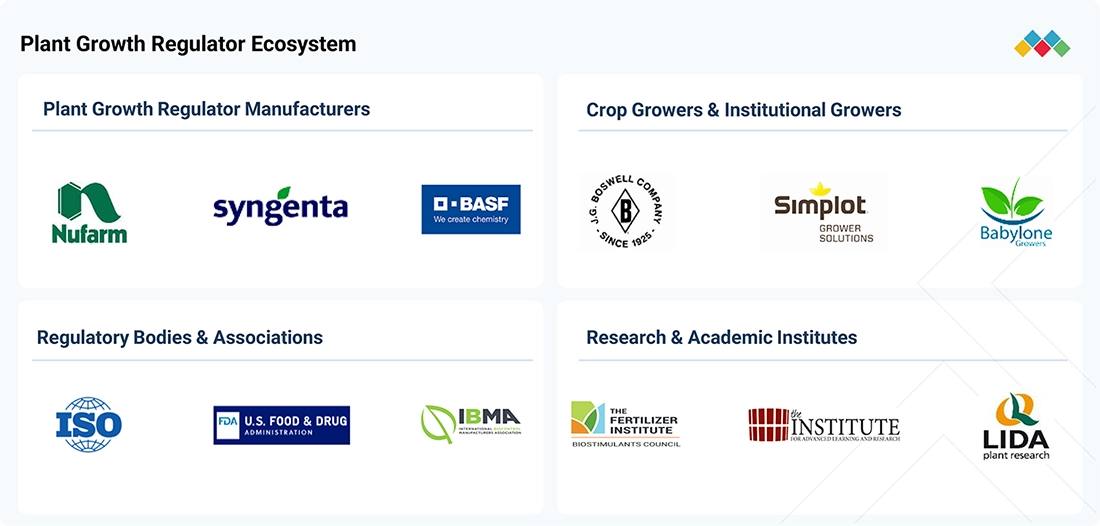
PLANT GROWTH REGULATORS MARKET : COMMERCIAL USE CASES ACROSS INDUSTRIES
| COMPANY | USE CASE DESCRIPTION | BENEFITS |
|---|---|---|
 |
Development and commercialization of chemical and bio-based PGRs for cereals and horticultural crops | Improved yield stability, enhanced stress tolerance, and regulatory-compliant solutions |
 |
PGRs and biological growth enhancers integrated with seed and crop protection programs | Optimized crop vigor, uniform growth, and improved productivity across cropping systems |
 |
Plant growth regulators and biostimulants for fruits, vegetables, and row crops | Enhanced crop quality, uniform ripening, and better resource-use efficiency |
 |
Growth regulators for crop and turf management applications | Controlled plant growth, reduced lodging, and improved crop performance |
Logos and trademarks shown above are the property of their respective owners. Their use here is for informational and illustrative purposes only.
Related Ecosystem
Agricultural Biologicals
- Bionematicides
- Auxins
- Cytokinins
- Ethylene
- Humic Substances
- NICHINO INDIA PVT LTD.
- Corteva, Inc.
- Basf se
- AZELIS HOLDINGS SA
- BAYER AG
Agrochemicals
- Phosphatic Fertilizers
- Potassic Fertilizers
- Fungicides
- Ammonium Nitrate
- Anticoagulant Rodenticides
- AZELIS HOLDINGS SA
- Basf se
- Origin Enterprises plc
- MITSUI AGRO BUSINESS SACO
- SNF HOLDING COMPANY INC.
Key Takeaways
- Europe's Plant Growth Regulators Market is valued at USD 997.8 million in 2024 and will reach USD 1,361.0 million by 2029 at a 6.4% CAGR.
- Europe's regulatory framework prioritizes sustainable and environmentally compliant growth regulation solutions, influencing product development and adoption strategies.
- European farmers are increasingly adopting plant growth regulators to optimize yields while meeting strict food safety and environmental standards.
- Europe's market growth is supported by precision agriculture adoption, biotechnology innovation, and the presence of both global and regional suppliers.
Plant Growth Regulators Market Report Scope
| Report Metric | Details |
|---|---|
| Base Year | 2024 |
| Fastest Growing Segment | MICROBIALS (Source) |
| Forecast Period | 2024-2029 |
| Growth Rate | CAGR of 7.2% from 2024 to 2029 |
| Largest Segment | MICROBIALS (Source) |
| Market Size Base Year (Billions) | ~USD 3.25 (2024) |
| Revenue Forecast (Billions) | ~USD 4.6 (2029) |
| Segments Covered | Type, Crop Type, Formulation, Function, Source |
Europe Plant Growth Regulators Market Report Segmentation
5 segment dimensions are covered across the global market.
By Type
- Auxins
- Corn
- Cotton
- Cytokinins
- Ethylene
- Fruits
- Gibberellins
- Other Cereals & Grains
- Other Oilseeds & Pulses
- Other Types
- Rice
- Soybean
- Sunflower
- Vegetables
- Wheat
By Crop Type
- Cereals & Grains
- Fruits & Vegetables
- Oilseeds & Pulses
- Turf & Ornamentals
By Formulation
- Solutions
- Water-Dispersible & Water-Soluble Granules
- Wettable Powder
- Wettable Powders
By Function
- Biocontrol
- Biofertilizers
- Plant Growth Inhibitors
- Plant Growth Promoters
- Plant Growth Regulators
By Source
- Beneficial Insects
- Biochemicals
- Microbials
Target Audience
- Agrochemical Manufacturers : Develop targeted product strategies and market entry plans for Europe by understanding country-specific demand, competitive intensity, and regulatory requirements across the region's USD 997.8M market.
- Agricultural Distributors & Retailers : Optimize inventory management and sales strategies by identifying high-potential European markets and understanding regional growth rates, customer preferences, and distribution channel dynamics.
- Crop Consultants & Agronomists : Stay informed on market trends, emerging product categories, and regional best practices in plant growth regulator application to provide evidence-based recommendations to European farming clients.
- Investment & Private Equity Firms : Evaluate investment opportunities in European agricultural technology and agrochemical companies with comprehensive market sizing, growth forecasts, and competitive analysis across key European markets.
- Government & Agricultural Policy Bodies : Inform agricultural policy, subsidy programs, and sustainability initiatives with data-driven insights into Europe's plant growth regulator market dynamics and alignment with environmental and food security objectives.
Countries within Europe - compare and drill down
| Country | 2025 size (native) |
|---|---|
| Germany | USD 279.6 Million |
| UK | USD 164.5 Million |
| France | USD 302.4 Million |
| Poland | USD 82.8 Million |
| Spain | USD 261.6 Million |
| Rest Of Europe | USD 270.1 Million |
Country market size visualization
Reasons to Buy this Report
- Country-Level Market Breakdown : Access detailed market sizing for 6 European countries including France (USD 302.4M), Germany (USD 279.6M), Spain, UK, Poland, and Rest of Europe, enabling precise market targeting and regional strategy development.
- Competitive Landscape Intelligence : Understand market dynamics specific to Europe's mature agricultural sector, including key players, product portfolios, and competitive positioning across Western and Eastern European markets with distinct regulatory environments.
- Growth Opportunity Identification : Identify high-growth segments and emerging opportunities within Europe's 6.4% CAGR expansion, including sustainable formulations, precision agriculture integration, and organic farming applications aligned with EU regulations.
- Regulatory & Compliance Insights : Navigate Europe's complex regulatory landscape with market analysis informed by EU sustainability directives, pesticide regulations, and organic certification requirements that shape product development and market entry strategies.
- Strategic Market Forecasting : Leverage 5-year forecast data (2024-2029) to plan product launches, capacity investments, and market expansion initiatives with confidence in Europe's projected growth trajectory and regional demand patterns.
Frequently asked questions
What is the current size of Europe's Plant Growth Regulators Market?
Europe's Plant Growth Regulators Market was valued at USD 997.8 million in 2024.
What is the projected market size for Europe by 2029?
Europe's Plant Growth Regulators Market is projected to reach USD 1,361.0 million by 2029.
What is the CAGR for Europe's Plant Growth Regulators Market?
Europe's Plant Growth Regulators Market is expected to grow at a compound annual growth rate (CAGR) of 6.4% from 2024 to 2029.
What factors are driving growth in Europe's Plant Growth Regulators Market?
Growth in Europe is driven by precision agriculture adoption, stringent regulatory compliance requirements, sustainable farming practices, and the need to optimize crop yields while managing environmental impact.
How does Europe's regulatory environment impact the Plant Growth Regulators Market?
Europe's strict regulatory framework emphasizes environmental sustainability and food safety, which shapes product development and encourages the adoption of compliant, innovative growth regulation solutions.
RESEARCH METHODOLOGY
The study involved four major activities in estimating the current size of the plant growth regulator market. Exhaustive secondary research was done to collect information on the market, peer, and parent markets. The next step was to validate these findings, assumptions, and sizing with industry experts across the value chain through primary research. Both top-down and bottom-up approaches were employed to estimate the complete market size. After that, market breakdown and data triangulation were used to estimate the market size of segments and subsegments.
Secondary Research
This research study relied heavily on secondary sources—directories and databases such as Bloomberg Businessweek and Factiva—to identify and collect information useful for a technical, market-oriented, and commercial study of the plant growth regulator market.
In the secondary research process, various sources such as annual reports, press releases & investor presentations, white papers, certified publications, articles from recognized authors, gold- and silver-standard websites, directories, and databases were used to identify and collect information. This research study relied heavily on secondary sources—directories and databases such as Bloomberg Businessweek and Factiva—to identify and collect information useful for a technical, market-oriented, and commercial study of the plant growth regulator market.
Secondary research was mainly used to obtain key information on the industry’s supply chain, the total pool of key players, and market classification and segmentation aligned with industry trends, down to the regional market level, as well as key developments from both market- and technology-oriented perspectives.
Primary Research
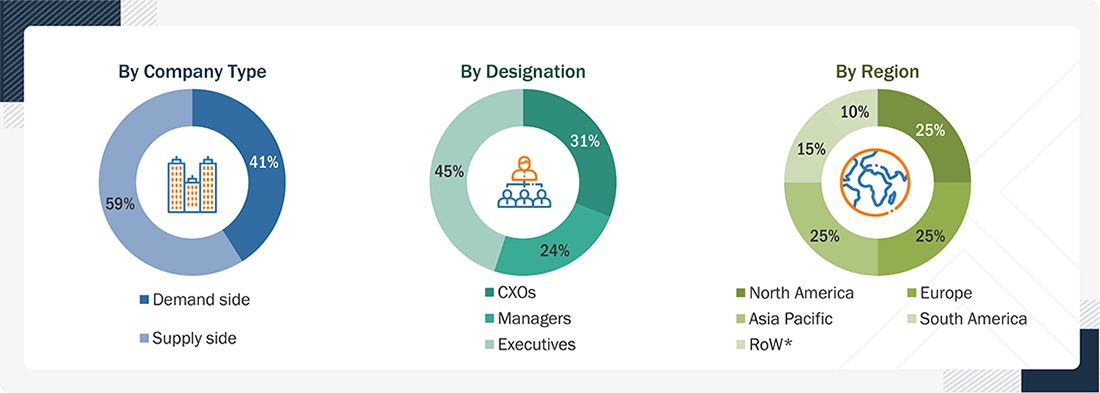
Extensive primary research was conducted after obtaining information regarding the plant growth regulator market scenario through secondary research. Several primary interviews were conducted with market experts from both the demand and supply sides across major countries of North America, Europe, Asia Pacific, the Middle East & Africa, and South America. Primary data was collected through questionnaires, emails, and telephone interviews. Primary supply-side sources included industry experts such as Chief X Officers (CXOs), Vice Presidents (VPs), Directors from business development, marketing, research, and development teams, and key executives from distributors and key opinion leaders. Primary interviews were conducted to gather insights such as market statistics, revenue data from products and services, market breakdowns, market size estimates, market forecasts, and data triangulation. Primary research also helped understand trends related to crop type, type, formulation, function, and region.
Breakdown of Primary Participants
To know about the assumptions considered for the study, download the pdf brochure
Market Size Estimation
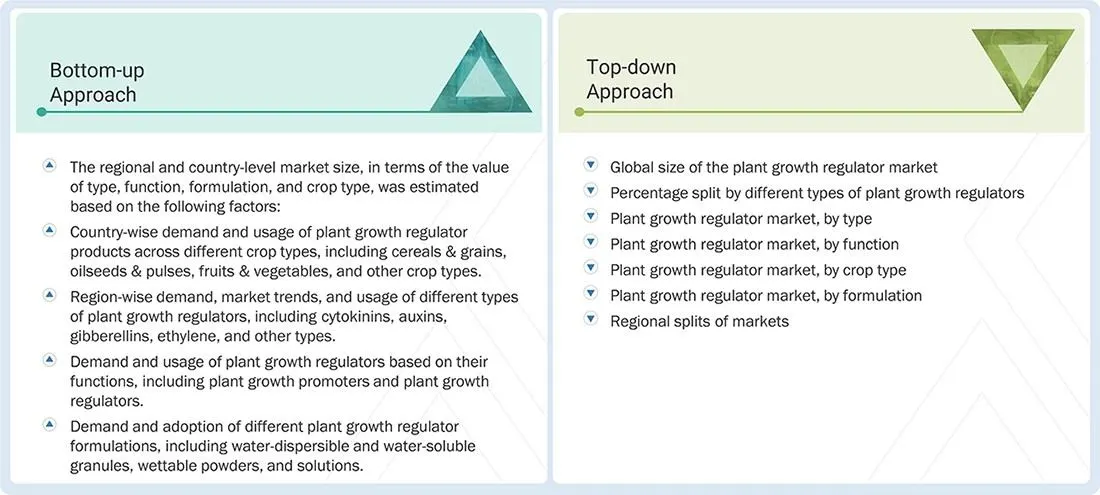
Both the top-down and bottom-up approaches were used to estimate and validate the total size of the plant growth regulator market. These approaches were also used extensively to estimate the size of various dependent submarkets. The research methodology used to estimate the market size includes the following:
- Key players were identified through extensive secondary research.
- Primary and secondary research determined the industry’s value chain and market size.
- All percentage share splits and breakdowns were determined using secondary sources and verified through primary sources.
- All possible parameters affecting the markets covered in this research study were accounted for, examined in detail, verified through primary research, and analyzed to obtain the final quantitative and qualitative data.
- The following figure illustrates the complete market size estimation process used in this research study, providing a consolidated estimate of the plant growth regulator market.
The following sections (bottom-up & top-down) depict the overall market size estimation process used in this study.
Global Plant Growth Regulator Market: Bottom-up Approach
Data Triangulation
After estimating the overall market size as explained above, the total market was split into several segments and subsegments. Data triangulation and market breakdown procedures were employed, wherever applicable, to estimate the overall plant growth regulators market and arrive at the exact statistics for all segments and subsegments. The data was triangulated by studying various factors and trends from the demand and supply sides. The market size was also validated using both the top-down and bottom-up approaches.
Market Definition
According to the Ministry of Agriculture, Food and Rural Affairs, Ontario:
Plant Growth Regulators are chemicals used to modify plant growth, such as increasing branching, suppressing shoot growth, increasing return bloom, removing excess fruit, or altering fruit maturity. Numerous factors affect plant growth regulator performance, including how well the plant absorbs the chemical, tree vigor and age, dose, timing, cultivar, and weather conditions before, during, and after application. Plant growth regulators fall into six classes: compounds related to auxins, gibberellins, gibberellin biosynthesis inhibitors, cytokinins, abscisic acid, and compounds affecting ethylene status.
Key Stakeholders
- Supply Side: Plant Growth Regulator Producers, Suppliers, Distributors, Importers, and Exporters
- Demand Side: Large-scale Crop Farmers, Large-scale Orchids, and Researchers
- Agricultural Co-operative Societies
- Government, Research Organizations, and Institutions
- Technology Providers to Plant Growth Regulator Manufacturing Companies
- Regulatory Bodies
- World Health Organization (WHO)
- European Crop Protection Agency (ECPA)
- Pesticides Manufacturers and Formulators Association (PMFAI)
- China Crop Protection Industry Association (CCPIA)
- Food and Agriculture Organization (FAO)
- US Department of Agriculture (USDA)
- Institute of Food and Agricultural Sciences (IFAS)
- US Environmental Protection Agency (US EPA)
- Organisation for Economic Co-operation and Development (OECD)
- Federal Office of Consumer Protection and Food Safety
- European Food Safety Authority
- Ministry of Agriculture & Farmers Welfare
- Department of Agriculture, Cooperation & Farmers Welfare
- Directorate of Plant Protection, Quarantine & Storage
- Commercial Research & Development (R&D) Institutions and Financial Institutions
Report Objectives
MARKET INTELLIGENCE
- To determine and project the size of the plant growth regulator market by function, type, formulation, crop type, and region over five years, from 2026 to 2031
- To identify the attractive opportunities in the market by determining the largest and fastest-growing segments across the key regions
- To analyze the demand-side factors based on the following:
- Impact of macro- and microeconomic factors on the market
- Shifts in demand patterns across different subsegments and regions
COMPETITIVE INTELLIGENCE
- Identifying and profiling the key players in the plant growth regulator market
- Providing a comparative analysis of market leaders based on the following:
- Product offerings
- Business strategies
- Strengths and weaknesses
- Key financials
- Understanding the competitive landscape and identifying the major growth strategies players across the country adopt
- Providing insights on key product innovations and investments in the plant growth regulator market.
Available customizations:
With the given market data, MarketsandMarkets offers customizations according to company-specific scientific needs.
The following customization options are available for the report:
PRODUCT ANALYSIS
- Product Matrix, which provides a detailed comparison of each company's product portfolio.
GEOGRAPHIC ANALYSIS
With the given market data, MarketsandMarkets offers customizations according to company-specific scientific needs.
- Further breakdown of the Rest of Europe into Spain, the Czech Republic, the Netherlands, Belgium, Hungary, Romania, Ireland, and other EU & non-EU countries.
- Further breakdown of the Rest of Asia Pacific into South Korea, Thailand, Kazakhstan, Vietnam, Indonesia, and Myanmar.
- Further breakdown of the Rest of South America into Chile, Colombia, Peru, Uruguay, and other South American countries.
COMPANY INFORMATION
- Detailed analyses and profiling of additional market players (up to five)
Get the Full Plant Growth Regulators Market Report
Full forecast, segment splits, and company analysis for all Plant Growth Regulators Market.
- Canada Plant Growth Regulators Market
- US Plant Growth Regulators Market
- Mexico Plant Growth Regulators Market
- Germany Plant Growth Regulators Market
- UK Plant Growth Regulators Market
- France Plant Growth Regulators Market
- Poland Plant Growth Regulators Market
- Spain Plant Growth Regulators Market
- China Plant Growth Regulators Market
- India Plant Growth Regulators Market
- Japan Plant Growth Regulators Market
- Brazil Plant Growth Regulators Market
- Argentina Plant Growth Regulators Market
- Rest Of Europe Plant Growth Regulators Market
- Rest Of Asia Pacific Plant Growth Regulators Market
- Africa Plant Growth Regulators Market
- Middle East Plant Growth Regulators Market
- Rest Of South America Plant Growth Regulators Market
Need a Tailored Report?
Customize this report to your needs
Get 10% FREE Customization
Customize This Report
