
UAE Pressure Sensor Market (2025-2030)

The UAE Pressure Sensor Market was valued at $132.7 Million in 2025 and projected to reach to $182.6 Million by 2030, representing a compound annual growth rate of 6.6%. The UAE pressure sensor market is poised for sustained growth driven by diversification initiatives beyond oil and gas into aerospace, automotive, and smart infrastructure sectors.


| Market Size in | USD 26.32 MN |
| Market Forecast in | |
| CAGR | |
| Forecast Period | |
| Units Considered | Value (USD MN) |
UAE Pressure Sensor Market Trends and Insights
- The UAE's rapid industrialization, particularly in oil and gas, aerospace, and automotive sectors, is driving demand for advanced pressure sensing technologies.
- The UAE's strategic position as a regional hub for manufacturing and innovation supports the adoption of precision measurement instruments across multiple industries..
Key Market Statistics
- CAGR (2025-2030) 6.6% CAGR
- Market Size, 2025 ~USD 132.7 Million
- Forecast, 2030 ~USD 182.6 Million
- Country UAE
UAE Pressure Sensor Market Overview
Market Valuation :
The UAE pressure sensor market is valued at USD 132.7 million in 2025, with a projected CAGR of 6.6% through 2030, reaching USD 182.6 million by forecast end.
Oil & Gas Dominance :
The UAE's robust oil and gas sector remains a primary driver of pressure sensor adoption, with critical applications in upstream, midstream, and downstream operations across major facilities.
Aerospace & Defense Growth :
Expanding aerospace manufacturing and maintenance capabilities in the UAE are creating sustained demand for high-precision pressure sensing solutions in aircraft systems and avionics.
Regional Manufacturing Hub :
The UAE's position as a regional manufacturing and innovation center attracts multinational companies, accelerating technology adoption and localized production of advanced pressure sensors.
UAE Pressure Sensor Market Dynamics
- Government investments in industrial automation, renewable energy projects, and smart city developments are creating new demand vectors for pressure sensing technologies.
- The UAE's strategic focus on becoming a global innovation hub, combined with increasing foreign direct investment in manufacturing, positions the market for accelerated expansion.
- By 2030, the market is expected to benefit from technological advancements in IoT-enabled sensors and Industry 4.0 adoption across industrial facilities..
Market Ecosystem
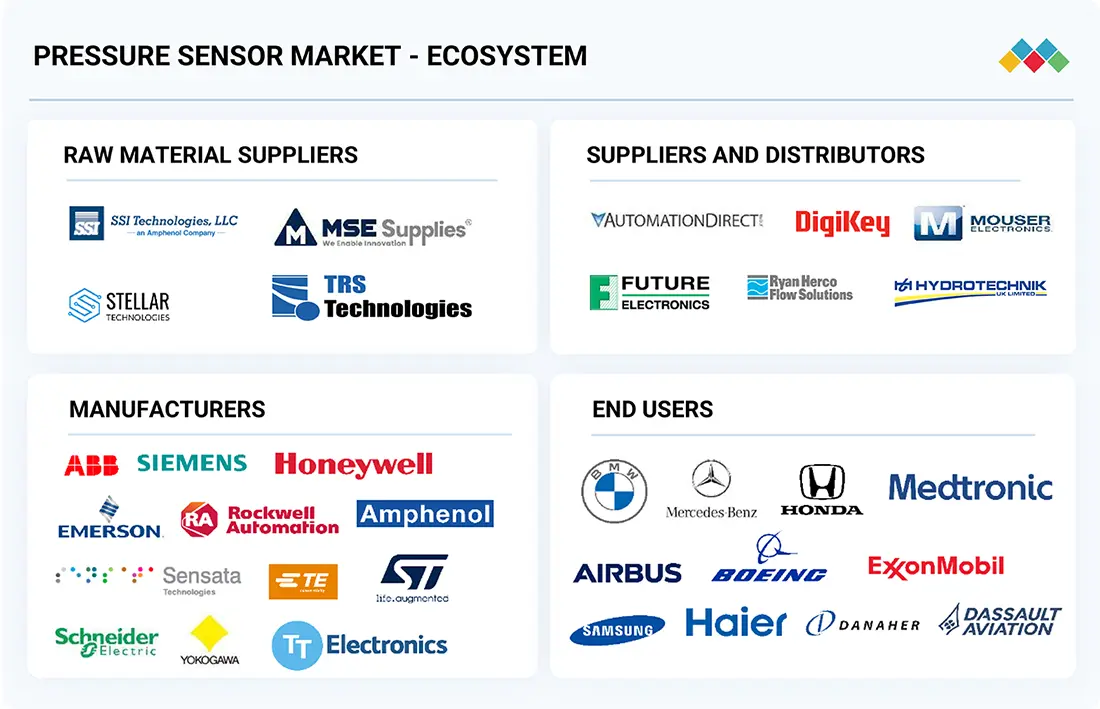
Pressure Sensor Market: COMMERCIAL USE CASES ACROSS INDUSTRIES
| COMPANY | USE CASE DESCRIPTION | BENEFITS |
|---|---|---|
 |
Pressure sensors integrated in automotive engine management and safety systems | Optimized fuel efficiency, reduced emissions, enhanced vehicle safety |
 |
Industrial pressure sensors for oil & gas and process control applications | Real-time monitoring, improved operational safety, minimized downtime |
 |
MEMS-based miniature pressure sensors for medical devices such as ventilators and wearables | Accurate patient monitoring, compact design, reliable long-term performance |
 |
Automotive pressure sensors for braking, engine, and tire pressure monitoring systems | Improved vehicle safety, compliance with emission standards, enhanced fuel efficiency, extended tire life |
 |
Industrial pressure sensors for oil & gas, chemical, and power generation sectors | Increased process reliability, real-time monitoring, reduced downtime, improved safety in hazardous environments |
Logos and trademarks shown above are the property of their respective owners. Their use here is for informational and illustrative purposes only.
Related Ecosystem
Cns Systems
- C-Band
- Ka-Band
- Antennas
- Unmanned Ground Vehicles (UGV)
- Rotary Wing Aircraft
- L3Harris Technologies, Inc.
- Thales group
- HONEYWELL INTERNATIONAL INC.
- Northrop Grumman Corporation
- LOCKHEED MARTIN CORPORATION
Industrial Automation
- Sensors
- Image Sensors
- Manufacturing Execution System (MES)
- Actuators
- Flow Sensors
- ABB India Limited
- Siemens ag
- Emerson Electric Co.
- HONEYWELL INTERNATIONAL INC.
- SCHNEIDER ELECTRIC SE
Sensors And Control
- Sensors
- Image Sensors
- Temperature Sensors
- Pressure Sensors
- Flow Sensors
- BAUMER ELECTRIC AG
- HONEYWELL INTERNATIONAL INC.
- Lenovo
- Stmicroelectronics
- Texas Instruments Incorporated
Key Takeaways
- The UAE pressure sensor market is valued at USD 132.7 million in 2025 and will grow to USD 182.6 million by 2030.
- The UAE market is expanding at a 6.6% CAGR, driven by industrial automation and infrastructure development.
- The UAE's oil, gas, and aerospace sectors are primary demand drivers for pressure sensor technology.
- The UAE's role as a regional manufacturing and technology hub accelerates market penetration and innovation adoption.
Pressure Sensor Market Report Scope
| Report Metric | Details |
|---|---|
| Base Year | 2025 |
| Fastest Growing Segment | MEDICAL (End Use) |
| Forecast Period | 2025-2030 |
| Growth Rate | CAGR of 6.2% from 2025 to 2030 |
| Largest Segment | WIRED (Connectivity) |
| Market Size Base Year (Billions) | ~USD 13.1 (2025) |
| Revenue Forecast (Billions) | ~USD 17.7 (2030) |
| Segments Covered | Connectivity, Sensing Method, End Use, Sensor Type, Pressure Range |
UAE Pressure Sensor Market Report Segmentation
5 segment dimensions are covered across the global market.
By Connectivity
- Wired
- Wireless
By Sensing Method
- Capacitive
- Electromagnetic
- Optical
- Other Sensing Methods
- Piezoresistive
- Resonant Solid-State
By End Use
- Automotive
- Aviation
- Consumer Devices
- Manufacturing
- Marine
- Medical
- Oil & Gas
- Other End Uses
- Utilities
By Sensor Type
- Absolute Pressure Sensors
- Differential Pressure Sensors
- Gauge Pressure Sensors
- Sealed Pressure Sensors
- Vacuum Pressure Sensors
By Pressure Range
- 101-1,000 Psi
- Above 1,000 Psi
- Up To 100 Psi
Target Audience
- Pressure Sensor Manufacturers : Manufacturers need UAE market data to identify expansion opportunities, assess competitive dynamics, and develop localized product strategies for the region's industrial and aerospace sectors.
- Oil & Gas Operators : UAE-based and international oil & gas companies require market intelligence to benchmark sensor technology adoption, evaluate supplier capabilities, and plan infrastructure modernization investments.
- Aerospace & Defense Companies : Aerospace manufacturers and MRO providers operating in the UAE need insights into sensor specifications, supplier networks, and market trends to support aircraft production and maintenance operations.
- System Integrators & Distributors : Regional system integrators and sensor distributors require detailed market forecasts and sector-specific demand drivers to optimize inventory, identify growth segments, and plan channel strategies.
- Government & Economic Development Agencies : UAE government bodies and economic zones need market analysis to support industrial policy development, attract sensor manufacturing investments, and align sector growth with national diversification goals.
Reasons to Buy this Report
- Sector-Specific Insights : Gain detailed intelligence on pressure sensor demand across UAE's key verticals including oil & gas, aerospace, automotive, and emerging smart infrastructure projects with quantified market sizing.
- Competitive Landscape Analysis : Understand the competitive positioning of local and international pressure sensor manufacturers operating in the UAE market, including market share distribution and strategic partnerships.
- Investment & Expansion Strategy : Identify high-growth opportunities and emerging applications in the UAE market to inform capital allocation, facility expansion, and product development roadmaps for the 2025-2030 period.
- Regulatory & Standards Compliance : Access UAE-specific regulatory requirements, industry standards, and certification pathways essential for market entry and product commercialization in the region.
- Demand Forecasting : Leverage granular market projections and growth drivers specific to UAE to optimize supply chain planning, inventory management, and sales forecasting through 2030.
Frequently asked questions
What is the current size of the UAE pressure sensor market?
The UAE pressure sensor market is valued at USD 132.7 million in 2025.
What is the projected market size for the UAE pressure sensor market by 2030?
The UAE pressure sensor market is forecast to reach USD 182.6 million by 2030.
What is the CAGR for the UAE pressure sensor market?
The UAE pressure sensor market is growing at a compound annual growth rate of 6.6% from 2025 to 2030.
Which industries drive demand for pressure sensors in the UAE?
The UAE's oil and gas, aerospace, automotive, and manufacturing sectors are the primary drivers of pressure sensor demand.
Why is the UAE an important market for pressure sensors?
The UAE's strategic position as a regional manufacturing hub, combined with rapid industrialization and infrastructure development, makes it a key market for advanced pressure sensing technologies.
RESEARCH METHODOLOGY
The research process for this study included systematic gathering, recording, and analysis of data about customers and companies operating in the pressure sensor market. This process involved the extensive use of secondary sources, directories, and databases (Factiva and Oanda) to identify and collect valuable information for the comprehensive, technical, market-oriented, and commercial study of the Pressure sensor market.
In-depth interviews were conducted with primary respondents, including experts from core and related industries and preferred manufacturers, to obtain and verify critical qualitative and quantitative information and assess growth prospects. Key players in the pressure sensor market were identified through secondary research, and their market rankings were determined through primary and secondary research. This research included studying annual reports of top players and interviewing key industry experts, such as CEOs, directors, and marketing executives.
Secondary Research
Various sources were used in the secondary research process to identify and collect information crucial for this study. These include company annual reports, press releases, investor presentations, white papers, technology journals, certified publications, articles by recognized authors, directories, and databases. Secondary research was mainly used to obtain key information about the industry’s value chain, the total pool of market players, the market classification according to industry trends to the bottom-most level, regional markets, and key developments from market and technology-oriented perspectives.
Primary Research
Primary research was also conducted to identify the segmentation types, key players, competitive landscape, and key market dynamics, such as drivers, restraints, opportunities, challenges, and industry trends, along with key strategies adopted by players operating in the pressure sensor market. Extensive qualitative and quantitative analyses were performed on the complete market engineering process to list key information and insights throughout the report.
Extensive primary research has been conducted after acquiring knowledge about the pressure sensor market scenarios through secondary research. Several primary interviews have been conducted with experts from the demand (application and region) and supply side (solution type) across four major geographic regions: North America, Europe, Asia Pacific, and RoW. Approximately 60% and 40% of the primary interviews were conducted from the supply and demand sides. These primary data have been collected through questionnaires, emails, and telephonic interviews.
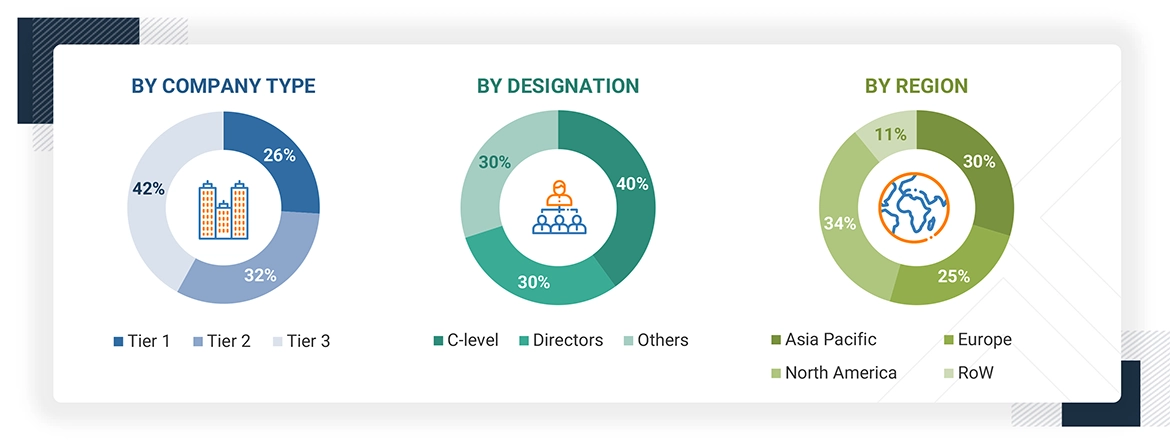
Note: The three tiers of the companies have been defined based on their total/segmental revenue as of 2024: Tier 1 = >USD 1 billion, Tier 2 = USD 1 billion–USD 500 million, and Tier 3 = USD 500 million. ‘Others’ include sales, marketing, and product managers.
To know about the assumptions considered for the study, download the pdf brochure
Market Size Estimation
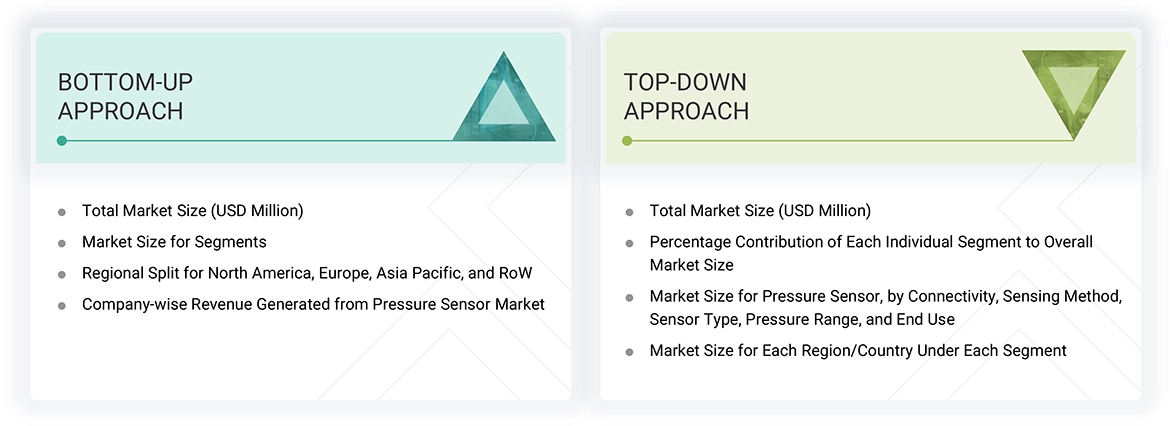
In the complete market engineering process, the top-down and bottom-up approaches and several data triangulation methods were implemented to estimate and validate the size of the pressure sensor market and various other dependent submarkets. Key players in the market were identified through secondary research, and their market share in the respective regions was determined through primary and secondary research. This entire research methodology included the study of annual and financial reports of the top players and interviews with experts (CEOs, VPs, directors, and marketing executives) for key insights (quantitative and qualitative).
All percentage shares, splits, and breakdowns were determined using secondary sources and verified through primary sources. All the possible parameters that affect the markets covered in this research study were accounted for, viewed in detail, verified through primary research, and analyzed to obtain the final quantitative and qualitative data. This data was consolidated and supplemented with detailed inputs and analysis from MarketsandMarkets and presented in this report.
Pressure Sensor Market : Top-Down and Bottom-Up Approach
Data Triangulation
After arriving at the overall market size from the market size estimation process, as explained above, the total market has been split into several segments and subsegments. To complete the overall market engineering process and arrive at the exact statistics for all segments and subsegments, market breakdown and data triangulation procedures have been employed, wherever applicable. The data have been triangulated by studying various factors and trends from the demand and supply sides. Along with this, the market has been validated using top-down and bottom-up approaches.
Market Definition
A sensor is a device that measures the changes in physical quantities or environmental characteristics of any material and converts them into signals, which, in turn, serve as inputs for controlling different kinds of systems. A pressure sensor is a transducer or instrument that converts an input mechanical pressure in gases or liquids into an electrical output signal. It consists of a pressure-sensitive element that can measure, detect, or monitor the pressure applied to electronic components and convert the information into electrical output signals. The pressure sensor measures the pressure of various gases and liquids.
Key Stakeholders
- Raw material suppliers
- Technology investors
- Pressure sensor designers, manufacturers, and suppliers
- Pressure sensor integrators, suppliers, and service providers
- Government laboratories
- In-house testing laboratories
- System integrators
- Distributors, resellers, and traders
- Research institutions and organizations
- Providers of application software
- Pressure sensor forums, alliances, consortiums, and associations
- Market research and consulting firms
- End use
Report Objectives
- To describe and forecast the pressure sensor market, by connectivity, sensing method, sensor type, pressure range, and end use, in terms of value
- To describe and forecast the pressure sensor market, by end use, in terms of volume
- To forecast the market for various segments with regard to four main regions: North America, Europe, Asia Pacific, and the Rest of the World (RoW), in terms of value
- To provide a detailed overview of the smart textiles supply chain, ecosystem analysis, Porter’s five forces analysis, case studies, tariff analysis, regulations, pricing analysis, patent analysis, AI impact, and the 2025 US tariff impact
- To provide qualitative information regarding pressure sensors for different media types and technologies related to pressure sensors
- To analyze the micromarkets1 with respect to individual growth trends, prospects, and contributions to the total market
- To study the complete supply chain and allied industry segments, and perform a supply chain analysis of the pressure sensor landscape
- To strategically analyze the regulatory landscape, tariffs, standards, patents, Porter’s Five Forces, import and export scenarios, trade values, and case studies pertaining to the market under study
- To analyze the opportunities in the market for various stakeholders by identifying the high-growth segments of the pressure sensor market
- To profile the key players and comprehensively analyze their market position in terms of ranking and core competencies2, along with detailing the competitive landscape for market leaders
- To analyze competitive developments, such as product launches, acquisitions, partnerships, expansions, and macroeconomic outlook, in the pressure sensor market
Customization Options
With the given market data, MarketsandMarkets offers customizations according to the company’s specific needs. The following customization options are available for the report:
Get the Full Pressure Sensor Market Report
Full forecast, segment splits, and company analysis for all Pressure Sensor Market.
- Canada Pressure Sensor Market
- Mexico Pressure Sensor Market
- US Pressure Sensor Market
- Germany Pressure Sensor Market
- UK Pressure Sensor Market
- France Pressure Sensor Market
- Italy Pressure Sensor Market
- China Pressure Sensor Market
- Japan Pressure Sensor Market
- India Pressure Sensor Market
- South Korea Pressure Sensor Market
- Rest Of Europe Pressure Sensor Market
- Rest Of Asia Pacific Pressure Sensor Market
- Bahrain Pressure Sensor Market
- Kuwait Pressure Sensor Market
- Oman Pressure Sensor Market
- Qatar Pressure Sensor Market
- Rest Of Middle East Pressure Sensor Market
- Saudi Arabia Pressure Sensor Market
Need a Tailored Report?
Customize this report to your needs
Get 10% FREE Customization
Customize This Report
