
Brazil Probiotics Market (2024-2029)

The Brazil Probiotics Market was valued at $4170 Million in 2024 and projected to reach to $6510 Million by 2029, representing a compound annual growth rate of 9.3%. Brazil's probiotics market is positioned for sustained expansion driven by increasing health consciousness and the growing middle class seeking preventive wellness solutions.


| Market Size in | USD 26.32 MN |
| Market Forecast in | |
| CAGR | |
| Forecast Period | |
| Units Considered | Value (USD MN) |
Brazil Probiotics Market Trends and Insights
- This expansion in Brazil reflects rising consumer awareness of gut health benefits and increasing adoption of functional foods across the country.
- Brazil's market growth outpaces the global average of 8.2%, driven by a large population with growing disposable incomes and expanding retail distribution networks. The probiotics sector in Brazil is benefiting from strong demand across dairy products, beverages, and dietary supplements.
- Brazil's food and beverage industry is leveraging local production capabilities and regional supply chains to meet this demand efficiently.
- Consumer preferences in Brazil are shifting toward preventive health solutions, positioning probiotics as a key category within the functional foods segment through 2029..
Key Market Statistics
- CAGR (2024-2029) 9.3% CAGR
- Market Size, 2024 ~USD 4170 Million
- Forecast, 2029 ~USD 6510 Million
- Country Brazil
Brazil Probiotics Market Overview
Market Size & Growth :
Brazil's probiotics market reached USD 4,170 million in 2024 and is projected to grow to USD 6,510 million by 2029, with a CAGR of 9.3%, outpacing the global average of 8.2%.
Consumer Health Awareness :
Rising consumer consciousness about gut health and digestive wellness is driving demand for probiotic products across Brazil's urban and emerging middle-class populations.
Functional Foods Adoption :
Brazilian consumers are increasingly incorporating functional foods and beverages into their daily diets, with probiotics becoming a mainstream wellness category in supermarkets and health stores.
Regional Market Leadership :
Brazil represents one of Latin America's largest probiotics markets, with strong potential for product innovation and distribution expansion across diverse consumer segments.
Brazil Probiotics Market Dynamics
- The market's 9.3% CAGR reflects strong consumer demand for functional dairy products, supplements, and fortified beverages containing probiotic strains.
- Distribution through modern retail channels, e-commerce platforms, and health-focused retailers is accelerating market penetration. Looking ahead, Brazil's probiotics sector will benefit from rising disposable incomes, urbanization trends, and greater availability of diverse probiotic formulations tailored to local preferences.
- Strategic partnerships between international brands and local manufacturers, combined with increased regulatory clarity around health claims, will further stimulate market growth through 2029..
Market Ecosystem
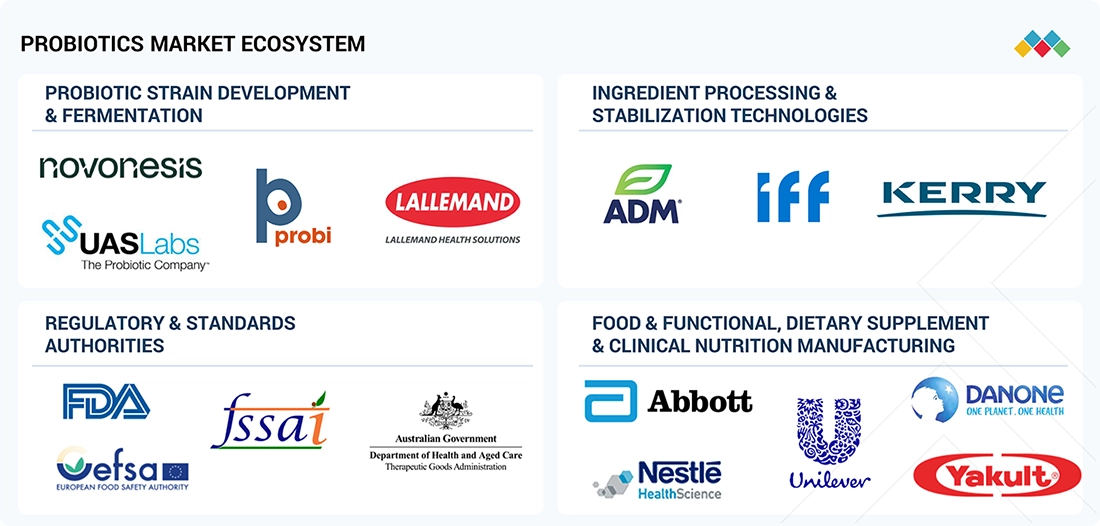
PROBIOTICS MARKET: COMMERCIAL USE CASES ACROSS INDUSTRIES
| COMPANY | USE CASE DESCRIPTION | BENEFITS |
|---|---|---|
 |
Development and large-scale fermentation of clinically documented probiotic strains for dietary supplements, functional foods, infant nutrition, and medical nutrition applications, with focus on strain stability and regulatory compliance | Ensures consistent strain performance, improves shelf-life stability, supports regulatory acceptance, and enables scalable supply across multiple end-use segments |
 |
Production of probiotic ingredients and formulation support for supplements and functional foods, including stability optimization and application-specific blends | Improves probiotic viability during processing and storage, supports targeted formulations, and enables integration into diverse food and supplement matrices |
 |
Delivery systems and formulation technologies for probiotics in supplements and functional beverages, designed to enhance survival through processing and digestion | Enhances gastrointestinal survival, supports controlled release, and maintains probiotic efficacy throughout product shelf life |
 |
Application-focused probiotic solutions for functional foods, beverages, and nutrition products, including multi-strain blends and stability-enhancing technologies | Enables incorporation of probiotics into everyday foods, improves taste and formulation compatibility, and supports clean-label positioning |
Logos and trademarks shown above are the property of their respective owners. Their use here is for informational and illustrative purposes only.
Related Ecosystem
Fandb Ingredients
- Dairy Products
- Bakery Products
- Microorganism
- Polydextrose
- Carbohydrates
- AZELIS HOLDINGS SA
- Archer-Daniels-Midland Company
- Kerry Group plc
- Amway
- DSM FIRMMENICH
Nutraceuticals And Dietary Supplements
- Dairy Products
- Animal-Based Sealants
- Carbohydrates
- Porcine
- Acrylic Polymers
- AZELIS HOLDINGS SA
- Amway
- Nestle s.a
- Kerry Group plc
- Basf se
Key Takeaways
- Brazil's probiotics market is valued at USD 4,170 million in 2024 and will reach USD 6,510 million by 2029, growing at 9.3% CAGR.
- Brazil's market growth rate of 9.3% exceeds the global probiotics CAGR of 8.2%, indicating strong regional momentum.
- Rising health consciousness and preventive wellness trends in Brazil are driving increased probiotics consumption across multiple product categories.
- Brazil's large population and expanding middle class create significant growth opportunities for probiotics manufacturers through 2029.
Probiotics Market Report Scope
| Report Metric | Details |
|---|---|
| Base Year | 2024 |
| Fastest Growing Segment | NONDAIRY BEVERAGES (Product Subtype) |
| Forecast Period | 2024–2029 |
| Growth Rate | CAGR of 8.2% from 2024 to 2029 |
| Largest Segment | HUMAN (End User) |
| Market Size Base Year (Billions) | ~USD 71.28 (2024) |
| Revenue Forecast (Billions) | ~USD 105.7 (2029) |
| Segments Covered | Product Type, Product Subtype, Ingredient, Type, Distribution Channel, End User |
Brazil Probiotics Market Report Segmentation
6 segment dimensions are covered across the global market.
By Product Type
- Dietary Supplements
- Feed
- Functional Food & Beverages
- Functionals Food & Beverages
By Product Subtype
- Capsules
- Cereals
- Dairy Products
- Gel Caps
- Infant Formula
- Liquids
- Non-Dairy Beverages
- Nondairy Beverages
- Other Functional Food & Beverages
- Powder
- Soft Gels
- Tablets
By Ingredient
- Bacteria
- Yeast
By Type
- Amino Acids
- Bifidobacteria
- Botanicals
- Calcium
- Collagen
- Enzymes
- Glucosamine-Chondroitin
- Lactobacilli
- Minerals
- Omega-3 Fatty Acid
- Other Dietary Supplements
- Other Types
- Other Yeasts
- Probiotics
- Saccharomyces Boulardii
- Streptococcus Thermophilus
- Vitamin D
- Vitamin K
- Vitamins
By Distribution Channel
- Convenience Stores/Small Retail Formats
- Hypermarkets & Supermarkets
- Hypermarkets/Supermarkets
- Online
- Pharmacies/Drugstores
- Specialty Stores
By End User
- Animal
- Human
Target Audience
- Food & Beverage Manufacturers : Companies seeking to launch or expand probiotic product lines in Brazil need market intelligence on consumer preferences, regulatory requirements, and competitive landscape to optimize product-market fit.
- Retail & Distribution Partners : Supermarket chains, health stores, and e-commerce platforms require market data to make informed decisions about shelf space allocation, supplier partnerships, and inventory planning for probiotics.
- Investment & Private Equity Firms : Investors evaluating opportunities in Brazil's food and beverage sector need comprehensive market analysis to assess growth potential, valuation benchmarks, and risk factors in the probiotics category.
- Marketing & Brand Strategists : Marketing teams developing campaigns for Brazil need consumer insights, market trends, and competitive positioning data to craft effective messaging and identify high-potential customer segments.
- Business Development Executives : Corporate development professionals seeking partnerships, acquisitions, or joint ventures in Brazil's probiotics market require detailed market intelligence to identify targets and negotiate valuations.
Key Companies in the Brazil Probiotics Market
| Company | HQ | Ownership | Strongest segments |
|---|---|---|---|
| SOJITZ CORPORATION | Japan | ||
| UNILEVER PLC | United Kingdom | ||
| AMWAY | United States | ||
| PROBI | Sweden | ||
| NESTLé | Switzerland | ||
| ADM | United States | ||
| DANONE | France | ||
| INTERNATIONAL FLAVORS & FRAGRANCES INC. | United States | ||
| YAKULT HONSHA CO., LTD. | Japan |
SOJITZ CORPORATION
Sojitz Corporation is a Japanese trading company that engages in various business segments including machinery, chemicals, metals, and food products across global markets.
UNILEVER PLC
Unilever PLC is a United Kingdom-based multinational consumer goods company producing food, beverages, personal care, and home care products sold worldwide.
AMWAY
Amway is a United States-based direct selling company that manufactures and distributes nutritional supplements, personal care, and home care products.
PROBI
Probi is a Swedish probiotic company that develops and markets probiotic supplements and functional food ingredients.
NESTLé
Nestlé is a Switzerland-based multinational food and beverage company offering products in nutrition, pet care, and confectionery across the globe.
ADM
ADM (Archer Daniels Midland) is a United States-based agricultural processing company producing ingredients and products for food, animal feed, and industrial markets.
DANONE
Danone is a France-based multinational food company specializing in dairy products, plant-based foods, and bottled water.
INTERNATIONAL FLAVORS & FRAGRANCES INC.
International Flavors & Fragrances Inc. is a United States company that creates and supplies flavors, fragrances, and specialty ingredients for consumer products.
YAKULT HONSHA CO., LTD.
Yakult Honsha Co., Ltd. is a Japanese company known for manufacturing and distributing probiotic beverages and related health products.
Reasons to Buy this Report
- Market Entry Strategy : Gain detailed insights into Brazil's probiotics landscape to develop targeted market entry strategies, identify key distribution channels, and understand local consumer preferences for product positioning.
- Competitive Intelligence : Analyze market dynamics, competitive positioning, and growth opportunities specific to Brazil to benchmark against regional players and identify white-space opportunities in the probiotics segment.
- Investment Decision Support : Access comprehensive market sizing and forecast data for Brazil to support investment decisions, partnership evaluations, and resource allocation for expansion in Latin America's largest probiotics market.
- Product Development Insights : Understand Brazil-specific consumer trends, health claims preferences, and functional food formats to guide R&D priorities and develop products aligned with local market demands.
- Revenue Forecasting : Utilize accurate market projections and CAGR data for Brazil to build reliable financial models, sales forecasts, and performance metrics for stakeholder reporting and strategic planning.
Frequently asked questions
What is the current size of Brazil's probiotics market?
Brazil's probiotics market was valued at USD 4,170 million in 2024 and is expected to grow to USD 6,510 million by 2029.
What is the projected growth rate for probiotics in Brazil?
Brazil's probiotics market is projected to grow at a compound annual growth rate (CAGR) of 9.3% from 2024 to 2029.
How does Brazil's probiotics market compare to global growth?
Brazil's probiotics market CAGR of 9.3% outpaces the global average of 8.2%, demonstrating stronger regional growth momentum.
What product categories drive probiotics demand in Brazil?
Brazil's probiotics demand is driven by dairy products, functional beverages, and dietary supplements, reflecting diverse consumer preferences.
What factors are accelerating probiotics adoption in Brazil?
Rising consumer health awareness, increasing disposable incomes, expanding retail distribution, and preventive wellness trends are key growth drivers in Brazil.
RESEARCH METHODOLOGY
The study employed two primary approaches to estimate the current size of the probiotics market. Exhaustive secondary research was conducted to gather information on the market, peer markets, and parent markets. The next step was to validate these findings, assumptions, and sizing with industry experts across the value chain through primary research. Both top-down and bottom-up approaches were employed to estimate the complete market size. After that, market breakdown and data triangulation were used to estimate the market size of segments and subsegments.
Secondary Research
This research study involved the extensive use of secondary sources, directories, and databases such as Bloomberg Businessweek and Factiva to identify and collect information useful for a technical, market-oriented, and commercial study of the market.
In the secondary research process, various sources such as annual reports, press releases & investor presentations of companies, white papers, food journals, certified publications, articles from recognized authors, directories, and databases were referred to identify and collect information.
Secondary research was mainly used to obtain key information about the industry’s supply chain, the total pool of key players, and market classification and segmentation as per the industry trends to the bottom-most level, regional markets, and key developments from both market- and technology-oriented perspectives.
Primary Research
Extensive primary research was conducted after obtaining information regarding the probiotics market scenario through secondary research. Several primary interviews were conducted with market experts from both the demand and supply sides across major countries of North America, Europe, Asia Pacific, South America, and the RoW. Primary data was collected through questionnaires, emails, and telephonic interviews. The primary sources from the supply side included various industry experts, such as chief executive officers (CXOs), vice presidents (VPs), directors from business development, marketing, research, and development teams, and key opinion leaders. Primary interviews were conducted to gather insights into market statistics, revenue from products and services, market breakdowns, market size estimates, market forecasting, and data triangulation. Primary research also helped in understanding the various trends in packaging materials, types, formats, technologies, and applications. Stakeholders from the demand side, such as research institutions and universities, and third-party vendors, were interviewed to understand the buyer’s perspective on the service, and their current usage of packaging and the outlook of their business, which will affect the overall market.
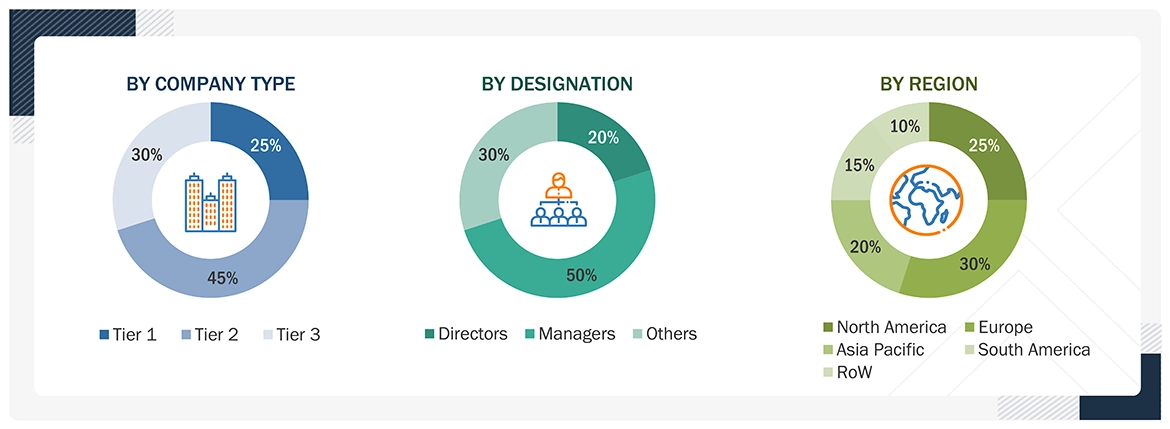
Note: The three tiers of the companies are defined based on their total revenues in 2024, as per the availability of financial data: Tier 1: Revenue >USD 1 billion, Tier 2: USD 100 million–1 billion, and Tier 3: Revenue USD 100 million.
To know about the assumptions considered for the study, download the pdf brochure
|
COMPANY NAME |
DESIGNATION |
|
Novonesis A/S (Denmark) |
R&D Scientist – Probiotics |
|
Danone S.A. (France) |
Global Probiotics Category Manager |
|
Nestlé Health Science (Switzerland) |
Medical Nutrition Manager |
|
Yakult Honsha Co., Ltd. (Japan) |
Probiotic Research Specialist |
|
BioGaia AB (Sweden) |
Clinical Affairs Manager |
Market Size Estimation
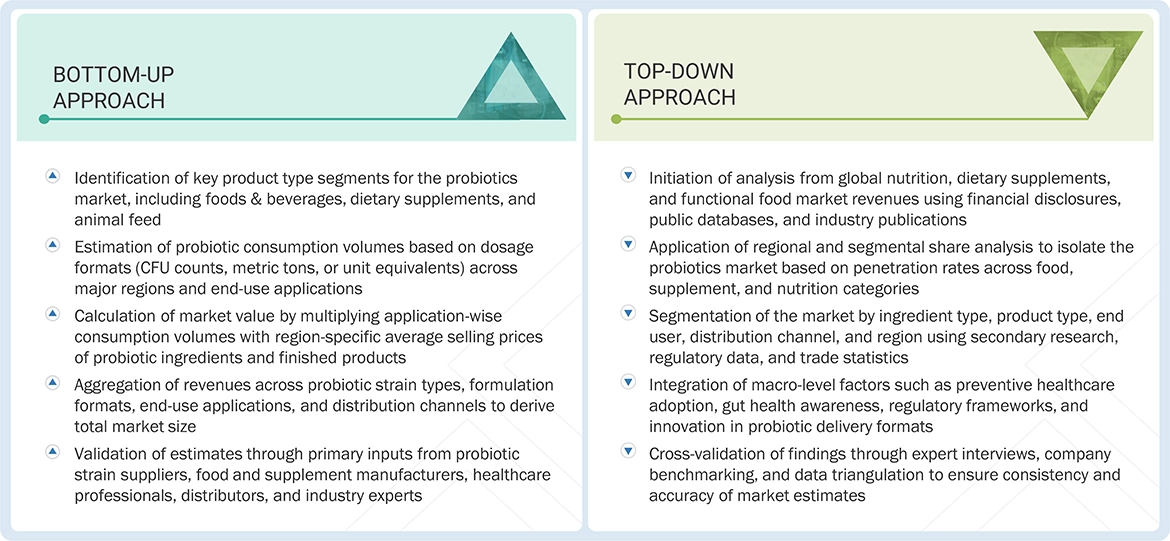
Both the top-down and bottom-up approaches were used to estimate and validate the total size of the probiotics market. These approaches were also widely used to determine the sizes of various subsegments in the market. The research methodology used to estimate the market size includes the following details:
- The key players in the industry and the overall markets were identified through extensive secondary research.
- All shares, splits, and breakdowns were determined using secondary sources and verified through primary sources.
- All possible parameters that affect the market covered in this research study were accounted for, viewed in extensive detail, verified through primary research, and analyzed to obtain final quantitative and qualitative data.
- The research included the study of reports, reviews, and newsletters of top market players, along with extensive interviews for opinions from leaders, such as CEOs, directors, and marketing executives.
Probiotics Market : Top-Down and Bottom-Up Approach
Data Triangulation
After arriving at the overall market size from the estimation process explained above, the total market was split into several segments and subsegments. The data triangulation and market breakdown procedures were employed, where applicable, to estimate the overall probiotics market and obtain exact statistics for all segments and subsegments. The data was triangulated by examining various factors and trends on both the demand and supply sides. The market size was also validated using both the top-down and bottom-up approaches.
Market Definition
The joint Food and Agriculture Organization (FAO)/World Health Organization (WHO) working group defines probiotics as “live micro-organisms, which when administered in adequate amounts confer a health benefit on the host” (FAO/ WHO, 2001).
Probiotics are living microorganisms that have been shown to provide specific health benefits to consumers. They are known to support gut health and help the digestive system run smoothly. Yogurt is one of the prime natural sources of probiotics.
According to the National Center for Complementary and Integrative Health, “Probiotics are live microorganisms that are intended to have health benefits when consumed or applied to the body.” The major function of probiotics is to maintain a healthy balance in the body. Several types of microorganisms are present in probiotics, and they may have different effects on the body. The most common bacteria belong to the group called Lactobacillus and Bifidobacterium.
Key Stakeholders
- Manufacturers, Importers and Exporters, Traders, Distributors, and Suppliers of Probiotics
- Nutraceutical Manufacturers
- Food Processors and Manufacturers
- Government and Research Organizations
- Trade Associations and Industry Bodies
- Regulatory Bodies and Associations
- Food and Agriculture Organization (FAO)
- World Health Organization (WHO)
- International Dairy Federation (IDF)
- European Food & Feed Cultures Association (EFFCA)
- National Yogurt Association (NYA)
- International Scientific Association for Probiotics and Prebiotics (ISAPP)
- International Probiotics Association (IPA)
- Council for Responsible Nutrition (CRN)
- National Yogurt Association (NYA)
- International Frozen Yogurt Association (IFYA)
- American Nutrition Association (ANA)
Report Objectives
- To determine, define, and project the size of the probiotics market, with respect to ingredient, product type, end user, distribution channel, and regional markets, over a five-year period, ranging from 2025 to 2030
- To identify the attractive opportunities in the market by determining the largest and fastest-growing segments across regions
- To provide detailed information about the key factors influencing the growth of the market (drivers, restraints, opportunities, and challenges)
- To analyze the micromarkets with respect to individual growth trends, prospects, and their contribution to the total market
- To strategically profile the key market players and comprehensively analyze their core competencies in each segment
- To track and analyze competitive developments, such as alliances, joint ventures, new product developments, mergers, and acquisitions, in the probiotics market
Available customizations:
With the given market data, MarketsandMarkets offers customizations according to company-specific scientific needs.
The following customization options are available for the report:
Product Analysis
- Product Matrix, which gives a detailed comparison of the product portfolio of each company
Geographic Analysis
With the given market data, MarketsandMarkets offers customizations according to company-specific scientific needs.
- Further breakdown of the Rest of the Europe probiotics market, by key country
- Further breakdown of the Rest of the Asia Pacific probiotics market, by key country
- Further breakdown of the Rest of South America probiotics market, by key country
Company Information
- Detailed analyses and profiling of additional market players
Get the Full Probiotics Market Report
Full forecast, segment splits, and company analysis for all Probiotics Market.
Need a Tailored Report?
Customize this report to your needs
Get 10% FREE Customization
Customize This Report
